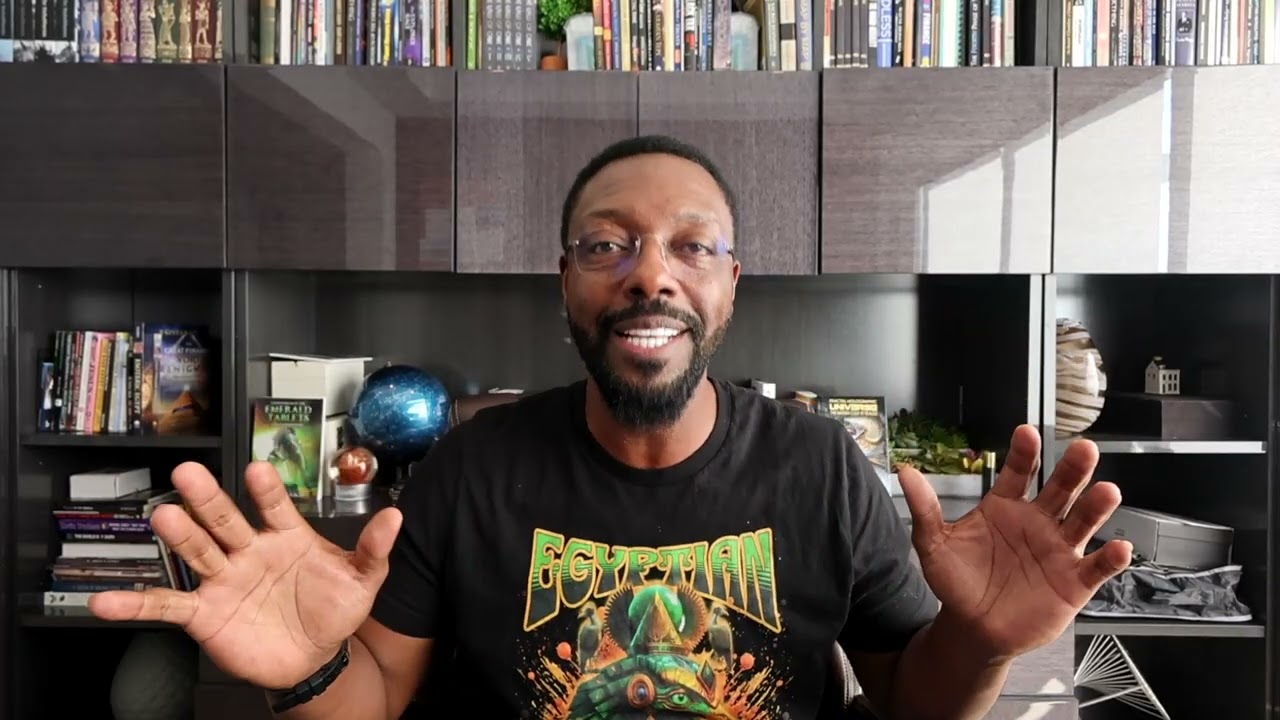
A missed opportunity, in Billy Carson's telling, is not usually a door that never opened. It is a door that opened, stayed open for a while, and closed while the person on the other side decided it could wait. In this eight-minute solo talk, recorded from a hotel room in Egypt while leading a tour, Carson tells the story he calls his most expensive lesson: a pre-IPO marketing deal he treated as already won, a flat tire on the morning of the signing, and a reschedule request that ended the relationship. He draws three rules from it: opportunities are windows and doors that close, priority is visible from the other side, and the decision to act should be a ritual rather than a reflex. Decision research has names for most of what he describes, and it does not agree with every part of his conclusion.
This article covers the deal, the morning it fell apart, the four options he says he ignored, the "windows and doors" model, his argument from cycles, the ritual he recommends, and what the research on procrastination, opportunity windows and hindsight says about each. It leaves out the Academy promotion that closes the video.
What was the deal Billy Carson says he lost?
Carson sets the story in the early 1990s, before the consumer internet and before ride-hailing apps. He describes running a "bustling media company" built on what he calls old-school marketing: nationwide classified ads, remnant television time on cable between 7 and 11 p.m., and remnant print space bought cheaply in local regions. By his account the business ran on referrals and he "barely even had to advertise."
A wealthy acquaintance then brought him a client. Carson says the company was "up and coming," preparing to go public, and wanted a marketing partner it could keep on a long-term contract paid partly in stock options. The introduction was warm, a meeting was set for 9 a.m., and in Carson's words the deal was "pretty much closed. I just had to sign and seal it."
He does not name the company. His claim is that it is now a Fortune 500 corporation worth billions and that the options he would have received "would have put me in the billionaire status." That figure is his own estimate of an alternative history and cannot be checked; what can be checked is the structure of the story, which matches a pattern decision researchers have studied for decades.
Remnant advertising, for readers unfamiliar with the term, is unsold inventory that stations and publishers release at a discount close to air or print time. It was a real and profitable niche for small agencies in the pre-digital era, which is consistent with the kind of business Carson describes.
What happened on the morning of the meeting?
Two things, by his account. The night before, he worked until about 3 a.m. on projects that had "completely nothing to do with" the deal. He woke around 7:30, dressed, walked outside and found a flat tire. He opened the trunk, saw the jack and the lug wrench, and went back inside to think.
The decisive moment, as he tells it, was not the tire. It was a thought: "This is a done deal. All right, it's signed, sealed, and delivered." On that reasoning he called the friend who had made the introduction rather than the company, asked for a reschedule, and went back to his day. The friend, he says, "was very pissed," relayed the message, and then stopped answering calls. About a week and a half later the answer came: the company had gone with someone else.
The exchange Carson quotes is the heart of the video. He protested that he had a flat tire. His friend asked a question in return: if his family would starve unless he drove to work the next morning, and he woke to four flat tires, would he find a way? Carson said of course. "You see?" the friend replied. "That's exactly why you lost the deal. You didn't see them as important enough to make them a priority."
What were the four options he says he ignored?
Carson lists them himself. He could have changed the tire and driven on the spare. He could have called a taxi, since this was "pre-Uber." He could have asked someone for a ride. He could have taken the bus. He adds a fifth, half in jest: he could have walked the roughly eight miles and arrived three hours late, which he says would still have been better than not arriving at all.
"I had four options and I chose none of them," he says. "That was the problem."
This is the part of the story that lines up most closely with the research. Piers Steel's 2007 review of procrastination studies in Psychological Bulletin found that the strongest predictors of putting things off are not laziness in any simple sense but a cluster of factors: the task feels aversive in the moment, its reward feels distant, and the person is tired or depleted. Carson had been awake until 3 a.m., the reward was a signature he believed was already his, and changing a tire in a suit is unpleasant. Steel's model would have predicted the reschedule.
The second half of the research is less flattering to the story's framing. Carson calls his decision "self-sabotage and this laziness," which is a judgment of character. Steel and later researchers describe the same behavior as a predictable failure of self-regulation under specific conditions. The practical advice is the same, show up anyway, but the explanation is situational rather than moral.
Why does he say the other side sees it differently?
Carson's sharpest observation is about perspective. "From their side," he says, "it looked like I didn't give a damn about them." He assumed the deal was done; they were still deciding whether he was the kind of partner who would be there when something went wrong.
Social psychologists call the underlying error the fundamental attribution error, described by Lee Ross in 1977: observers explain other people's behavior by their character and their own behavior by their circumstances. Carson had a tire. The company saw a man who did not come. Both readings were available on the morning in question, and only one of them mattered to the signature.
There is a related point in the negotiation literature. Margaret Neale and Max Bazerman's 1985 study of overconfidence found that negotiators who overrated their position conceded less and reached impasse more often than better-calibrated ones, and their later book Negotiating Rationally treats "assuming the deal is done" as one of the standard errors. A deal is closed when the other party believes it is closed, not when you do.
What does Carson mean by windows and doors?
The model he builds from the story is simple. "Opportunities are like windows and doors," he says. "Windows and doors open, all right? But also windows and doors close. They don't always stay open." The skill he wants listeners to develop is twofold: to see what is behind the opening, and to move through it before it shuts, "because it will."
This is close to a concept with a formal pedigree. In 1984 the political scientist John Kingdon published Agendas, Alternatives, and Public Policies, in which he described "policy windows": brief periods when a problem, a workable solution and the political mood line up, and during which a proposal can pass that would fail at any other time. Kingdon's windows open unpredictably, stay open briefly, and close whether or not anyone acts. His advice to policy entrepreneurs was to have the proposal ready before the window opens, because there is no time to build it once the window is there. Carson's version, aimed at individuals rather than legislatures, is the same instruction.
A second strand of research supports his claim that noticing is a skill. Richard Wiseman's studies of people who describe themselves as lucky or unlucky, summarized in The Luck Factor in 2003, found that the self-described lucky were more likely to notice chance opportunities, in part because they were more relaxed and open to the unexpected. In one experiment both groups were asked to count photographs in a newspaper; a half-page notice reading "Stop counting, there are 43 photographs in this newspaper" was spotted far more often by the "lucky" group. Wiseman's conclusion was that luck, so defined, is partly a habit of attention.
Does everything really move in cycles?
Carson widens the lens near the end. "Everything operates and moves in cycles," he says, listing rise and fall, open and close, wealth and poverty, and "the rise and fall of civilizations." He suggests that a person can "enter into a cycle of abundance" by recognizing opportunities and making them a priority.
The claim that economies move in cycles has a long documented history. Clément Juglar described seven-to-eleven-year investment cycles in 1862. Nikolai Kondratiev proposed roughly fifty-year "long waves" in 1925, and Joseph Schumpeter built his 1939 book Business Cycles on top of them. Economists still argue about whether long waves are real regularities or artifacts of how the data are smoothed, but shorter business cycles are accepted and tracked by national statistical agencies.
The claim about civilizations is also a live research field. Joseph Tainter's 1988 book The Collapse of Complex Societies argued that societies fall when the returns on added complexity turn negative, and Peter Turchin's work on "secular cycles" since the 2000s has tried to put numbers on recurring waves of elite overproduction and instability. Neither author treats these cycles as something an individual can step into or out of by attitude. Carson's move from macro-cycles to personal abundance is his own extension, and it is where his argument leaves the documented record.
His narrower point survives on its own: if opportunities arrive in clusters rather than at a steady rate, the cost of missing one is higher than it looks, because the next may be years away.
What is the ritual he recommends?
Carson's closing instruction is procedural rather than mystical. "Make it an actual thing, a ritual," he says, "to take information, take data that's presented to you in a constructive way, sit down, analyze it, meditate on it before making a decision whether to act on it or not."
Two pieces of research bear on this. The first is Peter Gollwitzer's work on implementation intentions, the "if-then" plans that specify in advance what a person will do when a trigger appears. Across more than ninety studies reviewed by Gollwitzer and Paschal Sheeran in 2006, people who formed such plans were far more likely to follow through than people who merely held a goal. A plan of the form "if something goes wrong on the morning of a meeting, I call a taxi" is exactly the device that would have changed Carson's morning.
The second is the research on hindsight. Baruch Fischhoff showed in 1975 that once people know how a story ended, they overestimate how predictable that ending was. Carson's story is told with the ending known, and the "billions" he attaches to it depend on every later event breaking in his favor: the IPO happening, the company surviving, the options vesting, the contract lasting. The lesson about priorities is sound. The price tag is a product of hindsight, and he is candid that it is a guess, adding that he would "probably still be talking to you" either way.
What should a reader take from the story?
Stripped of the dollar figure, Carson's lesson is three claims that the research supports in different degrees. Opportunities are time-limited, which Kingdon's windows and Wiseman's attention studies both back. The other party judges commitment by behavior, not by your private sense that the deal is done, which the attribution and negotiation literature backs. And the fix is a decision procedure made in advance, which Gollwitzer's work backs more strongly than any other finding in the field.
What the research does not support is the idea that one morning's choice can be traced to a single trait, or that any cycle, economic or civilizational, can be entered by attitude alone. Carson's own account contains the better explanation: he was tired, the task was unpleasant, and he believed the work was finished. Those are the conditions under which almost anyone reschedules. The point of a ritual is to decide before those conditions arrive.
Watch, read and listen next
The same story appears as a closing anecdote in Metaphysics Behind the Veil with Doctah B Sirius and as the self-sabotage block in the reason people don't manifest: Billy Carson's seven blocks. For his longer treatment of grit and procrastination, read why aren't you a millionaire yet. The "done deal" assumption connects to the moment of now and the hourglass and to the universe isn't testing you, it's reflecting you. The action half of his method is in the success formula with Kevin Trudeau and manifesting power: why most people give theirs away. The scarcity-mindset argument he makes elsewhere is in the principle of correspondence, the cycles theme in Kali Yuga and the Yuga cycle explained, and the wider background in the law of attraction explained and the Manifestation topic hub.
Frequently asked questions
What is the flat-tire story Billy Carson tells? In the early 1990s, by his account, a friend arranged a pre-IPO marketing contract that included stock options. On the morning of the signing he found a flat tire, assumed the deal was secure, asked to reschedule, and never got another meeting. He says the company is now a Fortune 500 firm and that the options would have made him a billionaire, a figure he presents as his own estimate.
What does he mean by "windows and doors"? That opportunities open for a limited time and close whether or not you act, so the skill is to recognize what is behind the opening and move before it shuts. The idea resembles John Kingdon's "policy windows" from 1984 and Richard Wiseman's finding that self-described lucky people notice chance opportunities more often.
Is missing an opportunity really "laziness and self-sabotage"? Carson uses those words about himself. Procrastination research, including Piers Steel's 2007 review, describes the same behavior as a predictable failure of self-regulation when a task is unpleasant, the reward feels distant and the person is tired. The advice is identical; the explanation is situational rather than a character flaw.
What practical step does he recommend? Make a ritual of sitting with any constructive offer or piece of information, analyzing it and reflecting before deciding whether to act. Peter Gollwitzer's research on implementation intentions suggests the most effective version is an if-then plan made in advance, such as deciding now what you will do if something goes wrong on the morning of an important meeting.
Sources mentioned
- Piers Steel, "The Nature of Procrastination: A Meta-Analytic and Theoretical Review of Quintessential Self-Regulatory Failure," Psychological Bulletin (2007)
- Lee Ross, "The Intuitive Psychologist and His Shortcomings," Advances in Experimental Social Psychology (1977), on the fundamental attribution error
- Max Bazerman and Margaret Neale, Negotiating Rationally (1992)
- John Kingdon, Agendas, Alternatives, and Public Policies (1984), on policy windows
- Richard Wiseman, The Luck Factor (2003), and his newspaper-photograph experiment
- Clément Juglar, Des Crises commerciales et de leur retour périodique (1862)
- Nikolai Kondratiev, "The Major Economic Cycles" (1925); Joseph Schumpeter, Business Cycles (1939)
- Joseph Tainter, The Collapse of Complex Societies (1988); Peter Turchin and Sergey Nefedov, Secular Cycles (2009)
- Peter Gollwitzer and Paschal Sheeran, "Implementation Intentions and Goal Achievement: A Meta-Analysis of Effects and Processes," Advances in Experimental Social Psychology (2006)
- Baruch Fischhoff, "Hindsight Is Not Equal to Foresight," Journal of Experimental Psychology: Human Perception and Performance (1975)
- Billy Carson, "The Universe Tested Me, And I Failed the Lesson," Billy Carson Official (YouTube), the talk this article covers