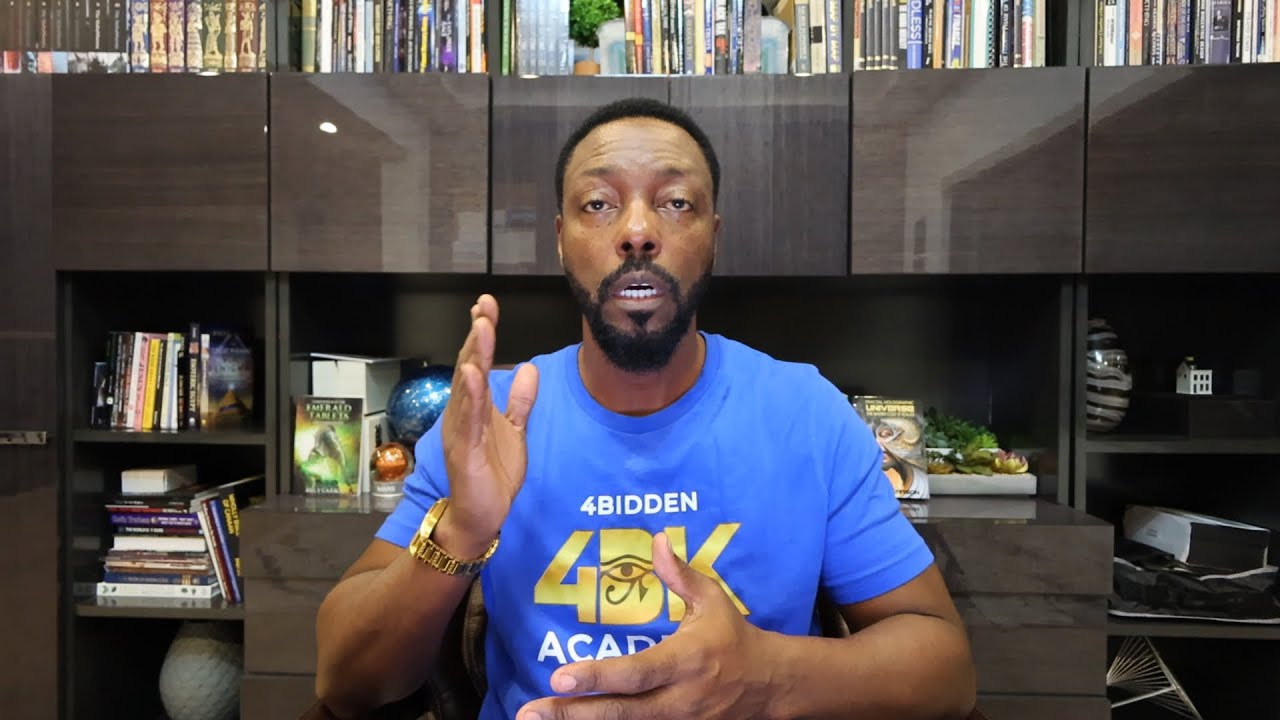
"The matrix is blocking your manifestation" is Billy Carson's way of saying that the world you see is a coded, fractal projection and that the code running inside you, not the world outside, decides what you can bring into it. In this solo talk he argues that reality is a holographic program, that your surroundings mirror your inner state, that early childhood and your ancestors wrote most of your subconscious software, and that the way out is to reprogram it. He supports the picture with the Adinkra codes of physicist James Gates, the Mandelbrot set, pixelation, and a claim that light hops from pixel to pixel. Some of those references are real discoveries that mean something narrower than he says; the practical advice underneath them has a conventional research base of its own.
This article walks through his argument in the order he makes it, sets the documented record beside each claim, and leaves out the repeated invitations to his paid community, which take up the closing minutes of the video.
What does Billy Carson mean by a fractal holographic matrix?
Carson's opening line sets the frame: "You're not living in a solid world. You are living in a fractal holographic matrix made of light that's imbued with divine codes and it can only interact directly with consciousness." Scientists, he says, zoomed into reality and "saw the largest part in the smallest piece," proving that "the universe as a whole is one gigantic fractal." The ancients knew it first, through the hermetic maxim "As above, so below. As within, so without."
Two separate ideas sit inside that paragraph. Fractals are real mathematics: Benoit Mandelbrot coined the word in 1975 for shapes that repeat their structure across scales, and coastlines, river networks, lungs and ferns are fractal over a limited range of magnifications. The holographic principle is real physics too, proposed by Gerard 't Hooft in 1993 and developed by Leonard Susskind, and it says the information inside a region of space can be described on its boundary. Neither says the universe is a projection made for consciousness, and the holographic principle is a statement about information bookkeeping in gravity, not about illusion. The maxim itself comes from the Emerald Tablet, a short Arabic-to-Latin text of the early Middle Ages, and was popularized for modern readers by The Kybalion in 1908. The library's articles on the fractal holographic universe and the holographic principle cover the distance between the physics and the metaphor.
Does a messy room really reveal your inner state?
This is Carson's most concrete claim and the one he most wants you to act on. "If you see a lot of chaos," he says, "if papers aren't stacked or filed properly, if there are old dishes and boxes of pizza laying around," then "that is a direct evidence of what's going on inside of you. The chaos and the entropy happening within you has now manifested on the outside." The same logic runs to mood: if you are still angry at someone who has left the room, "that frequency that you're vibrating at, it now has touched everything within your range spiritually," and the people around you "become agitated and frustrated."
There is ordinary psychology behind both halves. Emotional contagion is a well-studied effect: Elaine Hatfield and colleagues documented in the 1990s how people unconsciously mimic and absorb the moods of those around them, and Christakis and Fowler's Framingham analyses found happiness and loneliness spreading through social ties. Clutter has been measured too. Darby Saxbe and Rena Repetti's 2010 UCLA study found that women who described their homes as cluttered showed a flatter daily cortisol pattern, while Kathleen Vohs's 2013 experiments found tidy rooms nudged people toward conventional choices and messy rooms toward creative ones. Those are correlations and small effects, not a law that a dirty stove equals inner entropy, and the causation runs both ways. Carson himself calls it "a very simple way of looking at" the idea, and that is the right level to take it at.
Was there really an experiment about food cooked with love?
Carson tells of a study in which ten cooks "on a high vibration" and ten who "actually hated" cooking prepared the same dishes, and blind tasters preferred the food "cooked with love." He uses it to argue that you should not cook while angry because "that same energy is going into the food."
No published study matching that description could be found. The nearest documented research is on expectation and taste: Hilke Plassmann's 2008 study showed that the same wine tasted better, and lit up reward areas more, when people were told it cost more, and a long line of blind-tasting work shows that labels, prices and stories move ratings. What those show is that beliefs about food change how it tastes to the eater, not that a cook's mood enters the dish. A cook who enjoys the work may well season and time things better, which would explain a preference without any transfer of energy. Treat the story as an illustration of his position rather than a result.
What are the Adinkra codes and do they prove we live in a program?
The centerpiece of the talk is a physics reference. Carson says Professor James Gates Jr., "the former scientific adviser to President Obama," assembled "super mathematicians" to "unravel the nature of this reality" and discovered "Adinkra codes," which he says are the "same error correcting codes which run the ether of spacetime that also control search engines and web browsers." His conclusion: "we're living in a programmed matrix running on software and this scientific discovery proves it."
Gates is a real and distinguished theoretical physicist at the University of Maryland, and he did serve on President Obama's Council of Advisors on Science and Technology. The adinkras are real too, but they are diagrams, not codes found in nature. Michael Faux and Gates introduced them in 2005 as a graphical way to keep track of how supersymmetry transformations act on fields, and they borrowed the name from the Adinkra symbols of the Akan people of Ghana and Ivory Coast, not from the Dogon of Mali, whom Carson credits. In 2010 Gates wrote in Physics World that when his group classified these diagrams, the mathematics turned out to contain doubly-even self-dual binary codes, a family related to the Hamming error-correcting codes used in digital transmission. Gates has described this as "suggestive" and has been careful to say it is not evidence that we live in a simulation, only that the equations of supersymmetry share a structure with information theory. Supersymmetry itself has not been observed; the Large Hadron Collider has excluded its simplest versions. Nothing in the result concerns "the ether of spacetime," and Google's search ranking does not run on Hamming codes.
The Dogon detour is a separate story: the Nommo and Sirius B come from Marcel Griaule's fieldwork and Robert Temple's 1976 book The Sirius Mystery, and Walter van Beek's 1991 restudy found no trace of the star lore among the Dogon themselves. The library's article on the Dogon and Sirius covers that debate.
Did Pixar build its films on the Mandelbrot set?
Carson credits "Benoir Mandelro" with rediscovering "the fractal code" and says Pixar embedded the Mandelbrot set in its software so that "no more need to create every single image. The fractal mathematical code created everything including the animated characters on the fly."
Mandelbrot's set was first plotted in 1980, and fractal mathematics did change computer graphics. Loren Carpenter, who later co-founded Pixar, showed fractal mountains in his 1980 short Vol Libre and used the technique for the Genesis planet in Star Trek II in 1982, and procedural methods still generate terrain, clouds and foliage. Characters are another matter: Pixar's films are built from hand-modeled meshes, animated frame by frame by artists and rendered in full through RenderMan. Nothing in them is created "on the fly" by the Mandelbrot set. Carson's broader point, that video games render only what the player can see, is an accurate description of culling in game engines and the standard analogy behind simulation theory.
Does light move from pixel to pixel?
"Light doesn't go in a straight line," Carson says. "Light moves from pixel to pixel," so the photon that reaches your eye from a star "is not the original photon that took off," and reality itself is "a pixelated realm" where zooming in loses only resolution.
Physics does have a smallest meaningful length, the Planck length of about 1.6 x 10^-35 meters, and some quantum-gravity proposals treat spacetime as discrete at that scale. That is a hypothesis under test, not a finding. If space were a coarse grid, light of different colors would travel at slightly different speeds across the universe; the 2009 Fermi observation of gamma-ray burst GRB 090510 found no such spread down to scales below the Planck length, and Fermilab's Holometer reported a null result for one class of spacetime "pixel" jitter in 2015. Photons are also not relayed from cell to cell; a photon from a star is the same quantum of the electromagnetic field, propagating as a wave, until something absorbs it. The library's long conversation on whether light travels, with Robert Edward Grant, covers the same idea from the other direction.
When does the programming start, and can it be changed?
Here the talk turns toward what Carson wants listeners to do. He says the code begins "from the time that you are in the gestation period inside the womb," that "everything that happens from the age of 1 to the age of seven is all programming code," that "scientists now realize" those years fix "the personality traits of who you pretty much are going to be for the rest of your life," and that "anything after the age of seven is going to require a lot of work and reprogramming." On top of that sit "15 to 20 generations of epigenetic programming code" passed down "through the father's RNA."
The strong version is older than neuroscience: "Give me the child until he is seven" is attributed to the Jesuits. The research is more modest. Early childhood does matter; the Dunedin study led by Avshalom Caspi found that temperament observed at age three predicted adult personality, but the correlations were small to moderate, and large longitudinal reviews, including Brent Roberts's 2006 meta-analysis, show personality continuing to change through the twenties and beyond. Prenatal influence is a real field, the developmental origins of health and disease, which traces how conditions in the womb shape later development, but the gravitational pull of star alignments is not part of it. Transgenerational epigenetic inheritance is the most contested item: it is well documented in plants and worms, Brian Dias and Kerry Ressler showed in 2014 that mice could pass a learned odor fear to offspring through sperm, and Rachel Yehuda's work on the children of Holocaust survivors found differences in a stress-related gene, but human evidence is thin, limited to one or two generations, and the mechanisms involve small RNAs and methylation marks rather than a paternal record of "all of his traumas." The library's article on epigenetics and the biology of belief sets out what is established and what is not.
Carson's remedy is the light switch: "If we understand that the things that we think about the most and the things that we speak on the most actually become our perception of reality, well then why don't we just change what we're thinking and what we're speaking." Habits of thought can change, and cognitive-behavioral therapy rests on that fact, but Daniel Wegner's white-bear experiments in 1987 showed that trying to suppress a thought makes it return more often, so the switch is not as clean as the metaphor. Reframing, noticing and replacing a thought with a chosen one is the version that holds up, and the library's article on reprogramming the subconscious covers the methods with evidence behind them.
Why does Carson say money is only an instrument?
The final argument is about money. "Money is nothing more than a holographic projection," he says, "an energy exchange within this matrix." His illustration is a person trapped in an ice cave with a million dollars and a match: that night the money is worth one more night of warmth, and "the next day when they find you, it'll be back to whatever a million dollars can buy." His advice follows: "don't chase money. Follow your passions. Find a need for that passion in the world," and the money "will be the side effect." He adds that financial markets call money "an instrument" because they understand it is a vibration.
The ice-cave story is a good teaching example of a standard idea in economics: value is subjective and situational, the insight Carl Menger built on in 1871, and fiat money rests on nothing but the agreement that it will be accepted. "Instrument" in finance, though, is a legal term for a tradable contract such as a bond, with no connection to the musical sense, and "find a need and fill it" is a line attributed to the industrialist Henry J. Kaiser. Nothing here is financial guidance; it is a description of Carson's framing and where it comes from.
What can you take from the talk?
Carson's useful claims survive without the cosmology. Your environment and mood do affect the people around you, and tidying the space you work in is a cheap experiment. Specific, repeated thoughts do shape attention and behavior, and they can be redirected with practice. Value is something people assign, which is why the same dollar means different things in different rooms. The references to Gates, Mandelbrot and pixelated light are real names attached to much narrower results, and the claim that any of them proves we live in a program is his position, not theirs.
Watch, read and listen next
The physics behind the framing is in the fractal holographic universe explained and is the universe a hologram. The same maxim gets a full talk in what is the principle of correspondence, and the hermetic source text is in the Kybalion and the seven hermetic principles. The Nommo story is examined in the Dogon and Sirius explained, and the pixel-to-pixel idea in does light travel. For the program metaphor, read did the Anunnaki program the matrix and simulation theory explained. The inheritance claims are weighed in epigenetics and the biology of belief and the generational theme in what is the Agent Smith effect. The practice side is in how to reprogram your subconscious mind and how to raise your vibration, and the whole subject lives in the Manifestation topic hub.
Frequently asked questions
What does Billy Carson mean when he says the matrix blocks manifestation? He means that reality is a coded holographic program and that the subconscious programming you absorbed in childhood and from your ancestors runs against what you consciously want. In his view the fix is to reprogram that inner code rather than to work harder on the outside.
Did James Gates discover computer code in the equations of the universe? Gates and his collaborators found that the mathematics of supersymmetry, drawn as diagrams they named adinkras, contains structures equivalent to a family of error-correcting codes. Gates has called the finding suggestive and has said it does not show we live in a simulation. Supersymmetry itself remains unconfirmed.
Is there evidence that the universe is pixelated? Not so far. The Planck length is the smallest scale at which current physics is expected to apply, but searches for the effects a discrete spacetime would produce, including the 2009 Fermi gamma-ray burst measurement and the 2015 Holometer result, have found nothing.
Does your childhood really fix your personality by age seven? Early years matter and temperament shows some continuity, but longitudinal studies show personality keeps changing well into adulthood. The "age of seven" rule is an old saying rather than a scientific finding.
Sources mentioned
- Benoit Mandelbrot, The Fractal Geometry of Nature (1982); the Mandelbrot set first plotted in 1980
- Gerard 't Hooft, "Dimensional Reduction in Quantum Gravity" (1993); Leonard Susskind, "The World as a Hologram," Journal of Mathematical Physics (1995)
- The Emerald Tablet (Tabula Smaragdina); The Kybalion (1908)
- Elaine Hatfield, John Cacioppo and Richard Rapson, Emotional Contagion (1994); James Fowler and Nicholas Christakis, BMJ (2008) and related Framingham analyses
- Darby Saxbe and Rena Repetti, Personality and Social Psychology Bulletin (2010); Kathleen Vohs, Joseph Redden and Ryan Rahinel, Psychological Science (2013)
- Hilke Plassmann and colleagues, "Marketing actions can modulate neural representations of experienced pleasantness," PNAS (2008)
- Michael Faux and S. James Gates Jr., "Adinkras: A graphical technology for supersymmetric representation theory," Physical Review D (2005); S. James Gates Jr., "Symbols of Power," Physics World (June 2010)
- Marcel Griaule and Germaine Dieterlen, Le Renard Pale (1965); Robert Temple, The Sirius Mystery (1976); Walter van Beek, "Dogon Restudied," Current Anthropology (1991)
- Loren Carpenter, Vol Libre (1980) and the Genesis sequence in Star Trek II (1982); Pixar RenderMan documentation
- Fermi LAT and GBM collaborations, "A limit on the variation of the speed of light arising from quantum gravity effects," Nature (2009); Aaron Chou and colleagues, the Holometer, Physical Review Letters (2016)
- Avshalom Caspi and colleagues, "Children's behavioral styles at age 3 are linked to their adult personality traits at age 26," Journal of Personality (2003); Brent Roberts, Kate Walton and Wolfgang Viechtbauer, Psychological Bulletin (2006)
- Brian Dias and Kerry Ressler, Nature Neuroscience (2014); Rachel Yehuda and colleagues, Biological Psychiatry (2016)
- Daniel Wegner and colleagues, "Paradoxical effects of thought suppression," Journal of Personality and Social Psychology (1987)
- Carl Menger, Principles of Economics (1871)