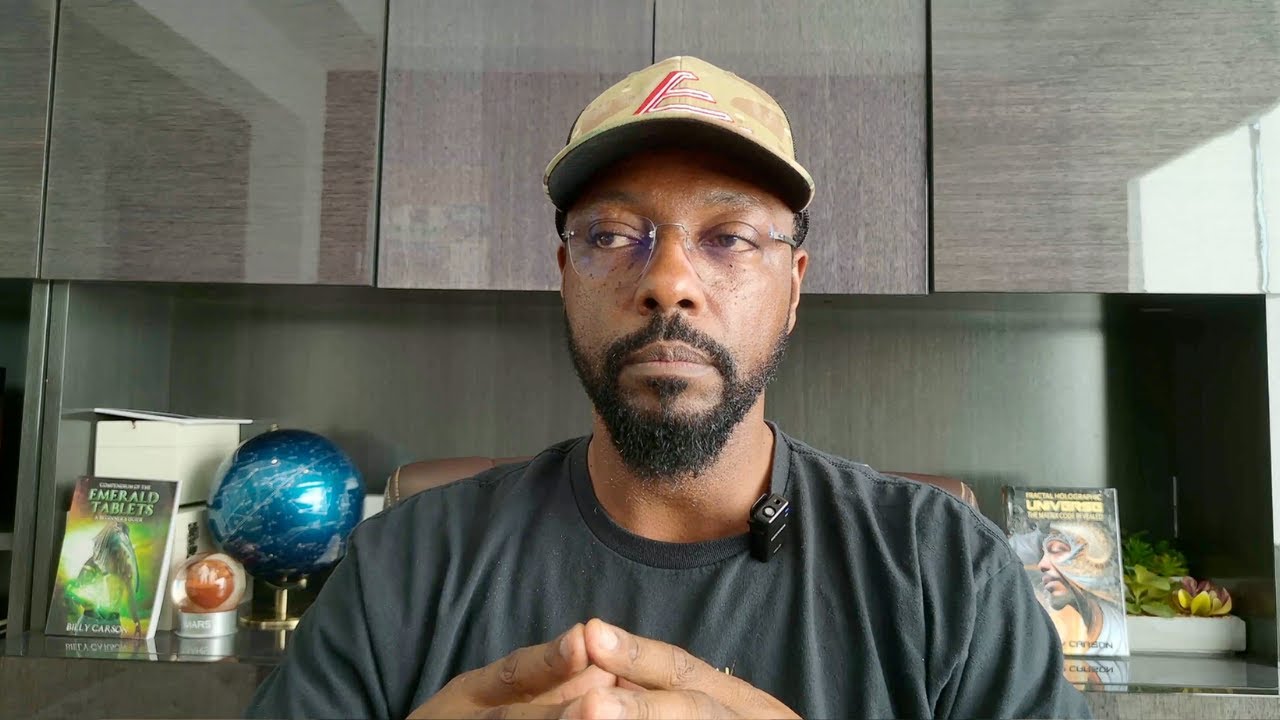
In "The Frequency Parasites," Billy Carson argues that the worst energy vampires are not outside forces but people's own habits: the attention, focus and emotional capacity they let other people, platforms and news cycles drain away. The live talk walks through how that happens, from cluttered rooms and doom-scrolling to hostile comment sections, and closes with everyday resets for getting back to what he calls the wealth frequency.
The topic matters because the complaint is nearly universal. Many people finish an evening on their phone feeling flat, short-tempered and unable to concentrate, without knowing why. Carson gives that experience a name and puts the responsibility, and the remedy, back with the individual. He is explicit that he means "not supernatural forces, but real energetic emotional and psychological drains," which makes this one of his more practical talks on manifestation.
Watch the video
What the video covers
The twist: the vampire is us (from about 1:10)
Carson opens by asking who is really responsible for people's energy, wealth and sovereignty being siphoned away. His answer: us. He describes energy being taken one bite at a time, playing on the digital byte, and says the most effective drains, whether a person, a company or the news, work so smoothly that nobody notices. He includes himself. Early on he also warns viewers to trust only links posted from his verified accounts, calling impersonators another kind of energy vampire.
Balance, not avoidance (from about 10:58)
He does not tell viewers to ignore difficult news. Staying aware matters, he says, but living in a constant stream of dark material leaves people angry and triggered in ways that spill onto everyone around them. His example is water: essential to the body, yet five gallons in one sitting could kill a person. That is accurate: drinking far more than the kidneys can clear dilutes blood sodium, a dangerous condition called hyponatremia. From about 12:07 he ties this to manifestation: someone can be saying the right affirmations, but if their energy is leaking in every direction, the results fall short.
What wealth actually means (from about 12:50)
"Wealth is health," Carson says, meaning physical and mental health first; without them, a person is poor whatever their bank balance. Abundance, in his definition, is when "your needs are met when they need to be met": rent paid, the power on, food on the table, the children fed.
Low-frequency environments (from about 13:50)
Clutter, noise, chaos and stressful spaces keep the nervous system activated. He compares heavy phone use to deliberately standing between two opposing factions in a dangerous neighbourhood, only without leaving the house. He plays on words, reading "television" as tell-a-vision and a broadcast as broadly casting a spell, then stresses that the effect is biology, not mysticism. In survival mode, he says, blood leaves the frontal lobe for the hindbrain and creativity shuts down. That is simplified: research describes acute stress shifting control away from the prefrontal cortex, which handles planning and flexible thinking, toward faster, more reactive circuits. His advice is to dip a toe in for information, think about solutions, then step back out.
One source, light and dark (from about 17:14)
Carson cites the Book of Isaiah, where God says he creates both good and evil. He gives the reference as Isaiah 47; the verse is Isaiah 45:7, which reads in the King James Version: "I form the light, and create darkness: I make peace, and create evil: I the LORD do all these things." He reads it as one source producing both, like yin and yang, and adds that he sees the creator not as a he or a she but as a frequency people tune into. From about 18:25 he turns inward: everyone has dark corners, and the work is to face them and keep them under control. He borrows a line from an unnamed martial-arts teacher, that the aim is not to eliminate evil but to control it, and illustrates it with a phone flashlight that makes darkness in a room give way instantly.
Emotional contagion and the signs of being drained (from about 21:15)
The nervous system, he says, syncs with the emotions around it, from gossip nearby to the news and the posts in a feed. Time with chronically negative people or content shrinks a person's state, and the warning signs are ordinary: missed workouts, arguments with a partner, constant frustration, skipped meals or overeating, yelling at the kids for no reason.
The comment-section story (from about 23:10)
This is the centrepiece. A hostile comment lands on someone's post, and within seconds their heart rate rises and cortisol spikes. They reply. Carson traces the reply by microwave from tower to tower to the commenter's phone, where it delivers a rush of satisfaction. He calls that rush oxytocin; a closer description is the brain's reward response, usually associated with dopamine. The angry reply, in his telling, has fed them. He is clear about the metaphor: "we're talking about neural emotional loops," not entities.
The reset (from about 28:00)
His fix: notice you are not acting like your normal self, be honest about it, then take ten deep breaths, meditate, recall a great moment from your life and feel gratitude for it. He links this to brain-heart coherence (from about 26:30), the idea that mind, emotions and actions line up, which our article on heart and brain coherence explores further.
Energy as a bank account (from about 30:07)
Attention, focus and emotional capacity are finite, Carson says, and every argument or hour of doom-scrolling is a withdrawal. Like a phone battery, the reserve drains until the device shuts off, leaving a person like an NPC, a non-player character on autopilot.
Habits and practical protection (from about 31:20)
The wealth frequency, he says, means looking after the body: eating well, moving through the day, exercising as far as one is able and reading about health. From about 33:20 he lists ways to protect it: direct sunlight, decluttering, conscious breathing and breathwork, grounding outdoors, intentional media that educates rather than provokes, healthy boundaries and a supportive circle. On that last point he invokes the idea, popularised by Jim Rohn, that a person becomes the average of the five people they spend the most time with. His summary: "these are not rituals. These are nervous system resets." One line needs correcting. He says vitamin D comes from the sun, not a cow; in fact sunlight lets the skin make vitamin D, and fortified milk, oily fish and egg yolks are dietary sources. Many people find time outdoors helps them feel calmer, but none of these habits should be read as a treatment for any condition.
Changing the conversation (from about 39:40)
He closes by asking viewers to gently steer loved ones who dwell on bad news toward solutions, service and gratitude. Good days stack, he says, into a good week, a good month and a great year.
Key takeaways
- Carson's central claim is that the most damaging energy vampires are people's own habits of attention, not outside entities.
- He treats awareness of hard news as necessary but argues for deliberate, limited doses followed by a turn toward solutions.
- Wealth, in his definition, starts with physical and mental health, and abundance means having your needs met on time.
- Hostile comment threads work, in his account, as a loop that spikes stress in one person and rewards another.
- His reset is concrete: notice the shift, take ten deep breaths, meditate and recall a moment you are grateful for.
Billy Carson's reading
Carson's interpretation rests on two ideas. First, energy, attention and emotion behave like a finite account drawn down by environments and inputs a person chooses, which is why he puts the responsibility on the individual rather than on whoever does the draining. Second, inner state shapes what a person can build: when the frequency drops, affirmations, business plans and relationships stall. That is the logic behind his broader teaching on how to raise your vibration and his own account of changing his frequency through daily practice.
He draws the view partly from scripture and partly from his life and business coaching. Readers who want his step-by-step approach to goals can start with how to manifest what you want using the Billy Carson method.
What mainstream scholarship says
"Energy vampire" is a pop-psychology metaphor for relationships that leave people depleted; Albert J. Bernstein's book Emotional Vampires helped popularise it. Some of what Carson describes has research behind it. Emotional contagion, picking up the moods of those around us, is well documented, and studies have linked heavy consumption of negative news and social media with lower mood and higher anxiety. Work by Amy Arnsten and others shows acute stress impairs prefrontal functions such as planning and focus. The "frequency" and "vibration" in the talk, however, are metaphors for mood and mental state, not quantities physics can measure.
On Isaiah 45:7, many modern translations render the Hebrew ra as "calamity" or "disaster" rather than moral evil, and scholars usually read the verse, addressed to the Persian king Cyrus, as a statement of God's sovereignty over all events rather than a yin-yang principle. Grounding research consists of small studies, and its proposed mechanisms are not established.
Watch, read and go deeper
For the evidence behind one of his recommendations, read our explainer on grounding and earthing. The full audio of this talk is on the 4biddenknowledge Podcast episode page. More talks in the same vein are collected in Best of Billy Carson on 4BK TV, and the manifestation topic hub gathers every related article.
Frequently asked questions
What is an energy vampire?
An energy vampire is a popular term for a person, habit or source of content that leaves someone drained, anxious or irritable. Billy Carson extends it to doom-scrolling, clutter and hostile comment sections, and argues the biggest drain is the attention people give away themselves.
Is doom-scrolling bad for your mood?
Studies have linked heavy consumption of negative news and social media with lower mood and higher anxiety, though cause and effect are hard to separate. Carson's advice is to take in enough to stay informed, then turn deliberately toward solutions and uplifting material.
What does Isaiah 45:7 mean?
In the King James Version, Isaiah 45:7 reads "I form the light, and create darkness: I make peace, and create evil." Billy Carson reads it as one source creating both light and dark. Many modern translations use "calamity" or "disaster," and scholars generally read the verse as a statement of God's sovereignty.
How do you protect your energy, according to Billy Carson?
He recommends noticing when you are not acting like yourself, then taking ten deep breaths, meditating and recalling a moment you are grateful for. Day to day he suggests sunlight, decluttering, breathwork, time in nature, intentional media, boundaries and a supportive circle.
Sources mentioned
Carson cites the Book of Isaiah, giving the passage as chapter 47; the verse he paraphrases is Isaiah 45:7, quoted here from the King James Version. He quotes an unnamed martial-arts instructor, refers to brain-heart coherence, and uses the "average of five people" idea associated with Jim Rohn. For background: Elaine Hatfield, John T. Cacioppo and Richard L. Rapson, Emotional Contagion (1994); Albert J. Bernstein, Emotional Vampires: Dealing with People Who Drain You Dry (2001); and Amy F. T. Arnsten, "Stress signalling pathways that impair prefrontal cortex structure and function," Nature Reviews Neuroscience (2009).
This article is for information only and is not medical advice; talk to a clinician about vitamin D, sun exposure or mood concerns.
These statements have not been evaluated by the Food and Drug Administration. This content is for information only and is not medical advice.