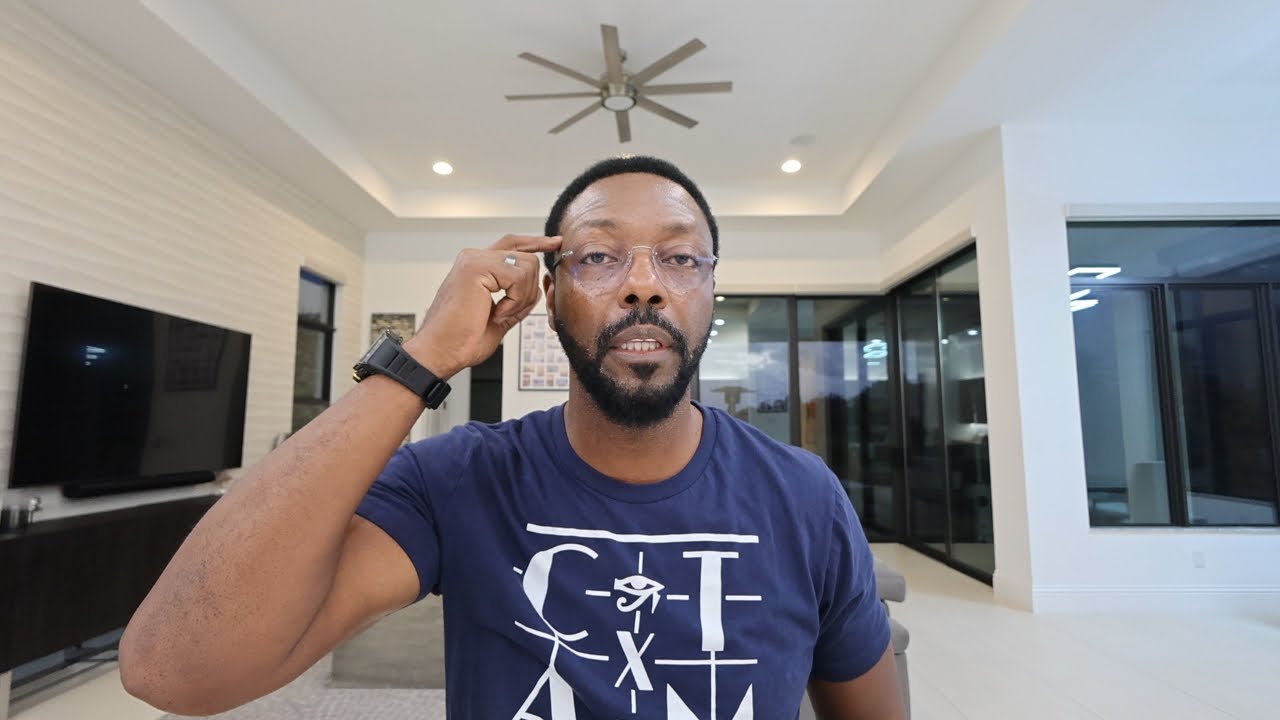
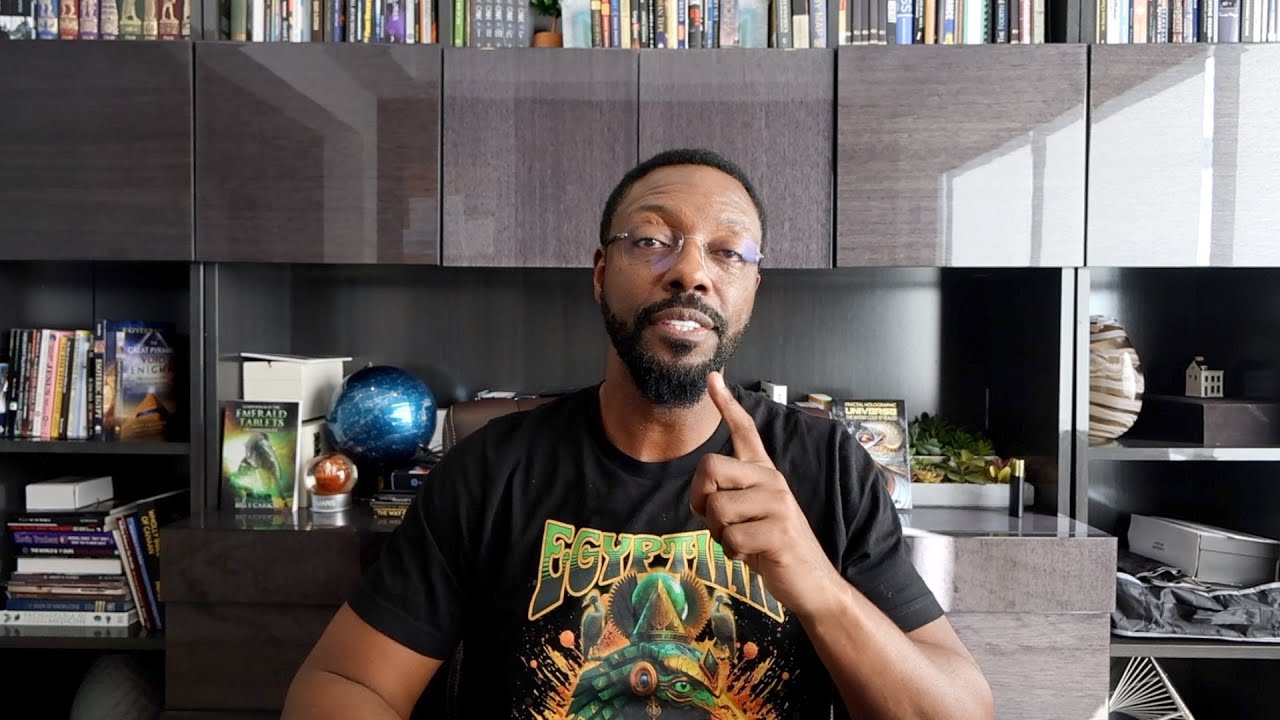
The power of will, as Billy Carson and Sharif Anael-Bey describe it in this 4biddenknowledge Podcast conversation, is a faculty that can be trained: belief comes first, discipline builds it, and a trained will is what keeps a person moving toward a goal when life gets hard. Across nearly two hours, Carson and Anael-Bey, national press secretary of the Moorish Science Temple of America, move from that idea through cyclical time, hidden history, consciousness research and the difference between a will and a wish.
The video carries the title Never Give Up on Your Dreams Even When Life Gets Tough, and the thread running through its many tangents is persistence. Anael-Bey, a martial artist and qigong teacher, argues that most people fall short not for lack of ability but because they hold a set of competing wishes instead of a single will.
What the video covers
A guest who grew up with the questions (from about 3:00)
Anael-Bey describes attending the Muhammad University of Islam for first and second grade, where he first heard Nation of Islam teaching about a mother ship, and later moving into hermeticism, esoteric orders and the Moorish Science Temple of America. He gives the organisation's own origin story: Noble Drew Ali began teaching in Newark, New Jersey, in 1913, and the movement had spread nationally by the 1920s. He also points to Duse Mohamed Ali, the Sudanese-Egyptian publisher who launched the African Times and Orient Review in 1912.
Cyclical time and the box on the puzzle (from about 9:00)
The Moorish Science Temple measures time in cycle ages, Anael-Bey says, and that changes how ancient monuments look. Rather than assume today's world is humanity's most advanced, he asks whether people are catching up to an earlier cycle. His analogy is a jigsaw: the pieces are useless without the picture on the box, and the picture is the narrative.
The Inquisition and a lost way of thinking (from about 12:30)
The guest cites Peter Tompkins's Mysteries of the Mexican Pyramids on the Spanish Inquisition's targeting of people who taught chemistry, mathematics and physics in the Moorish centres of Córdoba and Seville. He then uses James Reston Jr.'s Dogs of God on the Spain of Ferdinand and Isabella, after nearly eight centuries of Muslim rule in Iberia. Both men argue that an intellectual culture was suppressed and that science was set back by centuries. Later (about 30:00) Anael-Bey links the start of the Atlantic slave trade to a 1442 bull of Pope Eugene IV issued as part of the Reconquista.
Consciousness and technology (from about 16:30)
Anael-Bey uses the terms radionics and psychotronics for what he calls consciousness-assisted technology. Carson describes recent laboratory work: researchers exchanging information with people while they dream, EEG headsets linking two people's brains, and headsets that let a user turn lights on or steer a toy car by thought. Anael-Bey sets machine-based transhumanism against what he calls bioenergetic transhumanism, developing human ability through practice, and mentions the declassified Stargate program. The conversation later turns to Hemi-Sync (about 44:00), the audio technique assessed in the Army's 1983 Gateway Process memo.
Belief, the will and the bicep (from about 23:00)
This is the centre of the episode. Anael-Bey says that in his reading of quantum mechanics the "quantum operator" that turns a probability into an event is human belief, and that the will can be developed without limit. His fitness analogy: lifting weights does not build muscle on its own; it breaks tissue down, and growth comes later with food and sleep, a pattern he compares to death, burial and resurrection. Chinese martial artists, he says, learned that "you could build the will just like you build a bicep." The catch is that discipline starts with belief. In his experience of internal-energy training, students spend years simply accepting that something intangible can be trained at all.
Ultraterrestrials and the nature of time (from about 36:00)
The pair discuss physicist Hal Puthoff's paper Ultraterrestrial Models, which they summarise as proposing that the intelligence behind UAP may be terrestrial or interdimensional rather than a visitor from another star. Carson adds a relativity scenario: travellers moving at a large fraction of light speed age slowly relative to Earth, so a returning crew could find that generations had passed. Anael-Bey connects this to the opening line of Moorish Science teaching, "time never was when man was not," which he treats as a contemplation that trains the mind to think outside time. Later (about 50:00) Carson recounts asking the AI robot at the Sphere in Las Vegas about the fractal holographic universe and hearing it answer with both physics and metaphysics.
Sinai and monatomic gold (from about 69:00)
Anael-Bey turns to Flinders Petrie's work at Serabit el-Khadim in Sinai, a temple of Hathor that he identifies with Mount Horeb. Hathor's cow imagery, he says, connects to the golden calf of Exodus 32, and the white ash Petrie reported was, following the late Laurence Gardner, a monatomic form of gold. He describes these M-state elements as a possible bridge between the body and David Bohm's implicate order.
The will in the occult tradition (from about 76:00)
Anael-Bey quotes Pascal Beverly Randolph's declaration of the omnipotence of the human will and the Moorish Science teaching that God is closer than the jugular vein (Quran 50:16). Carson points to estimates of DNA's data-storage density as a sign of how much capacity is built into the body. Genesis 3:22, where the man becomes like one of the Elohim, is read as a graduation rather than a punishment. Anael-Bey argues that Christianity as practised today took shape in Rome under Constantine, then turns to Carl Jung (about 86:00): the question of what happens after death is among the deepest patterns in the psyche, so whoever shapes that story shapes the culture. Carson's reply: "People got to understand that we are already eternal."
From about 92:00 comes the line that best fits the video's title. Citing Aleister Crowley's definition of magick as causing change in conformity with will, Anael-Bey adds: "Most people don't have a will. They only have a set of wishes." A wish says maybe; a will leaves no other option.
Perception and its limits (from about 98:00)
The closing stretch sets science against what Anael-Bey calls scientism, the rule that nothing exists beyond the five senses. His example is colour: a red heel looks red because the material reflects that wavelength and the brain builds the experience. The guest's caution is the most practical line in the episode: "our objective is to expand our perception without cracking the psyche in the process."
Key takeaways
- The conversation treats the will as a skill built through practice, in the way a muscle is built through stress and recovery.
- Anael-Bey's distinction between a will and a set of wishes is the episode's clearest answer to the question of why people give up.
- Both men argue that the story used to read the evidence decides what history looks like.
- Carson presents human ability as something people are born with and have been taught to forget.
- The guest warns that expanding perception has to be done with discipline and care for mental health.
Billy Carson's reading
Carson's position in the episode is that the human body is technology animated by spiritual energy, and that intuition and higher perception are natural abilities that conditioning has dulled. It fits his wider model of reality, set out in the fractal holographic universe, in which consciousness is primary and the physical world is its expression. On that view, a trained will is not wishful thinking but the practical edge of the same principle he teaches in his method for manifesting what you want, where belief and consistent action work together.
For readers interested in how belief and habit can be reshaped in practice, the site's guide to reprogramming the subconscious mind sets out the techniques and what the research supports.
What mainstream scholarship says
In physics, an "operator" is a mathematical object that represents a measurable quantity, and mainstream accounts of measurement, including decoherence, do not require a conscious observer or belief; the double-slit experiment is often cited for that idea, but "observer" there means any interaction that records which path was taken. Psychology supports part of the practical message. Gollwitzer and Sheeran's 2006 meta-analysis found that specific if-then plans ("implementation intentions") substantially improve goal attainment, while a large 2016 multi-lab replication found little support for the idea that willpower is a fuel that runs out. The popular split between "left-brained" and "right-brained" people is not supported by imaging studies such as Nielsen and colleagues (2013).
On the history, executions by the Spanish Inquisition are estimated by historians working from its own records in the low thousands across more than three centuries, far below figures raised in the conversation. Most historians date the Atlantic slave trade to Portuguese voyages along the West African coast from the 1440s and point to the later bulls of Nicholas V, Dum Diversas (1452) and Romanus Pontifex (1455). The Council of Nicaea in 325 dealt mainly with the Arian controversy and the date of Easter; the virgin birth already appears in the Gospels of Matthew and Luke, and Acts 11:26 places the first use of "Christians" in Antioch, a city of Roman Syria.
Petrie's excavation at Serabit el-Khadim, published in Researches in Sinai (1906), documented a Hathor temple serving Egyptian turquoise-mining expeditions; the monatomic-gold reading comes from later authors, and claims that such materials act as superconductors in the body have not been demonstrated. Puthoff's ultraterrestrial hypothesis remains speculative.
Watch, read and go deeper
The full audio is on the podcast episode page, and more conversations like it are collected in the 4biddenknowledge Podcast on 4BK TV. For Carson's step-by-step approach, start with his manifestation method. The manifestation topic hub gathers related articles on belief, habit and practice, and readers curious about the Sinai material can see what ORMUS and monatomic gold are and what the evidence shows.
Frequently asked questions
What is the difference between a will and a wish?
In this conversation a wish is a hope held alongside other, contradictory hopes, while a will is a single decision that leaves no alternative. Sharif Anael-Bey, drawing on Aleister Crowley, argues that most people carry a set of wishes that cancel each other out. A will, in his telling, is built through practice and discipline.
Who is Sharif Anael-Bey?
Sharif Anael-Bey is national press secretary of the Moorish Science Temple of America, a martial artist and a qigong instructor.
What is the Moorish Science Temple of America?
It is a religious movement founded by Noble Drew Ali, who began teaching in Newark, New Jersey, in 1913; the organisation grew in Chicago and other cities in the 1920s. Its teachings present African Americans as Moorish Americans and include its own scripture, the Holy Koran of the Moorish Science Temple of America.
Does quantum physics prove that belief shapes reality?
No. The idea that belief collapses a wave function is an interpretation held by some writers, not a result of quantum physics; standard accounts describe measurement through physical interaction and decoherence. Research on goal-setting and planning does show that how people frame and commit to goals affects whether they reach them.
Sources mentioned
Anael-Bey cites Peter Tompkins's Mysteries of the Mexican Pyramids, James Reston Jr.'s Dogs of God, the African Times and Orient Review founded by Duse Mohamed Ali, Hal Puthoff's paper Ultraterrestrial Models, Ron Eglash's African Fractals, David Bohm, Flinders Petrie's excavations in Sinai, Laurence Gardner's writing on monatomic gold, Pascal Beverly Randolph, Aleister Crowley's definition of magick, Carl Jung's archetypes, Genesis 3, Exodus 32, and the Quran (50:16). Standard references include Petrie's Researches in Sinai (1906), Henry Kamen's The Spanish Inquisition: A Historical Revision, Gollwitzer and Sheeran's 2006 meta-analysis of implementation intentions and Edward E. Curtis IV's Islam in Black America.
These statements have not been evaluated by the Food and Drug Administration. This content is for information only and is not medical advice.