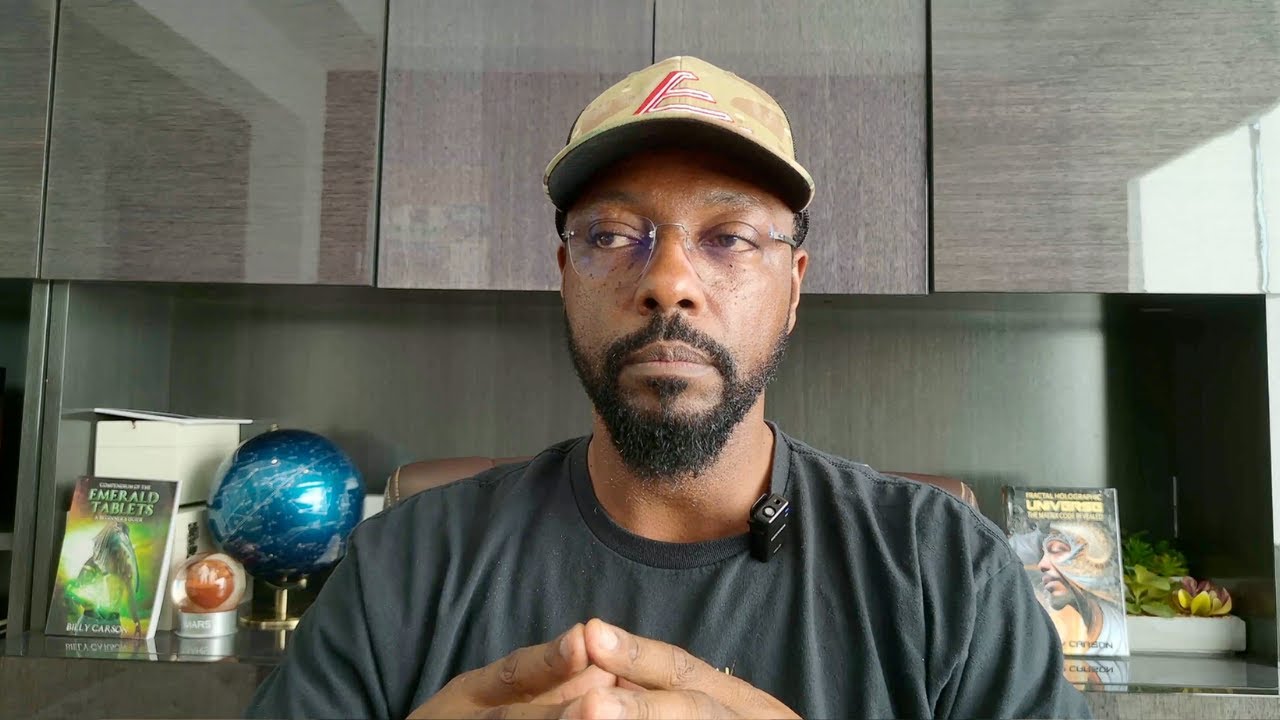
Billy Carson's argument in this talk is that the universe is a mirror: it is not testing or judging anyone, it is reflecting their dominant frequency back to them. Delays, closed doors and repeating cycles are, in his account, feedback about the signal a person is sending, so the useful question shifts from why something is happening to what it is showing. The 17-minute talk makes the case through the Hermetic principles, a model of mind at two scales, an EEG example and a test anyone can run on their own phone contacts.
It matters because the idea that the universe is testing you is one of the most common ways people explain a hard stretch. Carson moves the focus to a person's own thoughts, words, emotions and company. Skeptics will reject the cosmic mechanism, but the practical half, minding self-talk, choosing a response and auditing your company, can be judged on its own terms.
What the video covers
The mirror, not the test (from about 1:00)
Carson opens with the thesis. If you feel stuck, he says, "it's not because the universe is testing you. It's because the universe is reflecting you." Reality is not random in his telling; it mirrors a person's dominant frequency, and every delay or repeated cycle carries information about their current vibration. He offers two images: a mirror, which returns your reflection reversed, and a boomerang. The line that sums it up is "You're going to attract what you are, not what you want." His example is money: announcing that you want a billion dollars does nothing unless you are on the frequency of a billion-dollar mindset.
Thoughts and words as encoded waves (from about 2:30)
Next he describes thoughts as vibrations, waves of light encoded with information that reach outward to the universe and inward to every cell of the body. Words work the same way: speaking hatred, anger or frustration sends that signal both out and in, producing an inside-out turmoil. He ties this to the Hermetic principles and the axiom as within, so without. Someone who attacks you with negativity, he adds, is projecting their own turmoil. Because humans are a fractal of the universe, he argues, the universe works the same way.
What the real test is (from about 4:10)
Carson keeps the word test but redefines it. The test is whether you respond as the version of yourself that already has what you want, or whether you begin to chase, beg, hope and wish.
Scarcity language and what it reflects (from about 4:30)
He illustrates with comments he sees online, where people write that they are broke, will never be able to afford something and hope that someday they might. Their intentions are good, he says, but the words tell the universe they do not believe in abundance or in their own worth. The mirror then returns more bills, more debt and constant worry about the next paycheck, a frequency of damage control instead of problem-solving. The fix, in his framing, is to get on the frequency of the thing wanted, whether wealth, success or happiness. He mentions that he teaches this in more depth in his Academy.
The micro and the macro: one consciousness (from about 8:25)
The longest section lays out the model behind the talk. The universe, Carson says, is a fractal holographic matrix, so each person is "a fractal of the whole," and there is only one consciousness. The brain sits in darkness and relies on the five senses to go out, collect data and send it back as electrical impulses; the brain sorts that data and projects the hologram we move through. Scale it up and the universe is the mind, while every person and everything made of atoms or energy is its sensory network, reporting experience back in real time. The universal mind answers down what he calls a spiritual tether. If what goes up is fear, doubt and lack, the mind reads that as what the person wants more of and sends it back, which is why some people face problem after problem.
The EEG example (from about 12:20)
To ground this in basic science, Carson points to EEG. A cap resting on the scalp, with no surgery, picks up signals while a person thinks, and a computer displays them. Remove the cap, he says, and those thoughts still leave the skull around the clock into an interconnected energetic grid, and the connection runs both ways. Shift into compassion, gratitude, enthusiasm and service, and the mirror returns that higher energy, building an abundance mindset and helping reprogram the subconscious.
The phone-call test (from about 14:35)
The most down-to-earth part of the talk is a thought experiment. Think of the caller ID that makes you cringe, the person with a problem for every solution, then the friend whose calls you look forward to, who stays mostly positive through ups and downs. Carson's point is that the mirror is visible in the people closest to you. "It's not woo-woo. It's not magic. It's not metaphysics. It's actually real everyday life."
Taking inventory (from about 16:20)
He closes on response instead of circumstance. Life will happen regardless; the skill is catching yourself in anger or frustration, moving through it and coming back up without punishing yourself. When events blindside you, he recommends an inventory of your thoughts, emotions and the people around you most consistently, followed by real changes. He is blunt about the last part: "Some people will have to get cut off."
Key takeaways
- Carson's central claim is that the universe reflects your dominant frequency instead of testing or judging you.
- In a hard stretch, he wants people to ask what the situation is showing them, not why it is happening to them.
- In his framing, scarcity language about being broke or never affording something reinforces the lack it describes.
- He grounds the idea in the Hermetic Principle of Correspondence and his fractal holographic model of one consciousness.
- The real test, as he defines it, is whether you act as the version of yourself that already has what you want.
- The practical upshot is an honest audit of your thoughts, words, emotions and closest company.
Billy Carson's reading
Carson's position rests on two layers. The first is Hermetic. The axiom "as above, so below" is the Principle of Correspondence, the second of the seven principles in The Kybalion (1908). It sits alongside Mentalism, "The All is Mind; the Universe is Mental," and Vibration, "Nothing rests; everything moves; everything vibrates." Together those three supply the skeleton of this talk: reality is mental at root, inner and outer correspond, and everything has a frequency. If inner and outer follow the same pattern, outer events become a readout of inner states, which is what turns a judge into a mirror. The guide to the Kybalion and the seven Hermetic principles covers each principle and the text's origins.
The second layer is his own model. In the fractal holographic universe, every part carries the pattern of the whole, so a human mind is a small-scale copy of a universal one. That is why the brain-and-senses analogy carries so much weight here. For Carson it is the same structure at two scales, not a loose metaphor.
The talk also maps onto the method in his book. Manifestation Codes treats manifestation as a repeatable sequence of practices, and the guide to the Billy Carson method organizes it as thought, frequency and action. This video sits mostly in the middle. The billion-dollar example is thought without frequency: a clear desire with no matching inner state. The scarcity comments are frequency undermined by words. The closing inventory, with its emphasis on problem-solving and changing your company, is the action step, because in Carson's framework the reflection only changes when something real changes. Read that way, the talk is about alignment between what a person says they want and how they actually live.
What mainstream scholarship says
On the physics and neuroscience, the mainstream picture differs from Carson's. EEG records tiny voltage changes at the scalp produced by the synchronized activity of large populations of neurons. The signals are electrical, measured in microvolts, and fade so quickly with distance that electrodes have to sit on the head. They are not light, and there is no evidence that they carry information into space or that anything answers them. Scholars date the Greek Hermetic writings to roughly the first to third centuries CE and place The Kybalion in early twentieth-century American New Thought, so ancient describes the lineage of ideas more than that book. Physics has a holographic principle, but it concerns information encoded on a region's boundary, not a universe that works like a mind.
The practical core, however, overlaps with well-studied psychology. Reframing a setback from punishment to information is close to cognitive reappraisal, which emotion-regulation research associates with better outcomes than suppressing feelings. Nicholas Christakis and James Fowler's analysis of Framingham Heart Study data found that happiness clusters in social networks, which lends some support to choosing your company with care, and Robert Merton's self-fulfilling prophecy describes how expectations shape behavior and outcomes. One caution runs the other way: Sendhil Mullainathan and Eldar Shafir's work on scarcity suggests financial pressure itself narrows attention, so a scarcity mindset is often a consequence of hardship, not only its cause.
Watch, read and go deeper
The Billy Carson method and Manifestation Codes, linked above, are the natural next reads. Readers drawn to number-based routines can compare it with the 369 manifestation method. The manifestation topic hub gathers every related article, and the audio version of this talk is on the 4biddenknowledge Podcast. More of Billy's short talks are collected in Best of Billy Carson on 4BK TV.
Frequently asked questions
What does it mean that the universe is a mirror?
In Billy Carson's usage, it means outer circumstances reflect a person's dominant inner state: their thoughts, emotions, words and habits. He contrasts it with the idea that the universe is testing or judging people. The phrase draws on the Hermetic Principle of Correspondence, often summarized as as above, so below; as within, so without.
Is the universe testing you when things go wrong?
Carson's answer is no. He argues that setbacks reflect the frequency a person is broadcasting, not examinations set from outside. The only test he accepts is whether you respond as the version of yourself that already has what you want, or fall back into chasing and wishing.
How do you change the frequency you are sending out?
Carson's prescription is to take an inventory of your thoughts, emotions, words and closest company, then make concrete changes. He emphasizes catching yourself in anger or frustration and returning to gratitude, compassion and enthusiasm. Much of this resembles reappraisal and changing your social environment.
Is there scientific evidence that the universe is a mirror?
There is no scientific evidence that thoughts travel into the cosmos or that the universe responds to them; EEG signals are weak electrical fields at the scalp. There is good evidence that how people interpret events and who they spend time with affect their mood, choices and results.
Sources mentioned
In the video Carson draws on the Hermetic principles and the axiom as within, so without; his own fractal holographic model of the universe and of one consciousness; and electroencephalography (EEG) as an example of measurable brain activity. Standard references for context include The Kybalion, published in 1908 under the name Three Initiates; Brian Copenhaver's Hermetica (1992), the standard English translation of the Corpus Hermeticum; James Gross's research on emotion regulation and cognitive reappraisal; Christakis and Fowler's 2008 BMJ study on the spread of happiness in a social network; and Mullainathan and Shafir's Scarcity (2013).