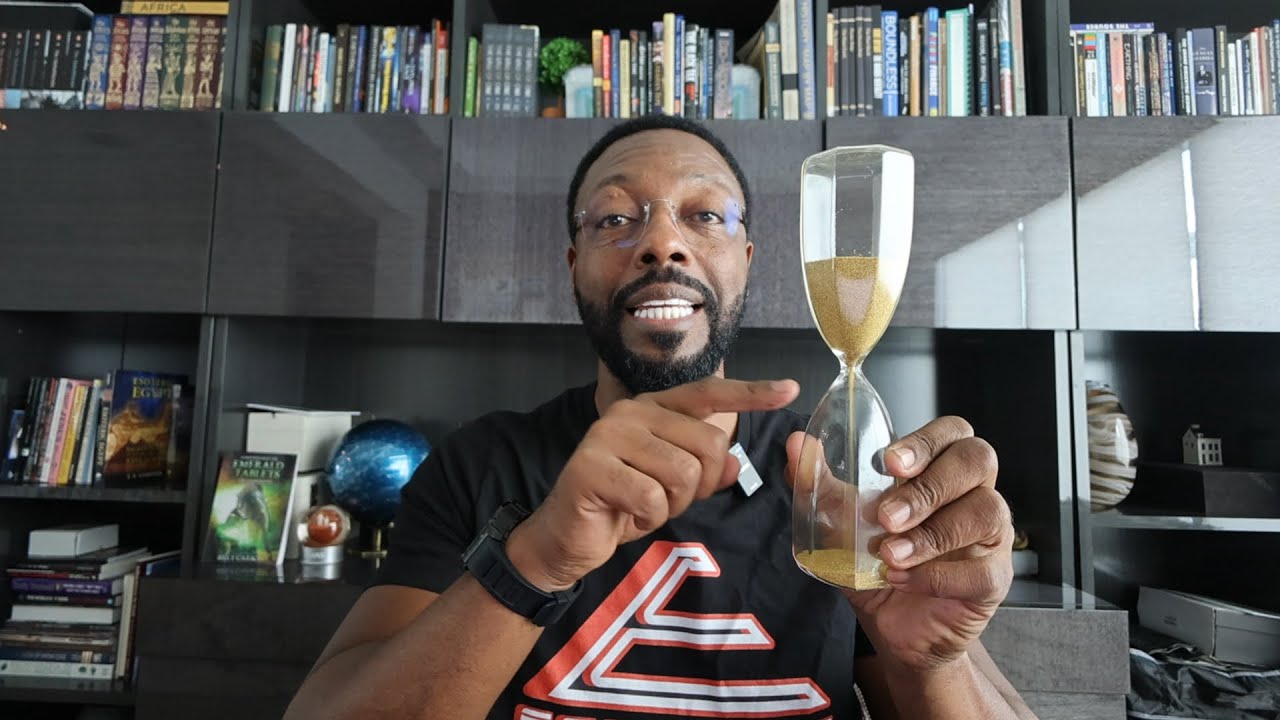
"Your old frequency is blocking your new reality" is Billy Carson's warning that people ask for a different future while showing up with the same energy, habits and self-talk that built their present. In this solo talk he argues that every thought a person acts on splits their timeline, that the Hermetic Principle of Cause and Effect guarantees a result from every action, and that a desired future has its own frequency a person has to match before it arrives. He backs it with two stories from his own life: selling nonstick pots and pans door to door in Miami high-rises, where he was trained to answer "Fantastic" every time, and a free-throw ritual from his basketball years. Research supports his pre-shot routine and the spread of moods between people; physics and neuroscience describe timelines and brain waves differently.
This article covers the split-timeline idea, the cause-and-effect principle, his reading of brain waves, the mismatch between thoughts and feelings, the "Fantastic" rule, mirror neurons and the free-throw routine. It leaves out the Academy promotion at the end, his medical remarks about stress and disease, and family details.
What does Billy Carson mean by your old frequency?
Carson opens bluntly: "You keep saying that you want a new reality, but you keep showing up with the same energy and frequency that created the old one." To create the reality you want, he says, you have to get on the vibration of that future timeline first.
Habit research describes something similar. Wendy Wood's studies suggest a large share of daily behavior runs on habit in familiar settings, and that intentions rarely override habits the environment keeps triggering. Changing outcomes means changing the cues and routines. Carson calls that bundle a frequency.
Does every decision really split your timeline?
Carson's next claim is that every thought you take action on "will fracture and split your timeline." Right now, he says, one version of you is listening to him, while in another reality a different version made a different choice and is doing something else. Listening is not enough to change anything. What fractures the future is comprehension, then action, then implementation, at which point "you will actually jump to a brand new timeline" and "rendezvous with a new version of yourself."
The physics behind this is the many-worlds interpretation that Hugh Everett proposed in 1957, in which every quantum measurement outcome occurs in its own branch. There, branching is driven by quantum events, not human decisions, and no one chooses a branch. As a model of choice, Carson's point is practical: each action changes which futures you can reach. Peter Gollwitzer's research on implementation intentions, plans of the form "when X happens, I will do Y," found that people who set them follow through far more often than people who only set goals.
What is the Principle of Cause and Effect?
Carson ties the timeline idea to "one of the most ancient universal principles," known in the Kemetic teachings and later in the Hermetic principles. Every conscious thought you act on and put energy into, he says, gives you a result. It may be a good consequence or a bad one, but a consequence is guaranteed.
The Principle of Cause and Effect is the sixth of seven in The Kybalion, published in 1908 under the name "Three Initiates" and usually attributed to the New Thought writer William Walker Atkinson. Its summary line is "every cause has its effect; every effect has its cause." Carson traces it to ancient Egypt, which is his position; historians of the Hermetic tradition place its written sources in the early centuries of the common era and see The Kybalion as a modern New Thought work that uses Hermetic language.
Can an EEG really show the frequency of your thoughts?
To show that thought frequency is "real science," Carson describes an EEG cap connected to a computer, where a doctor can look at the vibration of your thoughts as a wave. When you are distraught, angry or worried, he says, the wave stretches out with long spaces between peaks. When you move into excitement, exhilaration or love, the peaks get taller, the troughs deeper and the spacing very short.
Hans Berger recorded the first human EEG in 1924 and published it in 1929. An EEG measures the summed electrical activity of large groups of neurons and sorts it into bands such as delta, theta, alpha (about 8 to 13 hertz) and beta (about 13 to 30). It cannot read the content of a thought. It also runs partly opposite to Carson's description: alert, aroused states tend to show faster but smaller waves, while deep sleep shows the slowest and largest ones. The broad link he draws, that mental state changes the brain's rhythm, is accurate. The specific picture of love as a tall, tightly packed wave is his own.
Why do your thoughts and your feelings need to match?
This is the center of the talk. You can be thinking all the right things about what you want to create, Carson says, while underneath you are still running what he calls ANTs, automatic negative thoughts, along with stress, fear and frustration. The conscious mind is saying "I'm going to create this," but the subconscious and the body are vibrating somewhere else. "So now you have a conflict," he says, "a conflict of vibration and frequency," and it blocks the manifestation. The fix starts with honesty about how you really feel.
The term "automatic negative thoughts" comes from Aaron Beck's cognitive therapy of the 1960s. Carson also links long-term stress to the body; that medical side of the talk is a question for a physician and is not covered here. The psychological point stands on its own: affirmations that clash sharply with how a person feels can backfire. Joanne Wood and colleagues found in 2009, in Psychological Science, that people with low self-esteem felt worse, not better, after repeating "I am a lovable person," which supports Carson's view that the inner state has to move along with the words.
What is the "Fantastic" rule from his pots-and-pans days?
Carson's main story comes from the early days of mass-market nonstick cookware. He joined a company as an independent contractor, trained at its Miami warehouse in the art of closing, and was assigned office buildings downtown to canvass for a week at a time. He pitched receptionists with sample pans, left an order sheet and returned at the end of the week to collect orders and deliver from his car.
The training had one rule he still uses. When someone asked "How are you?" the answer was always "Fantastic," said with energy. Carson calls it a mind trick that told his own body and cells he was fantastic, and kept his energy high through the pitch. Answer "I'm okay" and the energy spikes and drops, the buyer reads the drop, and the deal is lost. He says he later bought the pans wholesale and ran it as his own business.
Nonstick cookware dates to Tefal's first coated pans in 1956 and the Happy Pan in American stores in 1961. On the "Fantastic" rule, the facial-feedback hypothesis, tested by Fritz Strack in 1988, holds that expressing an emotion can nudge the feeling itself; a 2019 meta-analysis by Nicholas Coles and colleagues found the effect real but small. The bigger effect is on the listener.
Do mirror neurons make people match your energy?
Carson says the buyer's mirror neurons "are going to match my energy, whether they want to or not," and the same neurons match a drop when your energy falls. That is why, in his view, a salesperson who slips into a low mood mid-pitch loses the sale.
Mirror neurons were first reported in macaque monkeys by Giacomo Rizzolatti's group in Parma in 1992 and 1996: cells that fired both when a monkey grasped an object and when it watched someone else do it. Human evidence is mostly indirect, and Gregory Hickok's 2014 book The Myth of Mirror Neurons argues they are credited with far more than the data show. The behavior Carson describes is better documented under another name. Elaine Hatfield, John Cacioppo and Richard Rapson's work on emotional contagion showed that people automatically mimic and catch the expressions and moods of others, and S. Douglas Pugh's 2001 study of bank tellers found that employees' displayed positive emotion lifted customers' mood and their rating of the service.
How did his free-throw ritual work?
Carson says he shot about 95 percent from the free-throw line as a player, one of the best marks in his county and region. Everyone practices form and visualizes the ball dropping through the net, he says. His extra step was to attach an imagined, unbearable cost to a miss, a deliberately extreme mental image that made every part of the motion, from his feet to the flip of his wrist, feel like it had to be perfect. That raised the stakes enough to lock him onto the frequency of making the shot, and his team put the ball in his hands late in close games.
His 95 percent figure cannot be checked here; for scale, the best NBA career marks sit just above 90 percent. The documented part of his ritual is the routine itself. Studies of basketball players, including Chris Lonsdale and Jason Tam's 2008 analysis of NBA free throws, found that players who kept their usual pre-shot routine made a higher share of their shots than when they broke it. A consistent ritual narrows attention to the task.
Watch, read and listen next
The split-timeline idea starts in the moment of now and fracturing timelines, and the physics is laid out in the double-slit experiment explained. For his own frequency story, read Billy Carson on changing your frequency and how to raise your vibration explained. The pull of the old self is the subject of why you keep manifesting the same reality, and the principle behind it is covered in the Kybalion and the seven Hermetic principles explained. For the formula he builds on, see why manifesting isn't working, the doubters he warns about appear in the Agent Smith effect, and the whole subject sits in the Manifestation topic hub.
Frequently asked questions
What does "your old frequency is blocking your new reality" mean? It is Carson's claim that a new future needs a new inner state. If you keep the same energy, habits and self-talk that produced your present, he argues, you will keep producing it, however clearly you state what you want.
Does every decision create a new timeline? In Everett's many-worlds interpretation, quantum events branch reality, not human choices, and no one can pick a branch. Carson uses the idea as a model of choice: each action changes which futures are still within reach.
Can an EEG read your thoughts? No. An EEG measures broad electrical rhythms of the brain, such as alpha and beta waves, which shift with alertness, relaxation and sleep. It cannot show what a person is thinking.
Why does saying "Fantastic" help in sales? Moods spread between people through mimicry, a process called emotional contagion, and studies of service workers show displayed positive emotion lifts customers' mood. Saying it may also nudge the speaker's own mood slightly, as facial-feedback research suggests.
Sources mentioned
- Three Initiates, The Kybalion (1908), the Principle of Cause and Effect
- Hugh Everett, "'Relative State' Formulation of Quantum Mechanics," Reviews of Modern Physics (1957)
- Peter Gollwitzer, "Implementation intentions: Strong effects of simple plans," American Psychologist (1999)
- Wendy Wood, Good Habits, Bad Habits (2019)
- Hans Berger, first human electroencephalogram (recorded 1924, published 1929)
- Aaron Beck, cognitive therapy and automatic thoughts (1960s)
- Joanne Wood and colleagues, "Positive self-statements: Power for some, peril for others," Psychological Science (2009)
- Fritz Strack and colleagues, facial-feedback study (1988); Nicholas Coles and colleagues, facial-feedback meta-analysis, Psychological Bulletin (2019)
- Giacomo Rizzolatti and colleagues, mirror-neuron studies in macaques (1992, 1996)
- Gregory Hickok, The Myth of Mirror Neurons (2014)
- Elaine Hatfield, John Cacioppo and Richard Rapson, Emotional Contagion (1994)
- S. Douglas Pugh, "Service with a smile: Emotional contagion in the service encounter," Academy of Management Journal (2001)
- Chris Lonsdale and Jason Tam, "On the temporal and behavioural consistency of pre-performance routines," Journal of Sports Sciences (2008)
- Tefal (1956) and the Happy Pan (1961), early nonstick cookware