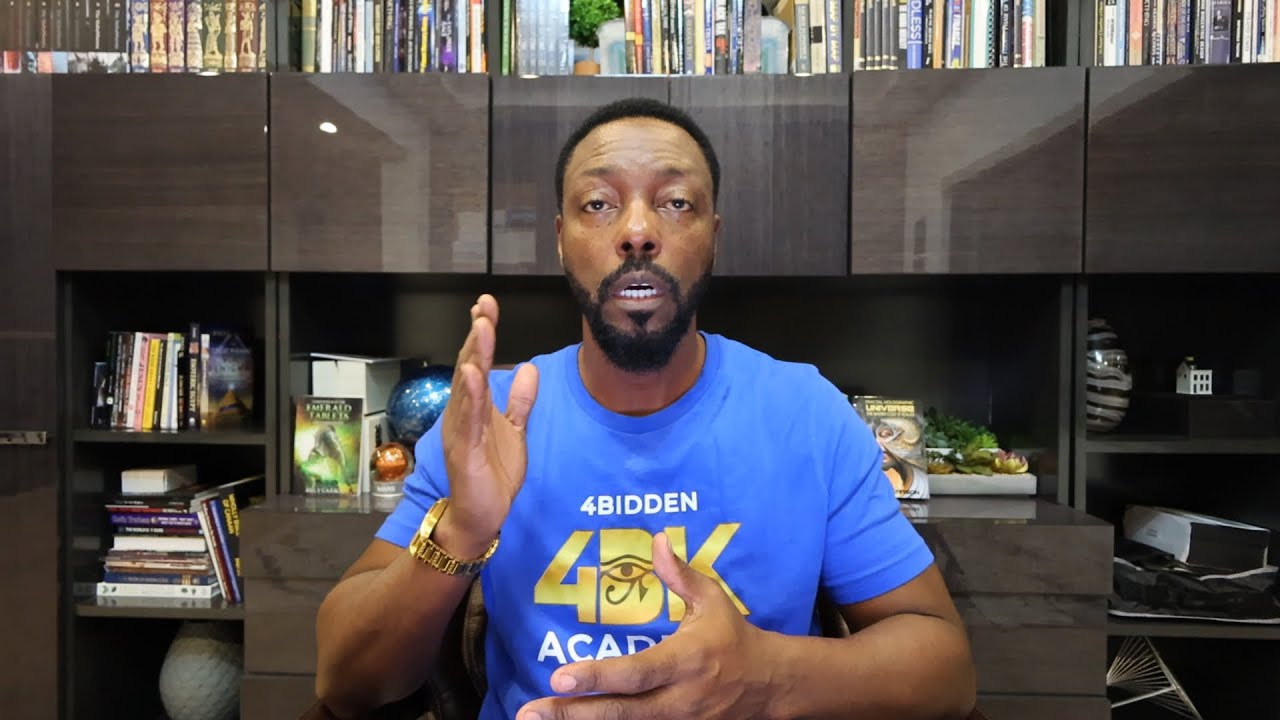
Being "on the wrong frequency" is Billy Carson's phrase for an emotional baseline of fear, doubt, anxiety or frustration that, in his view, keeps a person's circumstances fixed no matter how hard they work. In this solo talk he argues that life "isn't responding to your hard work, it's responding to your vibration," and lays out a maintenance routine: timed self-check-ins, processing hard feelings instead of masking them, a gratitude recall, journaling, habit-building and a closing mirror exercise built on self-forgiveness. Psychology does not use "frequency" the way he does, but several of his practices sit close to studied methods, and the research is set out beside his position below.
This article covers the vibration claim, the check-in timer, processing emotions, the gratitude and journaling anchors, the clutter test, the gym analogy and the mirror ritual. It leaves out the Academy promotion in the second half of the video.
What does Billy Carson mean by being on the wrong frequency?
Carson opens with the claim that effort alone does not move a life; the emotional state a person operates from does. Fear, anxiousness and doubt are "low vibrations," and many people, he says, wake up ready for the day and slide into those states within an hour without noticing. That gap between the abundance a person wants and the scarcity they feel is "the reasons why you might not be manifesting your best life."
The documented view is narrower. Emotions are not frequencies in the physical sense; the "raise your vibration" language comes from New Thought writers, not physics. What has support is the ordinary version of his claim: mood shapes attention, decisions and persistence. Barbara Fredrickson's broaden-and-build work, from 1998, found that positive states widen the range of thoughts and actions a person considers, while fear and anger narrow it. Carson's conclusion holds on those terms; the mechanism he names is a metaphor.
Why does he want a timer to go off three times a day?
The first tool is a self-check-in. Set a timer for morning, afternoon and evening, and when it goes off ask two questions: what emotional state am I in, and where do I feel it in the body? "Are you in fear? Are you in fight or flight? Are you in frustration or anger?" The point is to catch a low state early enough to correct it, and he pairs the check-in with three affirmations at the same intervals, such as "I am peace, I am abundance, I am joy." His earlier video on changing your frequency tells the business story behind that routine; this talk skips the story and goes straight to the practice.
The check-in resembles two things psychologists already use: experience sampling, which Mihaly Csikszentmihalyi and Reed Larson built in the 1980s by paging participants to record their current state, and affect labeling, where Matthew Lieberman and colleagues found in 2007 that putting a feeling into words reduced amygdala activity. The affirmations are the weaker element. Joanne Wood, Elaine Perunovic and John Lee found in 2009 that repeating positive self-statements lifted mood for people who already thought well of themselves and made people with low self-esteem feel worse, because the statement contradicted what they believed.
Does Carson say to ignore negative emotions?
No, and he is emphatic about it. The video's central correction is aimed at the version of positive thinking that papers over everything. "It's not that you want to ignore what's happened to you," he says. The method is to acknowledge the event, relive it briefly, name it, and release it with a spoken line such as "I release this pain." Only then does he move to the positive recall. He is equally direct about the "I'm fantastic" reflex: now, when he is not doing well, he says he is doing phenomenally except that he is working through a couple of things, and asks for "a little bit of grace."
Carson adds a claim that goes further than the evidence: that an unprocessed emotion "hides in the body" and that hidden "dis-ease eventually becomes disease." That is his position, stated as a certainty, and it should be read as such. The research supports a narrower point. James Gross and Oliver John showed in 2003 that habitual suppression, keeping a felt emotion off the face, goes with worse mood and weaker social support than reappraisal. James Pennebaker's expressive writing studies, from 1986, found small but real gains from writing about difficult experiences. None of that establishes a path from a suppressed emotion to a specific illness, and nothing here is medical guidance. The behavioral advice, acknowledge the feeling and talk about it honestly, is the part the literature backs.
What is the gratitude recall and why does it come second?
Once the negative has been processed, Carson's quickest route back is memory: pick a moment when you felt most blessed or at peace, relive it in detail, and feel the gratitude of it in the body. That shift, he says, moves a person from "the frequency of scarcity" back onto "the frequency of abundance." He is careful about sequence: the recall comes after processing, not instead of it.
Robert Emmons and Michael McCullough reported in 2003 that participants who kept weekly gratitude lists showed higher well-being and optimism than those who listed hassles, and Fred Bryant and Joseph Veroff's 2007 work on savoring treats deliberate reliving of positive memories as a learnable skill. His talk on gratitude and the heart chakra builds a longer practice on the same idea.
Why does he say most people cannot sustain a high state?
Carson's diagnosis of the common failure is not that people never reach a good state but that they cannot hold it or get back to it quickly. He calls it "a battle for consistency" and says the only answer is a daily "ritual for healing." He admits that "even I fall backwards from time to time."
His tool for consistency is journaling of a particular kind: not a diary of problems but a record of small moments of peace, a plant seen in a corridor, fifteen minutes of sunlight, any instant of being present. Those entries become "key anchors" to reread. Martin Seligman and colleagues tested a close cousin in 2005, the "three good things" exercise, and found gains in happiness still measurable six months later. Carson's addition is expectation setting: accept in advance that something will try to knock you off balance and you meet it as a problem to solve, which he frames as problem-solving versus victimhood, close to Julian Rotter's 1966 internal versus external locus of control.
What is the clutter test?
The talk's most concrete diagnostic is to look around. Carson says the outer world is "only a reflection of the inner world, period, point blank," and applies that to the nearest surfaces: a kitchen, a desk, the inside of a car. Clutter, in his reading, means the person is "in clutter mode" internally, and recognizing that gives them the power to change the inside first. He grounds the idea in the hermetic maxims "as above, so below" and "as within, so without."
The maxims are real and old. "That which is above is like that which is below" is the second line of the Emerald Tablet, an Arabic text of the eighth or ninth century; "as within, so without" is the Kybalion's 1908 phrasing, covered in the Kybalion and the seven hermetic principles explained and in Carson's own principle of correspondence talk. The clutter research is more modest. Darby Saxbe and Rena Repetti found in 2010 that women who described their homes as cluttered showed flatter daily cortisol slopes and lower mood than those who described restful homes; the study was correlational. Carson's practical conclusion, that tidying the immediate environment is a reasonable first move, needs no more than that.
Why does he compare the work to the gym?
To explain why a one-time shift does not hold, Carson reaches for weight training: the first weeks hurt, the soreness tempts a person to quit, and only repetition makes the practice a lifestyle. He widens it: every habit a person has is one they built, so every habit can be replaced. The "reality tunnels" he describes, lives on the same settings for twenty or thirty years, borrow a term from Timothy Leary by way of Robert Anton Wilson's Prometheus Rising (1983).
Habit research agrees with the analogy and corrects its timing: Phillippa Lally and colleagues found in 2010 a median of 66 days to automaticity, with a range of 18 to 254, and a missed day did not reset the process. Wendy Wood's work finds that cues and friction matter more than motivation once a routine exists, an argument for Carson's timers and written anchors.
What is the mirror forgiveness ritual?
The closing action step is what distinguishes this talk from his other frequency videos. Stand in front of a mirror, or open the phone's selfie camera, and hold your own gaze for sixty seconds. Then name out loud something you believe you did wrong, say "I forgive myself for" that thing three times, run the event back through your mind, state what you learned, and say three times, "I will never allow this to happen again." He frames the sequence as awareness, forgiveness, lesson and commitment, and says completing it is a kind of being "born again," something a person can do many times in one life.
This overlaps with self-forgiveness research. Julie Hall and Frank Fincham proposed in 2005 that self-forgiveness is a shift from self-condemnation to self-acceptance that still requires taking responsibility for the act, which is why Carson's lesson and commitment steps matter. Kristin Neff's self-compassion work, from 2003, treats speaking to oneself as one would to a friend as a trainable skill. The sixty seconds of eye contact has its own footnote: Giovanni Caputo reported in 2010 that ten minutes of mirror gazing in dim light produced vivid perceptual distortions, so a minute in ordinary light is a mild version of a known effect. Carson credits the method to wisdom keepers he met while traveling; that attribution is his own.
Watch, read and listen next
The timer routine comes with Carson's business story in Billy Carson on changing your frequency; the gratitude step is expanded in why gratitude changes your frequency. For the research on the vibration idea, read how to raise your vibration explained. The mirror metaphor runs through the universe isn't testing you, it's reflecting you and are you a mirror of the universe. The hermetic maxims are covered in the Kybalion and the seven hermetic principles and the principle of correspondence. The processing step borders on shadow work explained, the habit argument on how to reprogram your subconscious mind, and the check-in on meditation explained. The whole subject sits in the Manifestation topic hub.
Frequently asked questions
What does Billy Carson mean by "the wrong frequency"? An emotional baseline of fear, doubt, anxiety or frustration that, in his view, keeps circumstances fixed regardless of effort. Psychology does not treat emotions as frequencies, but mood does shape attention, decisions and persistence.
What is the three-times-a-day check-in? A timer set for morning, afternoon and evening. When it goes off, you name the emotional state you are in and where you feel it in the body, then correct course if it is low. It resembles experience sampling and affect labeling.
Does Carson recommend ignoring bad feelings and thinking positive? No. He says to acknowledge and process the feeling first, out loud if needed, and only then turn to a positive memory. Research on expressive suppression supports facing feelings over masking them, though his claim that hidden emotion becomes disease goes beyond the evidence.
How does the mirror forgiveness exercise work? Hold your own gaze for sixty seconds, name something you did wrong, say "I forgive myself for" it three times, state the lesson you learned, and commit three times not to repeat it. Self-forgiveness research finds the lesson and responsibility steps are what separate forgiveness from excuse-making.
Sources mentioned
- Barbara Fredrickson, "What good are positive emotions?" (1998)
- Csikszentmihalyi and Larson, the Experience-Sampling Method (1987); Lieberman et al., "Putting feelings into words" (2007)
- Wood, Perunovic and Lee, "Positive self-statements: power for some, peril for others" (2009)
- Gross and John on suppression and reappraisal (2003); Pennebaker and Beall, expressive writing (1986)
- Emmons and McCullough, "Counting blessings versus burdens" (2003); Bryant and Veroff, Savoring (2007)
- Seligman et al., "Positive psychology progress" (2005); Rotter on locus of control (1966)
- Saxbe and Repetti, "No place like home" (2010)
- The Emerald Tablet; Three Initiates, The Kybalion (1908); Robert Anton Wilson, Prometheus Rising (1983)
- Lally et al., "How are habits formed" (2010); Wendy Wood, Good Habits, Bad Habits (2019)
- Hall and Fincham on self-forgiveness (2005); Kristin Neff on self-compassion (2003); Caputo, "Strange-face-in-the-mirror illusion" (2010)