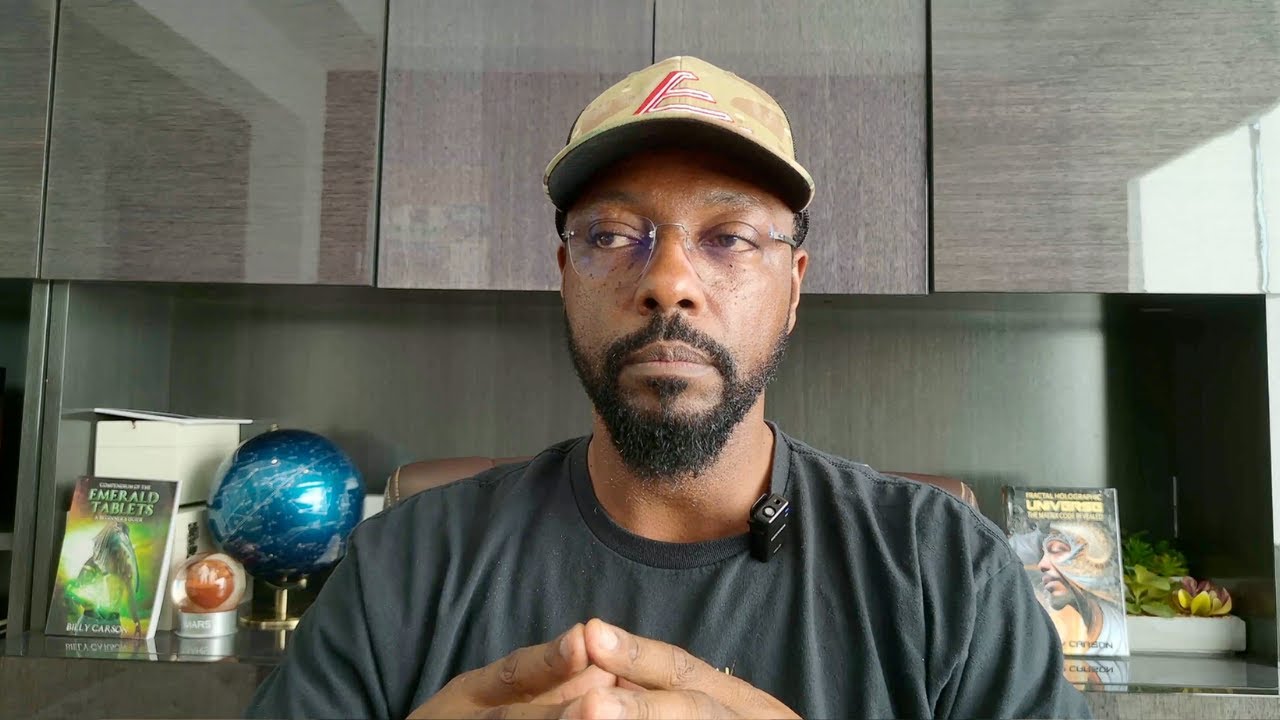
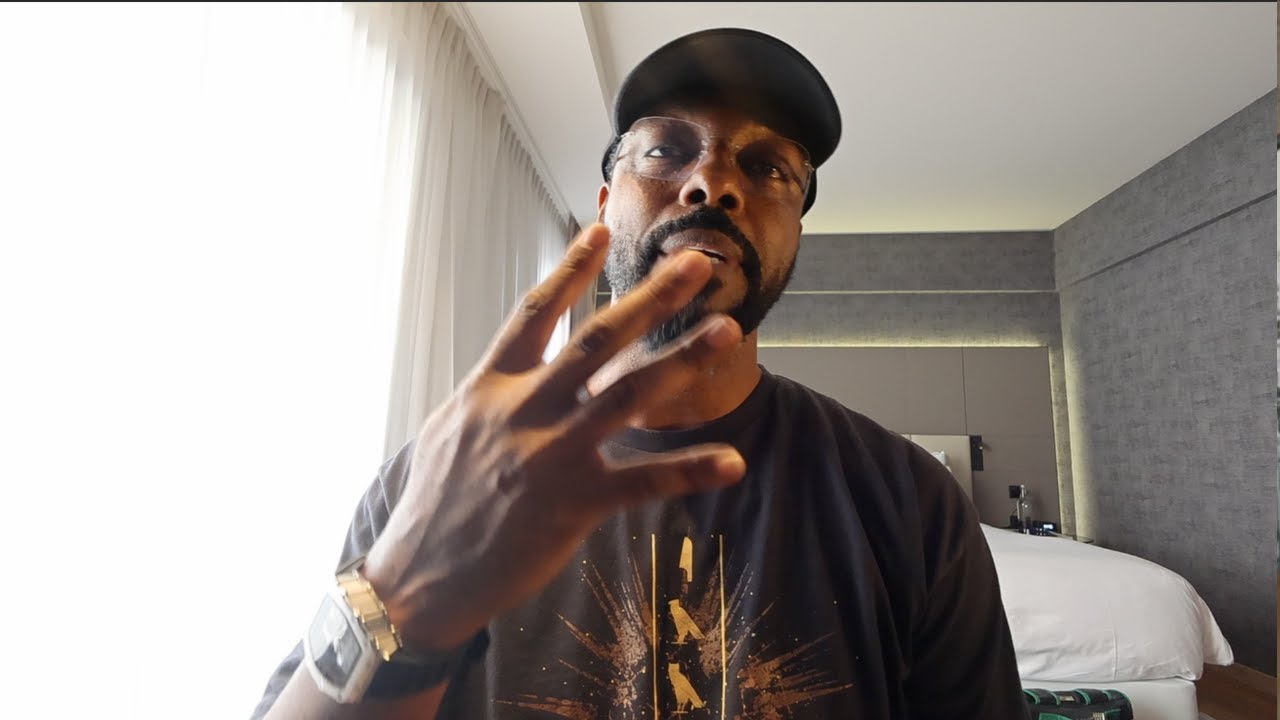
Why people don't manifest, in Billy Carson's account, comes down to seven blocks between a clear desire and its arrival: judging other people's lives from the outside, weak belief in oneself, self-sabotage, clinging to the outcome, a lack mindset, thought without action and a toxic environment. In this live stream, recorded in the first week of January 2023, Carson works through the blocks in order and illustrates each with a story, from a hypothetical one-on-one with Michael Jordan to a raffled Rolls-Royce.
The topic matters because manifestation is usually taught as a technique and abandoned when nothing changes. Carson instead asks what people are doing that cancels out the methods they already use, and much of his answer is practical whatever one makes of the metaphysics. For the method itself, see how to manifest what you want with the Billy Carson method.
What the video covers
Block one: judging from the outside looking in (from about 9:25)
Carson opens with a common complaint: some people seem rude or arrogant and still appear to get everything they want. His first answer is that the observer is on the outside looking in. A nice car and frequent travel reveal nothing about what a person privately longs for, and money is not the measure of manifestation. His second answer is less comforting: some people are simply more in tune with what it takes to shape their reality, regardless of character.
He uses Michael Jordan to make the point (from about 11:50). Others trained just as hard, Carson notes, yet Jordan pulled away from almost all of them. His explanation is that Jordan operated at a slightly higher frequency on court, entering the meditative state athletes call the zone, where everyone else appears to slow down. Carson says he has felt this himself a few times playing basketball.
From about 15:05 he turns this into a rule. People take on challenges every day, he says, but often ones they do not believe they can win. If Jordan offered him a one-on-one, Carson says he would accept only if he truly believed he would win that day. "If you take a challenge, you better believe you can win."
Block two: weak belief and weak knowledge of self (from about 18:50)
"Manifesting is all about belief," Carson says: belief in oneself, in one's abilities, and that the thing being sought already exists. The mechanism also runs in reverse. Thoughts of poverty, anger and a weak knowledge of self go out too, in his telling, and invite more of the same.
Block three: self-sabotage (from about 20:20)
When doubt creeps in, Carson says, people find a way to wreck a good opportunity. His own example: in his early twenties he had a long, lucrative marketing contract lined up that, he says, could have put him among the billionaires. On the day of the meeting he came outside to a flat tire, decided to reschedule rather than change it, and the meeting never happened. The lesson he took, and says he has never broken since, is to see any accepted challenge all the way through and not let bumps in the road become an exit.
Block four: clinging to the outcome (from about 23:10)
The fourth block is obsessing over whether and when a desire will arrive: checking the clock and the calendar every few minutes. Carson's instruction is blunt: "You got to do the work and release it."
His illustration is the raffle of his second Rolls-Royce, a 2013 model (from about 24:45). The winner, Austin Nelson, bought one ticket with what Carson describes as his last $50, focused on winning, spoke it, then let it go so completely that he forgot about it. According to Carson, Nelson had just been through a divorce, had lost his house and cars, and was sleeping on an air mattress at his grandmother's home. He could not afford the taxes to take delivery, so Carson sold the car for him; Carson puts the after-tax payout at $88,000, later rounding it to 80,000. Nelson, he says, moved to Austin, Texas, and restarted his life and his music business.
Other entrants, Carson says, contacted him almost weekly about the draw. Badgering the people in a position to help, he argues, creates a negative feedback loop.
Block five: the lack mindset (from about 29:05)
Believing one does not deserve something is, for Carson, the worst mindset possible. He holds that the law of attraction works with both negative and positive polarity, and that people are manifesting around the clock whether they like it or not. His example (from about 30:20) is a man with a strong product but little money. Carson says he arranged a pre-order deal through his marketing company that would have paid the man more than he had ever earned, and the man's response was to worry about the taxes. He says he walked away from the deal, concluding that anything built on that mindset was doomed.
Block six: thought without action (from about 32:30)
Carson says he answers a great many questions from people who stop him in public or message him, and by his estimate only about 10% follow through; those who do see their lives change completely. "Manifesting requires an energy exchange, period." His example is the cup in his hand, which went from an idea to a drawing to a factory, consuming energy at every step.
His own workshops are the case study (from about 35:50). Rather than just talking about teaching a manifesting class, Carson says he booked a conference room, checked the venue's technology, set up a ticketing page, marketed the event and taught for seven or eight hours. He says he ran three in the first month alone, the workshops moved online during the pandemic, and hundreds of thousands of people have since watched them.
Block seven: a toxic environment and low vibration (from about 39:25)
The last block is the people around a person: friends and family who drain energy, mock goals or pull backward like crabs in a bucket. Carson says he walked away from many friends and relatives and is less stressed for it, though distance does not mean ending love or the occasional check-in. His example is the holiday trips he used to make to relatives in Melbourne, Florida, which he says always meant preparing his family for drama. One year he stopped going, and he says the holidays have been better ever since.
From about 43:45 he ties this to low vibration. Carson claims an EEG shows whether a person is in a high or low frequency state, and that brain activity leaves the skull as waves of light that travel outward and draw in more of the same. That is why, he says, he cuts off people who call only with bad news: "I don't want your virus." He closes with broader advice: seek a psychotherapist or mental health support when stuck, practise unconditional love, forgive oneself rather than waiting on an outside source, and work through trauma.
Key takeaways
- Carson argues that other people's apparent success, seen from outside, reveals little about what they want or lack.
- Carson's rule is to take on only challenges one believes one can win, and then to take them on fully.
- He describes self-sabotage as doubt acting through small excuses, like his flat tire.
- He advises doing the work and then releasing the outcome, rather than badgering people or checking constantly.
- In his framework, belief and detachment do nothing without action, because manifestation requires an energy exchange.
- He treats distance from draining relationships, and professional help where needed, as part of the work.
Billy Carson's reading
Carson's position is that manifestation is a constant process rather than an occasional event. Every thought carries a frequency, in his framework, and a person's dominant frequency determines what comes back. He describes manifesting as selecting one reality from a superposition of possible realities in the quantum field and collapsing it into one's own life. Each of the seven blocks, on that reading, broadcasts the opposite of what a person says they want.
The same sequence of belief, focus, release and action runs through his book, covered in Manifestation Codes by Billy Carson: what the book teaches, and through an earlier talk summarised in the power of manifesting your reality. Readers drawn to numerical practices can compare the 369 manifestation method, and those interested in the meditative state he links to Jordan's zone can start with how to open the third eye through meditation.
What mainstream scholarship says
Several of Carson's blocks correspond to well-studied psychology. The zone he describes in Jordan is what psychologist Mihaly Csikszentmihalyi called flow: deep absorption in a challenging task, often with an altered sense of time. Albert Bandura's research on self-efficacy found that belief in one's ability to succeed predicts effort and persistence. Psychologists Steven Berglas and Edward Jones described self-handicapping, in which people create obstacles that give them a ready excuse for failure.
Mainstream science parts company with Carson on the mechanism. The law of attraction is not a recognised physical law, and there is no evidence that thoughts draw events toward a person. EEG records electrical activity at the scalp; it does not detect light leaving the skull, and brainwaves are not a broadcast to the universe. Gabriele Oettingen's research suggests that positive fantasy on its own can reduce effort, which echoes Carson's point that thought without action fails. Taken as practical advice (believe the goal is achievable, act on it, avoid obsessive checking, limit draining relationships), the talk lines up reasonably well with evidence-based approaches to goal pursuit.
Watch, read and go deeper
The full talk is also an audio episode on the 4biddenknowledge Podcast. More articles on belief, intention and daily practice are collected on the manifestation topic hub. For more of Carson's teaching on video, see Best of Billy Carson on 4BK TV.
Frequently asked questions
Why don't people manifest what they want?
According to Billy Carson, people fail to manifest because of seven blocks: misjudging others' success, weak self-belief, self-sabotage, clinging to the outcome, a lack mindset, thought without action and a toxic environment. His remedy is belief, focused action and release.
What does detachment from the outcome mean in manifestation?
In Carson's teaching, detachment means doing the work toward a goal and then letting it go instead of checking constantly or pressuring others. His example is a raffle winner who bought one ticket, focused on winning and then forgot about it.
Is the law of attraction scientifically proven?
No. The law of attraction is not recognised as a physical law, and there is no scientific evidence that thoughts attract events. Related ideas such as self-efficacy and flow do have research behind them.
What is a lack mindset?
A lack mindset, as Carson uses the term, is the belief that one is undeserving or that gains bring only new problems. His example is a business partner who worried about taxes on a deal that would have paid him more than he had ever earned, which led Carson to walk away.
Sources mentioned
Carson draws his evidence from sport and personal experience rather than ancient or scholarly texts. He compares Michael Jordan with Bill Russell, Kareem Abdul-Jabbar, Kobe Bryant and LeBron James, and refers to his YouTube interview with raffle winner Austin Nelson. He recommends The Recipe to Elevated Consciousness, a book by a teacher he names as Elizabeth. For the mainstream view, see Mihaly Csikszentmihalyi's Flow: The Psychology of Optimal Experience (1990), Albert Bandura's Self-Efficacy: The Exercise of Control (1997), Berglas and Jones's 1978 self-handicapping study in the Journal of Personality and Social Psychology, and Gabriele Oettingen's Rethinking Positive Thinking (2014).