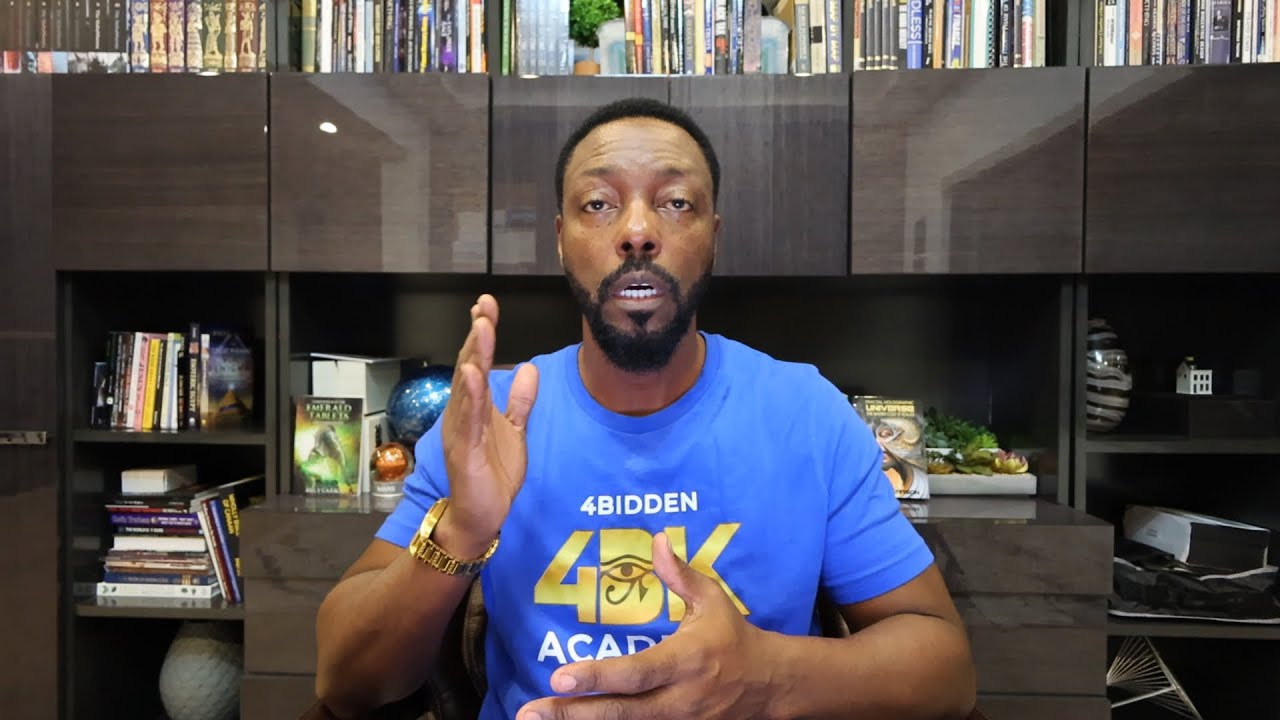
"Collapsing the wave function" is Billy Carson's name for the moment a possible future becomes the one you actually live. In this solo talk he builds the idea from the double-slit experiment, argues that an observer turns waves of potential into solid outcomes, and turns that into a two-part method for manifestation: a precise conscious thought, then action, which he writes as CT x A = M. Physics uses the phrase more narrowly than he does, the experiment he describes does not need a human mind to work, and the practical half of his method lines up with goal research that has nothing to do with quantum mechanics.
This article covers the double-slit story as he tells it, what the experiment shows and what it does not, his reading of the Sumerian "ordainers of destiny," the specificity rule behind the car example, the "thoughts become things" reframe, the EEG and brain-computer-interface claims, and the Emotiv demo he plays. It leaves out the community promotion that closes the video.
What does Billy Carson mean by collapsing the wave?
Carson opens with a picture of branching lives: "Right now, infinite versions of your life exist. One where you're rich and one where you're actually stuck." The question, as he frames it, is "which one are you observing." Until a person understands that, he says, "your manifestation techniques will always be hit or miss."
His diagnosis of why people fail is that they think vaguely. People "kind of want a relationship," "kind of want a nice house," and then pour action into that fog. "The actions don't manifest exactly what they want because they had ambiguous thoughts." To get a precise outcome, in his words, "you have to learn how to collapse the wave function into your reality."
A wave function, he explains, is "something that exists within the quantum field," and he insists the spiritual language of energy, frequency and vibration "is not woowoo" because quantum mechanics sits underneath it. That is his position. The rest of this article sets the physics beside it.
What does the double-slit experiment actually show?
Carson's account is close to the textbook version, with one addition. Scientists fire single electrons or photons at a partition with two slits, expect a scatter of dots on the back wall, and instead find bands of interference. Put a detector at the slits to see which one each particle passes through and the bands vanish. Remove it and they return. "The act of observing the outcome converted it and collapsed the wave function into solidity," he says, and then draws the conclusion that carries the talk: "Conscious intervention collapses waves into reality."
The experiment is real and old. Thomas Young demonstrated interference with light in 1801, Davisson and Germer showed electrons diffract in 1927, Claus Jönsson ran an electron double-slit in 1961, and Merli, Missiroli and Pozzi in 1974, then Akira Tonomura's team in 1989, sent electrons through one at a time and watched the bands build up dot by dot. Markus Arndt's group in Vienna has since shown interference with molecules of roughly 2,000 atoms. Superposition and wave-particle duality are not in dispute.
The added step, that a conscious mind does the collapsing, is where the documented view parts company with him. In every version of the experiment the "observer" is a piece of apparatus, and the pattern disappears whenever which-path information is recorded anywhere, whether or not a person ever looks at the record. Dieter Zeh in 1970 and Wojciech Zurek through the 1980s and 1990s described decoherence, the process by which interaction with any environment, a detector, a stray photon or air molecules, destroys interference. The 1998 Weizmann Institute experiment showed the pattern fading as an electronic which-path detector was turned up, with no human watching in real time. A reading in which consciousness causes collapse was floated by John von Neumann in 1932 and defended by Eugene Wigner in 1961; Wigner himself later dropped it, and it is a minority position today. Hugh Everett's 1957 interpretation, the source of the "infinite versions" language, says every outcome happens in its own branch and gives no one a choice of branch. The physics is laid out in the double-slit experiment explained, linked below.
Are the Sumerian "ordainers of destiny" the same idea?
Carson ties the experiment to the tablets: "We have rediscovered what the ancients already knew that we're living in a fractal holographic matrix of light." The Sumerians, he says, "called themselves specifically the ordainers of destiny," knew that multiple outcomes existed, isolated the one they wanted "through conscious thought," hyperfocused on it, which "in modern science we call the Hemi-Sync," and then acted.
The phrase is Sumerian, but the texts give it to gods rather than to people. The Anunnaki decree fates in Enki and the World Order, the Tablet of Destinies changes hands in the Anzu myth and the Enuma Elish, and the Sumerian word for fate, nam-tar, belongs to the divine council. Zecharia Sitchin's retellings carried the phrase into modern manifestation talk, and Carson's reading extends the title from the gods to their subjects. Hemi-Sync is not a scientific term either; it is a trademark of Monroe Products for the binaural-beat recordings Robert Monroe began selling in the 1970s. The library's own article on the Anunnaki as ordainers of destiny covers the tablets in more detail.
Why does Carson say we collapse waves all day without noticing?
His most practical point is that this is ordinary. You decided to pick up a phone, you typed or scrolled, "and now you've manifested listening to my voice at this exact moment in time. You collapsed the wave function and you didn't even realize you were doing it."
He then stretches the claim: anything you cannot currently see "doesn't exist as solid matter. It exists as waves," like a video game that renders the next room only when the player arrives. Game engines do work that way, and Nick Bostrom's 2003 simulation argument is the serious version of the comparison. Quantum mechanics does not say the same of the world: decoherence keeps large objects definite because they are in constant contact with their surroundings, so a chair in the next room stays a chair with no one in there. Unobserved rooms as pure potential is Carson's position, not a result.
What is the CT x A = M formula and why does specificity matter?
"This is the formula that I came up with to manifest. It's CT multiplied by A equals M. The conscious thought multiplied by action equals the manifestation." The multiplication matters to him: a vague thought times a lot of action still yields a vague result.
His worked example is a car. Do not send "I want a new car" into the universe, because "there are literally thousands of cars." Go and test-drive until you find the one, know the color, the engine size, the payment, the maintenance cost, and then stop saying "I hope I get this car" and start saying "I own this car. This is my car." Then build a plan, and expect "connections," "information" and "opportunities" to arrive that you must notice and act on.
Strip out the quantum framing and this is a recognizable method. Edwin Locke and Gary Latham's goal-setting theory, built from hundreds of studies since the late 1960s, finds that specific, difficult goals produce more effort and better results than vague "do your best" goals. Peter Gollwitzer's 1999 work on implementation intentions shows that deciding in advance when, where and how you will act substantially raises follow-through, with a medium to large effect across dozens of studies. Gabriele Oettingen's research complicates the "I already own it" step: in her studies, indulging in positive fantasies about an outcome lowered effort and results, while mental contrasting, holding the wish beside the obstacle, and pairing it with a plan raised them. The "opportunities start arriving" effect has a conventional name as well. Attention is selective, and a goal you have defined down to the trim level makes you notice listings, conversations and deals that were always there, the pattern psychologists file under selective attention and the frequency illusion. The library's article on why manifesting isn't working, on vibration, specificity and the CT x A = M formula, covers the formula from an earlier talk.
Why does he call a phone "someone's conscious thought"?
The middle of the talk is a reframe. Everything man-made, Carson says, began as waves in a skull, was encoded into a drawing or a CAD file, and was turned by an engineer into an object. Holding up his phone: "It's not a cell phone. This is someone's conscious thought. Mr. Samsung had this in his brain and it manifested into solid reality." His slogan is "thoughts become things," and his promise is that seeing objects this way will make "everything change for you."
As a description of design, the chain from idea to drawing to prototype to product is accurate, and the slogan is older than he is. Prentice Mulford published "Thoughts Are Things" in 1889, and Napoleon Hill opened Think and Grow Rich in 1937 with the same line. Samsung, for the record, was founded by Lee Byung-chul in 1938 and has no "Mr. Samsung." The useful part of the reframe is the agency it hands the listener: products are decisions, so decisions can make products.
Do thoughts leave the skull as waves of light?
Here Carson makes his strongest empirical claims. "Your mind is sending out waves of light into the quantum field," he says, and the proof is the EEG: "I can capture those waves of light leaving your skull." Newer systems, he adds, can "play back your conscious thoughts as a video," like Minority Report, and the waves travel "into this quantum field forever, for all eternity."
The instruments are real and the physics is not. Hans Berger recorded the first human EEG in 1924 and published in 1929. What the electrodes pick up is electrical potential, a few millionths of a volt, produced by synchronized neurons and conducted through tissue and bone to the scalp. It is not light, it falls off steeply within centimeters, and it does not propagate anywhere, let alone forever. The "thoughts as video" work he gestures at exists, but it uses fMRI, not EEG. Shinji Nishimoto and Jack Gallant's lab reconstructed blurry versions of film clips from the visual cortex of volunteers who were watching them in 2011, and Yu Takagi and Nishimoto did the same with a diffusion image model in 2023. Those systems are trained for hours on each individual, reconstruct what the person is looking at rather than what they are thinking, and produce approximations, not full-color replays. The gamma, theta and beta bands he names are frequency ranges in the scalp signal, not channels into a universal field.
What does the Emotiv clip prove?
Carson closes his argument with a video in which a presenter wears a headset at Emotiv's offices, watches her own brain activity light up on a screen, and learns that the system can read blinks, winks and raised eyebrows and can be trained to drive a toy car forward "just with my thoughts." His verdict: "your thoughts have power. If you didn't believe me, maybe you believe me now."
Emotiv is a real company whose consumer EEG headsets have been on sale since 2009, and the demo is a fair example of a brain-computer interface, a field older than the clip suggests. Jacques Vidal coined the term in 1973, implanted cursor control in a paralyzed patient was reported in 2006, and a 2021 Stanford study decoded imagined handwriting at 90 characters a minute. In every case a machine-learning model is trained to recognize a pattern of brain activity and map it to a command, exactly as the Emotiv engineer says in the clip. The headset reads electrical activity at the scalp; it does not receive thoughts broadcast through space. That is a strong result about engineering and a weak one about the quantum field.
What can you take from the talk?
The parts of Carson's method that hold up do not depend on the parts that do not. Define the outcome down to the detail, as he does with the car. Pair it with a plan that names when and how you will act, which is Gollwitzer's finding. Treat "I already own it" as motivation rather than metaphysics and keep the obstacle in view, which is Oettingen's. None of that requires a wave function, and all of it is backed by research he does not cite. Nothing here is advice about health or money; it is a reading of one talk beside the record.
Watch, read and listen next
The experiment at the center of the talk is covered in the double-slit experiment explained, and the limits of quantum language are in quantum entanglement explained. Carson's formula appears in an earlier talk in why manifesting isn't working and in the long workshop the power of manifesting your reality. His superposition picture of the future is in what is the moment of now. The tablets are in the Anunnaki as ordainers of destiny and the Sumerian tablets explained. For the Hemi-Sync reference, read what are command codes; for the holographic and video-game framing, the fractal holographic universe explained and simulation theory explained. The goal research sits behind scripting and visualization explained and how to reprogram your subconscious mind, and the whole subject lives in the Manifestation topic hub.
Frequently asked questions
What does "collapse the wave function" mean in Billy Carson's talk? It is his term for turning one possible future into the one you live, borrowed from the quantum description of a measurement returning a single outcome from a superposition. In his method it means defining an outcome precisely and acting on it.
Does the double-slit experiment show that consciousness creates reality? No. The interference pattern disappears whenever which-path information is recorded by any apparatus, with or without a person watching, and decoherence explains the effect through interaction with the environment. The consciousness-causes-collapse reading is a historical minority view.
What is CT x A = M? Carson's formula: conscious thought multiplied by action equals manifestation. His emphasis is on specificity, which matches goal-setting research showing that precise goals and advance plans improve follow-through.
Can an EEG replay a person's thoughts as video? Not an EEG. Research teams have reconstructed rough versions of film clips a volunteer was watching from fMRI data after hours of training per person. The results are approximate images of what was seen, not recordings of thoughts.
Sources mentioned
- Thomas Young, 1801 light interference; Davisson and Germer (1927); Claus Jönsson (1961); Merli, Missiroli and Pozzi (1974); Akira Tonomura and colleagues, "Demonstration of single-electron buildup of an interference pattern," American Journal of Physics (1989)
- Yaakov Fein, Markus Arndt and colleagues, "Quantum superposition of molecules beyond 25 kDa," Nature Physics (2019)
- Eyal Buks and colleagues, "Dephasing in electron interference by a 'which-path' detector," Nature (1998)
- H. Dieter Zeh (1970) and Wojciech Zurek (1991, 2003) on decoherence
- John von Neumann, Mathematical Foundations of Quantum Mechanics (1932); Eugene Wigner, "Remarks on the mind-body question" (1961)
- Hugh Everett, "'Relative State' Formulation of Quantum Mechanics," Reviews of Modern Physics (1957)
- Enki and the World Order, the Anzu myth and the Enuma Elish, Oxford Electronic Text Corpus of Sumerian Literature and standard translations; Zecharia Sitchin's retellings as the source of Carson's reading
- Robert Monroe and Monroe Products, Hemi-Sync
- Nick Bostrom, "Are You Living in a Computer Simulation?" Philosophical Quarterly (2003)
- Edwin Locke and Gary Latham, A Theory of Goal Setting and Task Performance (1990) and their 2002 review in American Psychologist
- Peter Gollwitzer, "Implementation intentions," American Psychologist (1999)
- Gabriele Oettingen, Rethinking Positive Thinking (2014)
- Prentice Mulford, Thoughts Are Things (1889); Napoleon Hill, Think and Grow Rich (1937)
- Hans Berger, "Über das Elektrenkephalogramm des Menschen" (1929)
- Shinji Nishimoto, Jack Gallant and colleagues, Current Biology (2011); Yu Takagi and Shinji Nishimoto, CVPR (2023)
- Jacques Vidal, "Toward direct brain-computer communication" (1973); Leigh Hochberg and colleagues, Nature (2006); Francis Willett and colleagues, Nature (2021)
- Emotiv Inc., consumer EEG headsets, as shown in the clip Carson plays