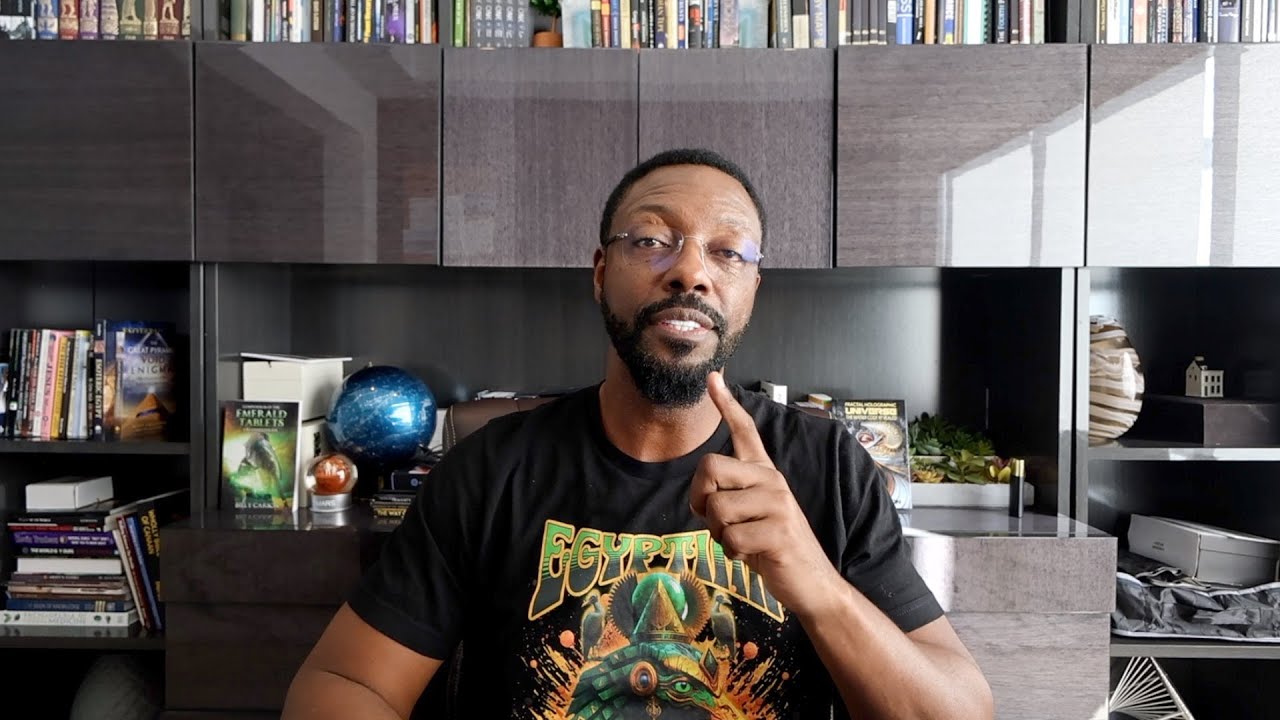
In "Why Most People Don't Use Their Manifesting Power," Billy Carson argues that everyone is born with the ability to shape their own reality, and that most people never use it because they have been taught to hand it to someone else. His claim is that religious dogma, political loyalty and the habit of begging an outside authority for help all drain the same reservoir, and that the fix is to recognise the creative power as already inside the body, forgive yourself, and start commanding outcomes instead of pleading for them. The talk covers where that power supposedly comes from, who collects it when it is given away, and the shift in posture he believes brings it back.
The topic matters because the question underneath it is practical: why do so many people who want a different life keep living the same one. Carson's answer is that the problem is an energy leak, not a lack of desire, and psychology has its own language for the same pattern, so the talk reads as both manifesting power teaching and an argument about personal responsibility.
What the video covers
Religion as the biggest leak (from about 1:30)
Carson opens by explaining why so many of his clips deal with religion: in his view it is one of the largest reasons people are not manifesting the reality they want. The point is not that a creator does not exist; he says clearly that he believes in one. The point is that religion, as most people practise it, teaches them to look outward for a power he believes is already inside them.
The power in every atom (from about 3:00)
If God exists and inhabits every atom in the body, Carson reasons, then a person is God walking in the flesh and the creator's power is physically present in them. For evidence he turns to physics: splitting an atom in a chain reaction releases, in his words, unparalleled power, which he takes as proof that each atom in the body holds unlimited energy, and quantum physics shows a zero-point energy at the centre of what he calls the vector equilibrium, present at every Planck unit of spacetime and therefore at every point in the body. Religion directs attention outward, so a person releases energy instead of using it. The message hurts some listeners, he says, because it runs against their programming code, his term for beliefs installed in childhood.
Name, race, religion (from about 5:30)
A recurring line appears here: at birth a person is given a name, a race and a religion, and then "you spend the rest of your life defending a false identity." Because people never learn who they are or what power they carry, he argues, they keep giving it away to outside sources.
Who collects the power (from about 6:30)
Carson sees people begging, kneeling and weeping in prayer and asks who takes that energy. His answer is religious leaders and governments, who he says alchemically convert it into their own kingdoms; cheering for one candidate over another is, in the same logic, handing creative energy to people who spend it on their own ends. He names specific politicians and the Vatican here; the article leaves those examples aside, since the claim is simply that any system which asks people to beg, hope and wait lives on the energy they give up.
You are the president of your own life (from about 9:30)
Carson's answer is a story he tells on himself: every four years he stands in line and writes his own name on the ballot, because he is the president of his own life, and the listener should believe the same about theirs. Until people adopt that mindset, he says, there will always be a boot on their neck. The prescription is three instructions: "vote for yourself, believe in yourself, forgive yourself." He singles out the last, calling unforgiven mistakes the biggest leak in a person's manifesting power.
Money is not the energy (from about 10:30)
He then turns to prosperity preaching and people giving everything they have to megachurches for a message of future abundance. Money, he says, is only paper and ones and zeros; what gets converted is the energy behind it, which the collectors turn into the mansions, land and investments they want for themselves. His conclusion is that "the biggest source of energy comes from you," so the move is to tap into yourself rather than fund someone else's outcome.
The prayer is commanding, not begging (from about 12:00)
This is the practical heart of the talk, and it is a reframing of prayer rather than a rejection of it. "The prayer is commanding, the prayer is not begging," he says. You claim what is yours, because it is your birthright to live in abundance; when a problem arises, the prayer is a command that you find the will, strength and knowledge to solve it. A pleading, uncertain prayer he calls low frequency, answered with more low-frequency problems. He does not stop at the words: the instruction is to command solutions, understanding and knowledge, then put action and work behind them. Kicking your feet up and watching the world burn is not part of the method.
A shark is a shark (from about 13:30)
Carson says the collectors know exactly what they are collecting, but he refuses to be angry at them. "A shark is a shark," he says; when sharks smell blood they attack, and it should surprise no one. The problem is not the shark but the person who keeps bleeding into the water. He tells the listener to look in the mirror, or put their phone in selfie mode, because the person in the frame allowed others to build kingdoms on their effort. He compares it to addiction: until someone admits the problem is in them, they are never free.
The Trojan horse (from about 16:00)
The final stretch explains Carson's own method. He describes himself as a Trojan horse to the mainstream, using psychology and perception to reach people from the inside out. A table of masterminds philosophising all day, he says, benefits no one outside the room; change happens when someone walks into what he calls the Matrix and teaches people running on programming to deprogram and reprogram. Turning darkness into light requires going into the darkness, and he closes by urging listeners to become Trojan horses of their own.
Key takeaways
Manifesting power is innate and universal, in Carson's thesis, and most people do not use it because they have been trained to give it away.
He locates the power physically, arguing that the energy released when an atom is split is present in every point of the body.
Religion, politics and prosperity preaching are, in his reading, three versions of one leak: a person begs an outside authority, and the authority converts that energy into its own kingdom.
The remedy is a change of posture: forgive yourself, treat yourself as the president of your own life, pray by commanding rather than begging, then act.
He refuses to blame the collectors, because a shark is a shark; responsibility stays with the person who keeps bleeding.
Thinking about consciousness is worth nothing, in his view, unless it is carried into the mainstream to help other people deprogram.
Billy Carson's reading
The talk is a compact statement of the model Carson lays out at length in his manifestation method and in Manifestation Codes. In that model the human being is not a petitioner asking a distant God for favours but a fractal of the creator, carrying the creative principle in every cell, which is why he reaches for nuclear physics and zero-point energy: he wants the listener to feel that the power is literal, not poetic. The same reasoning sits underneath his wider fractal holographic model of reality, in which every part contains the whole.
Two things distinguish this talk from a generic positive-thinking message. The first is self-forgiveness as the primary leak: Carson is not saying that wanting harder will work, but that a person who has not forgiven themselves is pouring energy into a hole, and no technique can out-manifest that. The second is the insistence on action. The commanding prayer fixes the direction of effort; it is not a substitute for it.
His reading of religion and politics is the contested part, and it is worth being precise: he does not say God is absent or that community is worthless, only that any structure which positions the individual as a beggar is, whatever its intentions, feeding on that individual's creative output. The same concern runs through his talk on frequency parasites and energy vampires, where the drain is personal rather than institutional. In both cases the instruction is the same: notice where your attention and emotion are going, and bring them home.
What mainstream scholarship says
The physics Carson cites is real but does not carry the weight he puts on it. Nuclear fission releases energy because of binding forces in the nucleus, regardless of anyone's intention. Zero-point energy is a genuine concept in quantum field theory, the lowest possible energy of a quantum system, but precisely because it is the lowest state it is not a reservoir that can be drawn on, by machines or by minds. The term vector equilibrium comes from Buckminster Fuller, who used it for the cuboctahedron in his synergetic geometry, not from physics. Energy in Carson's sense is best read as a metaphor for attention, emotion and effort.
Read that way, his argument maps onto established psychology. Julian Rotter's locus of control distinguishes people who believe outcomes depend on their own actions from those who attribute them to luck, fate or powerful others, and an internal locus is associated with better outcomes across decades of studies; Albert Bandura's self-efficacy and Martin Seligman's learned helplessness cover the same territory from two directions. Carson's commanding prayer with action attached is, in practice, an exercise in shifting locus of control, the ground covered in the article on how to reprogram the subconscious mind.
The claim that religion is a leading cause of unrealised potential is the weakest part on the evidence. The STEP trial published in 2006 found no benefit from intercessory prayer on surgical outcomes, which supports Carson's scepticism about petitionary prayer, but decades of survey research find that regular religious participation correlates with higher wellbeing and social support, so the picture is mixed. Critics of the law of attraction tradition also argue that it can slide into blaming people for circumstances they did not choose; the piece on the law of attraction and what psychology says covers that debate in detail.
Watch, read and go deeper
The talk is a short live session, so the structured practice, with the morning routine, gratitude work and dream board, is in the Billy Carson manifestation method. The manifestation topic hub collects every article on the subject. More of Carson's solo talks are gathered on the 4biddenknowledge Podcast page on 4BK TV.
Frequently asked questions
What does Billy Carson mean by manifesting power?
He means the innate ability to shape your own reality, which he locates in the body itself: the creative power that made the universe is, in his view, present in every atom of a person. It is not something to acquire, only something to stop giving away, and its practical expression is a commanding prayer followed by action.
Why does Carson say religion stops people from manifesting?
His argument is that most religious practice trains people to beg an outside authority for help, which directs their energy outward. He still believes in a creator; his objection is to begging, not belief. Research is mixed: petitionary prayer shows no measurable effect in controlled trials, but religious participation generally correlates with higher wellbeing.
What is the difference between a commanding prayer and a begging prayer?
A begging prayer, in Carson's description, is uncertain and pleading: it asks for help without expecting it or committing to act. A commanding prayer claims the outcome as a birthright, asks for the will, strength and knowledge to solve the problem, and is followed by work. He says the first attracts more low-frequency problems and the second redirects a person's effort.
Why does he say self-forgiveness is the biggest leak?
Carson treats forgiving yourself as the most important of his three instructions, because a person who has not forgiven their own mistakes keeps spending energy on the past, so no technique applied on top of that can hold. Self-compassion research reaches a similar conclusion, linking self-forgiveness to lower rumination and better follow-through on goals.
Sources mentioned
Carson cites no written texts directly in the talk. He appeals to nuclear physics (the energy released by splitting the atom) and quantum physics (zero-point energy at the Planck scale); the phrase vector equilibrium is Buckminster Fuller's, from Synergetics. The mainstream context draws on Julian Rotter's 1966 paper on locus of control, Albert Bandura's Self-Efficacy: The Exercise of Control, Martin Seligman's work on learned helplessness, and the 2006 STEP trial on intercessory prayer led by Herbert Benson. Carson's fuller treatment is in his book Manifestation Codes.