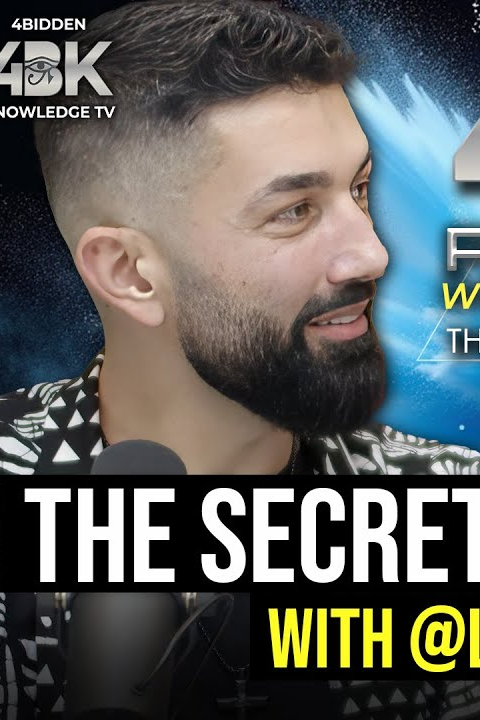
The "supermind codes," as Billy Carson and 19 Keys use the phrase, are the habits of thought that let a person recognise an opportunity in its moment, act on it, and keep rebuilding themselves afterwards. In this conversation the two men argue that the supermind is not a gift written into anyone's DNA but a trained state: built by listening to an inner voice, shedding old beliefs, working at the edge of your skill, and, above all, applying what you know. The talk mixes personal history with Greek philosophy, flow research and esoteric tradition.
It matters because both men reach very large audiences, and that reach shows up in unexpected places: on October 1, 2026 the UFC fighter Sean Sharaf told Joe Rogan he started learning about the subconscious mind through Billy Carson and 19 Keys. This is the conversation where the two of them define the supermind, and it is worth reading closely, both for what holds up and for what does not.
What the video covers
A prophecy acted on (from about 2:50)
Carson opens with an origin story: in the early 1990s, before the web existed, he read a version of a Hopi prophecy saying the world would be connected by a web through which information would travel instantly. When he saw a 1998 television spot showing nothing but IBM.com on a black screen, he took it as the prophecy arriving, went to a bookstore to learn what a dot-com was, and moved his business into the web. He nearly lost everything and was told he was crazy, but says he "held fast to my belief system and my belief in myself."
Opportune time and the supermind (from about 4:55)
19 Keys observes that Carson heard a prophecy and then wrote his own, then draws on the Greek distinction between ordinary sequential time and opportune time, the moment classical writers called kairos, when a window opens and closes. The early internet was one such window, he argues, and blockchain and AI are today's; a supermind is one developed enough to step through. He passes on a line from a mentor he calls Dr. Wesley: "the right idea at the right time, always equals success."
Two companies and seven years off (from about 7:40)
Carson details what stepping through looked like: a web company started in 1998 that grew into a multi-million-dollar business and was acquired, a seven-year non-compete spent with his children and volunteering in youth basketball, then a mobile app company whose best-known product let high school athletes share stats and highlights with college coaches within NCAA contact rules. The turning point, he says, came when he stopped building apps for other people and built only his own ideas.
The inner voice and the ten-years-ahead self (from about 10:45)
Keys describes hearing, at around five years old, a clear inner voice telling him he was destined to do something great, and a conviction that carried him through the streets of Oakland and St. Louis. He cites a claim that half of people have no inner voice, while saying he cannot vouch for it. His method is to act on the ideas that arrive distinctly, treating the higher self as a superior whose orders are not second-guessed, and to visualise himself ten years ahead in detail. He says he has now become the person he meditated on a decade earlier.
Shedding the old self (from about 16:05)
Carson reframes baptism as a baptism of consciousness rather than of water: looking back at a former self and seeing you have risen past it, which can happen many times in one life. Keys calls it reincarnation while living and describes the process of shedding old beliefs, fears, friends and ideologies. Growth, in his telling, runs through pain and darkness; you enter the darkness to take something from it, then transmute it back into light.
Programming, formulas and the speed of thought (from about 18:05)
Keys distinguishes natural intelligence from memorised answers and shares a formula he says he gives away often, M = PAT + V: the mind as potential, awareness and transformation, plus vision. That, he says, is the ordinary mind; the supermind codes go further. Carson argues that a person's beliefs are largely installed between the ages of one and seven, when name, race and religion are handed down, and that schooling trains memorisation rather than problem-solving. The pair also claim that thought travels faster than light, and Keys adds that Einstein's limits reflected how far Einstein himself could think.
The empty cup and the flow state (from about 24:25)
Keys argues that "An empty cup has all the potential in the world," and that emptying the mind is the precondition for what he calls super flow. Flow happens, he says, when a challenge sits slightly beyond your current skill. He illustrates the idea with the University of Washington bioengineer Gerald Pollack's work on the "fourth phase of water," in which charge separates next to certain surfaces, and with two repelling magnets, the energy in the gap being what he draws on. Michael Jordan is the example: a player who treated the game as meditation, for whom everyone else seemed to slow down.
Roots, energy and applied knowledge (from about 28:35)
Keys insists that "The fruit does not know better than the root," arguing that root words carry meaning below conscious education and that DNA works as a library, an Akashic record carried in the blood. He notes that D, N and A add up to 19 by alphabet position, a nod to his own name, and praises silence: every word marks the limit of what a speaker knows. Carson describes the brain as a battery that absorbs energy and sends thoughts out as encoded waves, which, backed by action, return as manifestation. Both criticise schools for never teaching consciousness or intuition, and Keys argues that the law of attraction alone fails, like a lawyer who knows only one law. The conversation closes on its central line: "Knowledge is not power. Applied knowledge will give you power."
Key takeaways
- Both men frame the supermind as trained, not inherited: what a person does with their mind, not a special gift.
- Opportunity is time-bound in their view, and the skill is recognising the window and acting before it closes.
- Inner listening and detailed visualisation of a future self are the core daily practices they describe.
- Growth requires shedding old beliefs and relationships, and that process is uncomfortable by design.
- Positive thinking alone is not enough; it has to be combined with other principles and, above all, with action.
Billy Carson's reading
Carson's position is that the mind is an energetic system whose output can be directed. Thought, in his account, is an outgoing signal; belief is installed early and can be rewritten; and action at the right moment closes the gap between vision and result. His own biography is the evidence he offers: a prophecy read in the early 1990s, a business bet in 1998, and a career built by spotting the next platform early. That is why he treats self-belief as practical rather than mystical; it kept him committed when the people around him thought he was wrong.
The same structure runs through his book Manifestation Codes and the method set out in [How to Manifest What You Want: Billy Carson's Method](/how-to-manifest-what-you-want-billy-carson-method): thought, frequency and action, with action as the part that cannot be skipped. The emphasis on an inner voice and a higher self connects to his teaching on meditation and intuition in [How to Open Your Third Eye](/how-to-open-your-third-eye-pineal-gland-meditation). Keys supplies the vocabulary of timing, flow and shedding; Carson supplies the case study.
What mainstream scholarship says
Several of the conversation's ideas line up with established research. Mihaly Csikszentmihalyi's flow research found that absorbed, high-performance states arise when a challenge slightly exceeds current skill, essentially Keys' description. Gabriele Oettingen's studies show that positive fantasy alone can reduce effort, while pairing a goal with its obstacles and a concrete plan improves follow-through, which supports the pair's point that positivity alone does not work. The Greek distinction between chronos and kairos is real; the scythe Keys mentions belongs to the Titan Kronos, a figure long blended with Chronos into "Father Time."
Other claims do not hold up. The brain uses about a fifth of the body's resting energy, and focused study raises that only slightly, so the claim that thinking consumes half of your calories is not supported. Living tissue emits extremely faint light as a by-product of metabolism, but there is no evidence that thoughts leave the skull as encoded signals. Nerve impulses travel at most about 120 metres per second, and physics has no evidence of anything moving faster than light. And relativity is not a failure of imagination; its predictions, including slower time for fast-moving clocks, have been confirmed repeatedly.
The rest is mixed. Inner speech varies widely between people, but the share reporting little or none is well under half in published studies. Early childhood is formative, yet neuroplasticity continues throughout life, which supports the pair's message that beliefs can change. Pollack's exclusion-zone experiments are real, but most physical chemists dispute that they show a new phase of water. Published versions of the web prophecy are secondhand retellings whose wording varies by source.
Watch, read and go deeper
For the practical method behind this conversation, start with [How to Manifest What You Want: Billy Carson's Method](/how-to-manifest-what-you-want-billy-carson-method), then follow intuition and inner listening through [the consciousness topic hub](/topics/consciousness); [the manifestation topic hub](/topics/manifestation) collects the rest of the site's work on intention and visualisation. The audio version is on the podcast episode page. If you arrived from the UFC 331 story, read [the Sean Sharaf / Joe Rogan article](/sean-sharaf-credits-billy-carson-for-mindset-on-joe-rogan-what-he-said-and-the-method): Sharaf told Rogan he learned about the subconscious mind through Billy Carson and 19 Keys, and this video is the two of them side by side explaining what they teach, which makes it the natural next watch.
Frequently asked questions
What are the supermind codes?
In this conversation, the supermind codes are the mental principles Billy Carson and 19 Keys say separate an ordinary mind from a highly developed one. They include acting at the opportune moment, listening to an inner voice, visualising a future self, shedding outdated beliefs, working in flow and applying knowledge rather than collecting it. Both present them as learnable skills.
Who is 19 Keys?
19 Keys is an entrepreneur and educator known for High Level Conversations on the Earn Your Leisure network. In the video he describes growing up in Oakland and St. Louis, and his teaching mixes personal development with physics, philosophy and esoteric vocabulary. He and Billy Carson have appeared together several times.
What does the M = PAT + V formula mean?
19 Keys uses M = PAT + V to describe how an ordinary mind develops: potential, awareness and transformation, plus vision. He presents it as the starting formula he shares freely and says the supermind codes go beyond it. It is a teaching mnemonic rather than a scientific equation.
What did Sean Sharaf say about Billy Carson and 19 Keys?
On October 1, 2026, after his win at UFC 331, Sean Sharaf told Joe Rogan he started learning about the subconscious mind through Billy Carson and 19 Keys, along with Joe Dispenza. He described listening to the material during long shifts as a Marine embassy guard.
Sources mentioned
In the video, Carson cites a Hopi prophecy about a world connected by a web, and Keys draws on the Greek ideas of chronos and kairos and on Gerald Pollack's research published as The Fourth Phase of Water. The pair also refer to Moore's law, Einstein's relativity, Rhonda Byrne's The Secret and the law of attraction, yin and yang, the libraries of Alexandria and Timbuktu, the Akashic records and Michael Jordan. For the mainstream side, see Mihaly Csikszentmihalyi's Flow: The Psychology of Optimal Experience, Gabriele Oettingen's Rethinking Positive Thinking, Marcus Raichle and Debra Gusnard's 2002 paper "Appraising the brain's energy budget" in PNAS, and Russell Hurlburt's research on inner speech.