The third eye is the name given, across several traditions, to an inner faculty of perception located at the brow: the ajna chakra of yogic and tantric teaching, the "eye of wisdom" of Hindu and Buddhist iconography and, in modern esoteric thought, the pineal gland at the centre of the brain. Opening it means training that faculty deliberately, through meditation, concentration and disciplined attention, until intuition and inner vision become reliable rather than occasional. There is no switch to flip; every tradition that describes the third eye describes a practice.
The question matters because it sits where three things meet: an ancient contemplative technology, a small endocrine gland that medicine understands reasonably well, and a modern claim that the two are the same thing. Getting the distinctions right separates a practice you can follow from a slogan. This guide lays out what the texts say, what the science says and what Billy Carson adds, as part of the [consciousness topic hub](/topics/consciousness).
What is the third eye in the yogic tradition?
In yogic tradition the third eye is the ajna chakra, the sixth of the seven principal energy centres, at the point between the eyebrows. The word ajna is usually translated as "command" or "perception", and the centre is described as the seat of intuition and inner instruction. The most detailed classical description comes from the tantric text Sat-Chakra-Nirupana (sixteenth century), which Sir John Woodroffe, writing as Arthur Avalon, translated in The Serpent Power (1919); it depicts ajna as a two-petalled lotus containing the syllable Om.
The Upanishads do not lay out the seven-chakra map most people know today; that scheme belongs to the later tantric and hatha yoga literature, and the rainbow colours are largely a twentieth-century Western addition.
Iconography gives the idea a face. Shiva is shown with a vertical third eye on his forehead, and in Kalidasa's Kumarasambhava it is this eye that burns Kama, the god of desire, to ash: insight consuming distraction. Images of the Buddha carry the urna, a small whorl between the brows counted among the thirty-two marks of a great being. In both cases the symbol points to perception that sees through appearances, not to anatomy.
What does the pineal gland actually do?
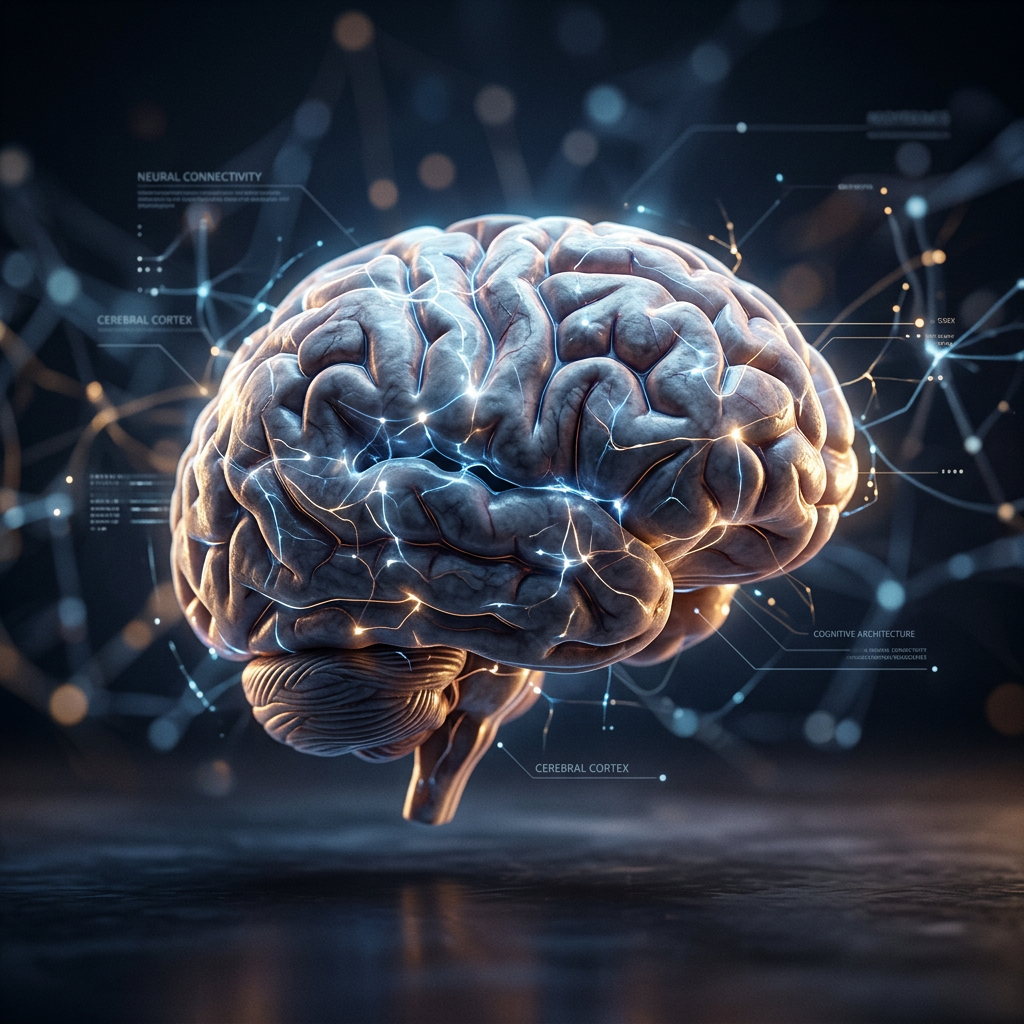
The pineal gland is a small endocrine gland, roughly the size of a grain of rice, sitting near the centre of the brain between the two hemispheres, and its main known job is to produce melatonin. Melatonin is synthesised from serotonin and released mainly at night; light reaching the retina is signalled through the hypothalamus to the pineal, which suppresses production by day and lets it rise in darkness. That rhythm is the gland's contribution to the circadian clock and the sleep-wake cycle.
The gland also accumulates calcium and phosphate deposits over a lifetime, known as corpora arenacea or "brain sand". These are common enough that radiologists use the calcified pineal as a midline landmark on CT scans, and their extent generally increases with age. Whether calcification meaningfully reduces melatonin output in healthy people is not settled.
There is one intriguing piece of biology behind the "eye" language. In some reptiles, amphibians and fish, the pineal complex includes a parietal eye, a light-sensitive structure on top of the head; the tuatara of New Zealand is the best-known example. Mammals have no such structure, and the human pineal responds to light only indirectly, through the eyes. It is fair poetry, not evidence that the human pineal sees.
Why did Descartes call it the seat of the soul?
René Descartes named the pineal gland "the principal seat of the soul" because it seemed to him the one unpaired structure in an otherwise doubled brain, and he needed a single point where an immaterial mind could act on a material body. He set out the idea in The Passions of the Soul (1649) and in the earlier Treatise of Man, published after his death. His anatomy was wrong, since he pictured the gland suspended in the ventricles and tilted by "animal spirits", and no one today defends the mechanism.
What survived was the association. When Helena Blavatsky wrote The Secret Doctrine (1888), she took up the pineal gland as a vestigial third eye, an organ of spiritual sight that had atrophied as humanity became more material. That Theosophical move is the real source of the modern equation between the yogic ajna and the endocrine pineal. The two ideas grew up separately and were joined in the late nineteenth century; the equation is roughly 140 years old, not thousands.
Is the Eye of Horus a diagram of the pineal gland?
Egyptology reads the Eye of Horus, the wedjat, as a symbol of healing, protection and wholeness tied to the myth in which Horus loses an eye fighting Set and has it restored by Thoth; the pineal reading is a modern esoteric interpretation, not a finding of the discipline. The comparison rests on placing a stylised wedjat over a mid-sagittal section of the brain, where its curves seem to trace the corpus callosum, thalamus and pineal region. It is a striking overlay, but no Egyptian text describes the eye in anatomical terms.
The uraeus, the rearing cobra on the pharaoh's brow, is similarly repurposed as a sign of an awakened third eye; in its own context it is Wadjet, the protective goddess of Lower Egypt, marking royal authority. The honest way to hold these readings is as symbolic correspondences a practitioner may find meaningful, set beside what the sources say. The [Ancient Egypt topic hub](/topics/ancient-egypt) covers the mystery-school question, including where Billy Carson's view diverges from the academic one.
What does the research on meditation show?
The research shows that regular meditation is associated with measurable changes in brain function and, possibly, structure, but the effects are modest, the studies often small, and the strongest claims have not all replicated. Sara Lazar's group at Harvard reported in 2005 that experienced insight meditators had thicker cortex in regions tied to attention than matched controls, and a 2011 study from the same group, led by Britta Hölzel, found increased grey-matter density in the hippocampus after an eight-week mindfulness course. Richard Davidson's laboratory at the University of Wisconsin–Madison has reported unusually strong gamma-band synchrony in long-term Tibetan practitioners during compassion meditation.
The caution is as important as the findings. In 2022, Davidson's own group published two combined randomised controlled trials in Science Advances that found no structural brain changes after an eight-week mindfulness course, directly qualifying the earlier grey-matter results. Cross-sectional studies of long-term meditators also cannot separate the effects of practice from the kind of person who practises for decades. The fair summary: meditation reliably changes how people feel and perform on attention tasks; lasting anatomical change is plausible but not proven. None of this research uses the language of the third eye. A companion piece on [how meditation changes the brain](/benefits-of-meditation-and-how-it-changes-the-brain) goes through the studies in more detail.
How do you actually practise opening the third eye?
The practices the traditions prescribe are concentration practices, and they work by training attention to rest steadily at one point for longer than it wants to. None requires belief, and all can be done in ten to twenty minutes a day.
Breath-focused meditation is the foundation everywhere. Sit upright, let the eyes close, and follow the breath at the nostrils; when attention wanders, return it. This is the basic training of dharana, or concentration, in Patanjali's Yoga Sutras, and it is the practice most of the mindfulness research above was measuring.
Brow-point visualisation is the practice most directly tied to ajna. With eyes closed, rest attention gently at the space between the eyebrows and hold a point of light or the syllable Om there. Strain is a sign to soften; the classical instruction is steadiness without force. Pressure or a sense of light at the brow within weeks is common, and the tradition treats it as ordinary, not as an arrival.
Trataka, or steady gazing, is listed among the six cleansing practices, the shatkarmas, in the Hatha Yoga Pradipika, a fifteenth-century manual attributed to Svatmarama. The practitioner gazes without blinking at a candle flame at eye level until the eyes water, then closes them and holds the after-image at the brow. It is one of the few third-eye practices with a clear textual pedigree; stop if the eyes hurt.
Sound, in the form of chanting Om or a mantra, works through vibration; the hum is felt in the skull and attention settles behind the brow. The guide to [raising your frequency and uplifting your energy](/increase-your-frequency-and-amplify-your-spirit-a-guide-to-uplifting-your-energy) treats sound and vibration as tools in their own right.
Darkness and sleep are the biological piece. Because melatonin is suppressed by light, the simplest thing anyone can do for the pineal gland is keep evenings dim, avoid bright screens before bed, sleep in a dark room and get daylight in the morning. This is standard sleep hygiene, and it costs nothing.
Do decalcification protocols work?
The claim that decalcifying the pineal gland through fluoride avoidance, special diets or supplements will open the third eye is a proponents' claim, and the evidence for it is limited. The idea rests largely on a 2001 study by Jennifer Luke, published in Caries Research, which found that fluoride accumulates in the pineal glands of elderly cadavers alongside the calcium deposits. That shows accumulation; it does not show that fluoride causes calcification, that calcification impairs anything, or that any protocol reverses it. No controlled trial has shown a diet or regimen reducing pineal calcification in living people.
None of this makes the practices above less worthwhile; it means the mechanism, if there is a physical one, is not yet known.
Billy Carson's reading
Billy Carson's position starts from a claim about consciousness rather than about the brain: "All that exists is the Universal Mind and nothing more than that one mind." In his teaching the third eye is not an organ that produces awareness but a faculty through which an individual mind tunes in more clearly to a consciousness that is already primary and shared. As he puts it, "There is only one intelligence, one mind in all creation, and we are all part of it." On that view, opening the third eye is about removing interference rather than generating something new, which is why he frames it as a discipline built over time rather than an event.
Carson connects that discipline to what he reads as the Egyptian mystery-school tradition: initiatory training in concentration and self-knowledge that, in his account, ran through the temple schools into Greek philosophy. Mainstream Egyptology does not recognise a formal mystery school in the modern sense; Carson's reading draws on the Hermetic and esoteric literature as much as the archaeological record. He also links the practice to manifestation: if mind is primary, a trained, quiet attention is the instrument by which intention becomes experience, a theme the [manifestation topic hub](/topics/manifestation) develops.
His Awaken the 6th Sense series on 4BK TV takes the practical side, and the earlier post on [the Universal Mind and why we are all one consciousness](/universal-mind-billy-carson-shares-how-we-are-all-one-consciousness) gives the philosophical frame, tracing the idea through Anaxagoras and Hegel.
Watch, read and go deeper
Start with [Awaken the 6th Sense on 4BK TV](/watch/awaken-the-6th-sense), Billy Carson's series on intuition and inner perception as a trained faculty. Pair it with the [Meditation collection on 4BK TV](/watch/meditation) for guided sessions that put the breath, brow-point and sound practices into use. For the science, read the piece on how meditation changes the brain linked above; for the philosophy behind Carson's position, the Universal Mind post. Everything on this subject gathers in the [consciousness topic hub](/topics/consciousness).
Frequently asked questions
Is the third eye the same thing as the pineal gland?
Not in the original sources. The third eye of yogic tradition is the ajna chakra, a centre of the subtle body at the brow, while the pineal gland is an endocrine organ near the centre of the brain that makes melatonin. The two were joined in the late nineteenth century, chiefly by Theosophical writers; the equation is a modern esoteric reading, not something the Upanishads or the Egyptian texts state.
How long does it take to open the third eye?
No classical text gives a timetable. Sensations such as pressure between the brows or light behind closed eyes often appear within weeks of daily practice and are treated as ordinary signs of concentration. Insight and reliable intuition, the actual aim, are described as the work of years.
Can meditation change the brain?
Yes, in the sense that brain activity changes measurably during and after practice, and regular meditators perform differently on tests of attention and emotional regulation. Whether it changes brain structure is less clear: early studies found thicker cortex and denser grey matter in meditators, but a 2022 randomised trial found no structural change after eight weeks. Functional change is well supported; anatomical change is still open.
Does fluoride block the third eye?
Fluoride has been found to accumulate in the calcified deposits of the pineal gland, but there is no evidence that this blocks any faculty or that avoiding it reverses calcification. Decalcification protocols are a proponents' claim without controlled evidence. Sleep in darkness, morning daylight and consistent practice are better supported.
Sources and further reading
- Sat-Chakra-Nirupana, translated by Arthur Avalon (Sir John Woodroffe) in The Serpent Power (1919)
- Svatmarama, Hatha Yoga Pradipika, chapter 2 (the shatkarmas, including trataka)
- Patanjali, Yoga Sutras, book III (dharana, dhyana and samadhi)
- René Descartes, The Passions of the Soul (1649), articles 31–32
- H. P. Blavatsky, The Secret Doctrine, volume II (1888), on the pineal gland as the third eye
- Sara Lazar et al., "Meditation experience is associated with increased cortical thickness", NeuroReport (2005)
- Tammi Kral, Richard Davidson et al., "Absence of structural brain changes from mindfulness-based stress reduction", Science Advances (2022)
- Jennifer Luke, "Fluoride deposition in the aged human pineal gland", Caries Research (2001)