The Moon has always been a symbol of mystery, distance, and quiet observation. But now, scientists are looking at it in a completely different way—not as something to admire from afar, but as a platform for precision technology that could redefine navigation, timekeeping, and deep space exploration.
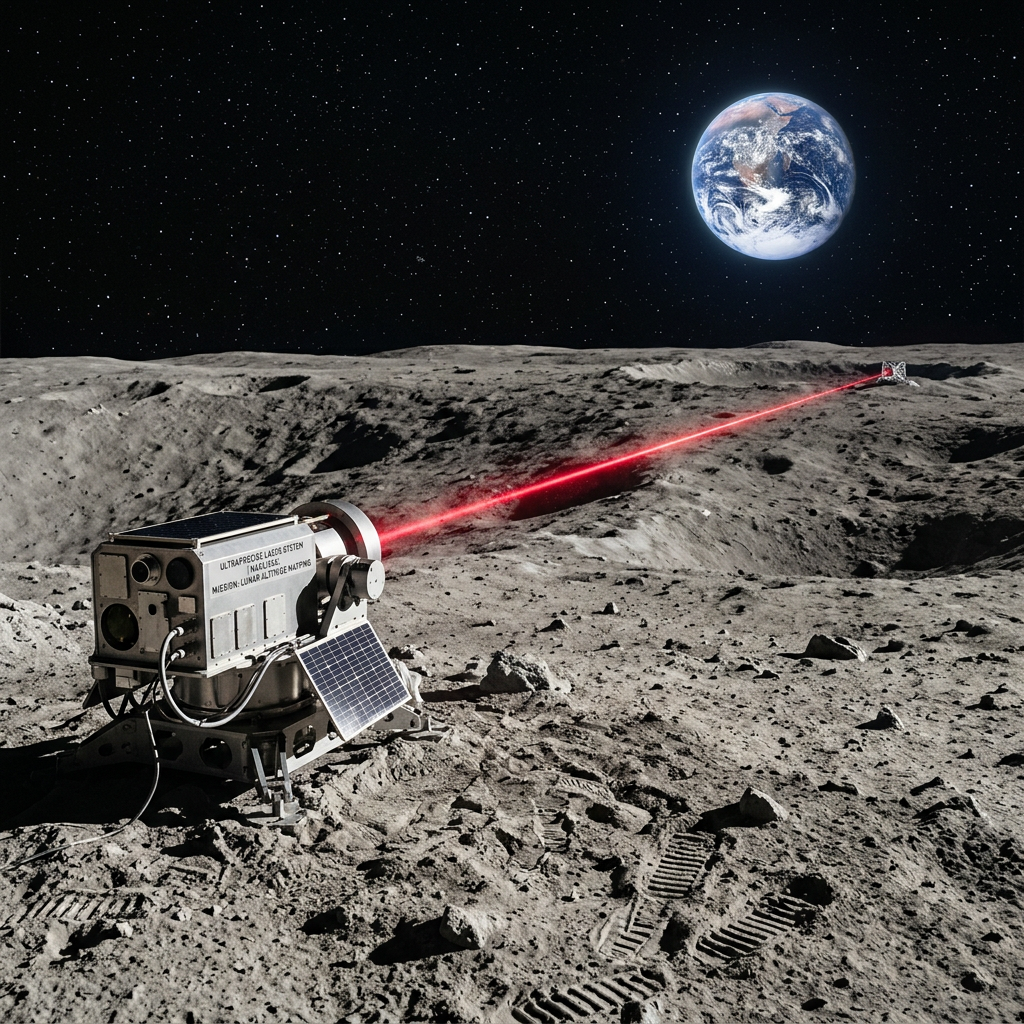
At the center of this idea is something that sounds straight out of science fiction: an ultrastable laser installed on the Moon.
What Is an Ultrastable Laser—and Why Does It Matter?
An ultrastable laser isn’t just a powerful beam of light. It’s engineered to maintain an incredibly consistent frequency over long periods of time. That consistency allows it to act as a reference point for time and measurement at a level that borders on atomic precision.
→ Think of it as a “cosmic metronome” → It keeps time more accurately than most Earth-based systems → It can anchor navigation systems far beyond our planet
According to researchers in optical physics and precision metrology, ultrastable lasers are already used in cutting-edge atomic clocks and experiments testing fundamental physics. Physicist Jun Ye, a leader in optical clock research, has emphasized that improving laser stability directly enhances our ability to measure time and space with unprecedented accuracy.
Why the Moon?
You might be wondering: why not just keep this technology on Earth?
The answer lies in the Moon’s environment—specifically, its polar regions.
→ Permanently shadowed craters near the lunar poles are extremely cold → These areas experience minimal temperature fluctuations → There is no atmosphere to distort light signals → Seismic and environmental noise is significantly lower than on Earth
These conditions make the Moon an ideal location for stabilizing sensitive instruments like lasers.
NASA scientists studying lunar environments have pointed out that these cold, dark craters act almost like natural cryogenic chambers—perfect for maintaining the stability required for precision systems.
What Could This Laser Actually Do?
If successfully deployed, a lunar-based ultrastable laser could unlock several breakthroughs:
→ Ultra-Precise Navigation on the Moon
Future astronauts and robotic missions will need reliable positioning systems. GPS doesn’t work on the Moon, so a laser-based timing system could fill that gap.
→ Deep Space Navigation
By extending precise timing signals from the Moon, spacecraft traveling deeper into the solar system could navigate more accurately.
→ Testing the Laws of Physics
Highly stable lasers allow scientists to test fundamental theories, including aspects of General Relativity, by measuring tiny variations in time and space.
Physicist Albert Einstein predicted that time itself is affected by gravity. With a lunar laser system, researchers could measure these effects with even greater precision than before.
→ Supporting Lunar Infrastructure
As agencies like NASA and private companies plan long-term lunar bases, a stable timing and communication backbone will be essential.
Why the Lunar Poles Are the Sweet Spot
Not all parts of the Moon are equal. The polar regions are especially valuable for this kind of technology.
→ Some craters never see sunlight, maintaining temperatures below -200°C → Stable cold conditions reduce thermal noise in laser systems → Nearby peaks receive near-constant sunlight, ideal for powering equipment
This unique combination—extreme cold for stability and nearby sunlight for energy—makes the lunar poles one of the most strategically important locations for future space infrastructure.
The Bigger Picture: Building a Lunar Network
This laser isn’t just a standalone experiment. It’s part of a broader vision.
→ A lunar-based timing network could act like a “Moon GPS” → It could connect with Earth-based systems for synchronized measurements → It may become a foundation for future Mars and deep-space missions
Researchers involved in lunar science and optical systems see this as a stepping stone toward a more connected solar system—where navigation and communication don’t rely solely on Earth.
What Scientists Are Saying
Experts in precision measurement and space science continue to emphasize the importance of stability and isolation for next-generation instruments.
Jun Ye and colleagues in optical clock research have shown that improving laser coherence directly improves measurement sensitivity—something that becomes even more powerful in a quiet, stable environment like the Moon.
Meanwhile, NASA researchers working on lunar exploration strategies have highlighted the poles as prime real estate not just for water ice, but for advanced scientific infrastructure.
Final Thoughts
This idea might sound futuristic, but it’s grounded in real science and real need.
As humanity prepares to return to the Moon—not just to visit, but to stay—we’ll need systems that are just as reliable and precise as the ones we depend on here on Earth.
An ultrastable laser on the Moon isn’t just about light. It’s about time, navigation, and pushing the boundaries of what we can measure and understand.
And in a place defined by silence and darkness, it might just become one of the most important signals we ever create.