 Billy's Colloidal Silver + Starfire Gold duo —
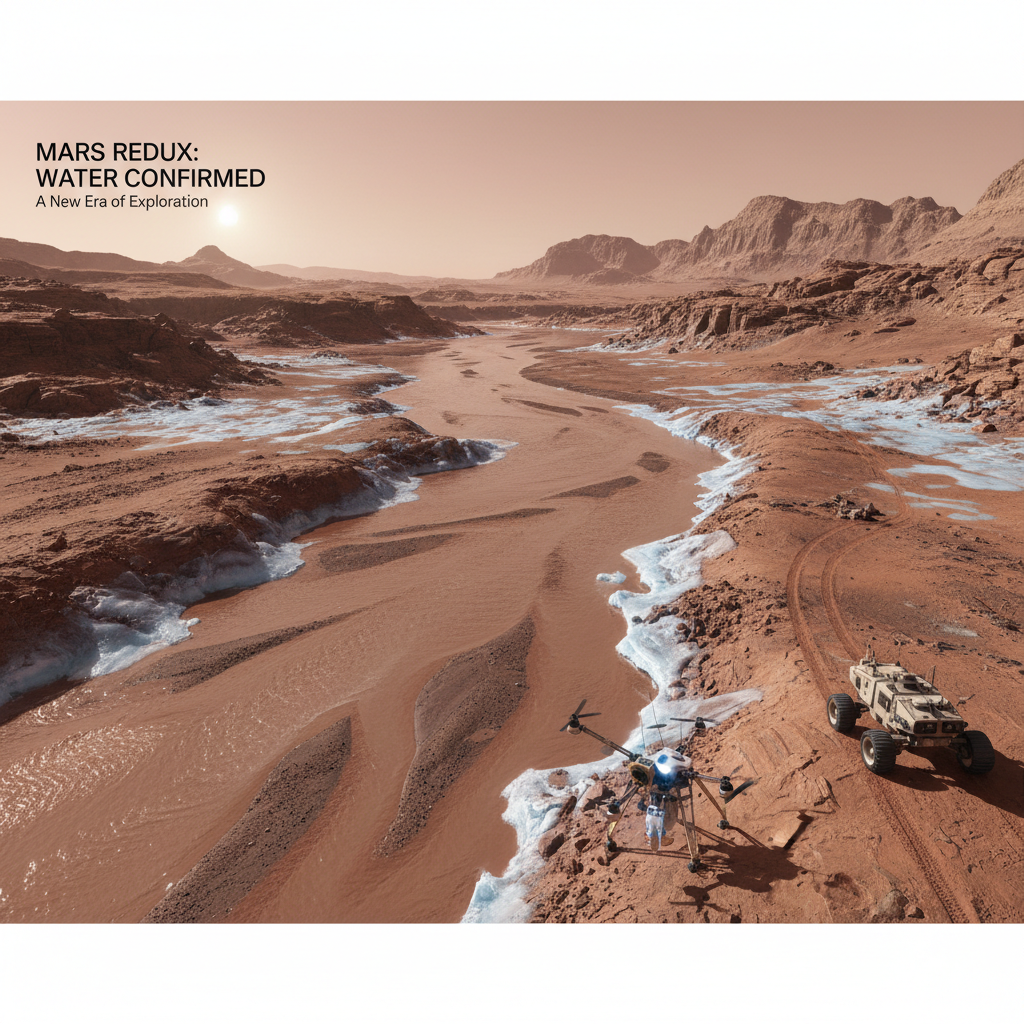
Mars wasn’t always the cold, dusty desert we picture today. Once upon a cosmic heartbeat, it had rivers carving valleys, lakes pooling in craters, and possibly even oceans stretching across its surface. The evidence is carved into the planet itself. But here’s the unsettling part: when scientists try to account for all that water, something doesn’t add up.
There’s a gap. A quiet, stubborn discrepancy that refuses to be explained.
Let’s walk through it.
What We Know: Mars Was Once Wet 6
Researchers have spent decades studying Mars through missions like NASA’s Mars Reconnaissance Orbiter and the Curiosity Rover, uncovering undeniable signs of past water.
→ Dry river valleys snake across the surface → Delta formations suggest long-standing lakes → Minerals like clays and sulfates form only in the presence of water
According to planetary scientist Michael H. Carr, Mars once had enough water to cover the entire planet in a global ocean hundreds of meters deep. More recent estimates suggest even deeper bodies—possibly comparable to Earth’s Arctic Ocean.
The Simple Expectation That Didn’t Hold Up
Scientists expected to track Mars’s water using a fairly straightforward idea:
→ Some water escaped into space → Some froze into ice caps or underground reservoirs → Some remained locked in minerals
Add those together, and you should roughly match the original water volume.
But when researchers actually did the math, the numbers came up short.
Not just a little short. Significantly.
The Missing Water Problem 7
A 2021 study led by Eva Scheller, published in Science, revealed something unexpected:
→ Only a fraction of Mars’s original water could be explained by atmospheric escape → Even accounting for polar ice and subsurface deposits, large amounts were still unaccounted for
Their conclusion?
A significant portion of Mars’s water didn’t disappear into space—it became trapped inside the planet itself.
Where Scientists Think the Water Went
Here’s where things get more complex—and more mysterious.
- Locked Inside the Crust
→ Water chemically bonded with rocks through a process called hydration → Minerals like clays essentially “store” water at a molecular level → Unlike Earth, Mars lacks plate tectonics to recycle this water back out
Scheller’s research suggests that 30–99% of Mars’s water could be locked this way.
That’s not a leak. That’s a burial.
- Atmospheric Escape Wasn’t Enough
NASA’s MAVEN mission has been studying how Mars lost its atmosphere.
→ Solar wind stripped away gases over billions of years → Hydrogen (from water) escaped into space → This contributed to water loss—but not nearly enough to explain everything
According to MAVEN data, atmospheric escape explains only a portion of the missing water.
- No Geological Recycling System
Earth has a built-in reset button:
→ Plate tectonics recycle water through volcanoes and mantle processes → Oceans are replenished over time
Mars?
→ No active plate tectonics → Minimal volcanic recycling in recent history
As noted by NASA researchers, this means once water gets locked into the crust, it’s essentially gone for good.
Why This Is Still a Mystery
The unsettling truth is that even with all our data, Mars refuses to give a clean answer.
→ Estimates of ancient water volumes vary widely → Subsurface water is difficult to measure directly → Mineral hydration levels are still being refined
Planetary scientist Bruce Jakosky has emphasized that Mars’s climate evolution is “more complex than we expected,” especially when trying to reconcile atmospheric loss with geological storage.
In other words: the more we learn, the less simple the story becomes.
Why It Matters More Than You Think
This isn’t just about Mars. It’s about understanding planets—including our own.
→ It helps scientists predict how habitable planets evolve → It informs the search for life beyond Earth → It reveals how fragile planetary environments can be
If Mars lost its water in ways we don’t fully understand, it raises a bigger question:
How stable are “habitable” worlds, really?