There’s a quiet tension building in modern cosmology—not loud, not chaotic, but persistent. Like a note slightly out of tune in an otherwise perfect symphony. For decades, scientists believed they had the universe largely figured out. Today, that confidence is beginning to crack.
Whether you call it a “vibe shift” or a full-blown paradigm shift, something fundamental is changing in how physicists understand the cosmos.
The Old Guard: A Universe That Made Sense
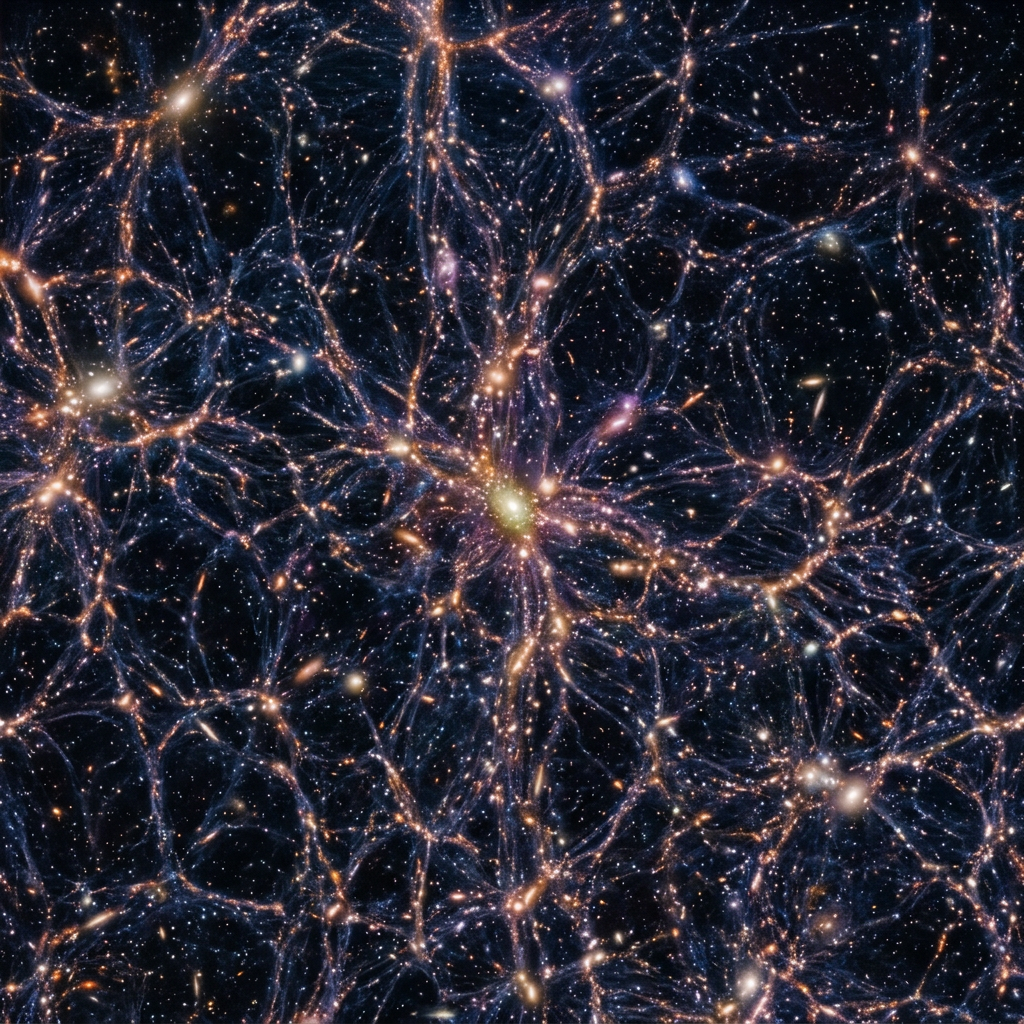
For most of the late 20th and early 21st centuries, cosmology rested on a model known as ΛCDM (Lambda Cold Dark Matter).
→ It explains how the universe expanded after the Big Bang → It accounts for invisible components like dark matter and dark energy → It successfully predicts large-scale structures like galaxies and clusters
Physicists leaned on this model because it worked—until it didn’t.
As Stephen Hawking once suggested, “We are just an advanced breed of monkeys on a minor planet… but we can understand the universe. That makes us something very special.”
That belief—that we can understand it—is now being tested.
The Cracks in the Model
Recent observations are forcing cosmologists to confront uncomfortable contradictions.
→ The Hubble Tension
Measurements of how fast the universe is expanding don’t agree.
→ Data from the early universe (cosmic microwave background) suggests one rate → Observations of nearby galaxies suggest a faster rate
This mismatch isn’t small—it’s statistically significant.
As noted by Adam Riess, one of the key figures behind this discovery:
→ “This is not just a small disagreement… it’s a breakdown in our understanding of the universe.”
→ Dark Energy Confusion
Dark energy was introduced to explain why the universe’s expansion is accelerating.
→ It makes up about 68% of the universe → Yet no one knows what it actually is
Some new studies suggest it might not even be constant—challenging the very “Lambda” in ΛCDM.
→ Early Galaxy Formation Problem
With data from the James Webb Space Telescope, astronomers are seeing galaxies that formed too early in cosmic history.
→ Galaxies appear massive and structured far sooner than expected → This contradicts predictions of gradual formation
Joel Primack has acknowledged that these findings are pushing scientists to reconsider timelines once thought reliable.
So… Why Call It a “Vibe Shift”?
Because this isn’t just about data—it’s about mindset.
For years, cosmology operated with a kind of quiet certainty. Now, that certainty is being replaced with something more honest:
→ Uncertainty → Curiosity → Willingness to be wrong
This is what philosopher of science Thomas Kuhn described in The Structure of Scientific Revolutions:
→ Normal science builds on existing frameworks → Anomalies accumulate → Eventually, a paradigm shift becomes unavoidable
Cosmology may be standing right at that edge.
The Workaround: Rethinking Without Breaking Everything
Here’s where things get interesting.
Instead of throwing out the entire model, researchers are exploring ways to adapt it.
→ Modified Gravity Theories
Some scientists suggest gravity itself may behave differently at cosmic scales.
→ Alternatives like MOND (Modified Newtonian Dynamics) are being revisited → These challenge the need for dark matter in some cases
→ Early Dark Energy Models
To resolve the Hubble tension, some propose a temporary form of dark energy in the early universe.
→ This would tweak expansion rates just enough to reconcile the data → It keeps most of ΛCDM intact while addressing its flaws
→ New Physics Beyond the Standard Model
There’s growing openness to entirely new particles or forces.
Neta Bahcall has emphasized that:
→ “We may be missing something fundamental… something we haven’t yet imagined.”
The Emotional Undercurrent No One Talks About
Science is supposed to be objective—but scientists are human.
Letting go of a long-standing model isn’t just intellectual—it’s emotional.
→ Careers are built on these frameworks → Reputations are tied to their validity → There’s comfort in what “works”
But progress doesn’t come from comfort.
As Albert Einstein once demonstrated when he reshaped physics itself:
→ “We cannot solve our problems with the same thinking we used when we created them.”
Where Cosmology Goes Next
This moment isn’t a crisis—it’s an opening.
A doorway into deeper understanding.
→ More precise observations will continue to challenge assumptions → New theories will compete, evolve, and sometimes fail → The definition of “truth” in cosmology will sharpen
And maybe—just maybe—the universe will reveal something we didn’t even know to look for.
Final Thought
Cosmology isn’t broken.
It’s growing.
And growth, especially at this scale, never feels comfortable.
It feels like doubt. It feels like tension. It feels like a shift in the air you can’t quite explain yet.
But that’s how every scientific revolution begins.