 Billy's Colloidal Silver + Starfire Gold duo —
Saturn has always been the showstopper of our solar system—the planet that looks like it belongs in a dream more than in space. But what if those iconic rings weren’t always there? What if they were born from destruction… specifically, a violent encounter involving its largest moon, Titan?
Recent studies are beginning to reshape how scientists understand the Saturnian system. The idea isn’t just that Saturn’s rings formed from debris—but that Titan itself may have played a central role in triggering the chaos that created them.
The Big Idea: Rings Born from Ruin
At the heart of this theory is a simple but powerful concept:
→ Saturn’s rings may be the remnants of a shattered moon → Titan’s gravitational influence could have destabilized that moon → A catastrophic collision or tidal breakup followed
Rather than being ancient relics from the birth of the solar system, Saturn’s rings may be relatively young—formed within the last few hundred million years.
According to planetary scientist Robin Canup from the Southwest Research Institute:
“The rings could be the debris of a former satellite that was destroyed after crossing Saturn’s Roche limit.”
This “Roche limit” is the critical distance where a planet’s tidal forces become strong enough to rip apart a moon.
Titan: More Than Just a Moon 4
Titan isn’t just another satellite—it’s a heavyweight in the Saturn system.
→ Larger than the planet Mercury → Wrapped in a dense, nitrogen-rich atmosphere → Home to lakes of liquid methane and ethane
But beyond its surface, Titan’s real influence lies in its gravity.
Researchers suggest that over time:
→ Titan’s orbit may have migrated outward → This migration could have gravitationally disturbed nearby moons → One unlucky moon may have been pushed past the Roche limit
That’s where everything changes.
The Chain Reaction
Once a moon crosses that invisible boundary:
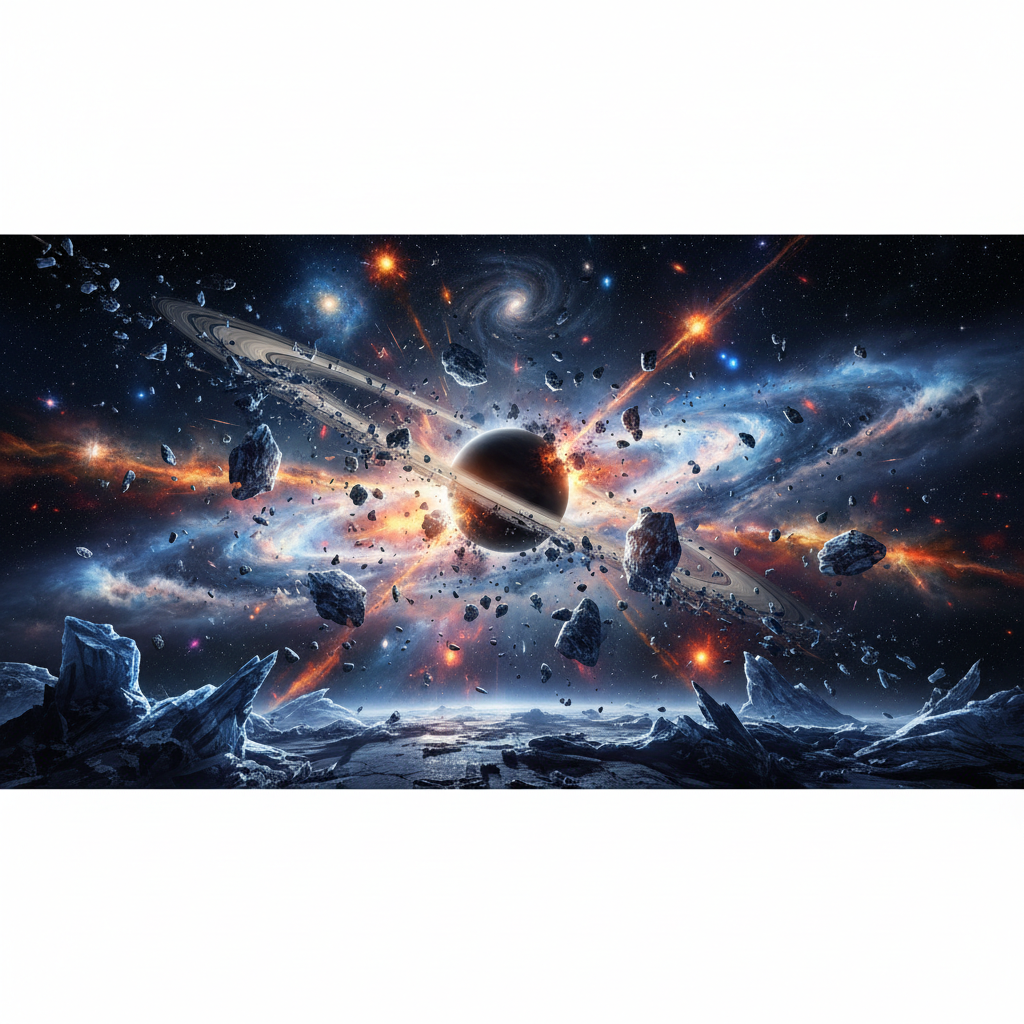
→ Tidal forces stretch and fracture it → The moon disintegrates into icy debris → That debris spreads into a disk around Saturn → Over time, the disk flattens and forms rings
This isn’t just speculation—it’s supported by simulations and observational data from NASA’s Cassini mission, which orbited Saturn from 2004 to 2017.
According to Jack Wisdom:
“The orbital evolution of Titan may have been far more dynamic than previously assumed, potentially influencing the structure of Saturn’s entire moon system.”
Why This Theory Matters
This isn’t just about pretty rings—it changes how we understand planetary systems as a whole.
→ Rings may be temporary, not permanent features → Moons can shape entire planetary environments → Planetary systems are far more dynamic and violent than they appear
It also suggests something deeper:
What we see today is just a snapshot. A moment in a long, chaotic story.
A System Still Evolving 4
Saturn’s rings won’t last forever.
Data from the NASA indicates that:
→ The rings are slowly “raining” into Saturn → They may disappear within the next 100–300 million years
So what we’re witnessing is rare—a fleeting cosmic feature.
The Bigger Picture
The idea that Titan helped create Saturn’s rings flips the narrative:
→ Moons aren’t passive—they’re active architects → Destruction can lead to beauty → Even giants like Saturn are shaped by their surroundings
As Carolyn Porco once reflected:
“The Saturn system is a dynamic, evolving place… not a static portrait frozen in time.”
Final Thought
Saturn’s rings might look delicate, almost peaceful—but their origin story could be anything but.
A shattered moon. A gravitational push. A system thrown into chaos… then slowly settling into something breathtaking.
And somewhere out there, Titan still orbits—quiet, massive, and possibly responsible for one of the most beautiful scars in our solar system.