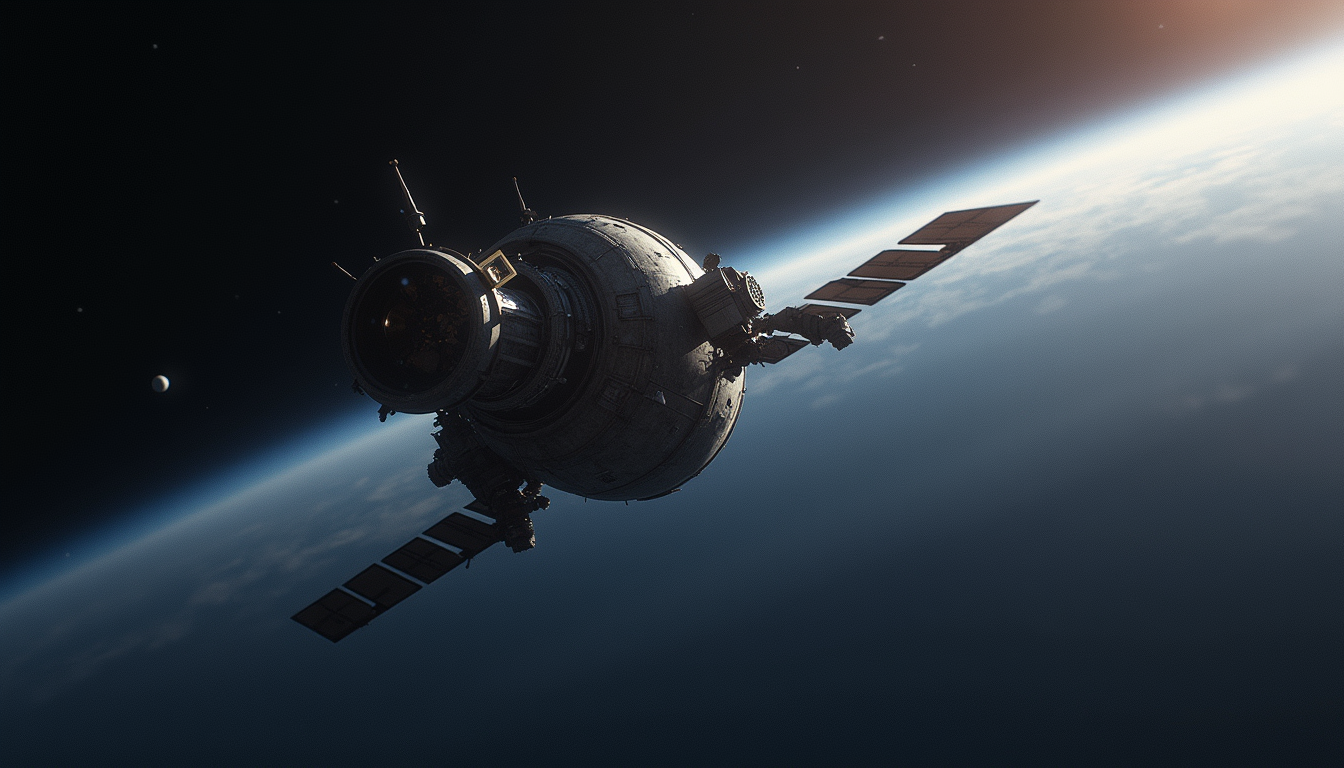
The Black Knight satellite is the name given to a supposed alien spacecraft said to have orbited Earth for thousands of years, watching humanity and occasionally signalling. No such object appears in any orbital catalogue. The Black Knight legend is a modern composite that stitches together at least seven unrelated events, from Nikola Tesla's 1899 radio experiments in Colorado to a set of NASA photographs taken during the STS-88 shuttle mission in December 1998, and the most famous of those images show a dark, angular object that NASA and the astronaut who photographed it identify as a lost thermal blanket.
The story matters because it is the most widely shared alien-satellite claim on the internet, and because it sits on top of things that are real: unexplained radio echoes from the 1920s, genuine NASA frames, a Mercury astronaut who believed in UFOs, and a government that now admits it cannot explain every object in its airspace. Separating the documented parts from the retold parts does not close the subject. It shows where the honest open questions are.
Where the name Black Knight comes from
The name comes from a British rocket, not from anything in orbit. Black Knight was a research rocket built by Saunders-Roe and launched from Woomera in South Australia between 1958 and 1965 to test re-entry vehicles for the Blue Streak missile programme. It never carried a satellite. Decades later the name migrated into UFO writing, and by the early internet era it had become a label for a bundle of older stories that had nothing to do with one another. The name came first; the object was assembled underneath it.
What Nikola Tesla heard in 1899
Tesla reported picking up rhythmic electrical disturbances at his Colorado Springs laboratory in 1899 and speculated that they might come from another planet. He described the experience in Talking with the Planets, published in Collier's Weekly in February 1901, writing that the periodic signals could not be traced to the Sun, the aurora or earth currents, and suggesting Mars as one possibility. Tesla never described a satellite, a craft or anything in orbit. His receiving equipment was untuned and crude by modern standards, and later engineers have proposed natural sources for what he heard, including lightning and the radio emissions of Jupiter. The point that survives scrutiny is narrow: Tesla heard something periodic that he could not explain. The leap from a signal to an orbiting observer was made by writers who came long after him.
The long-delayed echoes of the late 1920s
Long-delayed echoes are a real and still incompletely explained radio phenomenon, and they are the strongest thread in the whole legend. In 1927 a Norwegian engineer named Jorgen Hals, listening near Oslo to the Dutch shortwave station PCJJ in Eindhoven, noticed that transmitted pulses were followed by faint repeats several seconds later. A radio signal circles the Earth in roughly a seventh of a second, so delays of three to fifteen seconds could not be ordinary round-the-world echoes. The Norwegian physicist Carl Stormer and the Dutch physicist Balthasar van der Pol ran controlled tests in 1928 and reported them in Nature. Proposed mechanisms since then include reflection from plasma in Earth's magnetosphere, ducting along magnetic field lines, and reflection from the Moon, which would account for a delay of about two and a half seconds but not the longer ones. None fully explains every recorded case. That is a genuine open question in radio physics.
Duncan Lunan's star map and why he withdrew it
In 1973 the Scottish writer Duncan Lunan proposed that the 1928 echo delays were a message, and he later withdrew the idea. Lunan published an article in Spaceflight, the journal of the British Interplanetary Society, arguing that if the varying delays recorded in Stormer's tests were plotted against the pulse sequence, the result resembled a star map centred on Epsilon Bootis, sent by an automated probe that had parked itself near Earth some 13,000 years ago. Time magazine picked up the story, which is how the 13,000-year figure entered popular culture and became the supposed age of the Black Knight. Lunan himself re-examined the data, concluded that it did not support the interpretation, and said so publicly, repeating the retraction many times since. The star map survives online without its author's endorsement.
The 1954 two-satellites story and the 1960 dark satellite
Two Cold War newspaper stories supplied the legend with its supposed official confirmation, and neither holds up. In May 1954 papers including the St. Louis Post-Dispatch and the San Francisco Examiner reported that the Air Force had detected two satellites circling Earth, three years before Sputnik. The source was Donald Keyhoe, a retired Marine Corps major and author of Flying Saucers from Outer Space, who was promoting his book at the time; the Air Force denied the claim and no object was ever tracked or catalogued.
In March 1960 Time magazine ran a short item headed Space: A Dark Satellite, reporting that the United States had detected an unidentified dark object in a polar orbit at a moment when the fear was that it might be Soviet. The object was subsequently identified as debris from Discoverer 8, an American satellite launched in November 1959 whose re-entry capsule had been lost. The dark satellite was American hardware.
Gordon Cooper and Mercury 9
Gordon Cooper did not report a UFO during his Mercury flight, and he said so himself. The legend holds that on his fifteenth orbit aboard Faith 7 in May 1963 Cooper saw a glowing greenish object approaching his capsule, tracked by the Muchea station in Australia. Cooper was genuinely outspoken about UFOs: he described sightings from his Air Force years in Germany in the early 1950s and argued that the subject deserved serious study. But he stated repeatedly that the Mercury 9 story was fabricated and that he saw nothing of the kind on that flight, and the public mission transcripts contain no such report. His real views were more interesting than the invented ones, a pattern that repeats across this subject.
What the STS-88 photographs actually show
The photographs at the centre of the legend are real NASA frames, and NASA's record of that mission identifies the object in them as a thermal blanket. Space Shuttle Endeavour flew STS-88 in December 1998, the first International Space Station assembly mission, joining the American Unity node to the Russian Zarya module. Astronauts Jerry Ross and James Newman performed three spacewalks, and during that work a thermal cover for one of Unity's trunnion pins, the fittings that hold a module in the shuttle's payload bay, came loose and drifted away. The crew photographed it as it receded; the frames are catalogued in NASA's Gateway to Astronaut Photography of Earth as STS088-724-65 through STS088-724-70.
Viewed in sequence, the frames show a dark, folded, roughly angular object against the cloud tops, changing apparent shape as it tumbles. Ross has confirmed that it was the blanket. James Oberg, a former NASA mission control engineer and long-time space journalist, published a detailed analysis matching the object's appearance and timing to the EVA logs. Early catalogue captions describing the object only as debris, and the lack of scale in an image with nothing but Earth behind it, are what allowed the frames to circulate as pictures of a craft. The blanket was a few feet across and in a low orbit that decays quickly. It was not a persistent object.
Why the legend keeps coming back
The legend persists because every element in it has a real document behind it, and because official trust in this area has collapsed. The echoes are real, the photographs are real, and Tesla, Cooper, Lunan, Keyhoe and Time are all real; each has been quoted out of context and stacked onto the others. Meanwhile the wider UAP conversation has shifted. In June 2021 the Office of the Director of National Intelligence published a Preliminary Assessment on unidentified aerial phenomena covering 144 military reports and could confidently explain only one. On 26 July 2023 a House Oversight subcommittee heard sworn testimony from former intelligence officer David Grusch, former Navy pilot Ryan Graves and former Navy commander David Fravor, the pilot at the centre of the 2004 Nimitz encounter. In March 2024 the Pentagon's All-domain Anomaly Resolution Office released a historical review stating it had found no verifiable evidence of extraterrestrial technology. Both the official positions and the dissent from them are examined on 4BK TV in [Richard Dolan's UFO Chronicles](/watch/richard-dolans-ufo-chronicles), where the UFO historian works through the government record case by case. When the people asking the questions are Navy pilots and intelligence officers, a story that promises the watching has been going on all along finds a ready audience.
Billy Carson's reading
Billy Carson's position is that the Black Knight file deserves a fresh look and that the official explanations, while they may be correct on individual points, may not be complete. He does not argue that the STS-88 thermal blanket identification is fabricated, and the 4BK TV production Black Knight Satellite: Beyond the Signal, available through the Black Knight Satellite podcast episode, gives the NASA account its full weight. What Carson argues is that the signal history is a separate question from the photographs, and that answering the second does not answer the first. The long-delayed echoes were never resolved, Tesla's disturbances were never identified with certainty, and the modern UAP record shows that objects can go unexplained for decades before anyone with clearance says so. In his view, folding all of that into one debunked photo set is as much a shortcut as folding it into one alien craft.
Carson also places the question inside his wider reading of ancient texts. He argues, as his interpretation rather than as established history, that the Sumerian sources describe non-human intelligences with an ongoing interest in Earth, and he treats the idea of a long-term observer as consistent with that reading; the background is laid out in the [Anunnaki topic hub](/topics/anunnaki). He connects the signal question to his interest in information and consciousness as well, suggesting that if the universe behaves like a holographic information system, as he discusses in the [holographic universe topic hub](/topics/holographic-universe), then what counts as a signal from outside is broader than a radio receiver can settle. Skeptics will reasonably want evidence rather than framing for that step, and the companion episode, Black Knight Satellite: is there an alien satellite above our heads?, is where Carson makes the case in his own words, next to the mainstream identification.
Watch, read and go deeper
Start with the two podcast episodes, Black Knight Satellite and Black Knight Satellite: is there an alien satellite above our heads?, which together cover the signal history and the STS-88 record. For the government side of the UAP story, [Richard Dolan's UFO Chronicles](/watch/richard-dolans-ufo-chronicles) on 4BK TV traces the documents from the 1940s to the 2023 hearings, and the series [Unsolved](/watch/unsolved) takes on cases that have never been fully closed. Carson's ancient-observer argument is developed across the [Anunnaki topic hub](/topics/anunnaki), and the information-and-consciousness thread continues in the [holographic universe topic hub](/topics/holographic-universe).
Frequently asked questions
Is the Black Knight satellite real?
No object in any orbital catalogue matches the description of a 13,000-year-old alien satellite. The Black Knight is a composite legend built from separate events: Tesla's 1899 signals, the 1920s long-delayed echoes, Duncan Lunan's withdrawn 1973 star map, two Cold War newspaper stories, a denied Gordon Cooper anecdote and the 1998 STS-88 photographs. Each event is real; the connection between them is not documented.
What is the object in the NASA STS-88 photos?
NASA and astronaut Jerry Ross identify it as a thermal blanket, a cover for a trunnion pin on the Unity node, that came loose during a spacewalk in December 1998. The frames are catalogued as STS088-724-65 through -70. James Oberg's analysis matches the object and the timing of the photographs to the mission's EVA records.
Where does the 13,000 years figure come from?
It comes from Duncan Lunan's 1973 article in Spaceflight, which proposed that the 1928 long-delayed echoes encoded a star map from a probe that arrived near Earth around 13,000 years ago. Lunan later withdrew the interpretation, saying the data did not support it. The number outlived the retraction.
Did Nikola Tesla detect an alien satellite?
No. In 1899 Tesla recorded periodic electrical disturbances at Colorado Springs and speculated in a 1901 Collier's Weekly essay that they might come from another planet, possibly Mars. He never mentioned a satellite or an object in orbit, and natural sources such as lightning and Jupiter's radio emissions have since been proposed.
What does Billy Carson say about the Black Knight satellite?
Carson argues that the photographs and the signal history are two different questions, and that the thermal blanket identification, which he does not dispute, answers only the first. His view is that the unexplained echoes, Tesla's signals and the modern UAP record justify a fresh look, and he presents it in the 4BK TV production Black Knight Satellite: Beyond the Signal alongside the mainstream account.
Sources and further reading
- Nikola Tesla, Talking with the Planets, Collier's Weekly, 9 February 1901.
- Carl Stormer, Short Wave Echoes and the Aurora Borealis, Nature, vol. 122, 1928, with the companion letter by Balthasar van der Pol in the same volume.
- Duncan Lunan, Space Probe from Epsilon Bootis, Spaceflight (British Interplanetary Society), vol. 15, 1973, and his later published retractions.
- Donald E. Keyhoe, Flying Saucers from Outer Space, Henry Holt, 1953.
- Time magazine, Space: A Dark Satellite, 7 March 1960.
- NASA, Gateway to Astronaut Photography of Earth, STS-88 frames STS088-724-65 to STS088-724-70, and the STS-88 mission and EVA summaries.
- James Oberg, analysis of the STS-88 photographs and EVA records, jamesoberg.com.
- Office of the Director of National Intelligence, Preliminary Assessment: Unidentified Aerial Phenomena, 25 June 2021; U.S. House Committee on Oversight and Accountability, Subcommittee on National Security, the Border, and Foreign Affairs, hearing on unidentified anomalous phenomena, 26 July 2023.