To raise your vibration, in the everyday sense the phrase is used, means shifting your mood, energy and outlook from stress, fear and heaviness toward calm, gratitude and engagement. The language comes from early twentieth-century Hermetic and New Thought writing, where "vibration" described thoughts and emotions; physics does not measure emotions as a single frequency, so the phrase works best as a metaphor. The practical part is real, though: sleep, movement, daylight, nature, gratitude, slow breathing and people all have published evidence behind their effects on mood.
Why it matters: most writing on the topic mixes three things together, a history of ideas, claims dressed in physics vocabulary, and daily habits that research supports. Separating them lets a reader keep what works, drop what does not, and see why teachers such as Billy Carson put so much weight on daily practice. For the wider picture, the manifestation topic hub collects the related articles.
Watch the video
Where does the idea of "vibration" come from?
The idea that everything vibrates, and that thoughts carry a vibration of their own, entered popular spirituality through a handful of books published between about 1900 and 1910. Its best-known statement is in The Kybalion, published in 1908 by the Yogi Publication Society and credited to "Three Initiates." The book sets out seven principles, the third of which is the Principle of Vibration: "Nothing rests; everything moves; everything vibrates."
The Kybalion presents itself as a study of the Hermetic philosophy of ancient Egypt and Greece, but scholars place it firmly in its own era. Researchers including Philip Deslippe and Mitch Horowitz identify the New Thought writer William Walker Atkinson as its probable author, and historians of esotericism note that its idea of vibration owes more to modern thought than to the ancient Hermetic texts. Its "vibration" teaching is about a century old, not several thousand years old.
Two years before The Kybalion, Atkinson had already published Thought Vibration, or the Law of Attraction in the Thought World (1906). It argues that thoughts are vibrations that draw similar thoughts, people and circumstances to the thinker, the direct ancestor of modern law-of-attraction vocabulary.
Theosophy fed the same stream. In Thought-Forms, Annie Besant and C. W. Leadbeater described each definite thought as producing a double effect, "a radiating vibration and a floating form," and illustrated the colours they believed emotions produced.
How did "high vibration" become a scale of emotions?
The modern habit of ranking emotions from low to high comes mostly from two late twentieth-century sources. The first is Esther and Jerry Hicks, whose teachings are presented as coming from a non-physical group called Abraham. Their book Ask and It Is Given (Hay House, 2004) includes the 22-step Emotional Guidance Scale, running from joy, appreciation, freedom and love at the top, down through contentment, boredom, frustration, worry, anger and jealousy, to fear, grief, depression and powerlessness at the bottom. In the Hicks teaching, emotions indicate "vibrational" alignment, and the advice is to reach for a slightly better-feeling thought rather than leap from despair to joy.
The second source is David R. Hawkins's Power vs. Force (1995). Hawkins proposed a "map of consciousness" with calibrated levels running up to 1,000, placing shame at 20, courage at 200 as the turning point, love at 500, peace at 600 and enlightenment at 700 to 1,000. His numbers came from kinesiological muscle testing, in which a tester pushes on a subject's arm while a statement is held in mind. That method has not held up. Controlled studies of applied kinesiology, including a double-blind trial in the Journal of the American Dietetic Association in 1988 and a 2007 literature review by Haas, Cooperstein and Peterson, found muscle-test results no better than chance or unable to support the method's validity. The ordering may resonate, but the numbers are not measurements.
Do emotions have a frequency in hertz?
No; emotions are not a single frequency, and the "Hz of emotions" charts that circulate online have no measurement behind them. Many of these charts take the calibration numbers from Hawkins's map, such as shame at 20 or love at 500, and add a "Hz" label that his scale never had. Hertz means cycles per second, and no study has recorded gratitude or fear oscillating at a fixed rate.
What is true is that the body runs on real rhythms. A resting heart beats roughly once a second, and the small variations between beats, called heart-rate variability (HRV), shift with stress and relaxation. Brain activity measured by EEG shows rhythms such as alpha waves at about 8 to 13 Hz, which tend to rise in relaxed, eyes-closed states. Breathing has its own cycle. Atoms and fields oscillate too. But an emotional state involves many rhythms at once, plus hormones, memory and attention, and none of it reduces to one number on a chart.
The same caution applies to related claims about special tuning and planetary frequencies, which are covered in detail in 432 Hz vs 440 Hz explained and the Schumann resonance explained.
What does "low vibration" usually point to?
In practice, feeling "low vibe" usually maps onto ordinary, identifiable states: poor or irregular sleep, chronic stress, isolation, too little movement, too little daylight, and long hours absorbed in news or social feeds. Each of those has a lever a person can pull.
It also sets a boundary. Persistent low mood, loss of interest, hopelessness, changes in sleep or appetite lasting more than a couple of weeks, or any thoughts of self-harm are not a vibration problem to be fixed with affirmations. They are a reason to talk to a doctor or licensed mental-health professional. In the United States, the 988 Suicide and Crisis Lifeline is available by call or text.
Which daily habits have evidence behind them?
The habits most often recommended for raising your vibration overlap heavily with habits research links to better mood and energy. None of these studies measures "vibration"; they measure mood, rumination or wellbeing.
Regular sleep and morning daylight
Consistent timing matters alongside total hours. In a 2018 study of 91,105 UK Biobank participants published in The Lancet Psychiatry, Lyall and colleagues found that disrupted daily activity rhythms were associated with mood disorders and lower wellbeing. A 2023 analysis of more than 85,000 UK Biobank participants in Nature Mental Health found that low daytime light and bright light at night were both associated with psychiatric conditions. Both are observational, showing association rather than cause, but they support a simple habit: get outside in the morning and keep evenings dim.
Movement
A 2024 systematic review and network meta-analysis in The BMJ by Michael Noetel and colleagues, covering more than 200 randomized trials, found that exercise reduced depressive symptoms, with walking or jogging, yoga and strength training among the stronger options and higher intensity tending to do more. The authors noted limits, including small trials and the impossibility of blinding.
Time in nature
In a 2015 study in the Proceedings of the National Academy of Sciences, Gregory Bratman and colleagues at Stanford sent participants on a 90-minute walk through either a natural area or a busy urban street. The nature walkers reported less rumination, repetitive negative thinking linked to low mood, and showed reduced activity in the subgenual prefrontal cortex, a brain region associated with that kind of thinking. The urban walkers did not.
Gratitude
Robert Emmons and Michael McCullough's 2003 paper "Counting Blessings Versus Burdens," in the Journal of Personality and Social Psychology, compared people who regularly listed things they were grateful for with people who listed hassles or neutral events. The gratitude groups reported higher wellbeing on several measures. Later replications suggest the effect is real but modest.
Slow breathing
Breathing at about six breaths a minute, roughly 0.1 Hz, produces the largest swings in heart rate with each breath. Paul Lehrer and Richard Gevirtz, reviewing heart-rate-variability biofeedback in Frontiers in Psychology in 2014, describe this "resonance" breathing and summarize studies linking regular practice to better emotional regulation.
People, music and fewer feeds
Social connection is one of the strongest findings in health research: a 2010 meta-analysis of 148 studies by Julianne Holt-Lunstad, Timothy Smith and Bradley Layton in PLoS Medicine found that people with stronger social relationships had about 50 percent higher odds of survival over the study periods. Favourite music is a quick mood lever, and cutting late-night doom-scrolling protects sleep and attention.
A simple daily routine
A realistic routine looks like this. On waking, get ten to twenty minutes of outdoor light, ideally on a walk. Before the phone comes out, write three things that went right yesterday. At midday, do five minutes of slow breathing at about six breaths a minute, or move for twenty minutes. In the afternoon, contact one person by call or in person rather than by scrolling. In the evening, dim the lights, put screens away well before bed and keep the same bedtime. Once a week, spend a longer stretch somewhere green.
Repetition matters more than order, and each item targets one of the "low vibration" causes named above.
Billy Carson's reading
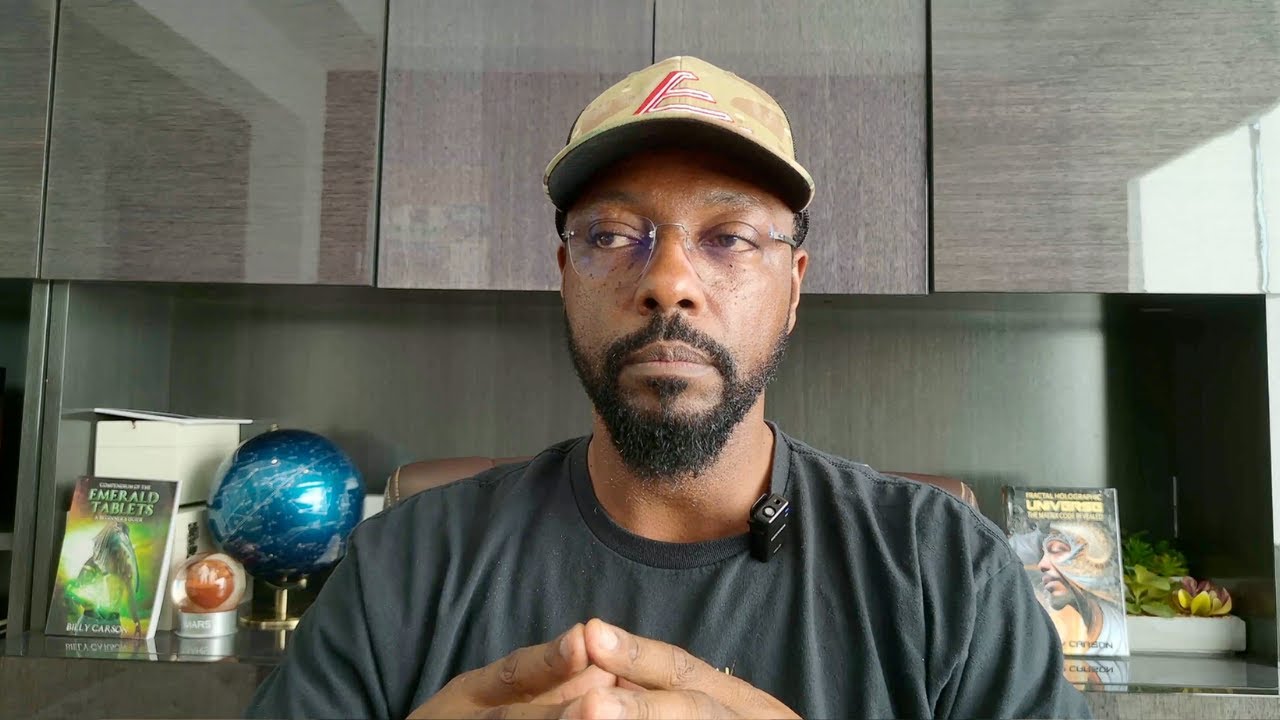
Billy Carson teaches raising your vibration as a daily discipline rather than a one-time breakthrough. In his frequency teaching, laid out in Billy Carson on changing your frequency, he argues that circumstances follow emotional state, and that moving away from fear and doubt toward peace and problem-solving is a habit built through repetition. His routine has three parts: writing and repeating present-tense affirmations several times a day, timed check-ins in the morning, afternoon and evening to name one's emotional state and notice where it sits in the body, and journaling plans, dreams and small positive moments as anchors to reread. He treats slipping back as normal and stresses correcting course quickly.
His video Raise Your Vibration in 2026 – Manifest Destiny & Break Free, embedded with this article, and the shorter clip Raise your vibration by Billy Carson carry the same message. In the podcast episode Stop Letting THIS Lower Your Vibration (Take Back Your Power), he focuses on the triggers and habits that pull a person's frequency down and on taking that power back. An older 4biddenknowledge guide, Increase your frequency and amplify your spirit, lists meditation, exercise, music, healthy food, nature and creative expression as everyday ways to lift one's energy.
Read alongside the research, Carson's approach and the evidence point the same practical way: notice how you feel, identify what drags you down, and build small daily habits that lift you. The vibration language is his framework; the habits stand on their own.
Watch, read and go deeper
Start with Billy Carson's Raise Your Vibration in 2026 video, then listen to the full Stop Letting THIS Lower Your Vibration episode of the 4biddenknowledge Podcast. For guided practice, the meditation collection on 4BK TV pairs well with the breathing habit described here. To see how vibration fits into goal-setting, read how to manifest what you want with Billy Carson's method, and browse the manifestation hub for the rest of the series.
Frequently asked questions
Is "raising your vibration" scientifically real?
Not in the literal sense. No instrument measures a person's emotional state as a single frequency, and the "Hz of emotions" charts online are not based on measurements. The phrase is best read as a metaphor for improving mood, energy and outlook, and many of the habits attached to it do have research support for those outcomes.
Where does the phrase "everything vibrates" come from?
The best-known source is The Kybalion (1908), whose Principle of Vibration states that "nothing rests; everything moves; everything vibrates." Scholars generally attribute the book to the New Thought author William Walker Atkinson, who also wrote Thought Vibration in 1906.
What are the quickest ways to raise your vibration?
Practical options include a walk outside, five minutes of slow breathing, music you love, writing down three things you are grateful for, or calling a friend. Each targets something that measurably affects mood.
Is the Hawkins map of consciousness accurate?
The order of states in David R. Hawkins's map, from shame and fear up through courage, love and peace, resonates with many readers as a description of personal growth. Its numbers, however, came from kinesiological muscle testing, and controlled studies of that method have found results no better than chance. The numbers should not be treated as measurements.
When is feeling "low vibe" a sign to get help?
If low mood, hopelessness, loss of interest, or changes in sleep and appetite last more than about two weeks, or if thoughts of self-harm appear, it is time to see a doctor or licensed mental-health professional. In the United States, the 988 Suicide and Crisis Lifeline is available by call or text.
Sources and further reading
- Three Initiates (attributed to William Walker Atkinson), The Kybalion (Yogi Publication Society, 1908)
- William Walker Atkinson, Thought Vibration, or the Law of Attraction in the Thought World (1906)
- Esther and Jerry Hicks, Ask and It Is Given (Hay House, 2004)
- David R. Hawkins, Power vs. Force (1995), read alongside Haas, Cooperstein and Peterson's 2007 review of applied kinesiology research
- Bratman, Hamilton, Hahn, Daily and Gross, "Nature experience reduces rumination and subgenual prefrontal cortex activation," PNAS (2015)
- Emmons and McCullough, "Counting Blessings Versus Burdens," Journal of Personality and Social Psychology (2003)
- Noetel et al., "Effect of exercise for depression: systematic review and network meta-analysis of randomised controlled trials," The BMJ (2024)
- Lehrer and Gevirtz, "Heart rate variability biofeedback: how and why does it work?" Frontiers in Psychology (2014)
These statements have not been evaluated by the Food and Drug Administration. This content is for information only and is not medical advice.