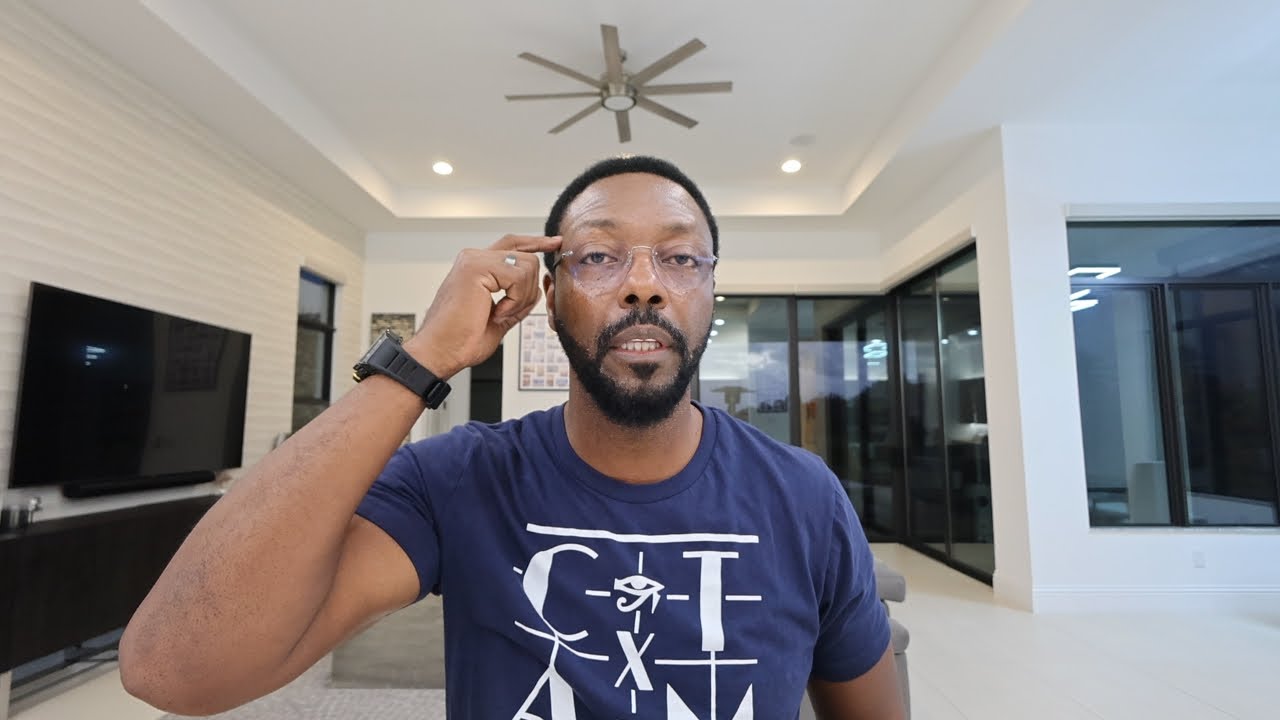
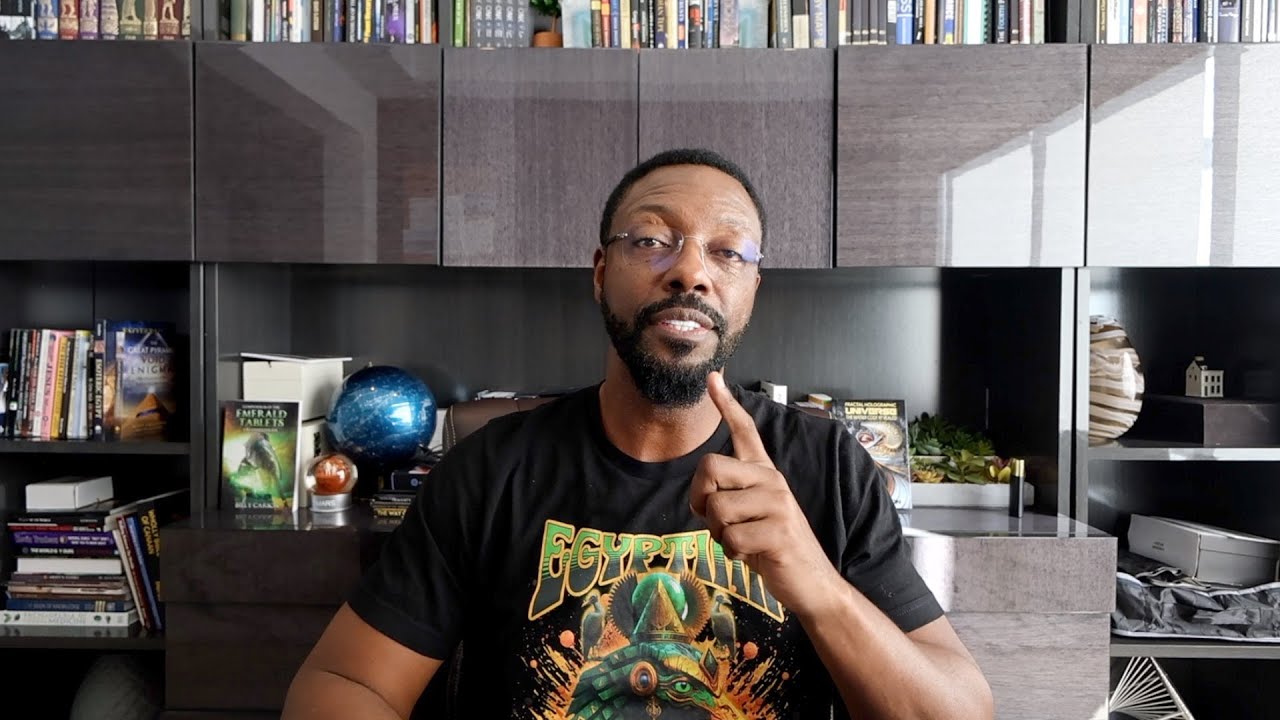
Why manifestation isn't working, in Billy Carson's account, comes down to four things: a low vibration fed by what a person consumes and who they give their energy to, a vague request instead of a specific one, a visualization that stays a wish instead of being lived as already done, and a missing action step. The ten-minute talk ends on the formula that ties the four together: conscious thought multiplied by action equals manifestation, or CT x A = M.
The topic matters because most people who try manifestation do what the popular books tell them, visualize and affirm, and then give up when nothing arrives. Carson's answer is a diagnosis of what cancels out the techniques people already use, and two of his four fixes, specificity and action, are also the two best-supported findings in the psychology of goals, which makes this one of his more testable talks.
What the video covers
The first problem is vibration (from about 0:25)
Carson opens by guessing at the viewer's situation: the visualizations are done and nothing is showing up. His first explanation is vibration, a frequency he says everyone resonates at consciously. Scientists, he says, have fitted people with EEG caps and read the frequency of their thoughts, and he concludes that a person focused on low-frequency content, gossip, hatred or pornography, will manifest at that level no matter what else they do. State of mind, in his phrase, decides what can enter a person's reality tunnel.
Your feed is a mirror (from about 1:30)
The practical half of the vibration argument is about media. Every piece of content a person consumes, Carson says, alters their vibration, and the effect can last for years. His test is the popular page on a social app. If it is full of fights, sexual content and scenes of disgust, that is what the algorithm has learned the user likes to watch; his own, he says, shows motivation, metaphysics, quantum physics and science. He adds a larger claim: the recommendation algorithm copies a program that already runs in nature, so the feed is a readout of what a person has been attracting.
Stop giving your energy away (from about 3:00)
Carson's second fix is boundaries. People wonder why their goals are not arriving, he says, while giving their energy to negativity and to people who do not deserve it, and he admits he has done the same in the past. Time and energy are the most valuable things a person owns, and given away without boundaries they shrink the capacity to manifest anything. His examples are a comment-section fight with a stranger halfway around the world, or someone who uses up hours that add nothing to one's greater good. Redirecting that energy toward self-healing, motivation and the work of manifestation is, in his telling, where life starts to change. He develops the same theme at length in the frequency parasites talk on energy vampires and doom-scrolling.
Three fast ways to switch state (from about 4:10)
For anyone who wants to shift quickly, Carson gives three moves. First, be of service: a person at the grocery store who knows an elderly relative who cannot get out sends a quick text offering to pick something up, a small gesture that raises vibration. Second, catch ANTs, automatic negative thoughts, and replace them by focusing on something positive that actually happened, then meditating on it for about five minutes with deep breaths. Third, move into forgiveness and gratitude, close the eyes, and relive the gratitude of a real moment rather than naming it. "Love is the highest frequency," he says, so gratitude and forgiveness are the quickest routes up. The daily habits are covered in how to raise your vibration.
The second problem is vagueness (from about 5:30)
Carson's second diagnosis is vagueness. He tells of a man who had been working on manifesting and could not get what he wanted: a new car, and when pressed, something in the fifteen to twenty thousand dollar range. Carson told him that right there he had already lost: an ambiguous request returns an ambiguous result. The fix is homework: test-drive cars within budget, find the one that fits, and know its colour, make, model, interior, wheels, exhaust and engine size as if it were already owned. The universe, in Carson's model, needs that data to build the magnet. "It's not about chasing, it's about attracting," and most people chase precisely because they do not know what they want.
Live it as already done (from about 6:40)
The third fix extends the car example into a full sensory rehearsal. In a meditative state, the person already has the keys, starts the engine, smells the leather seats, drives from the dealership to the house, opens the front door, walks through the rooms and sits on the couch. The point is to tell the brain that the thing has already happened and is happening now. Carson's analogy is a virtual-reality headset: put someone in front of a roller coaster in 3D goggles and the brain reacts as if the ride were real. Repeated consistently, he says, that self-talk reprograms the subconscious, the body changes frequency, and the thing is drawn in.
CT x A = M (from about 7:40)
The step people forget most, Carson says, is action, and here he gives his formula: "Conscious thought multiplied by action equals manifestation." Most people have the conscious thought and stop: they think about it, dream about it, meditate on it and never take the action steps he calls the catalyst of the end result. His evidence is everything man-made: the screen the viewer is watching on began as a thought in someone's mind, was collapsed into two dimensions in a computer-aided design program or on paper, and was turned into a three-dimensional object by an engineer. Nothing man-made, in his words, would exist without the action steps.
Applied to the car, the action steps are concrete. A down payment is needed, so the person works out where the money comes from, a new contract, a raise or savings, writes a goal sheet, sets benchmarks and starts hitting them. That is a snowball rolling downhill, and its energy exchange is what produces the manifestation. "You cannot get to the manifestation without the action steps."
Recognize the windows (from about 9:20)
The last point is discernment. Once a person is working toward something, Carson says, the universe sends signs, connections and information, and the task is to recognize them. The person who needs a down payment might be introduced to someone who leads to a new contract for whatever service they provide. "Windows open, but windows also close," and many people miss the opening and then conclude that nothing ever happened. The talk closes with an invitation to his community school, left aside here.
Key takeaways
- Carson's first explanation for stalled manifestation is vibration, measured in practice by what a person consumes and who they give their energy to.
- Vague goals return vague results; he wants the exact car, down to the engine size, known as if it were already owned.
- Visualization should be a lived rehearsal in the present tense, not a wish about the future.
- CT x A = M: conscious thought without action does not produce anything, and every man-made object is his proof.
- Opportunities arrive as people and information, and the skill is noticing them before the window closes.
Billy Carson's reading
Carson holds that thought is a frequency, that the body and the environment resonate with it, and that reality is shaped by what a person consistently broadcasts. That is the premise of his book Manifestation Codes, and it is why he treats a doom-scrolling habit or a comment-section fight as a manifestation problem rather than a time-management one.
What distinguishes this talk from a standard law-of-attraction pitch is the weight on the back half of the formula. Thought sets the direction and action supplies the energy exchange, and his examples, a CAD drawing becoming a product, a goal sheet becoming a down payment, are engineering examples rather than mystical ones. The formula is also his answer to the person who has meditated faithfully and seen nothing change: that person has, in his terms, multiplied a strong conscious thought by zero. His longer list of blocks, from self-sabotage to a lack mindset, is in Billy Carson's seven blocks explained.
What mainstream scholarship says
The vibration claims are where a skeptic will push back, and fairly. An EEG does record electrical activity from the scalp and sorts it into frequency bands, from delta through gamma, but those bands describe rhythms of synchronized neural firing, not the content of thoughts, and nothing in the research suggests they radiate outward to attract events. The idea that love is the highest frequency comes from David Hawkins' Map of Consciousness and the New Thought tradition, not from physics. Recommender systems, likewise, are built to maximize engagement: a feed full of fights reflects what the user lingered on, which is Carson's practical point even if his mechanism is not the one at work. The history of these ideas is traced in the law of attraction explained.
The rest of the talk sits closer to the evidence than its vocabulary suggests. Goal-setting research by Edwin Locke and Gary Latham found over decades that specific, challenging goals produce better performance than vague do-your-best goals, which is the car story in laboratory form. Peter Gollwitzer's work on implementation intentions shows that planning when, where and how a step will be taken sharply raises follow-through, which matches Carson's goal sheet and benchmarks. Gabriele Oettingen's studies are the most pointed: positive fantasizing about an outcome on its own tends to lower effort and results, while mental contrasting, pairing the desired future with the obstacles in the way, raises them. That is a scientific version of Carson's warning that most people stop at the thought. Gratitude exercises have modest but real effects on mood in work by Robert Emmons and Michael McCullough, automatic negative thoughts is a cognitive therapy term Daniel Amen popularized as ANTs, and Richard Wiseman found that self-described lucky people were simply better at noticing chance opportunities, which is Carson's windows argument without the universe sending them. The VR analogy is half right: presence in a virtual ride is a documented effect, but mental rehearsal improves skilled performance rather than conjuring objects.
Watch, read and go deeper
Start with the Billy Carson manifestation method for the full practice this video condenses. The manifestation topic hub gathers every related article, including the 369 and 5x55 methods and the law of assumption, and the frequency parasites talk linked above is the longer treatment of the media-diet and boundaries side. More of Carson's short talks on this theme are collected on 4BK TV in Best of Billy Carson.
Frequently asked questions
Why is my manifestation not working?
In Billy Carson's account there are four usual causes: a low vibration fed by negative content and draining relationships, a vague goal, a visualization wished about rather than lived in the present tense, and no action step. Psychology would reframe the first as attention and mood, but it agrees on the last three: specific goals, planned steps and contrasting the goal with its obstacles are what move outcomes.
What does CT x A = M mean?
It is Carson's formula for manifestation: conscious thought multiplied by action equals manifestation. Multiplication is the point: a clear thought with no action produces nothing, and action with no clear thought produces drift. His proof is that every man-made object began as a thought and was built by someone who did the work.
How specific should a manifestation goal be?
As specific as a purchase order, in Carson's telling: for a car, the make, model, colour, interior and engine, confirmed by test-driving it. Goal-setting research supports him: specific goals outperform general ones, and planning when, where and how a step will happen raises the odds of taking it.
How do you raise your vibration quickly?
Carson's three fast moves are an act of service for someone who needs it, catching an automatic negative thought and replacing it with a five-minute breathing meditation on a real positive memory, and re-living a moment of gratitude or forgiveness with the eyes closed. All three overlap with practices studies link to improved mood.
Sources mentioned
Carson cites no texts by name in this video; he leans on EEG research in general terms, his own social-media feeds and examples from product design and engineering. The phrase reality tunnel comes from Timothy Leary and Robert Anton Wilson, and ANTs is Daniel Amen's label for a concept from Aaron Beck's cognitive therapy. Standard references for the mainstream section are Edwin Locke and Gary Latham, A Theory of Goal Setting and Task Performance; Peter Gollwitzer's papers on implementation intentions; Gabriele Oettingen, Rethinking Positive Thinking; Robert Emmons and Michael McCullough's 2003 gratitude studies; Richard Wiseman, The Luck Factor; and David Hawkins' Power vs. Force for the frequency-of-love scale.