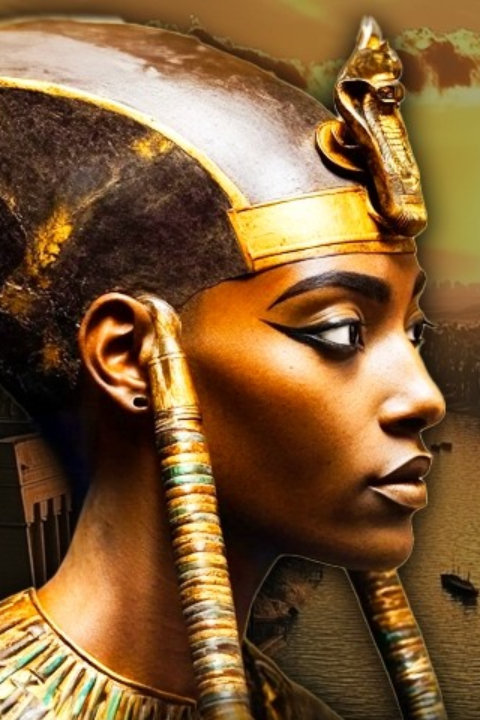
Nefertiti was the Great Royal Wife of the pharaoh Akhenaten in Egypt's 18th Dynasty, living roughly 1370 to 1330 BCE and serving as queen from about 1353 BCE. Her name means "the beautiful one has come," and she stood beside her husband at the center of the Aten cult at Amarna. She is best known today from a painted limestone bust in Berlin, and her final years, her burial and her mummy all remain unresolved.
Nefertiti matters because three of the most argued-over questions in Egyptology meet in her story: who owns the Berlin bust, what happened to the queen after Akhenaten's reign, and whether her tomb lies hidden behind the walls of Tutankhamun's burial chamber. Each question has generated headlines that run ahead of the evidence. This guide sets out what is documented, what is debated and what has simply never been found. The Ancient Egypt topic hub collects the related articles.
Who was Nefertiti
Nefertiti was the principal queen of Akhenaten, the king who began his reign as Amenhotep IV and later reorganized Egyptian state religion around the Aten, the disk of the sun. In the art of Amarna, the new capital the couple founded, she appears far more often and more prominently than earlier queens. She is shown offering to the Aten alongside the king, playing with their children under the god's rays and, in some scenes, striking enemies, a pose normally reserved for pharaohs. The full story of the reform she was part of is told in the companion guide to Akhenaten, the Aten and Amarna.
Her parentage is unknown. No surviving text names her father or mother. The courtier Ay, who later became king, is often proposed as her father because he carried the title "God's Father" and his wife Tey was called the nurse of the Great Royal Wife, but no source states the relationship outright.
Nefertiti and Akhenaten had six daughters: Meritaten, Meketaten, Ankhesenpaaten, Neferneferuaten Tasherit, Neferneferure and Setepenre. Ankhesenpaaten later changed her name to Ankhesenamun and became the wife of Tutankhamun. The couple's religious program displaced the crowded pantheon described in the guide to the Egyptian gods and goddesses, and it is in that break with tradition that the queen's unusual prominence makes sense.
How the Nefertiti bust was found
The Nefertiti bust was found on 6 December 1912 at Amarna, in the ruined workshop of the sculptor Thutmose, by the German Oriental Society's excavation led by Ludwig Borchardt. The dig was financed by James Simon, a wealthy Berlin collector and patron. The workshop held dozens of plaster studies and unfinished portraits, which is why the bust is generally read as a workshop model rather than a finished cult image.
The bust stands about 48 centimeters high and weighs about 20 kilograms. It has a limestone core covered with layers of painted stucco, and it shows the queen in her distinctive flat-topped blue crown. The right eye has a quartz inlay; the left eye has none. Borchardt's team searched for the missing inlay without success, and scholars still disagree over whether it fell out or was never fitted.
Under the rules of the time, finds from foreign excavations were split between the excavators and the Egyptian Antiquities Service. In the division of January 1913 the bust was allotted to the German side. It went to Simon, who gave it to the Berlin museums in 1920, and it was first shown to the public in 1924.
Where the bust went during the Second World War
During the Second World War the bust was moved several times for safekeeping. It was first stored in the cellar of a Berlin bank, then in the flak tower at the Berlin Zoo, and in March 1945 it was taken to a salt mine at Merkers in Thuringia. The US Army found it there in 1945. After several years in American custody in Frankfurt and Wiesbaden it returned to West Berlin in 1956.
Since the Neues Museum on Berlin's Museum Island reopened in October 2009, the bust has been its centerpiece, displayed alone in a domed room.
What the CT scans found
A CT scan carried out in 2006 and published in the journal Radiology in 2009 by a team led by Alexander Huppertz revealed a carved face in the limestone core beneath the stucco. That inner face is more lined, with creases around the mouth and cheeks and a slight bump on the nose, which the sculptor smoothed over with the outer layer. The finding supported the bust's authenticity at a time when a handful of writers had claimed it was a modern fake, and those claims have not been accepted by specialists.
Why Egypt wants the bust back
Egypt has asked for the bust's return repeatedly since it was first shown in 1924. Egyptian officials, including the former antiquities minister Zahi Hawass, argue that it left the country improperly and that its importance was understated during the 1913 division. Germany's position, maintained by the Prussian Cultural Heritage Foundation and the Neues Museum, is that the bust was acquired legally under the division protocol agreed at the time and that it is too fragile to travel.
Both positions continue to be stated publicly, and the dispute has become one of the best-known cases in the wider debate over museum collections formed during the colonial era. The documented facts are the find date, the 1913 division and the 1920 donation; how fairly the division was conducted is the point on which the two sides differ.
What happened to Nefertiti
For much of the 20th century Egyptologists assumed Nefertiti disappeared from the record around Akhenaten's Year 12, and various explanations were offered, from death to disgrace. Both ideas have weakened. Erasures at Amarna once read as evidence that the queen fell from favor were later shown to belong to monuments of Kiya, a secondary wife of Akhenaten, not Nefertiti.
The bigger change came in 2012, when the discovery of an ink inscription in a limestone quarry at Deir Abu Hinnis, in Middle Egypt, was announced. Published by the Belgian Egyptologist Athena Van der Perre, it names Nefertiti as Great Royal Wife in Akhenaten's Year 16, close to the end of his roughly seventeen-year reign. She was alive and still queen far later than had been assumed.
Did Nefertiti rule as pharaoh
Many scholars now think Nefertiti was raised to co-ruler late in the reign and may have ruled briefly on her own after Akhenaten's death under the throne name Neferneferuaten. A ruler of that name, using feminine grammatical forms in some inscriptions, is attested in the Amarna period. In 2016 James P. Allen, who had earlier favored one of the daughters, wrote that he now considered Nefertiti the likeliest candidate. Other Egyptologists prefer to identify the ruler as Meritaten, the eldest daughter, or connect the period with the shadowy king Smenkhkare. The evidence is fragmentary, and no identification is settled.
Has Nefertiti's mummy been found
Nefertiti's mummy has never been securely identified. The best-known candidate is the "Younger Lady," a female mummy found by Victor Loret in 1898 in KV35, the tomb of Amenhotep II in the Valley of the Kings. In 2003 the British Egyptologist Joann Fletcher suggested the Younger Lady might be Nefertiti.
The 2010 genetic and CT study led by Zahi Hawass, published in the Journal of the American Medical Association, identified the Younger Lady as the mother of Tutankhamun and as a daughter of Amenhotep III and Queen Tiye, which would make her Akhenaten's full sister. Because no source calls Nefertiti a king's daughter, most scholars take that result to rule her out. In 2013 Marc Gabolde, director of a French mission at Amarna, argued that three generations of first-cousin marriage could produce a DNA signal that looks like a brother and sister pairing, which would leave Nefertiti in play as Tutankhamun's mother. Hawass rejected that reading. The question remains open, and the Younger Lady is not definitively anyone.
The KV62 hidden-chamber search
The hidden-chamber theory holds that Tutankhamun's tomb, KV62, is the outer part of a larger tomb, possibly built for Nefertiti. The British Egyptologist Nicholas Reeves proposed it in 2015 after studying high-resolution scans of the burial chamber walls, in which he saw lines he read as plastered-over doorways in the north and west walls. The story of the tomb's original discovery is covered in the guide to Tutankhamun's tomb and the curse.
Radar results since then have pulled in different directions. The Japanese radar specialist Hirokatsu Watanabe scanned the chamber in late 2015 and reported possible voids behind the walls. A second radar survey by National Geographic in 2016 did not reproduce those results. In February 2018 three independent ground-penetrating radar surveys were run under the coordination of Franco Porcelli of the Polytechnic University of Turin. On 6 May 2018 Porcelli announced that there was "no evidence of doors or empty spaces beyond the funeral chamber up to four meters."
The 2026 survey
The debate reopened in September 2026. A report by Mamdouh Eldamaty, a former Egyptian antiquities minister, with colleagues including Reeves, appeared in the Occasional Papers of the Amarna Royal Tombs Project. Drawing on field seasons in 2023 and 2024, the team combined ground-penetrating radar, electrical resistivity tomography, microgravity and thermal imaging. They describe anomalies they interpret as a possible blocked doorway in the west wall of the burial chamber, and a corridor with further chambers extending some 25 to 30 meters north of the known tomb.
Nature's news coverage on 17 September 2026 described the data as tantalizing but said it was too early to draw definitive conclusions. The authors themselves say remote methods have reached their limits and that only direct investigation would settle the matter, and they have sought permission to drill a narrow borehole for a camera. Zahi Hawass remains skeptical, arguing that KV62 began as a small tomb intended for Ay and was adapted for Tutankhamun after his early death. As of October 2026 nothing has been opened and nothing has been found. The richness of what Carter did find, discussed in the article on the opulence of Tutankhamun's tomb, is one reason the possibility of a larger royal burial draws so much attention.
Billy Carson's reading
Billy Carson has addressed Nefertiti mainly through the question of Tutankhamun's family. In his talk on whether the Bible was copied from older texts, covered in the companion article Was the Bible copied from ancient texts, Carson says Akhenaten was Tutankhamun's father and that Nefertiti was Tut's stepmother rather than his birth mother. He adds that he has kept searching for what became of Tutankhamun's actual mother.
That position lines up with the 2010 DNA study, which identifies Tutankhamun's mother as the unnamed Younger Lady, a sister of Akhenaten, rather than Nefertiti. Readers weighing his view should also know Marc Gabolde's counter-argument that cousin marriage could explain the genetic result and that Nefertiti could still be Tut's mother. Carson did not discuss the Berlin bust or the KV62 scans in that talk, so those parts of the story are best read from the documented record above. His wider teaching on Egyptian religion and its esoteric currents is collected in the 4BK TV series Egyptian Mystery School.
Watch, read and go deeper
Billy Carson's Egyptian Mystery School on 4BK TV is the starting point for his full reading of Egypt's spiritual traditions. For the king Nefertiti ruled beside, read the guide to Akhenaten and the Amarna revolution, and for the tomb at the heart of the hidden-chamber debate, the guide to KV62 and the curse. The Ancient Egypt topic hub links every related article, from the gods of the old pantheon to the Valley of the Kings.
Frequently asked questions
Was Nefertiti Tutankhamun's mother?
Probably not, on current evidence. The 2010 DNA study identified Tutankhamun's mother as the Younger Lady, a full sister of Akhenaten, which most scholars take to exclude Nefertiti. Marc Gabolde has argued that generations of cousin marriage could mimic that genetic signal, so a minority view keeps Nefertiti as his mother.
Is the Nefertiti bust real?
Yes, specialists accept it as an authentic Amarna-period work. A 2006 CT scan found an earlier, more lined face carved into the limestone core beneath the painted stucco, and claims that it is a modern forgery have been rejected after scientific study.
Why does the Nefertiti bust have only one eye?
The right eye has a quartz inlay but the left eye was never found with one. Borchardt's team searched the workshop for the missing piece without success. Some scholars think the inlay fell out, while others believe the bust, a workshop model, was simply never finished.
Has Nefertiti's tomb been found?
No. Her tomb and mummy have never been securely identified. A 2026 geophysical report describes anomalies beyond Tutankhamun's burial chamber that some researchers link to Nefertiti, but nothing has been opened, and earlier radar surveys in 2018 found no evidence of hidden rooms within four meters of the chamber.
When did Nefertiti die?
No record gives her death date. An inscription from Deir Abu Hinnis shows she was still Great Royal Wife in Akhenaten's Year 16, near the end of his reign. If she ruled afterward as Neferneferuaten, as many scholars suspect, she lived a few years longer, but that identification is still debated.
Sources and further reading
- Joyce Tyldesley, Nefertiti's Face: The Creation of an Icon (2018)
- Barry Kemp, The City of Akhenaten and Nefertiti: Amarna and Its People (2012)
- Athena Van der Perre, "The Year 16 Graffito of Akhenaten in Dayr Abu Hinnis," Journal of Egyptian History 7 (2014)
- Alexander Huppertz et al., "Nondestructive Insights into Composition of the Sculpture of Egyptian Queen Nefertiti with CT," Radiology 251, no. 1 (2009)
- Zahi Hawass et al., "Ancestry and Pathology in King Tutankhamun's Family," Journal of the American Medical Association 303, no. 7 (2010)
- Nicholas Reeves, "The Burial of Nefertiti?" Occasional Papers of the Amarna Royal Tombs Project 1 (2015)
- Mamdouh Eldamaty et al., Occasional Papers of the Amarna Royal Tombs Project 8 (2026)
- Jo Marchant, "New evidence for hidden chambers beyond Tutankhamun's tomb," Nature news (17 September 2026)