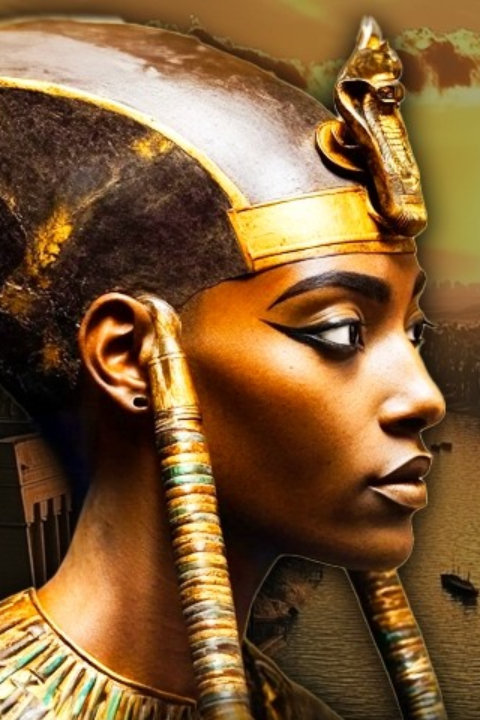
Akhenaten was an 18th Dynasty pharaoh of Egypt, ruling roughly 1353 to 1336 BCE, who began his reign as Amenhotep IV and changed his name in his fifth regnal year to honor the Aten, the disk of the sun. He shut down the state cults of the traditional gods, built a new capital at Amarna and launched a radical new art style. After his death his successors dismantled his monuments and cut his name from the official king lists.
Akhenaten matters because so many big questions about ancient Egypt run through him: whether Egypt produced the first monotheism, why Amarna art looks the way it does, where Tutankhamun fits in the family tree, and what happens when a ruler tries to rewrite a civilization's religion from the top down. He is argued over in Egyptology and alternative history alike, so it pays to separate the evidence from what has been layered on top of it. The Ancient Egypt topic hub gathers the related guides.
Who was Akhenaten
Akhenaten was the son of Amenhotep III and Queen Tiye, and he came to the throne at the height of New Kingdom wealth and power. Most modern chronologies date his reign to about 1353 to 1336 BCE, though some schemes shift it a couple of years. He was crowned as Amenhotep IV ("Amun is satisfied"), a name tying him to Amun, the god of Thebes whose Karnak temples were the richest in the land.
Within a few years that relationship was reversed. In regnal year 5 the king took the name Akhenaten, usually translated "effective for the Aten." The new name announced a state theology built around a single divine power visible in the sky. To see how unusual that was, it helps to know the crowded pantheon he turned away from, laid out in the guide to the Egyptian gods and goddesses.
What was the Aten and what changed in Egyptian religion
The Aten was the physical disk of the sun, an old solar concept that Akhenaten elevated into the sole object of royal worship. In Amarna art it appears as a disk whose rays end in small human hands, some holding the ankh sign of life toward the king and queen. The royal family presented itself as the main channel between the Aten and everyone else.
The reform went far beyond adding a favorite god. The priesthoods of the other gods were disbanded and their income redirected to the Aten, the traditional temples were closed, and the name of Amun was chiselled off monuments across Egypt. For a society whose worldview rested on maat, the balance kept by honoring many divine forces, this was a profound break. The guide to Kemetic spirituality, the Neteru and maat explains the system Akhenaten was overturning.
Why did Akhenaten build Amarna
Akhenaten built a new capital so the Aten could be worshipped on ground that belonged to no other god. He chose empty desert on the east bank of the Nile, roughly halfway between Thebes and Memphis, and named it Akhetaten, "Horizon of the Aten." Today the site is called Tell el-Amarna, or simply Amarna.
The founding is recorded on the boundary stelae, large inscriptions cut into the cliffs around the site. Sixteen have been identified. The earlier proclamation, dated to year 5, survives on three stelae; a later proclamation from year 6 appears on most of the rest, with additions made in year 8. These texts mark the city's limits, give the formal titles of the Aten, Akhenaten and Nefertiti, and set out instructions for royal burials there.
The contrast with the old religious capital is stark. Thebes, with Karnak and the royal tombs across the river, is covered in the guide to Luxor, Karnak and the Valley of the Kings, and it was at Karnak that Akhenaten's early Aten temples stood before they were torn down.
Why does Amarna art look so strange
Amarna art shows the king with a long narrow face, heavy-lidded eyes, a thin neck, a sagging belly and wide hips, a sharp break from the idealized, athletic pharaoh of earlier centuries. The colossal statues from his temple at East Karnak push these features to an extreme, and scenes became more intimate, showing the royal couple kissing their daughters beneath the Aten's rays.
Two broad explanations compete. The first is medical. Fröhlich's syndrome was floated early on; in the 1990s the researcher Alwyn Burridge argued for Marfan syndrome; others have proposed homocystinuria or Klinefelter syndrome. A common objection is that several of these cause infertility, which sits awkwardly with a king who fathered at least six daughters. The second explanation is stylistic and religious: the king chose to be shown this way, perhaps to embody both male and female creative aspects of the Aten, or to mark a clean break with the art of the Amun priesthood.
The 2010 genetic and CT study led by Zahi Hawass, published in the Journal of the American Medical Association, examined mummies thought to belong to Tutankhamun's family. It found no signs of Marfan syndrome or the other proposed disorders and concluded the features were most probably a royally decreed style tied to the religious reforms. That finding leans partly on the identity of the KV55 mummy, discussed below. Later pieces, such as the bust of Nefertiti from the workshop of the sculptor Thutmose, now in Berlin, show the style in a much softer form.
Who was Nefertiti and what happened to the royal family
Nefertiti was Akhenaten's Great Royal Wife, and she appears beside him in Amarna art far more prominently than earlier queens did, sometimes in poses traditionally reserved for kings. The couple had six daughters: Meritaten, Meketaten, Ankhesenpaaten (later Ankhesenamun), Neferneferuaten Tasherit, Neferneferure and Setepenre.
The end of the reign is the murkiest part of the story. Two shadowy rulers appear around Akhenaten's death: Smenkhkare and a ruler with the throne name Neferneferuaten. Scholars still debate whether either was a co-regent, whether they were the same person, and whether Neferneferuaten was Nefertiti ruling as king. The evidence is too fragmentary for confident answers.
What do the Amarna Letters and the Great Hymn to the Aten reveal
The Amarna Letters are an archive of 382 known clay tablets and fragments, most of them diplomatic correspondence in Akkadian cuneiform, the shared diplomatic language of the Late Bronze Age. Local villagers dug them from the ruins of Amarna around 1887 and sold them on the antiquities market, which is why they are now split between Berlin, London, Cairo and other collections. About 350 are letters exchanged between the pharaohs, from late in Amenhotep III's reign into Tutankhamun's, and the rulers of Babylonia, Assyria, Mitanni, the Hittites and the city-states of Canaan. They are cited by "EA" numbers from Jørgen Knudtzon's edition and read in English in William L. Moran's translation.
The Great Hymn to the Aten is the fullest statement of the new theology. Its long version was carved in the Amarna tomb of the courtier Ay, who later became king. It praises the Aten as the sole creator who made the earth, gives breath to the chick in the egg and sends the Nile flood. Readers have long noticed its resemblance to Psalm 104, which in the King James Version exclaims, "O LORD, how manifold are thy works." James Henry Breasted believed the psalm drew on the hymn; more cautious scholars, including Miriam Lichtheim, attribute the likeness to a shared hymn tradition rather than direct borrowing.
Was Akhenaten the first monotheist
Akhenaten is often called the first monotheist, but scholars are divided on whether his religion was monotheism or henotheism, the exclusive worship of one god without denying that others exist. The Aten cult had no sacred book and no community of ordinary believers in the biblical sense; it centered on the royal family as the god's intermediaries. Donald Redford, who worked for years on Akhenaten's Karnak temples, concluded there is little or no evidence that Akhenaten was a forerunner of biblical monotheism.
The opposite idea found its most famous champion in Sigmund Freud. In Moses and Monotheism, published in 1939, Freud argued that Moses was an Egyptian who carried Atenism to the Israelites. Historians do not accept that reconstruction, but it fixed Akhenaten in the popular imagination as a prophet born before his time.
Why was Akhenaten's name erased
Akhenaten's name was erased because the rulers who followed treated his reign as a disaster to be undone. Tutankhaten, very probably his son, changed his name to Tutankhamun, abandoned Amarna and restored the old cults. His Restoration Stela, found at Karnak in 1905 and now in the Egyptian Museum in Cairo, describes neglected temples and divine statues ignored or destroyed. The lavish burial of the boy king, explored in the guide to the opulence of Tutankhamun's tomb, reflects that return to tradition.
The campaign became systematic under Horemheb. He dismantled the Aten temples at Karnak and packed their small sandstone talatat blocks into his Second, Ninth and Tenth Pylons as fill, which ironically preserved them for modern researchers. Akhenaten, Smenkhkare, Neferneferuaten, Tutankhamun and Ay were all dropped from the official record: on the king list carved for Seti I at Abydos, the sequence jumps from Amenhotep III straight to Horemheb. Later documents avoid his name, calling him "the enemy" or "that criminal." In Egyptian belief a name had to endure for its owner to live on, a theme that runs through the Egyptian Book of the Dead, so this erasure was meant to be total.
The KV55 mummy
The likeliest physical remains of Akhenaten are a contested skeleton from tomb KV55 in the Valley of the Kings, found by Edward Ayrton for Theodore Davis in January 1907. Objects bearing Akhenaten's names pointed to him, but early anatomical estimates put the age at death in the early twenties, too young for a king who reigned about seventeen years, so many favored Smenkhkare. The 2010 Hawass study used DNA to identify KV55 as a son of Amenhotep III and the father of Tutankhamun, "most probably Akhenaten," and CT analysis suggested an older age. Other researchers have questioned both the DNA methods and the age estimate, so the identification remains debated.
Billy Carson's reading
Billy Carson approaches Egypt through the Emerald Tablets and the Neteru, which he treats as real beings rather than purely symbolic deities, placing the pharaohs within a longer story of contact between humanity and advanced teachers. In that framework, Akhenaten's turn toward a single source of light reads as part of an older esoteric current in Egypt's mystery traditions rather than one king's isolated invention.
On the Amarna images, Carson has raised the question of whether the elongated skulls in royal iconography, including the depictions of Akhenaten's daughters, reflect something more than artistic convention, a theme he explores more widely in the 4biddenknowledge Podcast episode "Mystery of the Elongated Skulls." That is his interpretation, not a consensus position: mainstream Egyptology reads the Amarna features as a deliberate royal style, and the 2010 genetic study found no disorder to explain them. His longer teaching on the Egyptian mysteries is collected in the 4BK TV series Egyptian Mystery School.
Watch, read and go deeper
Billy Carson's Egyptian Mystery School on 4BK TV is the place to start for his full reading of Egypt's esoteric traditions, the Neteru and Hermetic teaching. The Ancient Egypt topic hub links every related article, from the gods Akhenaten pushed aside to the temples Tutankhamun restored. For anyone who wants to stand at Karnak and the Valley of the Kings in person, the 4biddenknowledge tours page includes the Sacred Egypt Tour.
Frequently asked questions
When did Akhenaten rule?
Akhenaten ruled during Egypt's 18th Dynasty, roughly 1353 to 1336 BCE, a reign of about seventeen years; some chronologies shift those dates slightly. He began as Amenhotep IV and adopted the name Akhenaten in his fifth regnal year.
Was Akhenaten Tutankhamun's father?
Most Egyptologists now think so. The 2010 DNA study identified the KV55 mummy as Tutankhamun's father and "most probably Akhenaten." Because KV55's identity and the study's methods are still debated, the relationship is best described as very likely rather than proven.
Why is Akhenaten called the heretic pharaoh?
He abandoned Amun and the traditional gods, closed their temples and promoted the Aten as the sole focus of state worship. Later kings saw this as a betrayal of maat, tore down his monuments, left him off official king lists and referred to him as "that criminal" rather than by name.
Did Akhenaten invent monotheism?
That is still argued. His Aten cult was exclusive, so some scholars call it monotheism, while others prefer henotheism because it centered on the king as intermediary and never became a religion of ordinary believers. Freud's 1939 claim that Moses carried Atenism to the Israelites is not accepted by historians.
What happened to Amarna after Akhenaten died?
Amarna was abandoned within a few years, after Tutankhamun moved the court and restored the old cults, and its temples were later quarried for stone. Because it was occupied so briefly and never built over, it gives archaeologists an unusually clear view of an ancient Egyptian city.
Sources and further reading
- Barry Kemp, The City of Akhenaten and Nefertiti: Amarna and Its People (2012)
- Donald B. Redford, Akhenaten: The Heretic King (1984)
- William L. Moran, The Amarna Letters (1992)
- Miriam Lichtheim, Ancient Egyptian Literature, Volume II: The New Kingdom
- Zahi Hawass et al., "Ancestry and Pathology in King Tutankhamun's Family," Journal of the American Medical Association 303, no. 7 (2010)
- Sigmund Freud, Moses and Monotheism (1939)
- Encyclopaedia Britannica, "Akhenaten"