The Egyptian gods and goddesses were the netjeru, the divine powers ancient Egyptians believed kept the world in order, from Ra the sun god and Osiris, king of the dead, to Isis, Horus, Thoth and Anubis. Hundreds are known by name across more than three thousand years of Egyptian history, and they were grouped into overlapping families tied to particular cities, the best known being the Ennead of Heliopolis: the creator Atum and eight of his descendants.
The Egyptians never wrote one fixed mythology; gods merged, took animal or human form and changed roles from city to city and century to century. Knowing who they were, and where each story comes from, is the key to reading the temples and texts such as the Book of the Dead, and to separating the ancient record from Greek retellings and modern films. This guide is part of the [Ancient Egypt topic hub](/topics/ancient-egypt).
How the Egyptians thought about their gods
The Egyptians understood their gods as powers present in nature, in the kingship and in each person, reached through a name, a cult image and a temple. The Egyptian word for a god was netjer, plural netjeru, often written today as neter and neteru. Most gods began as local deities of a town or region: Ptah at Memphis, Thoth at Hermopolis, Amun at Thebes, Sobek in the Faiyum. When a city's rulers came to power, its god rose with them, which is how Amun of Thebes became king of the gods once Theban dynasties ruled Egypt.
Two habits confuse modern readers. The first is syncretism: gods could combine without either one disappearing, so Amun and Ra became Amun-Ra, and Ra and Horus became Re-Horakhty, "Ra-Horus of the Two Horizons." The second is the animal head. The Egyptologist Erik Hornung, in Conceptions of God in Ancient Egypt, argued that a falcon or jackal head was a way of showing a god's nature and powers, not a description of what the god literally looked like; the same god could appear as an animal, a human, a hybrid or a symbol. For the wider worldview, see [Kemetic spirituality explained](/kemetic-spirituality-explained-neteru-maat-and-the-ancient-egyptian-worldview).
Ra, Atum and the Ennead of Heliopolis
Ra was the sun god and, for most of Egyptian history, the king of the gods, with his main cult centre at Heliopolis, which the Egyptians called Iunu and which now lies within Cairo. He was pictured crossing the sky by day in a boat and travelling through the underworld by night, where the serpent Apophis tried to stop him before dawn. From the Fourth Dynasty onward, kings carried the title "son of Ra."
The priests of Heliopolis also taught a creation story centred on Atum, whose name means something like "the complete one." Atum rose from Nun, the dark primeval waters, onto the first mound of earth and produced the first divine pair, Shu (air) and Tefnut (moisture), from himself, as the Pyramid Texts describe. Shu and Tefnut produced Geb (earth) and Nut (sky), and Geb and Nut had four children: Osiris, Isis, Set and Nephthys. Those nine, Atum, Shu, Tefnut, Geb, Nut, Osiris, Isis, Set and Nephthys, are the Ennead of Heliopolis.
Atum and Ra were often treated as aspects of one creator, with Khepri the scarab as the rising sun and Atum as the setting sun. By the New Kingdom, Ra was joined to Amun as Amun-Ra, the state god whose temple at Karnak became the largest temple complex in Egypt.
Other creation traditions: the Ogdoad and Ptah of Memphis
Heliopolis was not the only answer to how the world began. At Hermopolis, Thoth's city, priests taught the Ogdoad, eight primeval gods in four male and female pairs who embodied the state of things before creation: Nun and Naunet (the waters), Heh and Hauhet (infinity), Kek and Kauket (darkness), and Amun and Amaunet (hiddenness).
At Memphis, the old royal capital, the creator was Ptah, god of craftsmen, shown as a mummiform man with a close-fitting cap and a straight beard. The Memphite Theology says Ptah created the world and the other gods through the thought of his heart and the command of his tongue. That text survives on the Shabaka Stone in the British Museum, carved under King Shabaka of the 25th Dynasty in the late eighth century BCE; the stone says it copies a worm-eaten older original, and scholars still debate how old the composition really is. Egyptologists generally read these systems as complementary rather than competing, each temple telling creation from its own god's point of view.
Osiris, Isis and Set: the murder at the heart of Egyptian myth
Osiris was the god of the dead and of regeneration: the king who was murdered by his brother Set, restored by his sister and wife Isis, and went on to rule the underworld. He is shown as a mummified king holding the crook and flail, often with green or black skin, the colours of new growth and of the Nile's fertile silt.
The fullest version of the story is not Egyptian at all. It comes from Plutarch's On Isis and Osiris, written in Greek in the 2nd century CE. In Plutarch, Set tricks Osiris into lying in a chest, seals it and throws it into the Nile; Isis recovers the body, Set finds it again and tears it into fourteen pieces, and Isis searches Egypt to gather them. Egyptian sources are far older but more allusive. The Pyramid Texts, carved inside royal pyramids from the late Fifth Dynasty, refer again and again to Osiris's death and revival, and the Great Hymn to Osiris on the Stela of Amenmose (Louvre C 286, 18th Dynasty) tells how Isis searched for him tirelessly, revived him and conceived their son and heir, Horus.
Isis was the great goddess of magic and motherhood, recognisable by the throne sign on her head. Her spells protected the infant Horus, hidden in the marshes of Chemmis, and her cult outlived pharaonic Egypt, spreading across the Roman world to temples at Pompeii and in Rome itself.
Set was the god of the desert, storms, foreign lands and violent disorder, shown with the head of an unidentified animal. He is not simply the villain: in the solar myth Set stands at the prow of Ra's boat and spears Apophis, and 19th Dynasty kings such as Seti I were named after him. Nephthys, the fourth sibling, was Set's wife but mourned Osiris beside Isis, and the two sisters appear together as protectors of the dead in funerary art and in [the Egyptian Book of the Dead](/the-egyptian-book-of-the-dead-explained-spells-judgment-and-the-afterlife).
Horus and the Eye of Horus
Horus was the falcon god of the sky and of kingship, and every living pharaoh was identified with him. The name covers both Horus the Elder, an ancient sky god, and Horus son of Isis and Osiris, and over time the two largely merged.
The longest account of his struggle is the Contendings of Horus and Seth, a story in Late Egyptian preserved on Papyrus Chester Beatty I, written around 1150 BCE. It is a courtroom drama, often comic, in which the gods of the Ennead argue for eighty years over whether Horus or his uncle Set should inherit Osiris's throne, through a series of contests that end with Horus crowned. In the wider myth Set injures Horus's eye and it is healed, by Thoth in many versions and by Hathor in the Contendings. The healed eye, the wedjat, became one of the most common protective amulets in Egypt. The myth also had a political job: the dead king was Osiris, the living king was Horus, and succession was legitimate because the son had avenged the father.
Thoth, Anubis and the judgment of the dead
Thoth and Anubis are the two gods most closely tied to knowledge and to death. Thoth was the god of writing, wisdom, the moon and reckoning, shown as an ibis-headed man or as a baboon, with his cult centre at Hermopolis. He was the gods' scribe, credited with inventing hieroglyphs; the Greeks later identified him with Hermes, and from that fusion came Hermes Trismegistus, the figure behind the Hermetic writings. His full story is in [who was Thoth](/who-was-thoth-egyptian-god-of-wisdom-hermes-trismegistus).
Anubis was the jackal god of embalming and cemeteries, guardian of tombs and guide of the dead. In the Old Kingdom he was the leading god of the dead, invoked in tomb offering formulas, until Osiris took over that role and Anubis became his embalmer.
The two meet in the most famous scene in Egyptian art, the weighing of the heart from Spell 125 of the Book of the Dead. Anubis tends the balance, the heart of the deceased is weighed against the feather of Ma'at, and Thoth records the verdict before Osiris. The declarations the dead recite in that spell are the source of what are now called [the 42 laws of Ma'at](/the-42-laws-of-maat-ancient-egypt-moral-code).
Other major Egyptian gods and goddesses
- Hathor: goddess of love, music, joy and motherhood, shown as a cow or as a woman with cow horns and a sun disk; her great temple stands at Dendera.
- Sekhmet: lioness goddess of war and plague, wife of Ptah at Memphis. In the Book of the Heavenly Cow, Ra sends his Eye to punish humanity and stops the slaughter only by flooding the fields with beer dyed red to look like blood.
- Bastet: cat goddess of Bubastis in the Delta and a protector of the home, whose festival Herodotus described.
- Sobek: crocodile god of the Nile's power and fertility, worshipped in the Faiyum and at Kom Ombo.
- Khnum: ram-headed god of the First Cataract at Elephantine, who shaped human beings on a potter's wheel.
- Ma'at: the goddess and the principle of truth, balance and justice, shown with an ostrich feather on her head.
- Aten: the sun disk, raised by the pharaoh Akhenaten (c. 1353–1336 BCE) to the centre of state religion at his new capital, Akhetaten, now Amarna. After his death the old cults returned and Tutankhaten became Tutankhamun; whether the Aten cult was true monotheism is still debated.
Billy Carson's reading
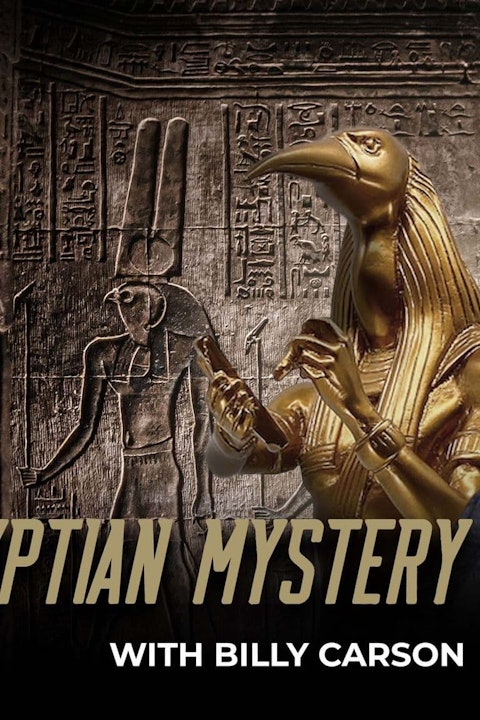
Billy Carson reads the Egyptian gods on two levels. In the [Egyptian Mystery School](/watch/egyptian-mystery-school) series on 4BK TV he treats the neteru as principles of nature and consciousness: forces such as order, wisdom, regeneration and creative speech that the temple tradition personified so they could be taught, remembered and meditated on. That part of his reading sits close to how many Egyptologists describe the gods, as powers rather than simple persons.
The second level is his ancient-astronaut framing. In it, Carson raises the possibility that the myths preserve memories of real beings, perhaps the same beings the Sumerian texts call the Anunnaki, recorded by each culture in its own symbols. He presents this as his interpretation, and mainstream Egyptology does not share it: no Egyptian text names the Anunnaki, and scholars read the gods' animal forms as symbolism rather than descriptions of visitors. Readers can compare the Mesopotamian side of the argument in [who were the Anunnaki](/who-were-the-anunnaki-sumerian-texts-vs-ancient-astronaut-theory).
Watch, read and go deeper
The [Egyptian Mystery School](/watch/egyptian-mystery-school) on 4BK TV carries Billy Carson's full treatment of the neteru and the temple tradition. The [Ancient Egypt topic hub](/topics/ancient-egypt) gathers every article on the gods, the pyramids and the afterlife texts. Readers who want to walk through Egypt's temples in person can check upcoming dates on the tours page.
Frequently asked questions
How many Egyptian gods were there?
There is no fixed number. Hundreds of deities are known by name, many of them gods of a single town, and major gods appeared in several forms or combined with others, as Amun-Ra did. The gods worshipped across the whole country at any one time were a much smaller group.
Who was the most powerful Egyptian god?
It depended on the period. Ra was king of the gods for much of Egyptian history, Amun-Ra was the supreme state god of the New Kingdom, and Osiris ruled the afterlife. For a brief period under Akhenaten, the Aten replaced them all in official religion.
Are the Egyptian gods the same as the Greek gods?
No, but the Greeks matched them to their own. Herodotus equated Amun with Zeus, Osiris with Dionysus, Isis with Demeter and Horus with Apollo, and in the Hellenistic period Thoth was identified with Hermes.
Is the film Gods of Egypt accurate?
No. The 2016 film borrows names such as Horus, Set, Ra, Thoth and Hathor, and the idea of Set taking Horus's eye, but invents its plot and presents the gods as giant, gold-blooded rulers living among humans. The ancient sources describe gods reached through temples, images and ritual.
What does the Eye of Horus mean?
The Eye of Horus, the wedjat, stands for healing, wholeness and protection, because in myth the eye Set injured was made whole again. Egyptians wore it as an amulet and placed it on mummies to protect the dead.
Sources and further reading
- Richard H. Wilkinson, The Complete Gods and Goddesses of Ancient Egypt (Thames & Hudson, 2003)
- Erik Hornung, Conceptions of God in Ancient Egypt: The One and the Many, translated by John Baines (Cornell University Press, 1982)
- Jan Assmann, The Search for God in Ancient Egypt, translated by David Lorton (Cornell University Press, 2001)
- Geraldine Pinch, Egyptian Mythology: A Guide to the Gods, Goddesses, and Traditions of Ancient Egypt (Oxford University Press; first published in 2002 as Handbook of Egyptian Mythology)
- Plutarch, De Iside et Osiride, edited and translated by J. Gwyn Griffiths (University of Wales Press, 1970)
- Miriam Lichtheim, Ancient Egyptian Literature, Volumes I and II (University of California Press, 1973 and 1976), for the Memphite Theology, the Great Hymn to Osiris and the Contendings of Horus and Seth
- R. O. Faulkner, The Ancient Egyptian Pyramid Texts (Clarendon Press, 1969)