 Travel with Billy Carson —
 Cleopatra VII Philopator (69–30 BCE) was the last active ruler of the Ptolemaic dynasty, the Macedonian Greek royal house that governed Egypt from Alexandria for almost three centuries. She ruled from 51 to 30 BCE, allied herself first with Julius Caesar and then with Mark Antony, lost the Battle of Actium to Octavian in 31 BCE and died in Alexandria in August 30 BCE, after which Egypt became a Roman province.
Her story matters because it sits at the hinge between two worlds: the end of three thousand years of pharaonic kingship and the start of Roman rule over the Mediterranean. Two questions remain open: how exactly she died and where she was buried. This guide sets out what the ancient sources say, what archaeology has added and where the evidence runs out.
Who was Cleopatra VII
Cleopatra VII was a queen of Egypt from a Greek-speaking dynasty, not an Egyptian one. The line began with Ptolemy I Soter, one of Alexander the Great's generals, who took control of Egypt after Alexander's death and assumed the title of king around 305 BCE. His successors made Alexandria the leading city of the Hellenistic world; the family and its great library are covered in the companion guide to the Library of Alexandria and the Ptolemies.
She was born in 69 BCE. Her father was Ptolemy XII Auletes; her mother is not securely identified. When her father died in 51 BCE she became queen at about eighteen, and under Ptolemaic custom she ruled alongside male relatives: first her brother Ptolemy XIII, then her younger brother Ptolemy XIV, and finally her own son, Ptolemy XV Caesarion.
The Ptolemies governed through Greek, and Egyptian-language documents of their reigns, such as the bilingual priestly decree of 196 BCE on the Rosetta Stone, were written by temple scribes rather than by the kings themselves. Cleopatra broke that pattern. Plutarch, writing in his Life of Antony (chapter 27), says she could speak with most foreign peoples without an interpreter, and that the kings before her had not even made the effort to learn the Egyptian language. She is therefore usually described as the first of her dynasty known to have learned it.
Cleopatra and Julius Caesar
Cleopatra met Julius Caesar in Alexandria in 48 BCE, in the middle of a civil war with her brother Ptolemy XIII, who had driven her out of the capital. Caesar had arrived in Egypt in pursuit of his Roman rival Pompey, and he set himself up in the royal palace to arbitrate the dispute.
Plutarch's Life of Caesar (chapter 49) tells how she reached him. She sailed into the harbour at dusk in a small boat with one companion, Apollodorus the Sicilian, and because there was no other way to get into the palace unseen, she lay full length inside a bed-sack that Apollodorus tied up and carried in to Caesar. The famous version in which she is unrolled from a carpet is a modern retelling of this account.
Caesar backed her claim. The fighting that followed, known as the Alexandrian War, ended with the death of Ptolemy XIII in early 47 BCE, and Cleopatra was restored to the throne with Ptolemy XIV as her nominal co-ruler. Her son by Caesar, Ptolemy Caesarion, was born in 47 BCE. She later stayed in Rome, and she was there when Caesar was assassinated on the Ides of March, 15 March 44 BCE. She returned to Egypt soon afterwards; Ptolemy XIV died that year, and Caesarion became her co-ruler.
Cleopatra and Mark Antony
Her alliance with Mark Antony began at Tarsus in 41 BCE. Antony, now one of the three men governing the Roman world, had summoned her to answer for her conduct during the Roman civil wars; Plutarch's description of her arrival on the river Cydnus in a gilded barge became one of literature's most retold scenes.
The partnership was both political and personal. In 40 BCE she bore twins, Alexander Helios and Cleopatra Selene, and in 36 BCE a son, Ptolemy Philadelphus. Antony relied on Egypt's wealth and fleet for his campaigns in the east.
In autumn 34 BCE came the ceremony known as the Donations of Alexandria. Cleopatra and Caesarion were proclaimed rulers of Egypt, with Caesarion presented as the son of the deified Caesar, while Alexander Helios was named king of Armenia, Media and Parthia, Cleopatra Selene received Cyrenaica and Libya, and the young Ptolemy Philadelphus received Syria, Phoenicia and Cilicia. In Rome, Octavian, Caesar's adopted heir, turned the event into propaganda: a Roman general handing out the eastern empire to a foreign queen's children. The alliance between the two men collapsed into open war.
The Battle of Actium and the fall of Alexandria
The war was decided at sea off Actium, on the western coast of Greece, on 2 September 31 BCE. Octavian's fleet, commanded by Marcus Agrippa, defeated Antony and Cleopatra; the two escaped with part of their ships, but most of their fleet was lost and their army in Greece went over to Octavian.
They withdrew to Egypt. Octavian advanced on Alexandria the following summer and took the city on 1 August 30 BCE. Antony, hearing a false report that Cleopatra was already dead, fell on his sword and died. Cleopatra was taken into Octavian's custody and died later that month; the date is usually given as 10 or 12 August 30 BCE, and she was 39.
Caesarion, who as Ptolemy XV was nominally king after her death, was hunted down and killed on Octavian's orders. Egypt was annexed as a Roman province under a governor answerable to Octavian alone. That is why Cleopatra is best described as the last active ruler of Ptolemaic Egypt rather than simply "the last pharaoh": her teenage son technically outlived her as king, if only briefly.
How did Cleopatra die
No one knows for certain how Cleopatra died, and the ancient writers said so themselves. The earliest surviving source, the geographer Strabo, who lived through these years, gives two versions: that she was bitten by an asp, or that she applied a poisonous ointment.
Plutarch, writing more than a century later, gives the fullest account (Life of Antony, chapters 85–86). He tells the story that an asp was smuggled to her hidden under figs and leaves in a basket, and then adds plainly that "the truth of the matter no one knows." He reports other versions: that she carried poison in a hollow comb hidden in her hair, or that the snake was kept in a water jar. No spot or sign of poison was found on her body, he says, though some reported two slight, indistinct punctures on her arm. Cassius Dio, writing in the third century CE, repeats the asp story and adds that others said she smeared poison on a pin she used to fasten her hair.
The snake version won the public argument early. Horace's ode on her death (Odes 1.37) speaks of her handling serpents, and in Octavian's triumph in Rome in 29 BCE an image of Cleopatra with an asp clinging to her was carried in the procession. The asp is the ancient tradition, and poison by other means is an equally discussed possibility; the honest answer is that the method is unknown.
How Cleopatra presented herself in Egypt
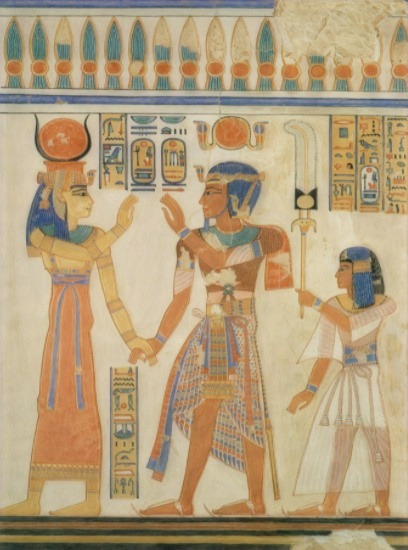
To her Greek subjects Cleopatra was a Macedonian queen; to Egypt's temples she was a pharaoh. In Egyptian reliefs she appears in fully traditional royal form, making offerings to the gods. The best-known example is the large relief on the rear wall of the Temple of Hathor at Dendera, where she stands with Caesarion before the deities; the temple and that relief are described in the guide to Hathor and the Dendera temple.
She was also closely associated with Isis, the great mother goddess, wife of Osiris and mother of Horus; ancient writers say she appeared in public dressed as the goddess and was hailed as a "new Isis." For who Isis was and why the link mattered, see the guide to the Egyptian gods and goddesses.
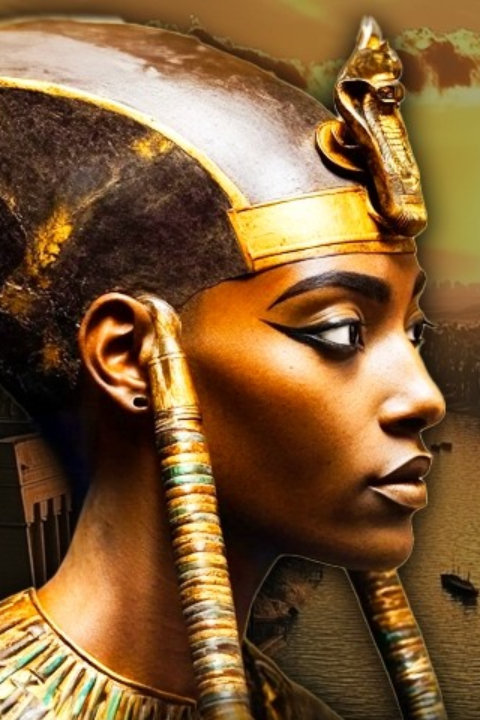
Her appearance and ancestry are regularly argued over in film and television casting debates, but the record names her father and not securely her mother, and her likeness survives mainly on coins and idealised sculpture.
Where is Cleopatra's tomb
Cleopatra's tomb has never been found. Plutarch says she had a lofty and beautiful tomb and monument built near the temple of Isis, and that she shut herself inside it as Octavian approached. After her death, he writes, Octavian ordered that she be buried with Antony in splendid and royal fashion. The location of that mausoleum is lost.
Part of the reason is that much of Alexandria's royal quarter now lies under water. Since 1992 Franck Goddio's European Institute for Underwater Archaeology (IEASM), working with Egypt's Supreme Council of Antiquities, has mapped the floor of the eastern harbour, the ancient Portus Magnus. The team located the royal island of Antirhodos with a small temple of Isis, and recovered finds including a granite head attributed to Caesarion and a black granite sphinx believed to represent Ptolemy XII. The submergence is attributed to a series of earthquakes and tidal waves. Most Egyptologists expect the royal tomb to have been in Alexandria, which would place it in the area that has been built over or has sunk.
The Taposiris Magna search
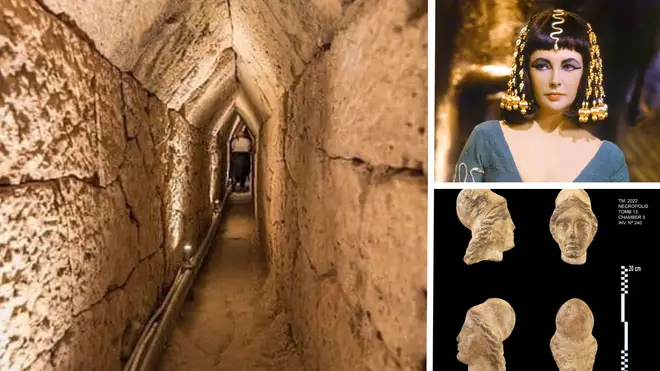
The best-known alternative is Taposiris Magna, a Ptolemaic temple site on the coast roughly 45 km west of Alexandria. The Dominican archaeologist Kathleen Martinez of the University of Santo Domingo has excavated there since the mid-2000s, arguing that Cleopatra and Antony may have been buried at the temple rather than in the capital. Her team has reported coins bearing the names and images of Cleopatra and Alexander the Great, figurines of Isis and Greco-Roman burial shafts.
In November 2022 Egypt's Ministry of Tourism and Antiquities announced that the mission had found a rock-cut tunnel about 1,305 metres long, about 2 metres high and about 13 metres below ground. The ministry compared its engineering to the Tunnel of Eupalinos on the Greek island of Samos, a 6th-century BCE aqueduct about 1,036 metres long. Part of the Taposiris complex lies under the sea, a result of earthquakes that struck the coast between 320 and 1303 CE. The tunnel's purpose is unknown, and no tomb has been found; the 4biddenknowledge blog covered the announcement in its report on the tunnel beneath Taposiris Magna. The theory remains a live hypothesis, not a result.
Billy Carson's reading
Billy Carson has not published a dedicated video or episode on Cleopatra, so this article does not attribute a position on her to him. Her story does, however, touch two themes that run through his work on Egypt.
The first is lost knowledge. In Carson's broader teaching, humanity has repeatedly built up advanced knowledge and then lost it, with what survives coming down in fragments; Cleopatra's Alexandria, with its library and its sunken palace quarter, is one of the clearest historical examples of a world that was partly erased. The second is the Egyptian temple tradition she adopted so deliberately, from the Isis cult to the Dendera reliefs, which Carson explores in the 4BK TV series Egyptian Mystery School. The 4biddenknowledge blog has followed the Taposiris Magna excavation as part of the search for her tomb, reporting it as an open question rather than a solved one.
Watch, read and go deeper
For Billy Carson's teaching on Egyptian temples, symbolism and the mystery traditions Cleopatra drew on, watch Egyptian Mystery School on 4BK TV. Read the Dendera and Library of Alexandria guides alongside this one for her temple portrait and the dynasty she ended. The Ancient Egypt topic hub gathers every related article, from the gods she identified with to the script her ancestors' priests carved at Rosetta.
Frequently asked questions
Was Cleopatra Egyptian or Greek?
Cleopatra belonged to the Ptolemaic dynasty, a Macedonian Greek royal family descended from Ptolemy I, one of Alexander the Great's generals. Her father was Ptolemy XII; her mother is not securely identified. She was born and ruled in Egypt, presented herself as a pharaoh in Egyptian temples, and according to Plutarch learned the Egyptian language, which her predecessors had not.
Was Cleopatra the last pharaoh of Egypt?
She was the last active ruler of Ptolemaic Egypt. After her death in August 30 BCE her son Caesarion, Ptolemy XV, was nominally king until Octavian had him killed, and Egypt then became a Roman province.
Did Cleopatra really die from an asp bite?
The method is unknown. Strabo, the earliest source, gives either an asp or a poisonous ointment, and Plutarch tells the asp-in-the-figs story but adds that "the truth of the matter no one knows," also mentioning poison in a hollow comb. The asp became the official version through Roman poetry and Octavian's triumph.
How many children did Cleopatra have?
Four are recorded. Caesarion, her son by Julius Caesar, was born in 47 BCE. With Mark Antony she had twins, Alexander Helios and Cleopatra Selene, in 40 BCE, and a son, Ptolemy Philadelphus, in 36 BCE.
Has Cleopatra's tomb been found?
No. Plutarch places her mausoleum near a temple of Isis in Alexandria, and most Egyptologists expect it to lie in the city, possibly in areas now built over or under the harbour. Kathleen Martinez's excavation at Taposiris Magna, including a 1,305-metre tunnel announced in 2022, is investigating an alternative site, but no tomb has been identified there.
Sources and further reading
- Plutarch, Life of Antony and Life of Caesar, in the Bernadotte Perrin translation (Loeb Classical Library)
- Strabo, Geography, Book 17
- Cassius Dio, Roman History, Books 50–51
- Duane W. Roller, Cleopatra: A Biography (Oxford University Press, 2010)
- Stacy Schiff, Cleopatra: A Life (2010)
- Franck Goddio and David Fabre (eds.), Egypt's Sunken Treasures (2008)
- Egypt's Ministry of Tourism and Antiquities, statement on the Taposiris Magna tunnel (November 2022)