 Travel with Billy Carson —
 Nefertari's tomb, catalogued as QV66, is the burial place of Queen Nefertari, the first Great Royal Wife of Ramesses II, cut into the hillside of the Valley of the Queens on Luxor's west bank in the 13th century BCE. Rediscovered by Ernesto Schiaparelli in 1904, it carries some 520 square metres of painted plaster based on the Book of the Dead and is often called the most beautiful tomb in Egypt.
It matters for two reasons. The paintings are among the best-preserved expressions of how Egyptians imagined a queen's journey through the afterlife, with the colours still bright more than three thousand years on. And the tomb is a case study in what modern conservation can and cannot do: by the 1980s the walls were shedding their paint, and the six-year project that saved them deliberately added nothing new.
Who was Nefertari?
Nefertari, in full Nefertari Meritmut ("beautiful companion, beloved of Mut"), was the first and most prominent of the Great Royal Wives of Ramesses II, who reigned from about 1279 to 1213 BCE. She married him before he became king, and her parentage is not recorded; a knob bearing the cartouche of the earlier pharaoh Ay found in her tomb has prompted speculation about a family link, but there is no conclusive evidence for it. She was not Ramesses' only wife, and she is not related to the better-known Nefertiti of the Amarna period, despite the similar name.
Her status shows clearly in stone. The Small Temple at Abu Simbel is dedicated to her and to the goddess Hathor, and on its façade her standing statues are carved at the same height as the king's, which is rare in Egyptian royal art. She also had a diplomatic voice. After the peace treaty between Egypt and the Hittites, she exchanged letters and gifts with the Hittite queen Puduhepa; cuneiform tablets from the Hittite capital Hattusa preserve this correspondence, in which she is called Naptera, Great Queen of Egypt.
Nefertari is last securely attested around the time the Abu Simbel temples were dedicated, in about year 24 of the reign. She probably died in the third decade of Ramesses' rule, around 1255 BCE, though the exact date is not known.
Where is QV66 and how was it found?
QV66 lies in the Valley of the Queens, a side valley of the Theban necropolis on the west bank at Luxor, a short distance from the Valley of the Kings (the Luxor guide covers the wider necropolis). The "QV" number is simply its place in the modern catalogue of the valley's tombs.
Ernesto Schiaparelli, director of the Egyptian Museum in Turin, led the Italian Archaeological Mission that entered the tomb in 1904. It had been robbed in antiquity, and the mummy and most of the burial goods were gone. What remained was still telling: fragments of the pink granite sarcophagus lid, about thirty shabti figures, pottery, pieces of furniture and wooden boxes, a pair of sandals, a djed amulet and parts of a mummy's legs. Most of these finds are now in the Museo Egizio in Turin.
In 2016 a multidisciplinary team led by Michael Habicht and Frank Rühli, with Joann Fletcher and colleagues, published a study of those legs in the journal PLOS ONE. Using radiocarbon dating, anthropology, palaeopathology, chemical analysis of the embalming materials and genetic testing, they found the knees belonged to an adult woman of about 40 who stood roughly 1.65 metres tall, and that the embalming fitted 13th-century BCE practice. Their conclusion was carefully worded: the most likely scenario is that the knees truly belong to Queen Nefertari. That is a strong probability, not proof, and the rest of her body has never been found.
How the tomb is laid out
The tomb is built on two levels. A rock-cut stairway leads down to an antechamber whose ceiling is painted dark blue and scattered with yellow five-pointed stars, the night sky through which the dead travelled. A doorway in the antechamber's east wall, flanked by Osiris and Anubis, opens through a vestibule into a side chamber decorated with offering scenes.
From the antechamber a second, steeper stairway descends to the burial chamber. This room covers about 90 square metres, and its starred ceiling rests on four pillars cut from the living rock and decorated on all sixteen faces. The sarcophagus once stood in a depression at the centre, between the pillars.
The rock itself was a problem. The limestone of the valley is fractured and banded with flint, so it could not take fine carving or paint directly. The builders instead covered the walls with layers of plaster, lightly carved the figures and texts into it in low relief, primed the surface with a gypsum wash and then painted. That technique is what gives the figures their soft modelled look, and it is also what made them so vulnerable.
What the paintings show
The decoration is a guided passage through the next world, drawn from the Book of the Dead. In the antechamber, texts from chapter 17, one of the longest and oldest spells in the collection, accompany the best-known image in the tomb: Nefertari seated under a reed shelter playing senet, a board game that by this period was bound up with the soul's passage into the afterlife.
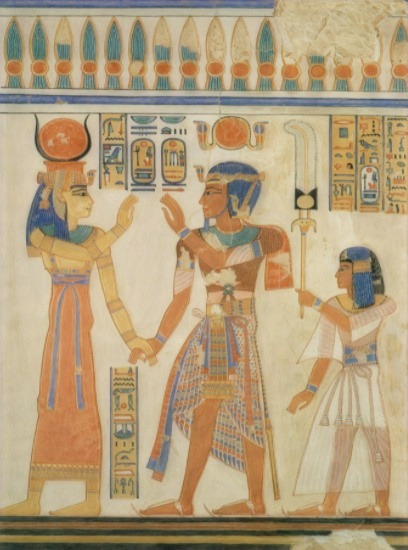
In the side chamber, chapter 94 is written out in full beside a scene of the queen standing before Thoth, the ibis-headed god of writing, with a stand holding a scribe's palette and water bowl between them. Nearby, chapter 148 shows seven cows and a bull who provide the dead with food. Elsewhere on the upper level Isis takes Nefertari by the hand and leads her to the gods, Hathor receives her, and a vignette shows the ram-headed god who unites Re and Osiris, flanked by Isis and Nephthys.
The burial chamber turns to the final stage of the journey. Chapter 144 on one side describes the gates of the realm of Osiris and their guardians, and chapter 146 on the other lists the portals the queen must name to pass. On the pillars Nefertari is welcomed by Isis, Hathor and Anubis, while Osiris figures and djed pillars, the "backbone of Osiris", face the space where the sarcophagus lay. A band of alternating djed pillars and tyet knots, symbols of stability and of Isis, once ran around the sarcophagus depression.
Why the paintings were falling off the walls
The paintings were already damaged when Schiaparelli opened the tomb, and the main culprit was salt. Salt is present in the local limestone and in the Nile-mud plaster. Whenever moisture got in, from occasional flash floods, seepage through cracks in the rock, or the humidity of people working and breathing inside, the salt dissolved and moved towards the surface. As the moisture dried, the salt crystallised in and behind the plaster, lifting the painted layer and pushing it away from the wall.
Human handling made it worse. In the decades after 1904 the tomb saw dust, soot, careless treatment and vandalism, and visitors added warmth and humidity. By the 1980s, according to the Getty Conservation Institute, at least a fifth of the wall paintings had been lost, and large areas were hanging on by a thread.
What the Getty conservation project did
From 1986 to 1992 the Getty Conservation Institute and the Egyptian Antiquities Organization ran a joint project with an international team of conservators and scientists. The first phase was emergency stabilisation: the most fragile areas of detaching plaster were faced with paper to hold them in place. The longer phase was conservation proper, re-attaching loose plaster, consolidating the paint and cleaning off dirt and salt.
The guiding principle was restraint. Nothing was repainted, nothing was reconstructed and the paintings were not "restored to new". The Getty states that not a single drop of new paint was added, and the cleaning methods were reversible. Where original paint had been lost, the gaps were left as plain patches of plaster made from local materials, so that what a visitor sees today is the ancient work and only the ancient work. The project also built up a scientific picture of the tomb's microclimate, and the Getty continued to monitor conditions after the treatment was finished, because the salt problem can be managed but not removed. The full record is published in the Getty volumes Art and Eternity (1993) and House of Eternity (1996).
Can you visit Nefertari's tomb?
Sometimes, and under strict limits. The tomb was closed to the public for most of the 20th century and opened to visitors in November 1995, after the conservation work. Since then access has been capped and sold as a separate, premium ticket on top of the general Valley of the Queens entry, and visitors typically report a short time limit inside of around ten minutes to keep humidity down.
In March 2024 Egypt's Ministry of Tourism and Antiquities closed the tomb for conservation work, and a specialist committee was then set up to measure humidity and decide the conditions for a controlled reopening. Reports since then have differed on its status, so anyone planning a trip should check the official Egyptian monuments site, egymonuments.gov.eg, before going rather than rely on older travel guides. Prices change often and are not given here.
If the tomb is shut, the Valley of the Queens is still worth the visit. The tombs of two sons of Ramesses III, Khaemwaset (QV44) and Amenherkhepeshef (QV55), have well-preserved paintings in a similar style; the story of Ramesses III and the harem conspiracy gives the background to that family. For contrast with a king's burial in the neighbouring valley, see the guide to Tutankhamun's tomb, KV62.
Billy Carson's reading
Billy Carson has not, so far as the 4biddenknowledge archive shows, published a talk devoted to Nefertari or to QV66 itself, so no specific interpretation of the tomb is attributed to him here. His closest material concerns the site most bound up with her memory. His official YouTube channel carries a livestream titled "The Abu Simbel Temple Alignment", tied to his Sacred Egypt tour, which looks at the temple complex where Nefertari's Small Temple stands beside the Great Temple of Ramesses II.
The questions Carson brings to Egypt in that material, about how much the builders knew of the sky and why they wrote that knowledge into stone, apply naturally to a tomb whose ceilings are painted as a starry night and whose walls map the soul's route through the heavens. The mainstream account above, from the Getty's conservation record to the 2016 study, is the foundation for asking them.
Watch, read and go deeper
Billy Carson's Abu Simbel livestream is embedded in the Abu Simbel guide, which covers Nefertari's Small Temple in detail. For further listening on Egypt's royal women and men, the podcast episode The Hidden Black Kings and Queens of Ancient Egypt with Billy Carson is on the 4biddenknowledge Podcast. The texts painted on Nefertari's walls are explained in the Book of the Dead guide, and the Ancient Egypt topic hub gathers every related article, from the gods to the temples of Thebes.
Frequently asked questions
Where is Nefertari's tomb?
Nefertari's tomb, QV66, is in the Valley of the Queens on the west bank of the Nile at Luxor, in southern Egypt. The valley is part of the Theban necropolis, close to the Valley of the Kings. It was rediscovered in 1904 by Ernesto Schiaparelli's Italian mission.
Was Nefertari's mummy found?
No complete mummy was found, because the tomb had been robbed in antiquity. Schiaparelli recovered parts of a pair of legs, now in the Museo Egizio in Turin. A 2016 PLOS ONE study concluded that these knees most likely belong to Nefertari, but that is a probability rather than proof.
Were the paintings repainted during the Getty conservation?
No. The Getty Conservation Institute and the Egyptian Antiquities Organization worked from 1986 to 1992 using cleaning and consolidation only. No new paint was added and no missing scenes were reconstructed; lost areas were left as plain plaster.
What is the famous senet scene?
In the antechamber Nefertari is shown seated under a reed shelter playing senet, a board game. The scene accompanies chapter 17 of the Book of the Dead, and the game was associated with the soul's passage through the afterlife.
Is Nefertari's tomb open to visitors?
Access has been limited and separately ticketed since the tomb opened to visitors in November 1995, and it was closed in March 2024 for conservation work and humidity checks. Reports on its status since then vary. Check the official site egymonuments.gov.eg before planning a visit.
Sources and further reading
- Michael E. Habicht, Frank J. Rühli, Joann Fletcher and colleagues, "Queen Nefertari, the Royal Spouse of Pharaoh Ramses II: A Multidisciplinary Investigation of the Mummified Remains Found in Her Tomb (QV66)", PLOS ONE (2016)
- John K. McDonald, House of Eternity: The Tomb of Nefertari (Getty Conservation Institute and J. Paul Getty Museum, 1996)
- Getty Conservation Institute, Art and Eternity: The Nefertari Wall Paintings Conservation Project, 1986–1992 (1993)
- Getty Conservation Institute, "Tomb of Nefertari" project records
- K. A. Kitchen, Pharaoh Triumphant: The Life and Times of Ramesses II (Aris & Phillips, 1982)
- Raymond O. Faulkner (trans.), The Ancient Egyptian Book of the Dead, edited by Carol Andrews (British Museum Publications, 1985)