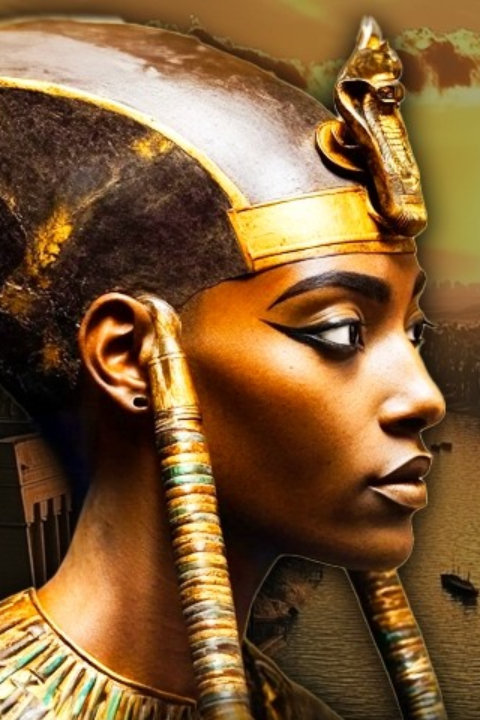
Hatshepsut was a female king of ancient Egypt, the sixth ruler of the 18th Dynasty, who reigned from about 1479 to 1458 BCE. She began as regent for her young stepson Thutmose III, took the full titles of a pharaoh by around his seventh regnal year, and ruled as senior king for roughly two decades. She built the terraced temple at Deir el-Bahari, sent a celebrated trading expedition to the land of Punt, and after her death had many of her names and images cut from Egypt's monuments.
Hatshepsut matters because she sits at the center of several questions people still argue about: how a woman held the most masculine office in the ancient world, why her memory was attacked, where Punt actually was, and whether a mummy found in a small tomb in the Valley of the Kings really is her. Each of those questions has a solid core of evidence and a fringe of speculation, and this guide separates the two. For the wider picture of Egypt's kings, gods and temples, start at the Ancient Egypt topic hub.
Who was Hatshepsut
Hatshepsut was a king's daughter, a king's wife and then a king in her own right. She was the daughter of Thutmose I and his great royal wife Ahmose, and she married her half-brother Thutmose II, as royal women of this dynasty sometimes did. Her personal name is usually translated as "foremost of noble women," and as king she took the throne name Maatkare, roughly "Maat is the ka of Ra," tying her rule to maat, the Egyptian principle of order and right.
When Thutmose II died, the heir was his son by a secondary wife, the future Thutmose III, who was only a small child, probably about two years old. Hatshepsut acted as regent, a normal arrangement for a royal widow. What was not normal is what happened next. By about Year 7 of Thutmose III's reign she had adopted the full royal titulary and was presented as king, with Thutmose III kept on as a junior co-ruler rather than removed. Most chronologies place her reign at roughly 1479 to 1458 BCE, with small differences depending on the dating scheme used.
She was not the first woman to rule Egypt. Sobekneferu had held the throne at the end of the 12th Dynasty, centuries earlier, and much earlier still the Sumerian King List names a woman, Kubaba of Kish, among its kings. But Hatshepsut's reign was longer, wealthier and far better documented than any earlier female ruler's.
How she presented herself as king
Hatshepsut's official image changed over time, from a royal woman in a queen's dress to a king in full regalia. Early statues show her with a female body and feminine dress. Later ones show her in the king's kilt, the striped nemes headcloth and the ceremonial false beard, with a body that follows the standard masculine conventions of royal sculpture. Yet many inscriptions kept feminine grammar, calling her "she" and using feminine word endings even beside male imagery.
Peter Dorman, an Egyptologist at the University of Chicago, argues that this was not a sudden coup. In his reading, "The question was not the wielding of power but how to represent it in a public context." Egyptian art and ideology had a ready-made picture for a king, and it was male, so Hatshepsut adapted herself to the picture rather than the other way round. To ground her claim, she stressed her descent from her father, Thutmose I, and in reliefs at Deir el-Bahari she had her conception and birth shown as the work of the god Amun, a theme known as the divine birth. Later kings, including Amenhotep III, used the same motif.
She was not simply a usurper who shoved a child aside, since Thutmose III remained a crowned co-ruler throughout.
Deir el-Bahari and the temple called Djeser-Djeseru
Hatshepsut's greatest monument is her mortuary temple at Deir el-Bahari on the west bank of the Nile at Thebes, modern Luxor. The Egyptians called it Djeser-Djeseru, usually translated "holy of holies." It rises in broad terraces linked by ramps against the cliffs, right beside the much older temple of the Middle Kingdom king Mentuhotep II, which it consciously echoes. If you want to place it in the landscape alongside Karnak, Luxor Temple and the royal tombs, the Luxor guide walks through the whole area.
The temple's colonnades carry her key propaganda: the divine-birth cycle, the transport of obelisks, and the Punt expedition. Her steward Senenmut, one of the most powerful officials of the reign, is often credited as its architect, but that attribution is not certain. Other officials, including the high priest Hapuseneb, are also associated with her building works, and no surviving text simply names a designer.
The reliefs also tell us about the people who made them. A 2021 study in the journal Antiquity, led by Anastasiia Stupko-Lubczynska of the University of Warsaw, found that work in one of the temple's chapels was done in stages by carvers of different skill levels, with practiced and less practiced hands working on the same scenes. The 4biddenknowledge write-up covers how masters and novices shared the work on her temple.
At Karnak, across the river, she raised obelisks to Amun. One of her pair still stands in the temple and is among the tallest surviving obelisks from ancient Egypt.
The expedition to Punt
In about Year 9 of the reign, an expedition sailed down the Red Sea to the land of Punt and came back with a cargo that the Deir el-Bahari reliefs record in detail. The inscriptions list myrrh resin, 31 live myrrh trees, frankincense and other incense, ebony, ivory, gold, aromatic woods, eye cosmetic, animal skins and live apes and monkeys. The live trees were meant to be planted at the temple so that Amun's incense could be grown in Egypt.
The reliefs show houses raised on stilts, the ships being loaded, and the ruler of Punt, named Parehu, with his wife, Queen Ati, whose heavy figure is one of the most recognizable images in Egyptian art. Punt was not a new discovery. Egyptians had traded there since the Old Kingdom, but Hatshepsut's expedition is the best recorded.
Where Punt was is still debated. Most scholars place it on the southern Red Sea or Horn of Africa coast, somewhere in the region of today's eastern Sudan, Eritrea, Ethiopia, Djibouti or Somalia, with some arguing for the Arabian side. No site has been definitively identified as Punt, so any claim that the question is settled goes beyond the evidence.
Why were her names and images erased
After Hatshepsut died, in Thutmose III's Year 22, many of her names and images were chiseled out, replaced with the names of Thutmose I, Thutmose II or Thutmose III, or covered over, and statues from Deir el-Bahari were smashed and dumped in nearby pits. The old explanation was simple: Thutmose III hated his stepmother and took revenge the moment he could.
The dating does not support that story. Dorman points out that at Karnak, Thutmose III encased Hatshepsut's suite of rooms in new sandstone walls and carved his own annals over them, and that this Hall of Annals was built no earlier than his Year 42, roughly two decades after her death. As he puts it, "Vengeance will not easily abide a delay of two decades." For many years after she died, her monuments appear to have been left largely alone.
So why do it at all? The most widely discussed explanation is dynastic. Late in his reign, Thutmose III was securing the succession for his own son, the future Amenhotep II, and a female king who traced her right to rule through Thutmose I offered an alternative line of legitimacy that was better left out of the record. Some scholars think the campaign continued into Amenhotep II's reign. Discomfort with the image of a female king may also have played a part, and Dorman suggests her successors could have found her position "ideologically problematic." That is one interpretation among several, not proof that she was erased simply because she was a woman.
Hatshepsut is not the only ruler of this dynasty whose memory was attacked. A century later, Akhenaten was struck from the king lists for very different reasons, and the Akhenaten guide explains how that erasure worked.
Where was Hatshepsut buried, and has her mummy been found
Hatshepsut was probably first buried in KV20 in the Valley of the Kings, a tomb originally cut for her father, Thutmose I, and extended for her. The story of her mummy runs through a different, much smaller tomb, KV60. Howard Carter found KV60 in 1903 and recorded two female mummies inside. One was later taken to Cairo, while the other was left lying on the floor of the tomb. In 1966 the Egyptologist Elizabeth Thomas was the first to suggest that the mummy left behind might be Hatshepsut. The tomb's location was then forgotten until Donald Ryan's team re-found it in 1989. Carter is better known for a later find in the same valley, covered in the Tutankhamun's tomb guide.
In June 2007 Zahi Hawass announced that the mummy known as KV60A had been identified as Hatshepsut. The key evidence came from CT scans of a small wooden box inscribed with her name, which had been found in the Deir el-Bahari royal cache, DB320. The box held a mummified liver and a single molar, and the team reported that the tooth fitted a gap in KV60A's jaw. The project was funded and filmed by the Discovery Channel for the documentary "Secrets of Egypt's Lost Queen." The scans suggested the woman was older and heavily overweight, with severe dental disease, osteoarthritis and a probable cancerous tumor.
The identification is widely accepted, but it is not beyond dispute. J. L. Thimes argued in KMT in 2008 that the tooth may have been misidentified, and Bickerstaffe questioned the attribution in The Heritage of Egypt the same year. DNA work was reported as encouraging at the time, but a conclusive DNA match has not been published. On 3 April 2021 the mummy traveled with 21 others, 18 kings and four queens in all, in the Pharaohs' Golden Parade from the Egyptian Museum in Tahrir Square to the National Museum of Egyptian Civilization in Cairo.
Billy Carson's reading
Billy Carson has not, so far as the 4biddenknowledge archive shows, released a dedicated talk on Hatshepsut, and this guide does not attribute specific claims about her to him. His broader work on Egypt focuses on Kemet's mystery traditions and on recovering the stories of its royal women and men, and Hatshepsut's reign is a natural case study for that wider conversation. The 4biddenknowledge blog has also covered the University of Warsaw study of her temple's artists, using it to make the point that Kemet's monuments were the work of skilled and trained people, which the research itself supports.
For readers following Billy's Egypt material, the useful frame is to start from what the reliefs, inscriptions and archaeology show, then weigh the interpretations built on top of them.
Watch, read and go deeper
For a guided series on Egypt's sacred sites and teachings, watch Egyptian Mystery School on 4BK TV. For further listening on Egypt's royal women and men, the podcast episode The Hidden Black Kings and Queens of Ancient Egypt with Billy Carson is a good place to start. To see where Deir el-Bahari sits on the ground, read the Luxor guide, and browse the rest of the series on the Ancient Egypt topic hub.
Frequently asked questions
Was Hatshepsut the first female pharaoh?
No. Sobekneferu ruled Egypt as king at the end of the 12th Dynasty, centuries before her, and a few other women may have held power earlier. Hatshepsut is the best known because her reign was long, prosperous and richly recorded on monuments that survive.
Why did Hatshepsut wear a false beard?
The false beard was part of the formal costume of kingship, worn by male kings as well, not a disguise. Her later images show her with the kilt, nemes headcloth and beard because Egyptian art had one standard image of a king, while many texts kept calling her "she."
Did Thutmose III erase Hatshepsut out of hatred?
That was the traditional view, but the evidence weighs against it. The most systematic attacks on her monuments date to late in Thutmose III's reign, about 20 years after her death, which points to dynastic politics and the succession of Amenhotep II rather than personal revenge.
Where was the land of Punt?
Nobody knows for certain. Most scholars place Punt on the southern Red Sea or Horn of Africa coast, roughly in the area of eastern Sudan, Eritrea, Ethiopia, Djibouti or Somalia, and some argue for southern Arabia.
How did Hatshepsut die?
The cause of death is not known. If mummy KV60A is hers, she was older, overweight and suffered from dental disease, arthritis and probably cancer. A 2011 suggestion that a skin lotion in a flask attributed to her contributed to her death is speculation, not an established finding.
Sources and further reading
- Peter F. Dorman, "Hatshepsut: Wicked Stepmother or Joan of Arc?" Oriental Institute News & Notes 168 (Winter 2001)
- Catharine H. Roehrig, ed., Hatshepsut: From Queen to Pharaoh (Metropolitan Museum of Art, 2005)
- Joyce Tyldesley, Hatchepsut: The Female Pharaoh (1996)
- James Henry Breasted, Ancient Records of Egypt, Volume II (1906), the Punt inscriptions
- Elizabeth Thomas, The Royal Necropoleis of Thebes (1966)
- J. L. Thimes, "A Dental Observation," KMT 19, no. 3 (2008)
- Anastasiia Stupko-Lubczynska et al., study of the Hatshepsut chapel reliefs, Antiquity (2021)