The Great Sphinx of Giza is a lion-bodied, human-headed figure carved directly from the limestone bedrock of the Giza plateau, about 73 metres long and 20 metres high, facing due east. Most Egyptologists date it to the reign of the Fourth Dynasty king Khafre, around 2558–2532 BCE, based on its quarry, its temples and its place in the Giza building sequence. A minority view, led by Boston University geologist Robert Schoch, argues that the weathering of its enclosure points to a much older origin.
The question matters because the Sphinx is the hinge of a larger argument about the human past. If the conventional date holds, the statue is one piece of a well-documented Old Kingdom building programme. If the weathering argument is right, the story of civilisation in the Nile Valley would need to be rewritten. This guide sets out the physical evidence, the water-erosion debate, what has been found underneath, and how Billy Carson reads the monument.
What is the Great Sphinx of Giza?
The Great Sphinx is a sculpture carved in place rather than built from blocks. Its body was cut from layers of the Mokattam limestone formation that vary in hardness, with the head shaped from a better-quality bed near the top. The carvers removed the rock around it, leaving the figure crouching in a deep quarried enclosure, and masonry was added later to protect and fill out the softer lower body.
The Sphinx sits at the foot of the causeway leading up to Khafre's pyramid, beside Khafre's valley temple. Directly in front of it stands a separate building, the Sphinx Temple, whose east–west axis lines up with the sunrise and sunset at the equinoxes.
The word sphinx is Greek, and no Old Kingdom inscription names the statue, which is a large part of why its date is argued over. Even Herodotus, who described the pyramids in the fifth century BCE, never mentions it, a puzzle explored in [why the Great Sphinx is missing from ancient history](/why-is-the-great-sphinx-missing-from-ancient-history). By the New Kingdom, more than a thousand years after Khafre, Egyptians called it Horemakhet, “Horus in the Horizon,” and venerated it as a form of the sun god. The wider family of deities it was tied to is covered in [our guide to the Egyptian gods and goddesses](/egyptian-gods-and-goddesses-explained-ra-osiris-isis-horus-thoth-and-more).
Who built the Great Sphinx? The case for Khafre
The mainstream answer is that Khafre's workforce carved the Sphinx, and that conclusion rests on several independent lines of evidence rather than on a single inscription.
The strongest is the quarry itself. Between 1979 and 1983, Mark Lehner's mapping project for the American Research Center in Egypt recorded the Sphinx and its enclosure stone by stone. The large limestone core blocks of the Sphinx Temple, and those of Khafre's valley temple next to it, match the geological layers cut away from the enclosure. In other words, the hollow around the Sphinx was quarried at the same time those temples were built, and the temples belong to Khafre's complex.
The layout points the same way. The Sphinx Temple and the valley temple share a plan and building technique, and the enclosure sits along Khafre's causeway, reading as one planned group. The wider building sequence at Giza is traced in [how the Great Pyramid of Giza was built](/how-was-the-great-pyramid-of-giza-built-evidence-theories-and-open-questions).
Then there is the Dream Stela, the granite slab set between the paws by Thutmose IV around 1400 BCE. It tells how the young prince fell asleep in the Sphinx's shadow and was promised the throne if he freed the statue from the sand. A damaged line contains the syllable “Khaf,” which early scholars took as a reference to Khafre. Because the surrounding text is lost, most Egyptologists now treat it as supporting evidence at best.
The softest argument is the face. Some scholars see a resemblance to statues of Khafre, while a forensic comparison by police artist Frank Domingo in the early 1990s concluded the faces did not match.
Could it have been Khufu or Djedefre?
A few Egyptologists accept a Fourth Dynasty date but name a different king. Rainer Stadelmann, a former director of the German Archaeological Institute in Cairo, argued on stylistic grounds that the Sphinx belongs to Khafre's father, Khufu. Vassil Dobrev of the French Institute in Cairo proposed that Djedefre, Khufu's son and Khafre's predecessor, commissioned it as an image of his father.
These disagreements span only a few decades and keep the Sphinx inside the same dynasty.
What is the water-erosion hypothesis?
The water-erosion hypothesis holds that the Sphinx enclosure shows weathering produced by long periods of heavy rainfall, which would place the carving thousands of years before Khafre.
The idea began outside geology. John Anthony West, building on the earlier writings of R. A. Schwaller de Lubicz, raised it in Serpent in the Sky (1979) and later brought the question to Robert Schoch. Between 1990 and 1992 Schoch examined the site with West and presented his findings at the Geological Society of America's 1992 annual meeting.
Schoch's core observation is the shape of the weathering. The enclosure walls and the body show a rounded, rolling profile cut by deep vertical fissures, which he reads as the signature of rainwater running down exposed rock over a very long time. He contrasts this with the more wind-scoured surfaces of Old Kingdom tombs cut nearby. A 1991 seismic survey he ran with geophysicist Thomas Dobecki also measured how deep the weathering reaches below the enclosure floor, and Schoch argued that the variation implied a long exposure.
His first estimate put the carving at least as far back as 7000–5000 BCE. He later suggested the core of the Sphinx could date to around 10,000 BCE or earlier. Schoch also argues that the limestone cores of the Sphinx and valley temples carry the same weathering and were refaced with granite in the Old Kingdom, which, in his view, answers the quarry argument.
Why most geologists and Egyptologists disagree
Most Egyptologists, and several geologists, reject the early date because they see the weathering as explainable within known history and find no trace of an older culture able to carve the monument.
The first objection is mechanism. K. Lal Gauri and colleagues, and Egyptologists Mark Lehner and Zahi Hawass, point to salt crystallisation: moisture draws salts out of the limestone, the crystals grow in the pores, and the stone flakes away in sheets, a process that is visibly active on the Sphinx today. Wind-blown sand, periodic Nile flooding and water trapped in the sand that repeatedly filled the enclosure add to it. James Harrell argued that moisture held in that sand fill could account for deep weathering without heavy rain.
The second concerns climate. Northeast Africa was markedly wetter in the millennia before the pyramids, the same humid phase that supported the cattle-herding communities of Nabta Playa in the Western Desert, and rainfall did not stop entirely in the Old Kingdom. Critics argue that this is enough to produce the features Schoch describes.
British geologist Colin Reader occupies the middle ground. He agreed that running water did real damage, but argued that surface run-off across the plateau explains it and that the evidence fits a date in the Early Dynastic period, a few centuries before Khafre rather than thousands of years.
The third objection is archaeological. A civilisation capable of carving the Sphinx millennia before the pharaohs would be expected to leave tools, workshops, settlements, pottery or burials. None has been found at Giza, and the wider record of the Nile Valley in those periods shows small farming and herding communities, not monumental stone-working.
Restorations, the missing nose and the head question
The Sphinx has been repaired again and again for roughly 3,400 years, which complicates any reading of its surface.
Thutmose IV cleared away the sand around it. Ramesses II carried out further work, and there were repairs in the Saite period and under Roman rule. In the twentieth century Émile Baraize cleared and consolidated the monument in the 1920s and 1930s, and a major conservation campaign followed in the 1980s and 1990s after a block fell from the shoulder in 1988.
The missing nose is not Napoleon's doing. The historian al-Maqrizi recorded that a Sufi named Muhammad Sa'im al-Dahr damaged the face in 1378, and the nose was gone by the fifteenth century, centuries before French troops reached Egypt in 1798.
The head itself has prompted alternative ideas. Because it looks small against the long body, some writers suggest it was recut from an original lion's head. Robert Temple, in The Sphinx Mystery (2009), argued the figure was first a recumbent Anubis, the jackal god, sitting in a moat. Mainstream Egyptologists regard the royal head as original to the carving, and no excavation has produced evidence of an earlier figure.
Is there a chamber beneath the Sphinx?
No chamber holding records or artefacts has been found beneath the Sphinx. What has been documented is a handful of small tunnels and cavities, plus survey readings whose meaning is disputed.
The modern search began with the American psychic Edgar Cayce, whose readings of 1932–33 described a Hall of Records left by survivors of Atlantis near the Sphinx and said it would be opened before 1998. It was not. Dobecki's 1991 seismic survey did detect an anomaly under the front paws, which he and Schoch suggested might be a cavity; most specialists consider it likely to be a natural hollow of the kind common in limestone. The known openings, including the Perring hole bored into the back in the 1830s and a short passage near the rump, were examined by Hawass and Lehner and turned out to be shallow dead ends.
[Our earlier report on the chamber claims](/a-man-made-chamber-was-discovered-after-scan-of-the-great-sphinx) follows one such story. The most recent came in 2025, when Italian researchers Filippo Biondi and Corrado Malanga presented synthetic aperture radar interpretations of large structures deep beneath Khafre's pyramid and the Sphinx area. Their work has not been peer reviewed, and geophysicists rejected it, noting that satellite radar cannot image solid rock at those depths in that detail. Billy Carson spoke with Biondi about the claims in Secrets Beneath Giza and the Lost Sphinx, which is worth hearing alongside the criticism.
Billy Carson's reading
Billy Carson rejects the Fourth Dynasty date and argues for a far older Sphinx, as much as 36,000 years old, a position he sets out in the podcast episode The Great Sphinx Is 36,000 Years Old. He ties the lion body and the eastward gaze to a Leo-era alignment, reading the monument as an astronomical marker from the precessional Age of Leo rather than a royal portrait.
Carson treats the water-erosion debate and the lion symbolism as pointing the same way: toward a monument that Egyptian kings inherited and restored rather than created. This is his interpretation, and it stands well outside the consensus. His date reaches far beyond even Schoch's estimate, and no geological or archaeological study has yet produced physical evidence of a carving at Giza 36,000 years ago.
Watch, read and go deeper
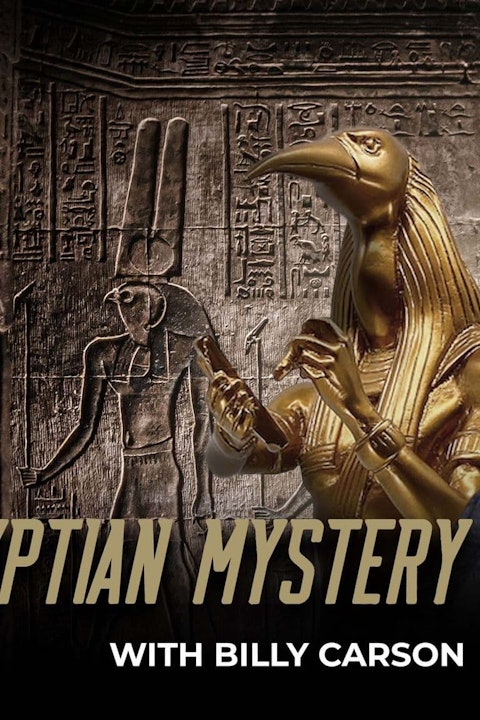
Billy Carson's 4BK TV series [Egyptian Mystery School](/watch/egyptian-mystery-school) explores the Sphinx, the Giza plateau and the symbolism behind them. For every guide on the pyramids, the gods and the dynasties, browse [the Ancient Egypt topic hub](/topics/ancient-egypt). To stand in front of the Sphinx yourself, see the guided journeys on the 4biddenknowledge tours page, which include Egypt.
Frequently asked questions
How old is the Great Sphinx?
The mainstream date is the reign of Khafre, around 2558–2532 BCE, making the Sphinx roughly 4,500 years old. Geologist Robert Schoch has argued for at least 7000–5000 BCE and later 10,000 BCE or earlier, based on weathering. Billy Carson argues for about 36,000 years. Only the Khafre date is supported by the quarry and temple evidence.
Who built the Great Sphinx?
Most Egyptologists credit the workforce of the Fourth Dynasty king Khafre, because the stone cut from the Sphinx enclosure was used in temples belonging to his pyramid complex. Rainer Stadelmann argued for Khufu, and Vassil Dobrev for Djedefre. All three candidates belong to the same dynasty.
Does water erosion prove the Sphinx is older than Egypt?
No. Schoch's reading of the weathering is a genuine scientific argument, but other geologists attribute the same features to salt crystallisation, wind, moisture in sand and the wetter climate of early Egyptian history. No physical trace of an older builder culture has been found.
What happened to the Sphinx's nose?
The historian al-Maqrizi recorded that a Sufi named Muhammad Sa'im al-Dahr damaged the face in 1378. The nose was gone by the fifteenth century, long before Napoleon's army arrived in 1798.
Is there a Hall of Records under the Sphinx?
Not that anyone has found. Edgar Cayce predicted in the 1930s that a Hall of Records would be opened before 1998, and it was not. Surveys have found small tunnels and an anomaly under the front paws, most likely a natural cavity, and the 2025 radar claims have not been peer reviewed.
Sources and further reading
- Mark Lehner, The Complete Pyramids (Thames & Hudson, 1997).
- Zahi Hawass and Mark Lehner, Giza and the Pyramids (Thames & Hudson, 2017).
- Mark Lehner, Archaeology of an Image: The Great Sphinx of Giza (PhD dissertation, Yale University, 1991).
- Robert M. Schoch with Robert Aquinas McNally, Voices of the Rocks (Harmony Books, 1999).
- John Anthony West, Serpent in the Sky: The High Wisdom of Ancient Egypt (1979).
- Colin D. Reader, “A Geomorphological Study of the Giza Necropolis, with Implications for the Development of the Site,” Archaeometry (2001).
- Robert Temple with Olivia Temple, The Sphinx Mystery (2009).