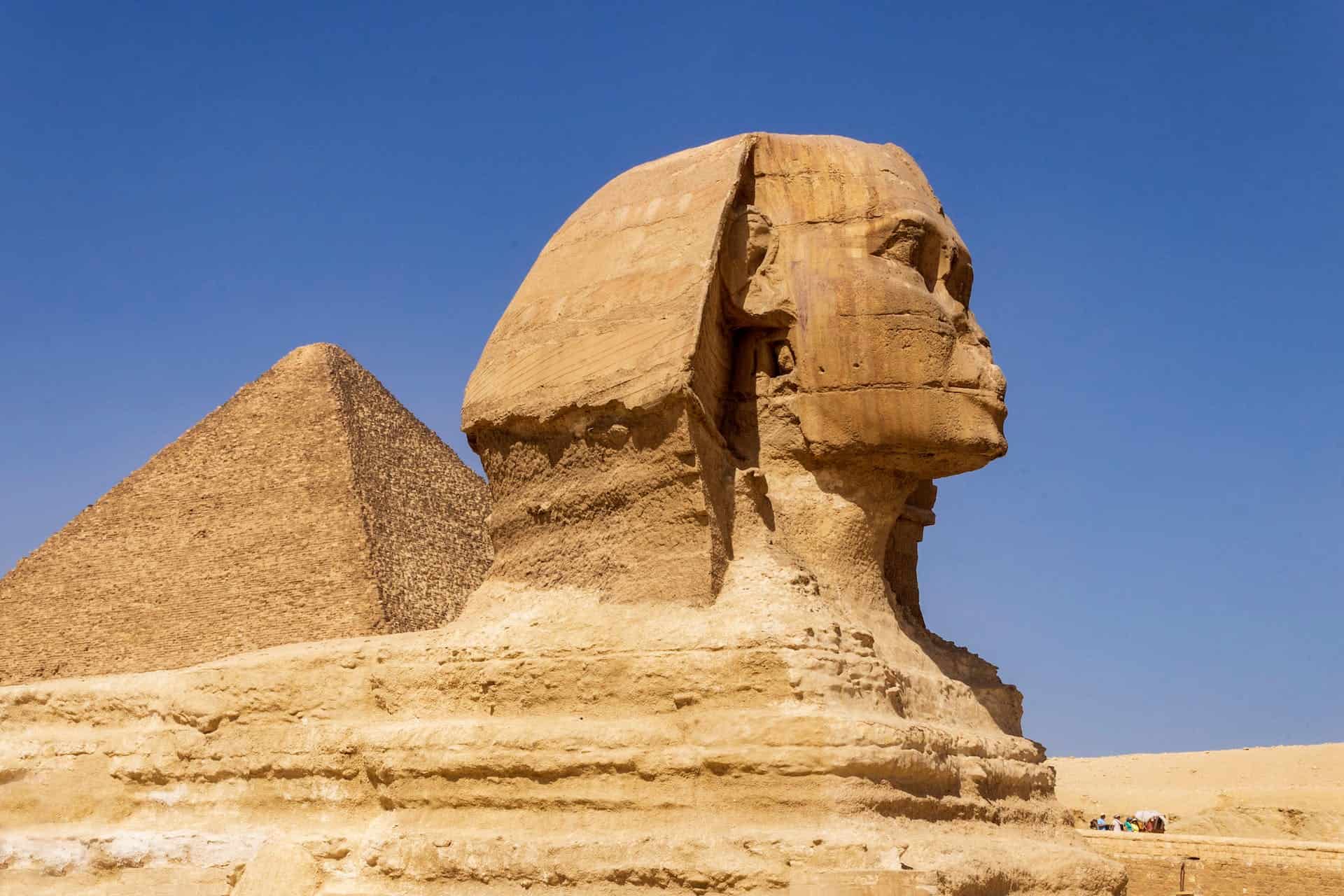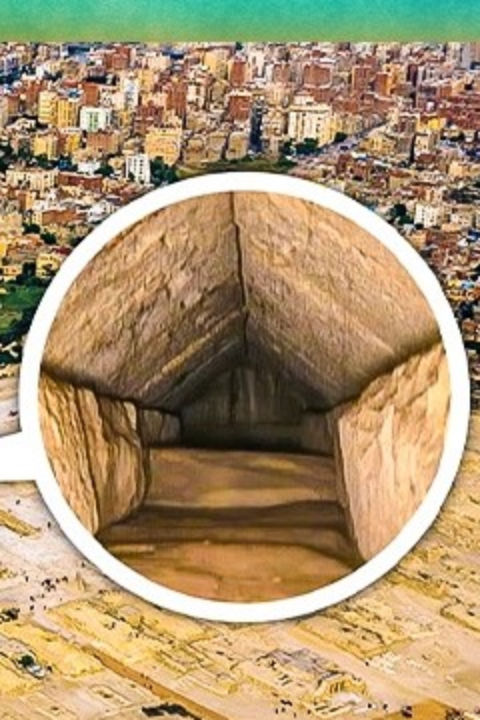
The Great Pyramid of Giza was built for the pharaoh Khufu (Cheops) around 2560 BCE, during Egypt's 4th Dynasty, from roughly 2.3 million blocks of limestone and granite raised by an organised, housed and fed Egyptian workforce. Quarries, a workers' town, contemporary papyri and ramp remains establish who built it and when; exactly how the heaviest blocks were lifted to the upper levels is still an open engineering question.
That gap is why the debate never ends. The Great Pyramid is the last surviving wonder of the ancient world, where archaeology, engineering and alternative history meet. Egyptology has never had more evidence for the builders, yet muon scans keep finding spaces inside the monument nobody predicted. Reading the argument honestly means separating what is documented, what is inferred and what is still unexplained, including the lost-knowledge interpretation Billy Carson has developed. For the wider context, start with [the Ancient Egypt topic hub](/topics/ancient-egypt).
The Great Pyramid by the numbers
The Great Pyramid was originally about 146.6 metres tall; with its capstone and top courses gone, it now stands at roughly 138.5 metres. Each side of the base measures about 230.3 metres, and the four sides are aligned to true north to within about 3 to 4 arcminutes.
The usual estimate is around 2.3 million blocks averaging about 2.5 tonnes each. Most of the core stone was quarried on the Giza plateau itself. The smooth outer casing was fine white limestone from Tura, across the Nile, and most of it was stripped away in the medieval period for building stone in Cairo. The heaviest elements are the granite beams roofing the King's Chamber and the relieving chambers above it, some estimated at 50 to 80 tonnes, quarried at Aswan more than 800 kilometres upriver.
Who built the Great Pyramid? The archaeological evidence
The archaeological record points to Egyptian crews working for the state under Khufu, not slaves and not an unknown earlier culture. Three bodies of evidence carry most of the weight.
The workers' town at Heit el-Ghurab
Since 1988, Mark Lehner and the team now organised as Ancient Egypt Research Associates (AERA) have excavated a settlement south of the Sphinx called Heit el-Ghurab, often described as the Lost City of the Pyramid Builders. It contains long galleries that likely housed rotating crews, bakeries built to produce bread at scale, and large deposits of cattle, sheep and goat bones. The picture is of a housed, fed and managed state labour force, not a slave camp. Nearby cemeteries excavated by Zahi Hawass from the 1990s hold the tombs of workers and overseers buried beside the king's monument, an honour slaves would not have received.
Herodotus, writing about two thousand years after Khufu, described 100,000 men working in three-month shifts over twenty years; the later image of enslaved builders has no support in the Egyptian record.
The Diary of Merer
In 2013, a mission led by the French Egyptologist Pierre Tallet recovered papyri at Wadi al-Jarf, an ancient harbour on the Red Sea coast. They are the oldest inscribed papyri yet found. Among them is the logbook of an inspector named Merer, whose crew shipped limestone from the Tura quarries along the Nile and through canals to Akhet-Khufu, the Horizon of Khufu, the ancient name of the pyramid. The entries date to around Khufu's 26th or 27th regnal year and name the official Ankhhaf, a half-brother of Khufu, as the director of the works. It is a contemporary record of the project in its final phase.
The quarry marks in the relieving chambers
In 1837, Colonel Howard Vyse used gunpowder to force his way into the upper relieving chambers above the King's Chamber and found red-painted quarry marks, including Khufu's name and the names of work gangs. Egyptologists accept these as genuine builders' marks, pointing out that some run into joints and faces that were sealed once the blocks were set. Alternative writers, most prominently Zecharia Sitchin, have argued that Vyse forged them. The Merer papyri, found 176 years later at a different site, independently tie the monument to Khufu's reign.
How were the blocks moved and lifted?
The tools and transport methods are well documented, but the exact lifting scheme for the upper pyramid is still debated. Egyptologists broadly agree on the toolkit: copper chisels and saws used with abrasive sand, hard dolerite pounders for shaping granite, wooden sledges, levers, rope, and river transport timed to the annual Nile flood.
Sledges and wet sand
A 2014 study led by physicists at the University of Amsterdam, published in Physical Review Letters, showed that wetting desert sand to the right degree roughly halves the force needed to drag a loaded sledge across it. The result matches a scene in the Middle Kingdom tomb of Djehutihotep, where a worker pours water onto the sand in front of a sledge carrying a colossal statue.
Ramps: straight, zig-zag, spiral or internal
Most reconstructions use ramps of mud brick, rubble and limestone chips; the argument is about their shape. A single straight ramp would have to grow enormously long as the pyramid rose. Zig-zag ramps up one face, or spiral ramps wrapping around the sides, need less material but make turning long blocks at the corners harder. In 2007, the French architect Jean-Pierre Houdin proposed an internal spiral ramp running just inside the outer faces, with an external ramp for the lower levels. It remains an untested hypothesis.
A 2018 discovery sharpened the debate. At the Hatnub travertine quarry, a team led by Yannis Gourdon of the French Institute for Oriental Archaeology and Roland Enmarch of the University of Liverpool documented a steep ramp flanked by two staircases lined with post-holes, associated with inscriptions from Khufu's reign. The layout suggests crews used posts and ropes to haul stone up far steeper slopes than older models assumed, so a steep-ramp technique was available to Khufu's engineers.
The granite problem
The hardest part of the story is the King's Chamber granite. Floating 50- to 80-tonne beams down the Nile on large barges during the flood is plausible, and the Merer papyri show how organised river logistics were. Lifting those beams dozens of metres into the core and setting them precisely is where the direct evidence is thinnest.
What is still unexplained inside the pyramid
Several internal features are still not understood, and the most striking finds are recent. The ScanPyramids project, launched in 2015 by Cairo University's Faculty of Engineering and the HIP Institute, uses muon imaging, which detects cosmic-ray particles passing through stone, to map density inside the monument without drilling.
In 2017 the team reported in Nature a large void at least 30 metres long above the Grand Gallery, now known as the Big Void. Its shape, its purpose and whether it is one space or several remain unknown. In 2023 the team confirmed a corridor about 9 metres long behind the chevron stones on the north face, first with muon data and then by passing an endoscope through a joint to film it. Both findings are covered in more detail in [the report on the new scans](/the-great-pyramid-s-new-scans-confirm-a-major-discovery-inside) and in [the roundup of findings inside the Great Pyramid](/scientists-uncover-groundbreaking-findings-inside-the-majestic-great-pyramid-of-giza).
Other long-standing questions include the narrow shafts leading from the King's and Queen's Chambers, the unfinished subterranean chamber cut into the bedrock, and the exact order in which the Grand Gallery and upper chambers were built. None of these overturns the Khufu dating, but together they show the building's interior is not fully mapped.
Alternative theories and how they hold up
Alternative theories fall into two groups: those that move the pyramid's date back thousands of years, and those that reinterpret what it was for. None has displaced the archaeological consensus, but several have shaped public debate for decades.
The American psychic Edgar Cayce claimed in trance readings that the Giza monuments were connected to a civilisation around 10,500 BCE and a hidden Hall of Records. Robert Bauval's Orion Correlation Theory, set out in The Orion Mystery (1994, with Adrian Gilbert) and developed with Graham Hancock in Keeper of Genesis (1996), argues that the three Giza pyramids mirror the belt of Orion and that the layout encodes a date around 10,500 BCE, with the chamber shafts pointing toward Orion and Sirius. Egyptologists accept that the shafts may have had stellar meaning in Egyptian afterlife belief, but reject the re-dating.
Christopher Dunn's The Giza Power Plant (1998) argues from the precision of the stonework that the pyramid was a machine for converting vibration into usable energy. Robert Schoch, a Boston University geologist, argued in 1992 that weathering on the Sphinx enclosure points to heavy rainfall long before the 4th Dynasty; his case concerns the Sphinx rather than the pyramid, and other geologists and archaeologists dispute it. Most recently, in 2025, Italian researchers including Corrado Malanga and Filippo Biondi claimed that satellite radar data revealed vast structures deep beneath the neighbouring pyramid of Khafre. The claim was not peer-reviewed and was rejected by geophysicists, who said the method cannot resolve structures at those depths.
Billy Carson's reading
Billy Carson's position is that the Great Pyramid is a repository of encoded advanced knowledge, and that dynastic Egypt inherited or restored something older rather than inventing it from nothing. In his presentations, Carson points to the monument's mathematical relationships, such as the ratio of base perimeter to height closely approximating 2π, along with the precision of its orientation and its placement on the landscape, as signs of a knowledge base more sophisticated than the standard picture of copper tools and ramps allows. He treats the structure as a possible energy device rather than only a royal tomb, and argues for a pre-dynastic origin tied to a lost, technologically capable civilisation.
Carson connects this to Thoth. In the Emerald Tablets text first published by Maurice Doreal, Thoth describes building the Great Pyramid, and Carson's Compendium of the Emerald Tablets reads that account as a memory of the monument's true origin; the background is laid out in [the guide to Thoth and Hermes Trismegistus](/who-was-thoth-egyptian-god-of-wisdom-hermes-trismegistus). He sets out the case in full in the podcast episode on the true builder of the Great Pyramid and in the episode on the pyramid's encoded knowledge.
The archaeological record answers differently, and readers should weigh both. Egyptologists note that the 2π ratio follows naturally from how Egyptian builders set a slope, by the seked, a horizontal run of five and a half palms for every cubit of rise; that scholars treat the Doreal tablets as a modern text rather than an ancient one; and that the workers' town, the Merer papyri and the quarry marks place construction in Khufu's reign. Carson's view is that this evidence records the dynastic Egyptians' work on the site without settling who first understood its design. He also leads tours to Egypt and Giza, where visitors can see the stonework for themselves.
Watch, read and go deeper
On 4BK TV, the [Secrets of the Pyramids Revealed workshop](/watch/secrets-of-the-pyramids-revealed-workshop) is Carson's dedicated session on the pyramids, and [Awaken Zone](/watch/awaken-zone) carries more of his lost-knowledge material. The two 4biddenknowledge Podcast episodes linked above give his position in his own words, and his book Compendium of the Emerald Tablets covers the Thoth material. Every related article, from Thoth to the Sphinx, is collected on [the Ancient Egypt topic hub](/topics/ancient-egypt).
Frequently asked questions
Who built the Great Pyramid of Giza?
The archaeological evidence points to Egyptian state workers under the pharaoh Khufu around 2560 BCE. The workers' town at Heit el-Ghurab, the builders' cemeteries at Giza and the Diary of Merer, a papyrus logbook from Khufu's reign, all document an organised, fed and housed labour force. Billy Carson argues that the knowledge behind the design is older than the dynastic builders.
How long did it take to build the Great Pyramid?
Herodotus reported twenty years, and most Egyptologists consider roughly two decades within Khufu's reign realistic. The Diary of Merer shows limestone still being delivered to the site around Khufu's 26th or 27th year, which suggests work continued late in his reign.
Was the Great Pyramid built by slaves?
No. Excavations since 1988 show a workforce with bakeries, meat rations, organised housing and honourable burials beside the pyramid. The slave image comes from later tradition and film, not the Egyptian evidence.
What is the Big Void in the Great Pyramid?
The Big Void is a large empty space at least 30 metres long above the Grand Gallery, detected by the ScanPyramids muon survey and published in Nature in 2017. Nobody has entered it, and its purpose is unknown.
Is the Great Pyramid older than Egyptologists say?
The mainstream date of about 2560 BCE rests on the Merer papyri, the quarry marks and radiocarbon dating of organic material in the mortar, which places construction in the third millennium BCE. Alternative writers, including Edgar Cayce and the proponents of the Orion Correlation Theory, have argued for dates near 10,500 BCE, but no excavated material from the pyramid supports that date.
Sources and further reading
- Mark Lehner, The Complete Pyramids (Thames & Hudson, 1997)
- Mark Lehner and Zahi Hawass, Giza and the Pyramids (Thames & Hudson, 2017)
- Pierre Tallet and Mark Lehner, The Red Sea Scrolls (Thames & Hudson, 2021)
- Herodotus, Histories, Book II
- K. Morishima et al., Discovery of a big void in Khufu's Pyramid by observation of cosmic-ray muons, Nature (2017)
- S. Procureur et al., Precise characterization of a corridor-shaped structure in Khufu's Pyramid by observation of cosmic-ray muons, Nature Communications (2023)
- A. Fall et al., Sliding friction on wet and dry sand, Physical Review Letters (2014)
- Billy Carson, Compendium of the Emerald Tablets