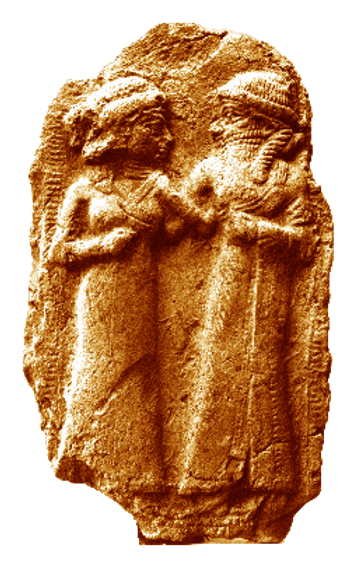
Billy Carson argues that the Anunnaki of the Mesopotamian tablets were called the ordainers of destinies because they settled on an outcome, decreed it as already done and then built toward it, and that this is the oldest description of manifestation on record. In this live talk from January 2023 he builds the case from the opening lines of the Myth of Etana, the Tablet of Destinies and the Myth of Adapa, then turns it into a working rule: plan for all time, not for the next paycheck.
The topic matters because the phrase is real. Ordainers of destinies is a standard translation of a line in the Etana prologue, and the idea that the gods fixed fates runs through Mesopotamian literature. Knowing what the tablets say, and where Carson's interpretation goes beyond them, is useful to fans and skeptics alike.
What the video covers
The Anunnaki as a deified breakaway group (from about 7 min)
Carson starts with his frame. The Anunnaki, a name he notes appears in the Enuma Elish, were in his reading an advanced group who came to found a breakaway civilization, met an earlier hominid and were worshipped because their technology looked like magic. They were, in his phrase, “Gods with the lowercase G”.
To show how deification happens, he points to cargo cults: islanders who watched soldiers arrive with aircraft and supplies, then built replica planes from reeds and painted USA on their chests while waiting for the visitors to return. He places this around the Bikini Atoll nuclear tests. The documented cargo cults were in Melanesia and grew out of the Second World War supply build-up; the best known, the John Frum movement on Tanna in Vanuatu, still holds parades with bamboo rifles and USA painted on the marchers' chests.
Ordainers of destinies and the crystal tablet (from about 12 min)
Carson reads the title as a description of method: the gods saw the range of possible futures, chose one, decreed it and treated it as settled. He does not present them as admirable. Enlil, he says, culled humans for being too noisy, a reference to the flood narrative scholars know as Atrahasis, while Enki and Thoth (whom Carson identifies with Ningishzida) showed sympathy for humankind. Even the harshest of them, he argues, understood how to decide a future.
He then describes a crystal tablet the gods looked into to see future outcomes, and compares choosing one to collapsing a quantum superposition. That is his analogy, not physics: superposition describes a quantum system before measurement.
The opening of the Myth of Etana (from about 17 min)
This is the textual core of the talk. Carson reads the prologue: “the great Anunnaki gods ordainers of destinies” sat taking counsel concerning the land; the Igigi ordained a festival for the people; no king had yet been set over the teeming peoples, and no headdress or crown had been assembled; the Igigi surrounded the city, Kish, with ramparts; and Ishtar came down from heaven to seek a shepherd and searched everywhere for a king. Carson reads the Igigi as a working class within the Anunnaki who volunteered to build the new civilization.
He then adds the detail the talk turns on: Enlil showing a crystal tablet with a city he will build, whose construction would last for all time. That detail is Carson's reading rather than a line in the standard translations, which are fragmentary here. For him the lesson is the timescale: Enlil plans not for next week or the next ten years but for all time. The full story of the eagle, the serpent and Etana's flight is told in The Myth of Etana Explained.
Adapa and untapped potential (from about 21 min)
Carson next cites the Myth of Adapa, which in his reading says humans were made with greater potential than the gods themselves, a potential not yet tapped. The text and its Genesis parallels are covered in The Adapa Myth Explained.
Planning for all time (from about 22 min)
Here the talk turns practical. Most people, Carson says, plan only as far as the next paycheck, while some companies, he says, work to plans measured in centuries. A plan for all time is not for the person making it but for later generations. He is frank about why it matters to him: both his parents died with debts and no plan, and he frames his response as a line in the sand, “this generational curse stops with me”. The baseline he names is a will and a trust, plus someone trusted who knows where the accounts and passwords are.
Cause and effect (from about 31 min)
Against the view that destiny is fixed before birth, Carson gives a deliberately simple demonstration with a phone and a glass of water on his desk: he can pick up either, or neither, and each choice carries a consequence. He calls this the Hermetic principle of cause and effect, and it is why he describes people as co-creators of their reality.
A staged inheritance (from about 37 min)
Carson outlines how he intends to pass on what he builds. In his plan, family members must attend quarterly financial-literacy classes, reach a set credit score, have held a job or run a business for at least a year, and hold a lease in their own name before receiving their share; grandchildren receive portions in stages at 18, 21 and 25. This is his personal plan, offered as an illustration rather than legal or financial advice; anyone setting up a trust should work with an estate attorney.
The Compendium edit and an Emerald Tablets passage (from about 45 min)
Carson tells how the first edition of his book was reworked after a publisher he met at a retreat said the science sections were too dense; they simplified it, added the subtitle A Beginner's Guide and cut its length by about half. His lesson: recognize the opportunity when it arrives and set ego aside long enough to take it.
From about 52 minutes he reads a passage in which Thoth tells the reader to turn the thoughts inward and place in the body “a thought-formed picture”. Carson reads it as a meditation instruction: hold the goal in full detail as if it already exists, down to how the steering wheel of the new car feels. Returning to the tablets near the end, he says whoever held the Tablets of Destinies held power and that they were stolen more than once, and he mentions studying remote viewing with Ed Dames, his teacher.
Key takeaways
- Carson reads ordainers of destinies as a description of method: choose an outcome, decree it and act as though it is settled.
- The phrase comes from the prologue of the Myth of Etana, where the gods take counsel about the land before kingship exists.
- He treats Enlil as a harsh figure whose long-range planning is still worth learning from.
- His practical application is legacy planning: a will, a trust and inheritances released in stages with conditions attached.
- The Emerald Tablets instruction to hold a thought-formed picture is, for him, the inner practice that goes with the plan.
Billy Carson's reading
Carson's position is that manifestation is ancient, not new age, because the tablets describe gods deciding outcomes in advance: fixing fates, preparing kingship before there was a king, planning cities. He reads those decrees through the language of quantum physics and through the Emerald Tablets, which he treats as Thoth's teaching on the same art in The Compendium of the Emerald Tablets.
He separates the method from the morals. The Anunnaki, in his view, misused their position, but the habit of deciding a future and planning for it across generations is worth taking back, which is why the talk ends with wills and trusts. His step-by-step approach to the inner practice is in How to Manifest What You Want.
What mainstream scholarship says
Assyriologists agree the phrase is genuine. Decreeing fates (Sumerian nam-tar, Akkadian šīmtu) was a core divine prerogative, and Babylonian ritual included a fixing of destinies at the New Year festival; in the Etana prologue the line describes the gods ordering the world before kingship, not a technique. The Tablet of Destinies appears in the Anzu myth, where Anzu steals it from Enlil and Ninurta recovers it, and in the Enuma Elish, where Tiamat gives it to Qingu and Marduk takes it. In both it is a token of supreme authority rather than a device for viewing futures, and the crystal tablet showing Enlil's city is not found in standard editions of Etana. The Enuma Elish is generally dated to the second millennium BCE.
The Sumerian King List names Etana as a king of Kish, the shepherd who ascended to heaven. Scholars read the Myth of Adapa as a story of lost immortality: Adapa refuses the bread and water of life on Ea's advice. It is often compared with Genesis 3, but neither is regarded as a copy of the other. In Atrahasis the Igigi are the gods who did the hard labor before revolting, which gives Carson's working-class reading some textual footing, and Thorkild Jacobsen argued that the divine assembly mirrored a primitive democracy in early Mesopotamia. The Emerald Tablets Carson quotes were published by Maurice Doreal in the 1930s; historians treat them as a modern work, distinct from the medieval Hermetic Emerald Tablet.
Watch, read and go deeper
For the wider question behind this talk, start with Who Were the Anunnaki? Sumerian Texts vs Ancient Astronaut Theory and then browse the Anunnaki topic hub. The audio of this talk is on the 4biddenknowledge Podcast, and longer lectures on the same material are in the 4BK TV series Anunnaki: Ancient Secrets Revealed.
Frequently asked questions
What does ordainers of destinies mean in Mesopotamian texts?
It describes the gods' power to decree fates, a core divine function in Sumerian and Akkadian literature. The phrase opens the Myth of Etana, where the great Anunnaki gods take counsel about the land before kingship has been established. Billy Carson reads it as a description of manifestation: deciding an outcome and treating it as already done.
What was the Tablet of Destinies?
In Mesopotamian myth the Tablet of Destinies conferred supreme authority over the gods' decrees. In the Anzu myth the bird Anzu steals it from Enlil, and in the Enuma Elish Marduk takes it from Qingu. Carson describes it as a crystal tablet in which the gods could see possible futures, which is his interpretation.
Who was Etana?
Etana was a legendary king of Kish, listed in the Sumerian King List as a shepherd who ascended to heaven. The Myth of Etana tells how the gods sought a king for humanity and how Etana, who had no son, rode an eagle toward heaven in search of the plant of birth.
How does Billy Carson connect the Anunnaki to legacy planning?
He takes Enlil's plan for a city that would last for all time as a model for thinking in generations rather than paychecks: a will, a trust and inheritances released in stages. He presents this as his personal approach, not legal advice.
Sources mentioned
In the video Carson cites the Myth of Etana, the Enuma Elish (which he also calls the Seven Tablets of Creation), the Myth of Adapa, the Sumerian accounts of Enlil's treatment of humankind, the Emerald Tablets of Thoth as presented in his book The Compendium of the Emerald Tablets, and the Hermetic principle of cause and effect. He names Ed Dames as his remote-viewing teacher. For standard references, see Stephanie Dalley's Myths from Mesopotamia and Benjamin R. Foster's Before the Muses for translations of Etana, Adapa, Anzu and Atrahasis; Thorkild Jacobsen's essay Primitive Democracy in Ancient Mesopotamia (1943); and Peter Worsley's The Trumpet Shall Sound on Melanesian cargo cults.