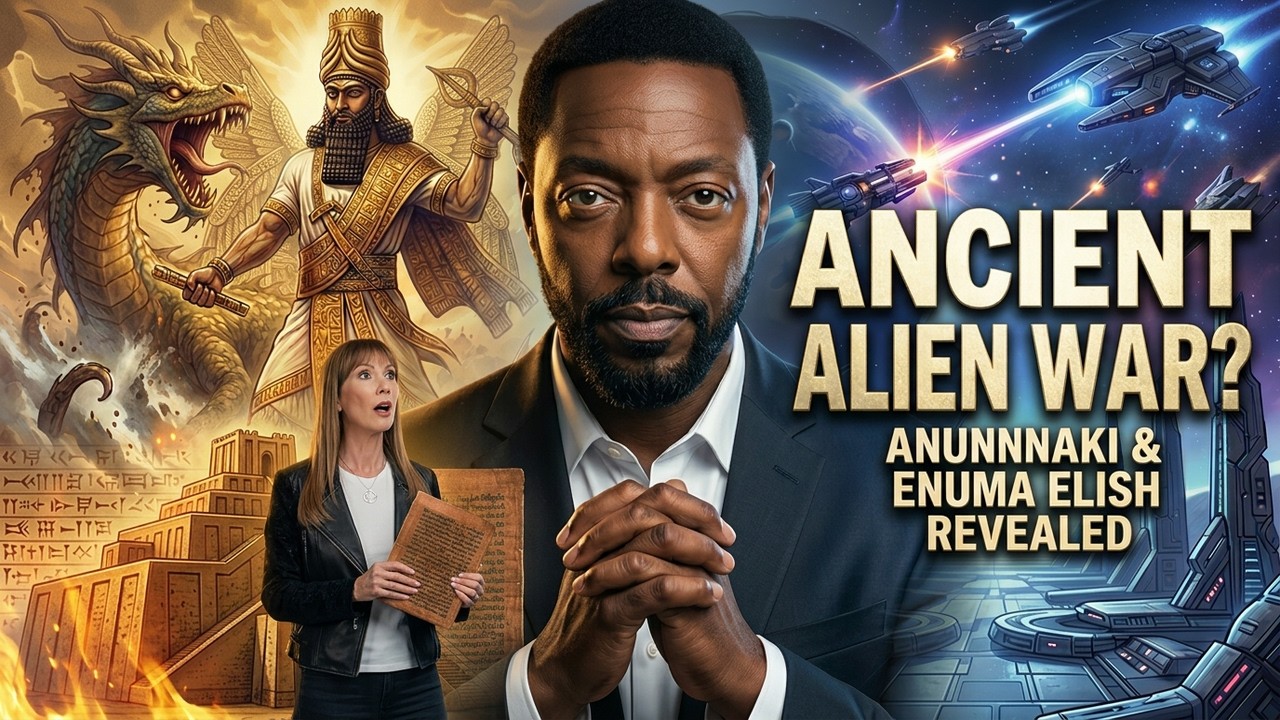
Did the Anunnaki masquerade as gods? In this talk from the 4biddenknowledge Podcast, Billy Carson argues that they did: a group of flesh-and-blood beings from another star system settled on Earth, put a modified human workforce to labour, and allowed people to worship them as deities. He builds the case from the Enuma Elish, the Atrahasis epic, the Emerald Tablets of Thoth and the Hebrew Bible, then argues that modern elites still follow the same pattern.
The question sits on a fault line. For Carson's audience, it reframes ancient religion as a record of real encounters. For Assyriologists, the same tablets are some of humanity's oldest literature, with a meaning worked out over 150 years of translation. Separating the texts from the interpretation lets readers judge the argument fairly.
What the video covers
The stream opens with setup and photos from Carson's visits to sites in Egypt, Peru, Mexico, Cambodia and Greece, which he offers as evidence that his research rests on fieldwork rather than secondhand accounts. The argument proper follows.
A galactic war and a general term (from about 17:50)
Carson begins with the Pleiades, noting that the Sumerians are the oldest written source he can find that refers to the cluster. In his reading, a long golden age among space-faring humanoid civilizations in that region collapsed over prejudice and a new space-age religion, and a galactic war followed. Refugees resettled around Orion, Aldebaran, Zeta Reticuli and Sirius.
This, he says, is where the Anunnaki come from, and the word is not a racial label. In his usage it means anyone who comes from heaven to Earth; a Floridian travelling to another planet, he points out, would simply call themselves an Earthling. "The Anunnaki is a generalized term," he says. The specific group he follows called themselves Atlanteans, a point he takes from the Emerald Tablets of Thoth.
Atlantis, the Brahmastra and Saturn's moons (from about 22:00)
Carson describes Atlantis as a global civilization with regional capitals, of which the sunken ring city was only one (his fuller argument is in the site's Atlantis explainer). He links the war's weaponry to the Brahmastra of the Mahabharata, a celestial weapon no defence could stop. Some refugees, he says, reached Nibiru, which he places in orbit around a brown dwarf companion to the Sun. He then claims that Saturn's moons Iapetus and Mimas are artificial remnants of planet-destroying weapons, pointing to the ridge around Iapetus's equator and the giant crater on Mimas.
Oppenheimer and the star-lore sources (from about 27:00)
To argue that modern weapons echo ancient texts, Carson cites J. Robert Oppenheimer's remark in the 1965 documentary The Decision to Drop the Bomb, "Now I am become Death, the destroyer of worlds," a line from the Bhagavad Gita, part of the Mahabharata. He then shows the books behind his Pleiades material, including Burnham's Celestial Handbook, Star Names: Their Lore and Meaning and Star Lore of All Ages.
The Enuma Elish and the Sitchin question (from about 29:40)
Carson calls the Enuma Elish, the Babylonian seven tablets of creation, the backbone of his case. It was recovered from the ruins of Ashurbanipal's library at Nineveh, near modern Mosul, in excavations that began with Austen Henry Layard around 1849, and published by George Smith in 1876. He notes that a long-missing section of Tablet V was later identified at the Sulaymaniyah Museum in Iraq. Its purpose, he says, was not theology but "an elevation of Marduk" over the other gods of Babylon (the site's guide to the Enuma Elish covers it tablet by tablet).
He also takes on a common objection. Zecharia Sitchin, Carson stresses, never translated the tablets or claimed to; he worked from translations made long before he was born. Carson concedes Sitchin may not be right in every detail, but says "he got the fundamental basis of the story accurate."
The jealous God passages (from about 33:30)
Carson reads Exodus 20:3-5, "thou shalt have no other gods before me," along with a passage describing "a jealous God among you" whose anger could destroy people from the face of the earth. Why, he asks, would an all-knowing creator need jealousy? He reads the verses as the voice of a powerful being with human emotions, and identifies that voice with Marduk, whom he equates with Amun Ra, and with Enlil, whom he equates with Yahweh.
The Igigi revolt and the worker being (from about 35:50)
Turning to the Atrahasis epic, Carson notes that the name Anunnaki appears in the Enuma Elish and links it to the biblical Anakim. In his telling, the Igigi, a lower class of gods, did the digging, canal building and construction for a very long time until they rebelled against Enki, Enlil and their father Anu. Enki proposed adding the gods' essence to an existing hominid so it could bear the labour. Carson reads that as the genetic modification of humans who were already on Earth, seeded by Pleiadians according to Aboriginal oral tradition as he relays it.
Willing servants and the modern masquerade (from about 41:00)
Carson claims the beings inserted a worship gene into the human genome, and that each ruled a region whose people, unable to travel, took their ruler for a god. Thoth and Enki, he says, were the exceptions who told humans the truth. The rest accepted prayer and offerings, and humans served willingly because they believed it honoured their gods. "So they were enslaved, but didn't know they were even slaves," he says.
From there he draws his thesis: fiat currency, religion and party politics keep people working for a system they treat as godlike, and today's oligarchs are "copying the ancient tradition of masquerading as a God."
Translators, offerings and Thoth (from about 46:00)
Carson returns to sources to show the tablets are not a modern invention. He profiles George Smith, the self-taught engraver who learned cuneiform at the British Museum and announced a Babylonian flood account in 1872; E. A. Speiser of the University of Pennsylvania, who excavated Tepe Gawra and translated Genesis for the Anchor Bible; Speiser's student Moshe Greenberg; Leonard William King; and Irving Finkel of the British Museum. He points viewers to the Cuneiform Digital Library Initiative, hosted at UCLA, to examine tablets themselves.
He then reads temple offerings as provisioning, describing storerooms where meat was salted and kept, and cites the Jewish Virtual Library's entry on Marduk. He closes with a scene from the Emerald Tablets in which Thoth lands in the land of Khem, is met with clubs and spears, stills the attackers with a ray of vibration, then refuses worship, calling himself a son of Atlantis and becoming a teacher instead.
Key takeaways
- Carson uses "Anunnaki" as a general term for any beings who came to Earth from elsewhere, not a single race.
- He treats the Enuma Elish and Atrahasis as historical records of a labour revolt and the engineering of human workers.
- He reads the jealous God verses of the Torah as the words of a powerful but limited being, whom he identifies with Marduk and Enlil.
- His conclusion is that modern elites copy the same pattern through money, religion and politics.
Billy Carson's reading
Carson's core claim is that the beings called gods in the oldest texts were real, technologically superior people who exploited the gap between their abilities and human understanding. To him, the details are too specific to be invented; nobody in ancient times, he argues, was writing science fiction in cuneiform. The Igigi revolt and the temple offerings read to him like the records of a colonial administration.
His framework draws on the full Sumerian cast, set out in the site's overview of Anu, Enlil, Enki, Inanna and the wider pantheon. His moral reference point is Thoth, whom he admires for declining the role of god. That portrait comes from the Emerald Tablets of Thoth, the text at the center of his book Compendium of the Emerald Tablets.
What mainstream scholarship says
In the Sumerian and Akkadian sources, the Anunnaki are a collective of deities, commonly understood as the offspring of the sky god An (Anu), who sit in the assembly of the great gods or judge in the underworld. Assyriologists do not read them as space travellers. The Atrahasis epic does tell of the Igigi digging canals and rebelling against Enlil, and of Enki (Ea) and the mother goddess creating humans from clay mixed with the flesh and blood of a slain god to carry the gods' work. Scholars agree with Carson that the Enuma Elish exalts Marduk as chief god of Babylon, though they read Nibiru in the poem as an astronomical name tied to Marduk, not a hidden planet. Sitchin's interpretations are rejected by cuneiform specialists, and historians date the Emerald Tablets of Thoth to their 20th-century publication by Maurice Doreal rather than to ancient Egypt.
Planetary scientists explain Iapetus's equatorial ridge through natural processes, with leading proposals tied to the moon's early rapid spin or debris from a collapsed ring, and Mimas's Herschel crater is the scar of a large impact. Oppenheimer's Gita quotation is well attested and reflects his study of Sanskrit; historians do not treat it as evidence of ancient nuclear war. Geneticists have not identified a switchable worship gene, and biblical scholars generally read God's jealousy in Exodus as the language of an exclusive covenant rather than the mark of a lesser being.
Watch, read and go deeper
The full talk is on the podcast episode page. For the wider debate, the pillar article on who the Anunnaki were sets the Sumerian texts beside the ancient astronaut theory. The Anunnaki topic hub gathers every article, video and episode on the subject. On 4BK TV, the series Anunnaki Ancient Secrets Revealed expands on the same material.
Frequently asked questions
What does the word Anunnaki mean?
In Billy Carson's usage, Anunnaki is a general term for beings who came to Earth from elsewhere. In the Mesopotamian texts, the Anunnaki are a group of gods, commonly understood as the offspring of the sky god An.
Did Zecharia Sitchin translate the Enuma Elish?
No. As Carson points out, Sitchin worked from existing translations; George Smith published the Enuma Elish in 1876, and many scholars have retranslated it since. Carson defends Sitchin's overall storyline, while Assyriologists reject his interpretations.
Who were the Igigi?
In the Atrahasis epic, the Igigi are junior gods who dig canals until they revolt against Enlil, which leads to the creation of humans to take over the work. Carson reads the episode as a historical labour dispute that led to the genetic engineering of humankind.
Are Iapetus and Mimas artificial moons?
Carson argues they are remnants of ancient planet-destroying weapons. Planetary scientists explain Iapetus's equatorial ridge and Mimas's Herschel crater through natural processes, including early spin dynamics and a major impact.
Sources mentioned
Carson cites the Enuma Elish and the Atrahasis epic; the Emerald Tablets of Thoth; Exodus 20 and the jealous God passages of the Hebrew Bible; the Mahabharata and Bhagavad Gita, via Oppenheimer's 1965 remark; and the Jewish Virtual Library's entry on Marduk. For the Pleiades he lists Burnham's Celestial Handbook, Richard Hinckley Allen's Star Names: Their Lore and Meaning, William Tyler Olcott's Star Lore of All Ages, Ian Ridpath's Star Tales and Halliday and Resnick's Fundamentals of Physics. On translation he names George Smith's The Chaldean Account of Genesis, E. A. Speiser's Anchor Bible Genesis, Leonard William King's First Steps in Assyrian, Irving Finkel and Zecharia Sitchin. Standard references: Stephanie Dalley's Myths from Mesopotamia and W. G. Lambert and A. R. Millard's Atra-hasis: The Babylonian Story of the Flood.