Atlantis is a lost island civilization described by the Greek philosopher Plato in two dialogues, the Timaeus and the Critias, written around 360 BCE. According to Plato, it lay "beyond the Pillars of Heracles", was ruled by descendants of the sea god Poseidon, waged war on ancient Athens some 9,000 years before the Athenian lawgiver Solon, and was swallowed by the sea "in a single day and night of misfortune". No text older than Plato mentions it, and no archaeological site has ever been confirmed as Atlantis.
The story matters because it has never stopped generating claims. Most classicists read it as a philosophical parable; a long line of writers, from Ignatius Donnelly in 1882 to online researchers today, read it as a memory of a real place. Billy Carson belongs to the second tradition, and his version ties Atlantis to the Anunnaki of Mesopotamian myth and to the founding of Egypt.
What Plato actually wrote about Atlantis
Plato's Atlantis is a large island empire that grew arrogant, attacked the Mediterranean world, was defeated by a virtuous early Athens, and then sank. The Timaeus gives the outline in a few pages; the Critias gives the detail and breaks off mid-sentence, unfinished.
In the Timaeus (24e to 25d in the standard Stephanus numbering), the character Critias says the island was "larger than Libya and Asia together", that it sat in front of the strait the Greeks called the Pillars of Heracles, and that its rulers tried to enslave Greece and Egypt. Athens beat the invaders alone. Then came earthquakes and floods, and the island "disappeared in the depths of the sea", leaving a shoal of mud that made the ocean beyond impassable.
The Critias fills in the picture. Poseidon fathered five pairs of twin sons with a mortal woman, Cleito, and divided the island among the ten. The eldest, Atlas, gave his name to the island and the surrounding ocean. Around Cleito's hill Poseidon cut alternating rings of sea and land, two of land and three of water. The capital was walled in stone of three colours and plated with bronze, tin and orichalcum, a metal Plato says was by his own day known only by name. The kings met periodically to hunt a bull in Poseidon's temple and renew their laws. For generations they were wise; then their divine blood thinned, greed took over, and Zeus decided to punish them. The dialogue stops there.
Two features matter for later theories: Plato gives concrete measurements for the plain, canals and rings, which is why candidate sites are so often chosen for their circular shape, and he dates the war to roughly 9,600 BCE, before any known city, writing system or metallurgy.
How the story reached Plato
Plato says the story came from Egypt through Solon. In the Timaeus, Critias explains that Solon (c. 630 to 560 BCE) travelled to Sais in the Nile Delta, where priests told him that the Greeks were "always children" because floods had repeatedly wiped out their memory, then recounted Athens' forgotten victory over Atlantis from their temple records. Solon brought the tale home and passed it down his family to the Critias of the dialogue.
Nothing in the surviving Egyptian record corroborates this: there is no Egyptian text about a western island power, and the 9,000-year date predates Egyptian writing by millennia. Skeptics note that a chain of oral transmission is exactly what a storyteller would invent to lend a fiction authority. Supporters reply that the Sais archives are lost, so absence of evidence is not proof of invention. The site's earlier piece on [the advanced technology of Atlantis](/the-advanced-technology-of-atlantis-secret-star-mappers-of-the-lost-world) takes the second view; the mainstream view is summarised below.
What mainstream scholarship says Atlantis is
Classicists overwhelmingly treat Atlantis as a philosophical invention: a thought experiment in which Plato's ideal state, sketched in the Republic, is set in motion against a rich, expansionist rival. Athens represents restraint and civic virtue; Atlantis represents hubris and decline.
The dialogues that carry the story are explicitly concerned with cosmology and the ideal city, and Plato uses the same device, a myth presented as history, in the Republic, the Phaedrus and the Statesman.
Aristotle, Plato's student, is often quoted as a skeptic. The line usually cited, that "the man who invented it also made it disappear", survives only indirectly in Strabo's Geography (book 2, chapter 3), and scholars debate whether Strabo is quoting Aristotle at all. The ancient world did not treat Atlantis as settled history; it is not accurate to say Aristotle definitively debunked it.
None of this proves Plato invented every element. Some scholars allow that he folded a real memory, perhaps of a Bronze Age catastrophe, into an invented frame. That possibility is the doorway through which every location theory walks.
Where people look for Atlantis
Candidate locations fall into two groups: sites that match the catastrophe and sites that match the shape. None has produced the walls, canals or inscriptions that would settle the question.
Santorini and Minoan Crete
The best-regarded candidate is the Aegean. In 1939 the Greek archaeologist Spyridon Marinatos argued that the eruption of the volcano at Thera (modern Santorini), dated to around 1600 BCE by most estimates, devastated Minoan Crete. Later writers, notably the seismologist Angelos Galanopoulos in the 1960s, connected that disaster to Plato's story, suggesting Solon's figures had been multiplied by ten and that the sea-going, bull-worshipping Minoans were the real Atlanteans. The theory has a real civilization and a real catastrophe; it also has Thera inside the Mediterranean, not beyond the Pillars of Heracles.
The Richat Structure, or "Eye of the Sahara"
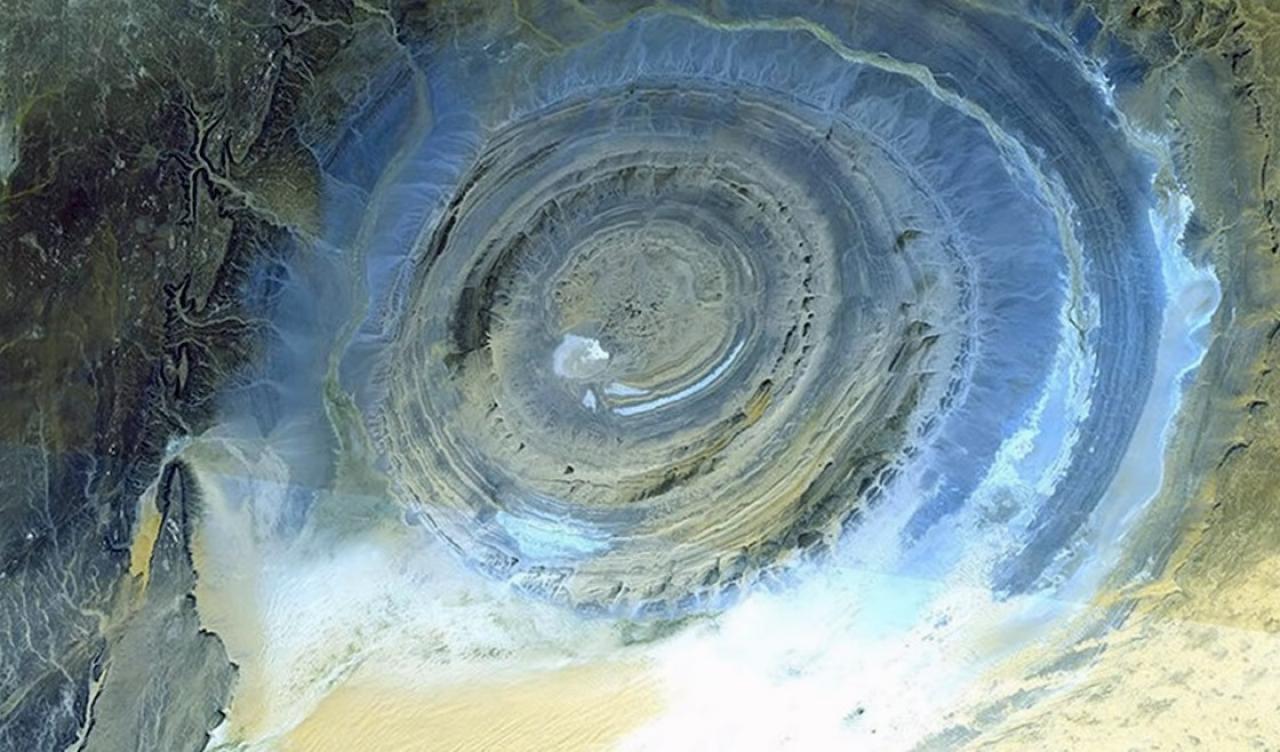
Since 2018, when a widely shared YouTube video proposed it, the Richat Structure in Mauritania has been the most searched Atlantis candidate online. It is a circular formation roughly 40 kilometres across, with concentric ridges visible from orbit. Geologists describe it as an eroded dome of layered sedimentary and igneous rock, uplifted and then stripped by wind and water over tens of millions of years. No excavation has found masonry, harbour works or artefacts, and the site sits inland rather than under the sea. 4biddenknowledge covered the claim in [Is Atlantis in the Sahara?](/is-atlantis-in-the-sahara-researchers-find-eye-of-the-sahara-to-be-the-lost-city); the geological verdict is that the rings are natural.
Southern Spain and the Doñana marshes
The Doñana wetlands near Cádiz, just outside the Strait of Gibraltar, are the leading candidate for readers who take "beyond the Pillars of Heracles" literally. Rainer Kühne argued in a 2004 note in Antiquity that satellite images showed rectangular features in the marsh, and the region hosted Tartessos, a real Iron Age trading culture. Surveys have not confirmed a submerged city.
Antarctica
The Antarctic theory rests on Charles Hapgood's Earth's Shifting Crust (1958) and Rand and Rose Flem-Ath's When the Sky Fell (1995). Hapgood proposed that the whole crust could slide rapidly over the mantle, moving Antarctica from a temperate latitude to the pole around 9,600 BCE, which would match Plato's date. Geologists reject rapid crustal displacement, and ice cores show Antarctica has been glaciated for millions of years. The idea remains a staple of alternative history and is the frame for the 4BK TV series [Secrets of Antarctica](/watch/secrets-of-antarctica).
The Bimini Road
In 1968 divers off North Bimini in the Bahamas found a line of rectangular limestone blocks about half a mile long, matching a 1940 Edgar Cayce reading that part of Atlantis would "rise again" in 1968 or 1969. Geologists identify the blocks as beachrock, a natural cemented sediment that fractures into rectangular slabs along shorelines worldwide.
Who turned Atlantis into a modern belief
Three authors moved Atlantis from Plato's pages into modern culture: Ignatius Donnelly, Edgar Cayce and Maurice Doreal.
Donnelly, a former Minnesota congressman, published Atlantis: The Antediluvian World in 1882. He placed the island in the mid-Atlantic with the Azores as its surviving peaks, an idea plate tectonics later ruled out, and argued that its survivors founded Egypt, Mesopotamia and the Americas and that every flood myth records its destruction. Nearly every later theory, including the idea that pyramids on different continents share one source, descends from it.
Edgar Cayce, the American psychic active from the 1920s to the 1940s, gave hundreds of readings describing Atlantis as a technologically advanced society destroyed in stages by misuse of its own power, with refugees carrying records to Egypt and a "Hall of Records" hidden near the Sphinx. Cayce is the source of the Bimini prediction and of much of the Atlantis-to-Egypt narrative in New Age writing.
Maurice Doreal, founder of the Brotherhood of the White Temple in Colorado, published The Emerald Tablets of Thoth the Atlantean in 1939, presenting it as his translation of tablets written by Thoth, an Atlantean priest-king who left the sinking island, founded Egypt and built the Great Pyramid. This is a different document from the short Hermetic Tabula Smaragdina, known from medieval Arabic and Latin manuscripts, and scholars regard Doreal's tablets as a twentieth-century composition. Doreal's text is the foundation on which Billy Carson's Compendium of the Emerald Tablets builds; the background is in [the Emerald Tablets of Thoth explained](/emerald-tablets-of-thoth-explained).
Billy Carson's reading
Billy Carson's position is that Atlantis was a real, technologically advanced pre-flood civilization, that it was connected to the Anunnaki described in Sumerian and Babylonian texts, and that its survivors seeded Egypt and the other ancient cultures that appear fully formed in the archaeological record. He has set this out most fully in "The Anunnaki & Atlantis", his most-viewed video with more than 1.4 million views, and in podcast episodes such as Atlantis, the Anunnaki and Mars anomalies explained.
In Carson's framework, the Anunnaki of the Mesopotamian creation and flood narratives are the ruling class Plato remembers as the descendants of Poseidon, and the Atlantean deluge is the same event the Sumerian flood tablets and Genesis describe. He reads Doreal's Emerald Tablets as an account of that migration: Thoth leaving Atlantis, arriving in Egypt and founding the mystery schools. Carson summarises the wider claim as "all ancient civilizations were Atlantis", the subject of a dedicated podcast episode: shared features across Egypt, Sumer, the Indus Valley and Mesoamerica, such as stepped pyramids, flood stories and sky-god founders, are in his view the fingerprints of one dispersed parent culture rather than independent invention.
Readers should hold this next to the scholarly picture. Mainstream Assyriology treats the Anunnaki as a category of gods in a religious literature, not a historical people; mainstream archaeology explains parallel pyramids as a convergent solution to building tall with stone; and no Atlantean artefact or inscription has been found. Carson does not dispute that the physical evidence is absent; his argument is that the texts, the myths and the anomalies of megalithic engineering line up too consistently to be coincidence. The Anunnaki side of that argument is developed in [the Anunnaki topic hub](/topics/anunnaki).
Watch, read and go deeper
The 4BK TV series [Secrets of Antarctica](/watch/secrets-of-antarctica) follows the crustal-displacement theory and the search for a lost civilization under the ice, and is the best on-screen introduction to Carson's approach. The podcast episode on Atlantis, the Anunnaki and Mars anomalies is the most complete audio treatment of his Atlantis position, and Ancient civilizations around the world were all Atlantis covers the diffusion argument in detail. The [Emerald Tablets topic hub](/topics/emerald-tablets) collects the tablet material, including Carson's Compendium of the Emerald Tablets.
Frequently asked questions
Did Atlantis really exist?
There is no physical evidence that it did. Every ancient mention of Atlantis traces back to Plato's Timaeus and Critias, and no excavation has found a city matching his description. Most classicists read the story as allegory; some researchers, Billy Carson among them, argue it preserves a memory of a real pre-flood civilization. It is unproven, not disproven.
Where did Plato say Atlantis was?
Plato placed it in the Atlantic, in front of the strait the Greeks called the Pillars of Heracles, the modern Strait of Gibraltar. He described it as larger than Libya and Asia combined, meaning North Africa and Anatolia in Greek usage, and said it sank about 9,000 years before Solon, roughly 9,600 BCE.
Is the Richat Structure the lost city of Atlantis?
Geologists say no. The Richat Structure in Mauritania is an eroded geological dome whose concentric rings formed over tens of millions of years, and no artefacts, walls or harbour works have been found there. The theory spread in 2018 because the rings resemble Plato's description; resemblance is the only evidence offered so far.
What is the connection between Atlantis and the Emerald Tablets?
The connection comes from Maurice Doreal's 1939 book The Emerald Tablets of Thoth the Atlantean, which presents Thoth as an Atlantean priest-king who founded Egypt after the island sank. Billy Carson's Compendium of the Emerald Tablets builds on Doreal's text. The older Hermetic Tabula Smaragdina does not mention Atlantis at all.
What does Billy Carson believe about Atlantis?
Carson argues that Atlantis was a real, advanced civilization linked to the Anunnaki of Mesopotamian texts, destroyed in a global flood, whose survivors seeded Egypt, Sumer and other ancient cultures. He presents their shared features as evidence of one parent civilization. This is his interpretation, not the view of mainstream archaeology or Assyriology.
Sources and further reading
- Plato, Timaeus and Critias, translated by Desmond Lee (Penguin Classics) or R. G. Bury (Loeb Classical Library)
- Strabo, Geography, book 2, chapter 3
- Ignatius Donnelly, Atlantis: The Antediluvian World (1882)
- Spyridon Marinatos, "The Volcanic Destruction of Minoan Crete", Antiquity (1939)
- Charles Hapgood, Earth's Shifting Crust (1958); Rand and Rose Flem-Ath, When the Sky Fell (1995)
- Maurice Doreal, The Emerald Tablets of Thoth the Atlantean (1939)
- Billy Carson, Compendium of the Emerald Tablets
- Richard Ellis, Imagining Atlantis (1998)