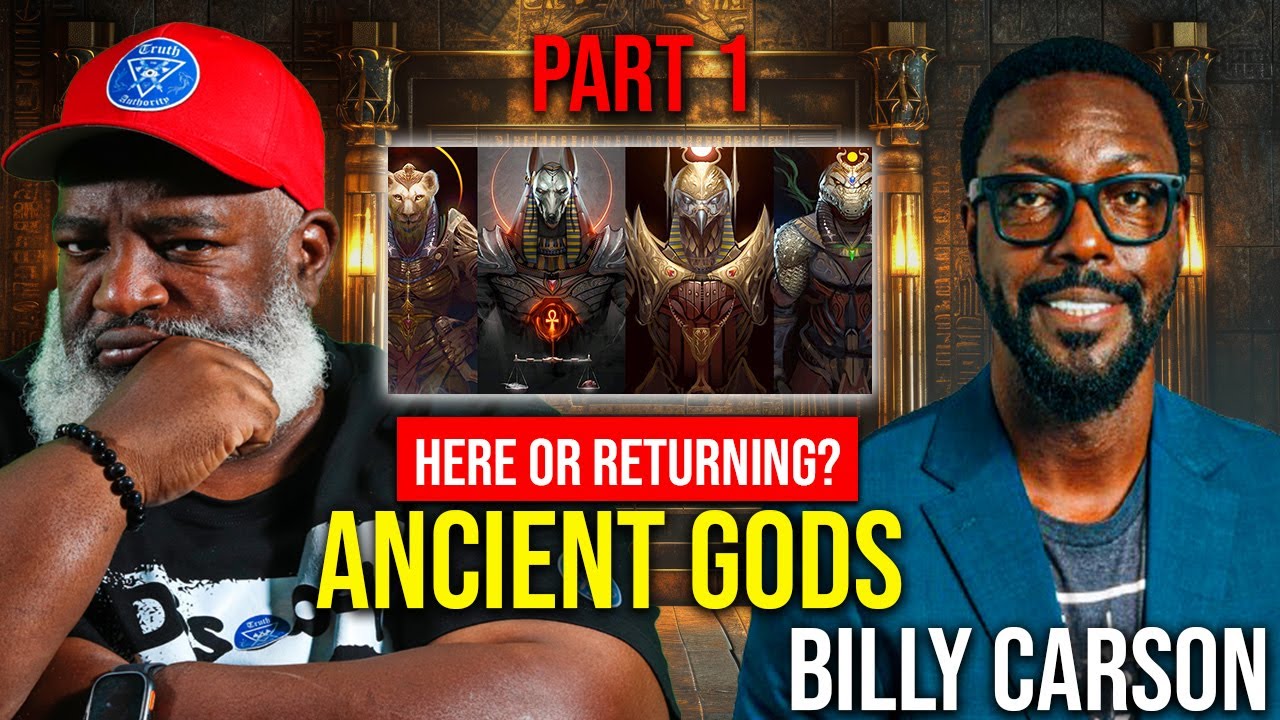
Is there a dragon in the Bible behind the stories of a jealous, violent god? In this conversation, Billy Carson and Paul Wallis, the former Anglican archdeacon behind the Eden series, argue that some of the harshest Old Testament episodes preserve older "dragon narratives": memories of nonhuman overlords who demanded tribute, fed on human fear and were eventually refused. The video walks through that reading, from Origen and the Book of Enoch to Bel and the Dragon, the Gnostic archons, the Ubaid figurines and Maya carvings.
The topic matters because it changes how readers handle the difficult texts. If every violent command is read as the voice of the source of the cosmos, believers must defend it; if some of those stories are reworked memories of rulers who masqueraded as gods, the same texts become, in Wallis's view, lessons in people power. Both men present this as a reason to go back to the original languages, not to throw the Bible away.
What the video covers
From archdeacon to paleo-contact (from about 5:00)
Wallis spent 33 years in church-based ministry, rising to archdeacon in the Anglican Church, and trained pastors as a theological educator. The tools he taught, source analysis, form analysis and the question of what each word actually means, kept producing a different storyline when applied to passages that never quite made sense: a summary of the Sumerian accounts of contact with sky people. Publishing the Eden series, he says, cost him friendships and professional standing built over three decades.
The experiencers in the pews (from about 8:30)
Since publishing, Wallis has heard from many churchgoers with close-encounter experiences who were told never to mention them, some silent from age 15 to 65. He describes fathers who hid their own encounters to protect their children, only to open up when a son called decades later with the same story. Carson adds that in Black and brown communities in the 1970s and 1980s, UFOs were close to unmentionable.
Editors, dragons and the early church (from about 14:30)
Wallis argues that sixth-century BC editors laid a word now understood as "God, the source of the cosmos" over older stories of oppression by draconian entities, producing a god who goes to war with himself and changes his mind mid-genocide. Against the charge that this is unorthodox, he points to Origen, Clement of Alexandria and Justin Martyr, citing Origen's warning that a literal reading makes readers believe things of God they would never believe of the cruellest of men. He reads 1 John 4 and Hebrews 12 as signs the first Christians knew about contact and ancestral spirits.
Tribute, refusal and 1 Samuel (from about 17:50)
Carson raises the commands to destroy a town and bring back the spoils, asking why a god would need gold, livestock and captive girls. Wallis says dragon stories from Wales to China and Russia share that shape: a nonhuman ruler is left in peace while tribute flows, until people realise that together they can refuse. He reads the passage in 1 Samuel where the people choose a human king as that turning point, and says the divine name itself carries phonetic clues to a dragon story.
Archons, Micaiah and the algorithm (from about 20:40)
Carson brings up the Nag Hammadi archons, one reptilian in appearance and one resembling a grey, that feed on negative emotion. Wallis calls the Gnostics the original Christians and the archons energy-based beings that push people into fear, rage and even war, then feed on the misery. He finds the same pattern where the prophet Micaiah sees a spirit volunteer to lure a king into battle on false information, and compares it to algorithms that profit from outrage. His advice: "you got to be very intentional about your emotional state."
Emotional hygiene and the Emerald Tablets (from about 24:30)
Carson links this to the dark brothers in the Emerald Tablets of Thoth and the practice the text gives: a closed dark space, an imagined circle and specific names he understands as frequencies that clear the aura. His own habit is to step back from his thoughts and refocus on people he loves and things he has accomplished. Wallis adds that young children are good at pulling a parent out of a bad headspace.
Root words and ancient technology (from about 27:00)
Wallis lists the words usually translated "God", Elohim, Elyon, El Shaddai and Yahweh, and renders them as the powerful ones, the more powerful one, the powerful one the destroyer, and a name he links to a draconian figure. He reads Ezekiel's chashmal and the six men with shattering weapons in Ezekiel 9 as faithful descriptions of technology by people who did not understand it. A few days of translation work, he says, put him squarely in the cuneiform texts of Sumer, Akkad, Babylonia and Assyria, using translations dating to the nineteenth century. Carson's line to viewers: "go research the translations for yourself so that you can make your own educated decision."
Enoch, Asherah and Bel and the Dragon (from about 31:30)
On the Book of Enoch, Wallis credits the Ethiopian Orthodox Church for keeping it, notes that Jude quotes it, and argues it was dropped because its abduction, invasion and hybridisation material did not suit a pyramid-shaped church. He reads Enoch's teachers of art, adornment and clothing as a story of humanity's leap into civilisation. He briefly revisits Asherah, then turns to Bel and the Dragon, absent from most Western Bibles, which he reads as showing that sacrificial food went to the Elohim to eat.
Ubaid figurines and cargo cults (from about 37:00)
Carson describes his replicas of the lizard-headed Ubaid figurines of southern Mesopotamia, including a mother nursing an infant, and argues they depict a real population. Wallis says museum explanations of Maya carvings, that strange headgear simply signals advancement, stop short of the next question. Both describe a cargo cult: a less advanced society imitating a more advanced one, as in Wallis's example of a Maya queen wearing what he reads as a non-working earpiece during a bloodletting meant to bring on an altered state.
Enlil, the Popol Vuh and Acts 15 (from about 42:30)
Carson recounts Enlil's anger at noisy humanity and his plan to starve them. Wallis adds a Maya parallel in which humans are deliberately dimmed so they must rely on authority, and contrasts Enlil the destroyer with Enki the rescuer, arguing the biblical Yahweh fuses both and becomes double-minded. He closes with Acts 15, Jesus calling the murderer from the beginning the father of lies, and Paul in Acts 17 describing humans as offspring of the source of everything. "You are an emanation of God," Wallis says.
Key takeaways
- Wallis came to paleo-contact through 33 years of church ministry and the standard tools of biblical scholarship, not from outside the church.
- He reads several harsh Old Testament episodes as reworked "dragon narratives" about extractive nonhuman rulers rather than as portraits of the source of the cosmos.
- Both men see the Gnostic archons, and the Micaiah council scene, as warnings about beings or systems that feed on fear, with modern algorithms as a close parallel.
- Their practical advice is to guard one's emotional state deliberately, an idea Carson ties to the Emerald Tablets.
- Wallis argues the Book of Enoch and other excluded texts were set aside because their contact material threatened institutional authority.
- Both treat Ubaid figurines and Maya carvings as possible evidence of a cargo-cult relationship with more advanced beings.
Billy Carson's reading
Carson's position is consistent across his work: he believes in a creator of the universe, but holds that some beings described in ancient texts were not that creator. They were advanced people, he says, "with more advanced knowledge but still people", who allowed themselves to be worshipped. Wallis gives that reading a scholar's frame, which is why Carson calls him a hero and urges viewers to check the translations themselves. Wallis's point that better technology did not make those beings better than humans captures the shared conclusion: the stories record an unequal relationship, not a moral authority. For the background, see the site's guide to who the Elohim were, the earlier conversations on Deuteronomy 32 and Psalm 82 and on the sky armies and Asherah, and Billy's books, including the Compendium of the Emerald Tablets.
What mainstream scholarship says
Several points in the conversation have a firm textual basis. Scholars do date much of the Hebrew Bible's editing to the exilic and post-exilic periods; Elohim is grammatically plural; Origen did write, in On First Principles, that literal readings lead people to believe things of God "not believed of the most savage and unjust of men"; Jude 14–15 quotes 1 Enoch 1:9; the Ethiopian Orthodox canon includes Enoch; and 1 Kings 22 does show Micaiah's vision of a lying spirit sent to entice Ahab. Most scholars, however, take Elohim with singular verbs as a title for one god, derive the name Yahweh from a Hebrew verb of being, and find no dragon behind it; the Bible itself casts Yahweh as the slayer of Leviathan in Psalm 74 and Isaiah 27.
Some details need correcting. The demand for a human king is 1 Samuel 8, where Samuel warns that a king will take sons, daughters, fields and flocks. The tribute of people and livestock "for the LORD" in Numbers 31 goes to Eleazar the priest. Bel and the Dragon is a satire of idol worship: Daniel proves the priests of Bel, not the god, eat the offerings, and the text says nothing about girls. Enlil's complaint about human noise and the famine plan come from the Atrahasis epic rather than the Epic of Gilgamesh. In the Popol Vuh it is Heart of Sky who clouds the first people's sight "as breath on a mirror". Cargo cults are documented in twentieth-century Melanesia.
On the archaeology, the Ubaid figurines (roughly 5500–4000 BC) are generally read as stylised human figures, perhaps reflecting masks, headdresses or head shaping; their meaning is debated, but nothing indicates a non-human species. Lady Xoc's ear ornaments on Yaxchilan Lintel 24 are ear flares, a standard item of Maya regalia. The Nag Hammadi codices date to the fourth century and preserve second-to-third-century texts, which is why most historians see Gnostic groups as one strand of early Christianity rather than its original form.
Watch, read and go deeper
The Book of Enoch guide covers the Watchers, the letter of Jude and the canon question raised here. The Atrahasis epic explainer sets out Enlil's noise complaint, the famine and Enki's rescue in full. For more on Mesopotamian sources, start at the Anunnaki topic hub, and for verse-by-verse readings, the Bible Study series on 4BK TV.
Frequently asked questions
Is there a dragon in the Bible?
Yes. The Hebrew Bible names sea monsters such as Leviathan and Rahab, and Revelation 12 calls Satan "the great dragon". In mainstream readings these creatures are enemies that God defeats. Paul Wallis's dragon-narrative reading goes further, arguing that some stories told of God preserve memories of draconian rulers.
What is Bel and the Dragon?
Bel and the Dragon is a short Greek addition to the Book of Daniel, printed as Daniel 14 in Catholic and Orthodox Bibles and among the Apocrypha in Protestant ones. Daniel shows that the priests of Bel secretly eat the offerings, then kills a dragon the Babylonians worship. Most scholars read it as satire against idol worship.
Who is Paul Wallis?
Paul Wallis is an Australian author and former archdeacon in the Anglican Church who spent 33 years in church-based ministry and trained pastors. He writes on paleo-contact in the Eden series, including Escaping from Eden, The Scars of Eden and The Eden Conspiracy, and hosts videos on the 5th Kind channel.
What are archons in Gnosticism?
In Gnostic texts from the Nag Hammadi library, archons are rulers who serve a flawed creator figure and keep souls bound to the material world. Texts such as the Apocryphon of John and the Hypostasis of the Archons describe them. Carson and Wallis read them as energy-based beings that feed on human fear.
Sources mentioned
In the video, Wallis and Carson cite Deuteronomy, 1 Samuel, 1 Kings 22, Ezekiel, Jeremiah, 2 Kings, 1 John, Hebrews, Jude, John and Acts. They discuss the Book of Enoch, Bel and the Dragon, the Nag Hammadi texts, the Emerald Tablets of Thoth, the Epic of Gilgamesh, the Popol Vuh and the writings of Origen, Clement of Alexandria and Justin Martyr, along with Wallis's Eden series, including The Eden Conspiracy. Standard references: Origen's On First Principles, the Atrahasis epic in W. G. Lambert and A. R. Millard's edition, Dennis Tedlock's translation of the Popol Vuh, and Mark S. Smith's The Early History of God on Yahweh, El and Asherah.