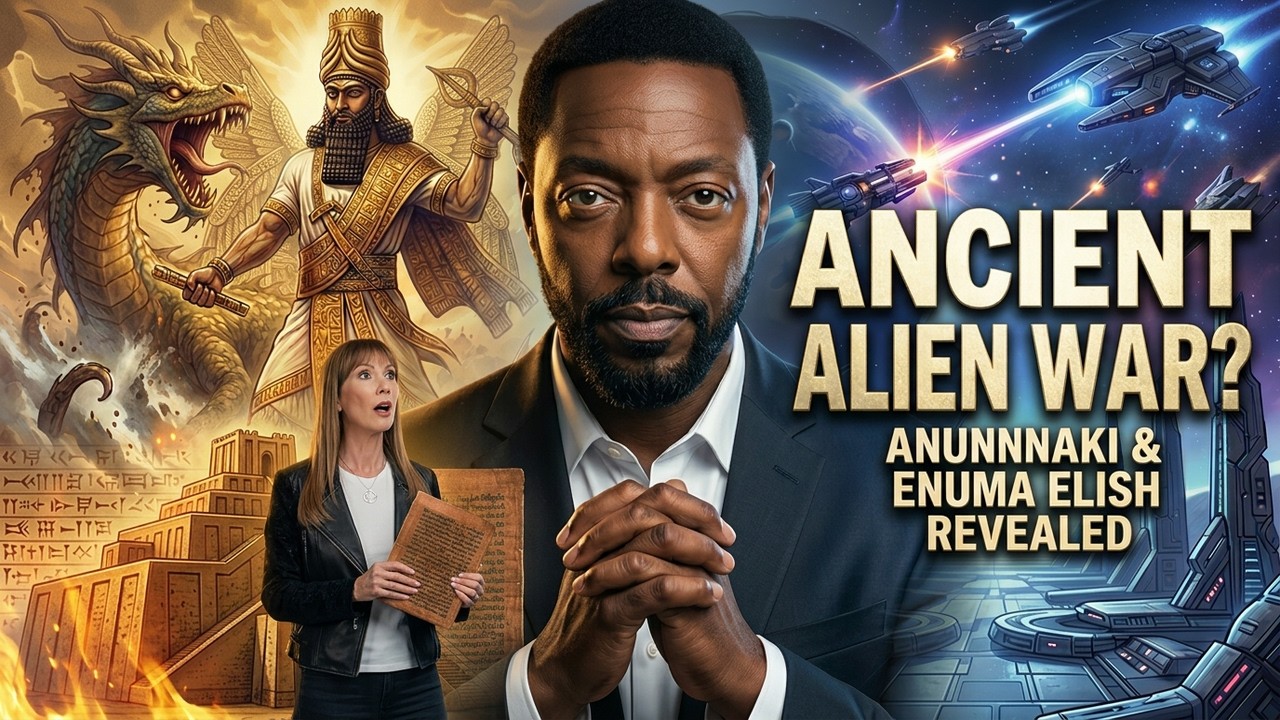
The Anunnaki war in heaven, as Billy Carson tells it, is the Babylonian Enuma Elish read literally: a real collision in the early solar system in which the planet-god Marduk, which he links to Nibiru, tore through a water-bearing world called Tiamat and left behind Earth and the asteroid belt. The episode follows that idea through the Mahabharata, the Tablet of Destinies, vitrified ruins, vimanas, the Dogon and the Hopi, and ends with the claim that humanity carries a god-like lineage.
Almost every ancient culture tells of gods fighting in the sky, and how to read those stories, as theology, as memory of real events or as something stranger, sits at the center of the Anunnaki debate. This episode from the Anunnaki Ancient Secrets Revealed series is Carson's most compact case for the literal reading. This article sets out what he argues and where historians and scientists land on each point.
What the video covers
The Enuma Elish as a celestial battle (from about 1:57)
Carson asks whether the fight between Marduk and Tiamat is a metaphor for order against chaos or a record of something physical. His answer: "if we interpret the text literally, we can see astrophysics, planetary alignments." In his telling, Tiamat was a planet four to six times larger than Earth, with oceans and the materials for life. Marduk, which he says an older version of the text calls Nibiru, drives through Tiamat's core and shatters it. One large chunk swings away with Tiamat's water and organic material and becomes Earth, pushing Mercury and Venus closer to the Sun. This is essentially the celestial-battle reading popularized by Zecharia Sitchin. Carson adds a question: if Earth did not yet exist, who watched Tiamat's oceans glow? He concludes another advanced culture was already present. The planet itself is covered in the site's guide to Nibiru and Planet X.
Mars and out-of-place artifacts (from about 5:06)
Carson suggests Mars may have been a habitable moon of a larger world, possibly Tiamat. He points to the contrast between a scarred hemisphere and one of the smoothest surfaces in the solar system, an axis he says shifted about 45 degrees, and signs of ancient water he reads as a global flood caused by debris strikes. From about 6:23 he cites a vase he dates to 500 million years and a hammer he dates to about 100 million years, the object usually identified as the London Hammer, and proposes that miners are reaching layers of a civilization on the larger planet Earth broke away from.
Wars in heaven across cultures (from about 7:24)
The episode widens to Ragnarok, the Titanomachy between Titans and Olympians, Michael against Satan in the Book of Revelation, and the war at Kurukshetra in the Mahabharata. Back in Sumer, Carson describes the Tablet of Destinies as the control for weapons of mass destruction, stolen several times. Those weapons released the Evil Wind, and he says the tablets describe people losing hair and fingernails and bleeding from the eyes. "It sounds a lot like radiation sickness," he concludes.
Iapetus and ancient weapons (from about 9:43)
Saturn's moon Iapetus, with its equatorial ridge and look of two halves joined, strikes Carson as possibly artificial, a Death Star from the past. He argues (from about 10:16) that the Anunnaki taught the Sumerians building, government, finance and alchemy, and that the same knowledge produced weapons. He cites the Brahmashira astra as rivaling a nuclear device, the Drona Parva, the seventh book of the Mahabharata, for passages he says read like nuclear war, and mentions advanced armor and unmanned craft he compares to drones.
Glass, radiation and a global war (from about 14:58)
For traces on Earth, Carson cites Mohenjo-daro, where he says buildings turned to glass, skeletons lie in the streets holding hands and remains read above background radiation. He adds glass balls in the sand at Giza, what he calls weapons-fire damage on the Bent Pyramid, and similar glass near Teotihuacan and in the Yucatan. "We have to keep looking at these ancient wars and asking questions," he says, reading the sinking of Atlantis as a sign the conflict was global.
Gods' technology, vimanas and the Dogon (from about 17:20)
Carson argues the Anunnaki used anti-gravity craft, faster-than-light travel, wormholes or teleportation. From about 19:29 he turns to vimanas, the flying chariots of the Vedas, the Mahabharata and the Ramayana, as vehicles of interstellar refugees taken for gods, then to the Dogon of West Africa and the Nommo, visitors linked to Sirius B. The spiritual core follows: if the Anunnaki made humans in their image, then "everyone on this planet right now has a Godlike lineage," which he believes lets individuals bypass religious institutions.
Enlil's cities, Atlantis, Derinkuyu and the Hopi (from about 25:31)
Carson reads a passage in which Enlil, flying with his sister Ninmah, lays out Eridu, Larsa, Lagash, Shuruppak and Nibru-ki, the crossing place that would house the Tablets of Destinies; the wording follows Sitchin's The Lost Book of Enki. In Egypt (from about 27:32) he points to Zep Tepi, the First Time when gods ruled, and the Neteru, whom he equates with the Anunnaki and credits with Atlantis, in his view one capital of an interplanetary civilization whose factions fought as far as Mars. From about 30:00 he cites Derinkuyu in Turkey and traditions of ant people leading humans underground, a motif he also finds in Egypt and among the Hopi, and asks whether the Hopi kachinas were the Anunnaki.
The DUR.AN.KI and the closing message (from about 34:15)
Carson interprets the DUR.AN.KI, which he translates as bond heaven-earth, as a portal, possibly an Einstein-Rosen bridge, letting the gods walk between Earth and their home world. He argues that accepting this history would force changes in physics and education, and ends on the viewer: "You are the godlike being right here right now on the earth."
Key takeaways
- Carson reads the Enuma Elish literally, as a collision between Marduk (Nibiru) and Tiamat that produced Earth and the asteroid belt.
- He treats Mars, Iapetus and out-of-place artifacts as physical traces of that conflict.
- He links the Tablet of Destinies and the Evil Wind to the weapons of the Mahabharata, reading both as weapons of mass destruction.
- He cites vitrified sites, desert glass and underground cities such as Derinkuyu as evidence the war reached Earth.
- His central conclusion is spiritual: humans descend from a god-like lineage and can claim that heritage directly.
Billy Carson's reading
Carson's position rests on a method more than any single piece of evidence: take ancient texts at their word, and treat agreement between cultures as a signal rather than coincidence. When the Enuma Elish, Revelation, the Mahabharata and Norse myth all describe battles in the sky, he sees a shared memory of real events, recorded by people who lacked words for planets, weapons and spacecraft. The Sumerian material carries the most weight because he regards the Anunnaki as the source of humanity's knowledge and origin. For the text itself, see the tablet-by-tablet guide to the Enuma Elish and the seven tablets of creation, and for how the Sumerian sources compare with ancient astronaut theory, who the Anunnaki were.
The reading has a practical edge too. Carson argues that recognizing an interplanetary past would push science toward new physics, change how history is taught and let each person trace their origin to a divine source. The same framework drives his view of Atlantis as one capital of a global Anunnaki civilization, covered in Atlantis and Billy Carson's Anunnaki connection.
What mainstream scholarship says
Assyriologists read the Enuma Elish as a Babylonian theological poem from the second millennium BCE explaining how Marduk, god of Babylon, became king of the gods. Tiamat is the primordial salt water, and Marduk splits her body to form sky and earth. Nibiru appears as one of Marduk's fifty names and an astral position tied to him, not a separate planet. Astronomers explain the asteroid belt as material Jupiter's gravity kept from forming a planet; its total mass is a few percent of the Moon's, far too little for a shattered world larger than Earth. Mars' contrasting hemispheres are studied as the result of an early giant impact or internal processes, and its ancient water is real, but none of this marks Mars as a former moon.
The Lament for Ur describes the fall of Ur around 2000 BCE to Elamite invaders, with storm and famine framed as Enlil's will; scholars read it as poetry about a sack, not fallout. The Mohenjo-daro skeletons come from different layers, no excavation report documents vitrified buildings or raised radiation, and the Indus cities declined gradually. Libyan Desert Glass is explained by a meteorite impact or airburst, and Yucatan spherules by the Chicxulub impact. Iapetus' ridge is considered natural, perhaps a collapsed ring. The Dogon and Sirius story traces to Marcel Griaule and Germaine Dieterlen, and Walter van Beek's fieldwork found no Sirius B tradition. The London Hammer is undated and most likely a 19th-century tool inside a quickly formed concretion.
The Enlil passage comes from The Lost Book of Enki (2002), which Sitchin presented as a reconstruction, not a translation of a tablet. DUR.AN.KI was the name of Nippur's sacred precinct as the link between heaven and earth, and Plato's Atlantis is widely read as a philosophical allegory.
Watch, read and go deeper
The full episode belongs to the Anunnaki Ancient Secrets Revealed series on 4BK TV, and the audio version is on the 4biddenknowledge Podcast. For the underground-city thread, read the guide to Derinkuyu and who dug it. Everything on the Mesopotamian gods, Sitchin and the ancient astronaut debate is collected on the Anunnaki topic hub.
Frequently asked questions
What is the war in heaven in the Enuma Elish?
In the Enuma Elish, the young god Marduk fights Tiamat, the primordial sea, after she raises an army led by Kingu. Marduk defeats her, splits her body to make sky and earth, and takes the Tablet of Destinies. Ancient astronaut writers such as Zecharia Sitchin and Billy Carson read it as a planetary collision; scholars read it as a myth of Marduk's kingship.
Is Tiamat a planet?
In the Babylonian text, Tiamat is a goddess who personifies salt water. The idea that she was a planet between Mars and Jupiter comes from Sitchin's 1976 book The Twelfth Planet, which Carson follows. Astronomers recognize no former planet there.
What was the Tablet of Destinies?
The Tablet of Destinies conferred supreme authority over the decrees of the gods. In the Enuma Elish it passes from Kingu to Marduk, and in the myth of Anzu the bird-demon Anzu steals it from Enlil. Carson interprets it as a control device for weapons.
Did the Anunnaki use nuclear weapons?
That is Carson's position, based on the Evil Wind passages, Mahabharata weapons and vitrified sites. Historians read these as poetry about invasion and epic imagery, and no excavated site has produced evidence of an ancient nuclear blast.
Sources mentioned
Carson draws on the Enuma Elish; Sumerian material on the Tablet of Destinies and the Evil Wind; Ragnarok; the Titanomachy; the Book of Revelation; the Mahabharata and its Drona Parva; the Vedas and Ramayana; Dogon lore of the Nommo; Zep Tepi and the Neteru; Plato's Atlantis; Hopi kachina traditions; and Sitchin's The Lost Book of Enki. Standard references include Stephanie Dalley's Myths from Mesopotamia, the Electronic Text Corpus of Sumerian Literature for the Lament for Ur, Sitchin's The Twelfth Planet and Walter van Beek's 1991 Dogon restudy in Current Anthropology.