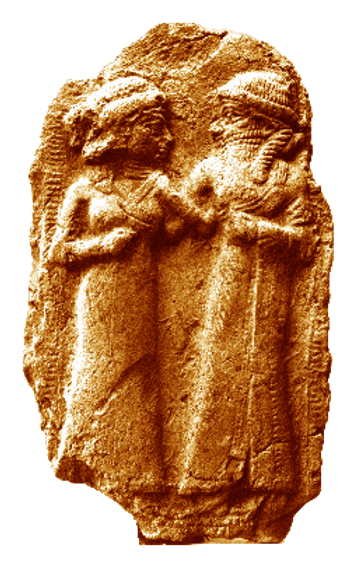
What is the divine council in the Bible, and why do Billy Carson and Paul Wallis read it as a memory of the Anunnaki? In this conversation, Wallis, a former Anglican archdeacon and author of the Eden series, argues that Psalm 82 and Deuteronomy 32 preserve a scene in which a senior being called El Elyon divides the nations among a council of powerful ones, the Elohim, and that Yahweh is a junior member who receives a people but no land. Carson adds the Sumerian side: the Adapa myth, and his view that Enlil's all-seeing eye in the flood stories was a technology.
The topic matters because the divine council is not a fringe idea: the plural noun Elohim and the council of Psalm 82 are the subject of serious scholarship, and Deuteronomy 32:8 differs between manuscripts in exactly the place that decides who got which nation. Carson and Wallis take that scholarship somewhere most scholars do not.
What the video covers
Who Paul Wallis is (from about 4:00)
Carson introduces Wallis as a bestselling author and co-founder of The 5th Kind channel on YouTube. Wallis describes 33 years in church ministry in Australia, including training pastors in hermeneutics and serving as an Anglican archdeacon, and says that applying those disciplines to anomalies in Genesis led him to paleo contact, the theory that humanity's ancestors had contact with extraterrestrial civilizations. His latest book, The Invasion of Eden (2024), relates the ancestral stories to the UAP disclosure fight in Congress.
The Bible as a summary of the Mesopotamian stories (from about 6:50)
Wallis's starting claim is that the narratives of Sumer, Akkad, Babylonia and Assyria are the bedrock of the biblical story. Treating the strange passages of Genesis as translation questions, he found a summary form of the Mesopotamian stories, overlapping at what he calls points of trauma: a planetary catastrophe, the creation of humans and their hybridization with more advanced beings, arguments among non-human entities about how large the human population should be and how long people should live, the carving up of land so that each parcel is managed by a non-human and served by humans, and a flood. The same traumas, he says, are recalled in the Yucatan, Scandinavia, Africa, Greece and India, which convinced him the biblical account came second. The Atrahasis epic is the clearest Mesopotamian example of the argument-about-humanity motif he has in mind.
Narrative control, briefly (from about 11:30)
Asked why modern people assume their ancestors were fools, Wallis answers with the reform of Hezekiah and Josiah in Judah, which he says turned a canon of memory about many beings into a canon about one, Yahweh. That reform is the subject of The Eden Conspiracy and of another conversation on this site, so it is only noted here, with one correction: Josiah was Hezekiah's great-grandson, not grandson.
No Hebrew word for God (from about 19:30)
The hinge of the conversation is Wallis's claim that these were never religious texts. There is no word in biblical Hebrew, he says, that means God as a modern reader means it, a transcendent source of the cosmos; the words later used for that concept originally meant a range of beings interacting with the ancestors. Read as a god story, the Elohim narratives lose their lessons about covert government and hidden hands, so his instruction is simple: "put Elohim back into the plural". Carson agrees and goes further: in his opinion the biblical texts, the Torah and the Quran contain useful teaching but mostly describe other entities taken for gods, mixed with the agendas of later editors.
Adapa and the resentful angels (from about 26:15)
Carson brings the Sumerian parallel. The Bible, he says, has angels upset that God made humans capable of a higher state than themselves, and the same idea appears thousands of years earlier in the Adapa myth, where the first man is told he can reach a higher estate than the Anunna. That is Carson's reading; the surviving Akkadian text says Ea gave Adapa wisdom but not eternal life. Both stories are compared in the Garden of Eden and the Anunnaki article.
Psalm 82 and Deuteronomy 32: the council and the landless god (from about 29:00)
This is the heart of the video. Wallis points to Psalm 82 and Deuteronomy 32 and describes a moment just after what he calls the invasion of the Elohim, a plural he renders as the powerful ones and regards as the Hebrew equivalent of Anunnaki. They form a council chaired not by Yahweh but by El Elyon, the most senior of them, who carves up the land: each Elohim gets a territory, the resources beneath it and the people on it. When it comes to Yahweh, "he gets a people group with no land", which makes him a junior member of the council. El Elyon has, in Wallis's phrase, "artificially created scarcity", and that frames every war in the Hebrew scriptures: Yahweh can only get land for his people by fighting other Elohim for theirs. Preachers tell it as chosenness; the text, Wallis argues, tells it as short shrift. He stresses that he is not undermining the Bible, only disagreeing with how it has been translated and preached. For what the plural noun does and does not prove, see who were the Elohim.
Enlil's all-seeing eye (from about 40:15)
Carson then offers two hypotheses, flagged as "just a couple theories I came up with". The first is physical. In the Mesopotamian flood tradition, Enlil knows where crops are growing, where populations are dense and where humans are making too much noise, and decides how many to cull. How could he know? Carson's answer is a device in polar orbit with a multispectral camera, which he connects to the Black Knight satellite, to a signal he says was decoded as pointing to Epsilon Boötis, and to Boötes being Enlil's constellation. The second is non-physical: if electrons behave differently when observed, as Carson reads the double-slit experiment, then every atom is in some sense conscious and reporting to the source. Wallis, noting Plato held a similar view, adds a textual point: in the Hebrew scriptures omniscience appears only in worship material, never in the narratives, where the character called God goes places to find out what is happening.
Watchers, observers and technology (from about 47:15)
Wallis ties the surveillance theme to names. In the Book of Enoch the beings who kickstart civilization are the Watchers; in the Sumerian stories the parallel figures are the Igigi, which he glosses as observers watching from stations among the stars. He suggests the Anunnaki framed enslavement as worship so that serving them would feel noble, and finds the same cynicism in the Popol Vuh, where the feathered serpents make humans to do the work and bring them food. Both men argue that translators with no technological vocabulary rendered machines as spiritual phenomena: what Wallis calls a rocket launch in Exodus, a craft carrying Ezekiel, and holes in the sky he would now call portals.
Eyewitnesses and the religious mind (from about 55:25)
The closing substance is about evidence. When Filipino, Hebrew and Maya tellings describe the same beings and machines with the same descriptors, Wallis argues, they are recalling a shared visual experience, so the stories are eyewitness testimony to be weighed rather than dismissed. Carson cites the Dogon account of visitors from Sirius B as one such tradition. Both close on temperament: Carson says "when you're born you're given a name, a race and a religion" and spends a lifetime defending them; Wallis says learning anything new requires permission to admit not knowing.
Key takeaways
Wallis reads Genesis through Kings as a compressed summary of older Mesopotamian narratives, overlapping at catastrophe, the making of humans and the flood.
His central text is the divine council of Psalm 82 and Deuteronomy 32, where El Elyon divides the nations among the Elohim and Yahweh receives a people without land.
Carson reads Enlil's knowledge of human numbers and crops as orbital surveillance and links it to the Black Knight satellite.
Mainstream scholarship accepts the divine council as a real feature of the text but explains it through Canaanite religion, not extraterrestrial contact.
Billy Carson's reading
Carson's position is that the Sumerian tablets are the source documents and the Bible a later edition of them, and that the beings called gods in both were a physical, technological civilization rather than the creator of the universe. He treats the Anunnaki of the Anunnaki hub as the Elohim under another name, so Wallis's reading of Psalm 82 gives him a biblical scene that looks like the Sumerian assembly of the gods. His own contribution is to push the surveillance motif into hardware, offered openly as a hypothesis. He also holds that this generation is the first with the vocabulary to read these texts, a theme he developed in the origins of religion, part 2 and in his docuseries Anunnaki: Ancient Secrets Revealed.
What mainstream scholarship says
The divine council is mainstream. Scholars such as Mark S. Smith and the late Michael Heiser read Psalm 82 as Israel's God standing in the council of El and sentencing the other elohim, and Deuteronomy 32:8–9 as Elyon apportioning the nations among divine beings with Yahweh taking Israel. The manuscript point is real: the Masoretic text reads sons of Israel, while a Dead Sea Scroll fragment (4QDeut j) and the Septuagint read sons of God or angels of God, which most critics take as the older wording. The consensus parts from Wallis on the explanation. The council is an inheritance of Canaanite religion, attested at Ugarit, where El presides over an assembly of gods; the Hebrew writers adapted it, Yahweh and El Elyon were identified, and the other gods were demoted to angels. Elohim is a Hebrew word built on El, not a translation of Anunnaki.
On the Sumerian side, the god disturbed by human noise who sends drought and famine before the flood belongs to the Atrahasis epic rather than Gilgamesh, and nothing in the text describes an instrument. The Black Knight satellite is best explained by a thermal blanket photographed drifting from the shuttle Endeavour in 1998, and the Epsilon Boötis signal was Duncan Lunan's 1973 interpretation of long-delayed radio echoes, which Lunan later withdrew. One strand of Carson's link does hold: the Babylonian star catalogue MUL.APIN names a star in Boötes, usually identified as Arcturus, as the star of Enlil. The Watchers of Enoch take their name from an Aramaic word meaning the wakeful ones, and the meaning of Igigi is uncertain. The Dogon material rests on Marcel Griaule's fieldwork, which Walter van Beek could not confirm in 1991.
Watch, read and go deeper
The companion to this conversation is the pillar on who were the Elohim. The Sumerian texts the two men lean on are explained in the Atrahasis epic and in the Garden of Eden and the Anunnaki, which covers Adapa. For the Watchers, read who were the Watchers, and for the object Carson connects to Enlil, the Black Knight satellite. Carson's docuseries Anunnaki: Ancient Secrets Revealed is on 4BK TV, and the Anunnaki hub collects the rest.
Frequently asked questions
What is the divine council in the Bible?
The divine council is the assembly of heavenly beings over which God presides in passages such as Psalm 82, 1 Kings 22 and Job 1. Scholars connect the scene to the Canaanite assembly of the gods known from Ugarit.
What does Deuteronomy 32:8 say about the sons of God?
The traditional Hebrew text says the Most High fixed the borders of the peoples according to the number of the sons of Israel, while the Septuagint and a Dead Sea Scroll fragment read angels or sons of God, which most text critics take as the earlier wording. On that reading each nation is assigned to a divine being and Israel to Yahweh.
Does Elohim mean the Anunnaki?
Not as a translation. Elohim is a Hebrew plural built on El, the chief god of the Canaanite pantheon, while Anunnaki is a Sumerian and Akkadian term for the great gods. Wallis and Carson argue that both words describe the same beings remembered by different cultures, a claim about history rather than language.
Who is Paul Wallis?
Paul Wallis is an Australian author and former Anglican archdeacon who spent 33 years in ministry. He co-founded The 5th Kind TV and wrote the Eden series, from Escaping from Eden to The Invasion of Eden, in the field he calls paleo contact.
Sources mentioned
In the video Wallis cites Genesis, Psalm 82, Deuteronomy 32, 2 Kings, Exodus, Ezekiel, the Enuma Elish, the Epic of Gilgamesh, the Atrahasis flood tablet, the myth of Adapa, the Book of Enoch, the Popol Vuh and Plato, names Michael Heiser, and refers to his own Eden series. Carson cites the Black Knight satellite, the Dogon accounts of Sirius and the double-slit experiment. Standard references for the mainstream reading are Mark S. Smith's The Origins of Biblical Monotheism, Michael Heiser's The Unseen Realm and Stephanie Dalley's Myths from Mesopotamia.