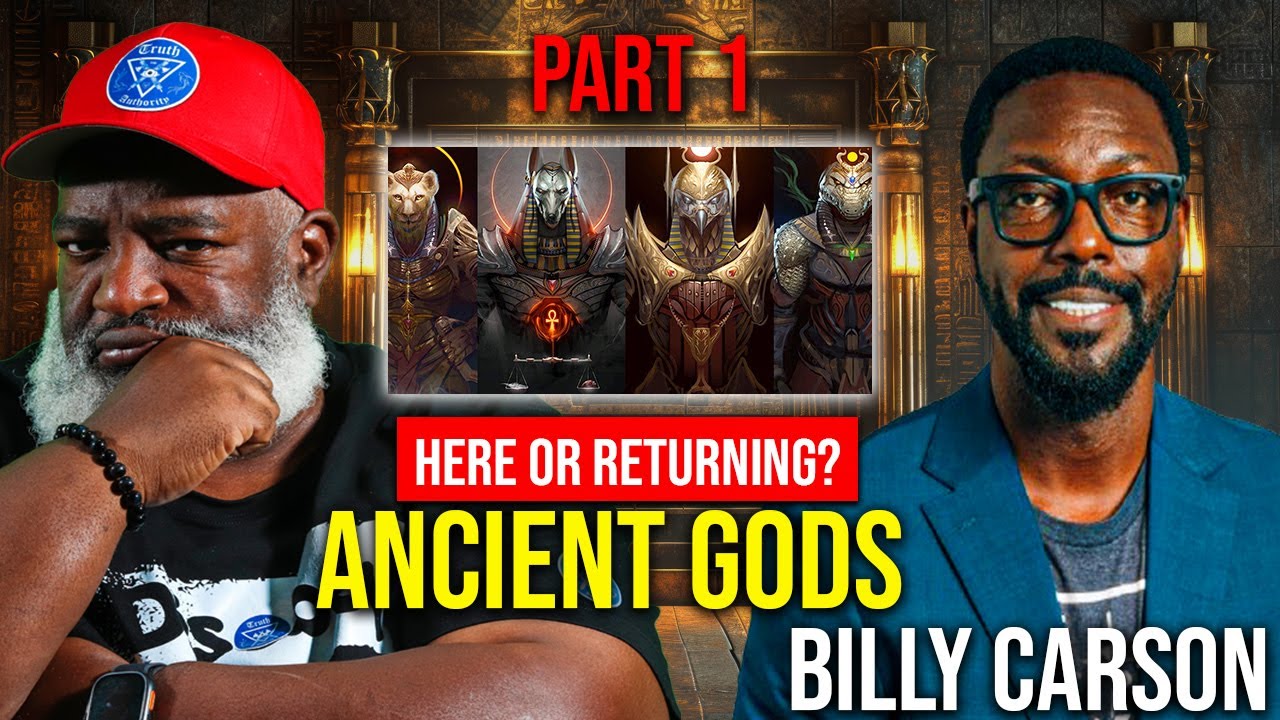
Did the Anunnaki create Adam and Eve? In this livestream Billy Carson argues that they created no one from nothing: in his reading of the Sumerian tablets, the Anunnaki took a hominid already living on Earth, combined its essence with their own, carried the first engineered child, Adamu, to term in a goddess's womb, cloned Eve from him, and scaled the result through birthing houses until a breeding population existed. The video runs from the Igigi revolt to the mark of Cain and ends with Carson's claim that every living person carries Anunnaki DNA.
The question matters because the Atrahasis and the Enuma Elish are among the oldest creation stories in existence, and Genesis came out of the same Near Eastern world. Whether those texts describe a laboratory, a metaphor or a theology is where ancient astronaut writers and Assyriologists part company, so this companion follows Carson's case in order and states where scholarship reads the same lines differently.
What the video covers
Anunnaki, Atlanteans and a cargo cult of eight billion (from about 0:00)
Carson opens by correcting what he calls a long-running misconception: the Anunnaki and the Atlanteans are the same people. Anunnaki, for him, is a general term for those who came from heaven to Earth, while Atlantean names the civilization they built, which he believes spanned Earth, the Moon and Mars. A civilization a million years ahead of ours would look like magic, and a less advanced people always deifies a more advanced one; humanity, he says, has become a cargo cult of eight billion. "God is a frequency," in his words, and it has no gender.
Scribes, the Emerald Tablets and a creator above the gods (from about 5:30)
Every ancient text, Carson says, was written by scribes taking dictation from beings who called themselves gods, with one exception: the Emerald Tablets of Thoth, which he argues Thoth wrote himself and which he treats in his Compendium of the Emerald Tablets. The tablets repeatedly invoke a creator of all to whom the gods would answer. "They masqueraded as gods, but they weren't gods," he says. Drawing on the Epic of Gilgamesh, the Atrahasis and the Enuma Elish, his thesis is that the ancient astronaut community has it slightly wrong: the texts describe genetic manipulation, not creation from scratch.
Elohim, Neteru and "let us make man in our image" (from about 9:30)
Carson argues that the Bible preserves the same beings under other names. He points readers to the Book of Enoch, cites the Old Testament line in which Israelite scouts were grasshoppers in the sight of the giants they met, and holds that the Elohim of Genesis, the Neteru of ancient Kemet and the Sumerian pantheon are one people with supreme technology; see who the Elohim were and the Nephilim of Genesis 6. His proof text is "Let us make man in our image and our likeness," which he says appears in the Enuma Elish long before Genesis. On his timeline the Anunnaki arrived about 455,000 years ago and the Adamu was made between 300,000 and 200,000 years ago.
Blood, clay and the existing being at the Abzu (from about 13:00)
Reading a passage that follows Zecharia Sitchin's treatment of the Atrahasis, Carson explains that the primitive worker was made by taking from a god's blood his tima, rendered by scholars as life essence and by Carson as DNA, and mixing it with the ti-it of the Abzu. Because ti-it has been linked to the Akkadian word for clay, the Bible ends up with Adam made from clay, a reading he rejects. In his version the god's essence was mixed with that of a being already living on Earth, at an Abzu he places in Africa. Did the Anunnaki create mankind? Yes in a way, he answers, but not from zero.
The Igigi revolt and the night the camp was encircled (from about 15:30)
The reason anyone was engineered at all is labor. The Igigi, kin to the Anunnaki, had worked the mines for what Carson gives as 250,000 to 300,000 years without rest. Gathering on Mars, they resolved to go to war against Anu and his sons Enlil and Ea, the brothers profiled in the site's piece on Enki and Enlil, and fell from Mars to Earth, which he identifies with the fallen angels of the Bible. In the scene he says the tablets record, the Igigi encircle the camp at night and the gods wake to a rabble at the door. Enki defuses the standoff with a proposal: there is an existing being on the planet; combine the gods' essence with its essence and the new creature will bear the load of the Anunnaki. The Igigi agree to stand down.
Clones that could not breed, Isis and the first Adamu (from about 22:00)
Answering a viewer, Carson adds that the Anunnaki considered artificial workers and rejected them as a threat to their makers. The first organic attempts were clones of the existing hominid, modified to understand the gods' language and obey, but like a lion-tiger hybrid they could not reproduce, and the gods needed a self-sustaining population quickly.
The breakthrough came from a goddess he names Isis: take an egg from one of the existing beings, add the gods' essence, and carry it in her own womb. Carson calls this a zygote, says the pregnancy ran ten months, and refers to a British Museum cylinder seal that he reads as the goddess holding up the first Adamu, first man. Adamu was raised to maturity and set to mate with the earlier clones in Edin, the Bible's Eden. "Eden was a gigantic outdoor laboratory with guards," Carson says, the same armed guards who stand at the gates in Genesis. The matings failed, so the gods cloned Eve from Adam's own DNA, and that pairing produced the first modified Homo sapiens who could breed with each other.
Birthing houses, the gene pool and Cain's wife (from about 26:00)
A pair cannot found a species, so Carson describes a phase of replication: eggs taken from other females and carried by Anunnaki women in birthing houses, whom he identifies with the Hathors of Egypt, until the gene pool was wide enough to avoid inbreeding.
His closing proof is Genesis. After Cain kills Abel, Cain tells God, whom Carson identifies as Enlil, that the people out there will kill him. Who could they be if only four humans existed? Carson concludes that hundreds of thousands already lived outside Eden, reads the mark of Cain as a brand warning them off, and notes that Cain finds a wife there. "It wasn't just Adam and Eve," he says.
Enlil as the lord of Eden, Enki as the serpent, and Adapa (from about 29:00)
Carson ends with the inversion that runs through much of his work. Enlil, lord of the Eden laboratory, is the figure the Bible later calls Satan; the serpent was his brother Enki, who left a little extra in the human genome that would one day let humans rise above the Anunnaki, and was called the devil for telling Adam and Eve so. Carson locates the story in the Myth of Adapa, which he studied with Matthew LaCroix, and closes with a call to reactivate so-called junk DNA, the pineal gland and a frequency of love and service. "All of us are Anunnaki," he finishes, because their DNA runs in every one of us.
Key takeaways
Carson's position is that the Anunnaki modified an existing Earth hominid rather than creating humans from nothing.
The motive he gives is the Igigi labor revolt in the Atrahasis, which forced the gods to produce a worker that could breed on its own.
In his reconstruction Adamu was a zygote carried by a goddess, Eve was cloned from Adam, and birthing houses built a gene pool large enough to avoid inbreeding.
He reads Cain's fear of the people outside Eden, and Cain's wife, as biblical evidence that humans already existed beyond the garden.
He identifies Enlil with Yahweh and Satan, Enki with the serpent, and the Myth of Adapa as the source of the idea that humans were made to outgrow their makers.
Billy Carson's reading
Carson's interpretation rests on three moves. The first is literalism: he takes the Atrahasis account of a god's flesh and blood mixed with clay and the Genesis phrase about the divine image as reports of a procedure, and translates their vocabulary into zygotes and cloning. The second is synthesis: the Sumerian Anunnaki, the Egyptian Neteru, the biblical Elohim and Plato's Atlanteans are one people seen through different scribes, which is why Isis and the Hathors can enter a Mesopotamian story. The third is purpose: the story is told so that readers will see worship as a cargo-cult reflex and recover abilities they already carry. He makes the fuller case in the Compendium of the Emerald Tablets, and the site's pillar on the Garden of Eden and the Anunnaki sets his reading of Edin and Adapa beside the Genesis text.
What mainstream scholarship says
Assyriologists do not read the Atrahasis as a laboratory report. In the standard translations the Igigi toil for 3,600 years, not hundreds of thousands, and they surround Enlil's temple, the Ekur at Nippur, not a camp in South Africa; Mars does not appear. The birth goddess is Mami, also called Nintu or Belet-ili, and she mixes clay with the flesh and blood of a slain god named We-ila so that his spirit will live on in the new creature. The line about making man in the gods' image is Genesis 1:26; the Enuma Elish instead has Marduk form humankind from the blood of Qingu. The name Anunnaki is usually explained as offspring of An; "those who came from heaven to Earth" is Zecharia Sitchin's rendering, which Sumerologists reject. The Abzu is the subterranean freshwater ocean beneath Eridu, not Africa, and Isis belongs to Egypt, not Mesopotamia. No British Museum cylinder seal carries an inscription about the first Adamu, though the Atrahasis does say the first child was born in the tenth month.
On the Bible, the grasshoppers line in Numbers 13:33 refers to the Nephilim and the Anakim, not to Enoch, and Cain's wife is usually explained as a sister, as the Book of Jubilees states, or as a sign that early Genesis was never meant as a census. Paleoanthropology dates the earliest Homo sapiens fossils, from Jebel Irhoud in Morocco, to about 300,000 years ago and explains the transition through ordinary evolution; Atlantis is Plato's fourth-century BC story and has no counterpart in any Mesopotamian text.
Watch, read and go deeper
Start with the Atrahasis epic explained, which lays out the Igigi revolt, the making of humans and the flood as the tablet tells them, then read the Garden of Eden and the Anunnaki for the Edin and Adapa material. The Anunnaki topic hub collects every related piece on the site, and the 4BK TV series Anunnaki: Ancient Secrets Revealed follows the same tablets episode by episode.
Frequently asked questions
Did the Anunnaki create Adam and Eve?
In Billy Carson's reading they engineered rather than created them: an existing Earth hominid supplied the egg, the gods supplied their essence, and Adamu was carried to term by a goddess before Eve was cloned from him. Assyriologists read the same Atrahasis passage as a myth of clay mixed with a slain god's flesh and blood.
Who was Cain's wife according to the Anunnaki theory?
Carson argues that Cain's fear of the people outside Eden in Genesis 4 shows that a population already existed, produced by the Anunnaki birthing houses, and that Cain married into it. The traditional answer, recorded in the Book of Jubilees, is that Cain married a sister; most scholars add that Genesis 1 to 11 was not written as a population record.
What does the Atrahasis epic actually say about the creation of humans?
The Igigi gods rebel against their labor, Enki proposes a worker to carry it, and the goddess Mami mixes clay with the flesh and blood of a slain god; fourteen birth goddesses then produce seven males and seven females, and the first birth comes in the tenth month. The text gives the Igigi's toil as 3,600 years and sets the revolt at Nippur.
What is the Myth of Adapa and why does Billy Carson cite it?
The Adapa myth is an Akkadian story in which Enki's protégé Adapa, summoned before Anu, follows Enki's advice to refuse the food and water offered to him and so loses the immortality on offer. Carson reads it as the source of the serpent-in-Eden motif and of the claim that humans were made with the capacity to surpass the gods.
Sources mentioned
Carson cites the Atrahasis epic, the Enuma Elish, the Epic of Gilgamesh, the Myth of Adapa, the Emerald Tablets of Thoth and his own Compendium of the Emerald Tablets, the Book of Enoch, the Vedas and the Mahabharata, and Genesis. He credits a study of the Adapa myth with Matthew LaCroix; the passage on tima and ti-it follows Zecharia Sitchin's The 12th Planet. Standard references for the mainstream reading are Lambert and Millard, Atra-hasis: The Babylonian Story of the Flood; Stephanie Dalley, Myths from Mesopotamia; Shlomo Izre'el, Adapa and the South Wind; and the Jebel Irhoud papers in Nature, 2017.