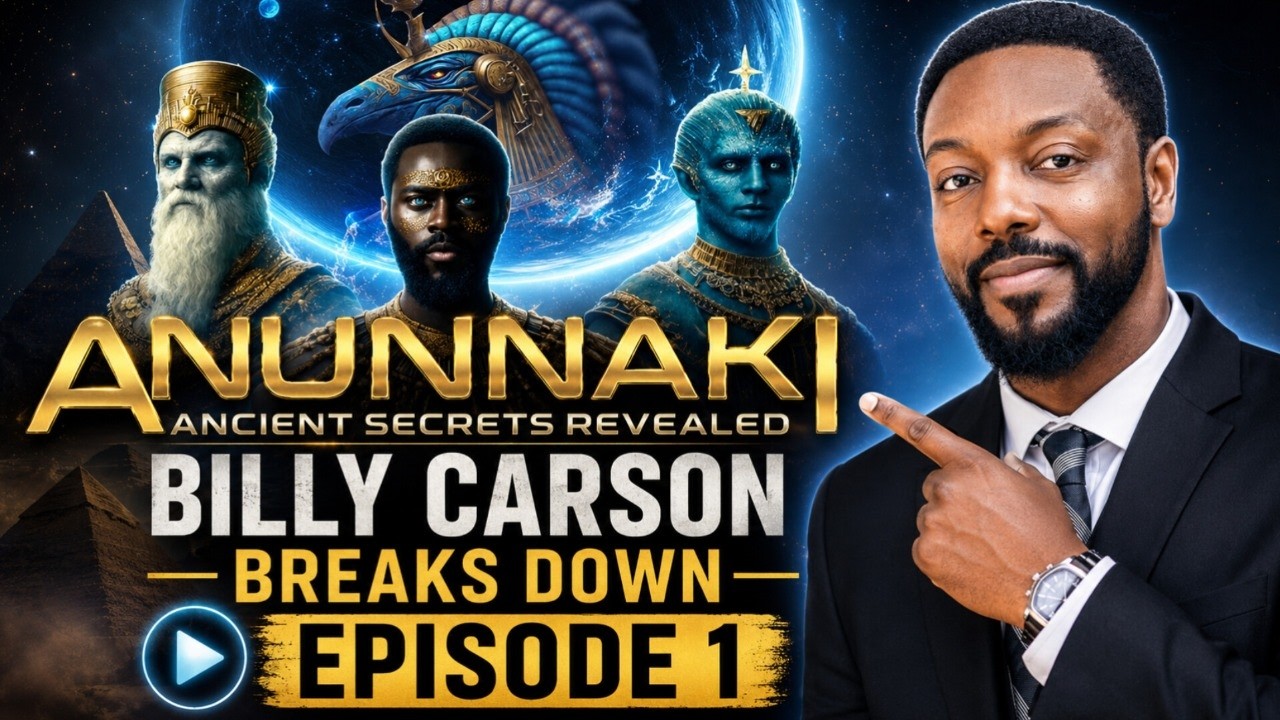
Anunnaki: Ancient Secrets Revealed episode 1 opens Billy Carson's docuseries, and in this live watch party Carson screens it and pauses to comment. The episode argues that the Anunnaki of Sumerian and Akkadian texts were advanced, multiracial beings tied to the Pleiades, that they reached Earth in the aftermath of a cosmic war, and that the Atrahasis epic records how they made humans to take over their labor. Carson's commentary adds his own framing: aliens did not build the ancient monuments, but they supplied the blueprint.
The topic matters because the Anunnaki sit where two conversations meet. For Assyriologists they are deities in some of the oldest literature on Earth. For ancient-astronaut researchers they are evidence of contact. Episode 1 puts the second reading on screen, so it is worth knowing what it claims, what it draws on and where the scholarly record parts company with it.
Watch the video
What the video covers
Why a docuseries, and why start with a war (from about 3:55)
Carson explains that he wrote a series rather than a film because "the story is so grand." He begins with what he calls a Pleiadian star-system war, potentially millions of years ago, reconstructed from the Vedas, the Mahabharata and the Bhagavad Gita, Akkadian and Babylonian epics, the Bible and the Quran, Greek and Roman epics, and Aboriginal, Hopi, Lakota, Maya and Quechua star lore.
The cold open: George Smith and the name Anuna (from about 12:10)
The episode opens with Sumerian accounts it says describe the mass cloning of hominids before Adamu, the first man. Researcher Matthew LaCroix then turns to George Smith, the British Museum Assyriologist whose The Chaldean Account of Genesis appeared in 1876. LaCroix highlights Smith's description of the gods moving "backwards and forwards" and reads it as a hint of time travel; that is LaCroix's interpretation, not Smith's. LaCroix also notes that the Sumerian form was Anuna, that Anunnaki is the later Akkadian term, and that the name points to An (Anu), whom he regards as the source.
Gilgamesh, Enkidu and the sky over Taurus (from about 15:20)
The Epic of Gilgamesh comes next: the king of Uruk, his companion Enkidu fashioned by the gods, and the quest for immortality. The episode reads it as a star map, with the Pleiades guarding Taurus and Gilgamesh approaching through Orion. It adds that Native American, Maya and Aboriginal Australian traditions describe being among the first people seeded by Pleiadians, and it presents the glyphs near Gosford in New South Wales as undeciphered Pleiadian hieroglyphs about 5,000 years old.
Carson's first pause: refugees and hands (from about 19:30)
Carson stresses that the Pleiades contain thousands of stars and explains the lost seventh sister as a bright star that faded within roughly the last thousand years. A war in a region that crowded, he argues, would have produced refugee civilizations of many races and hominid types. He adds a point about intelligence: in his view orcas, dolphins and elephants are smarter than humans, and people dominate the planet because hands let them build, not because of raw brainpower.
Who were the Anunnaki, and the Atrahasis epic (from about 27:25)
The episode weighs whether the Anunnaki were spiritual, multidimensional or physical, leans toward physical, and calls them multiracial gods from several star systems. It turns to the Atrahasis epic, fragments of which were found among the cuneiform tablets of the Library of Ashurbanipal at Nineveh, which Austen Henry Layard's excavations began uncovering in 1849. In the epic, the lower gods, the Igigi, dig the rivers, which the episode calls clearing "the lifelines of the land" (the Tigris and Euphrates). They revolt, and the gods agree to create humans to carry the work. LaCroix singles out a line he quotes as Enlil telling Enki "where you went, you were to undo the chain and set us free," and reads it as the gods being karmically bound to Earth until humans took on that responsibility. A full breakdown of the story is in our guide to the Atrahasis epic.
Gods who were not the Creator (from about 34:20)
The episode argues that the texts show the Anunnaki acknowledging a creator higher than themselves, and compares their reception to a Pacific cargo cult, with islanders building imitation runways after contact with American forces in World War II. The best-documented case is the John Frum movement on Tanna in Vanuatu, whose followers still parade with USA painted on their chests. The lesson drawn is to look inward. Enlil's eagle and Enki's serpent then appear as the episode's symbols for military power and esoteric wisdom.
The Pleiades and the cosmic wars (from about 39:55)
The episode describes the Pleiades as an open cluster in Taurus and retells the Greek myth of the Seven Sisters, daughters of Atlas, placing Zeus within the Anunnaki framework. It cites war narratives in the Mahabharata, the Vedas and the Enuma Elish, Krittika (the Vedic name for the Pleiades), the Rig Veda's Battle of the Ten Kings, and Zecharia Sitchin's idea that the planet Tiamat shattered into the asteroid belt and Earth. It follows Sitchin on a conflict between Marduk and Thoth, and claims the biblical jealous-god line and the word "amen" trace back to Marduk as Amun.
Atlantis, Lemuria and the sages (from about 48:00)
After summarizing Plato's Timaeus and Critias, the episode links Poseidon to Enki and compares the Mesopotamian Apkallu sages with the Nommo of the Dogon of Mali. In his second pause (from about 51:25), Carson argues that Atlantis was a global civilization with many capitals, recalls Aboriginal elders telling him in 2020 of an advanced Lemurian civilization before them, and points to Cydonia and what he calls weapons-grade xenon on Mars as signs of an ancient war. The episode then cites runes on a "K2 megalith" in the Bosnian "pyramids" tunnels, claimed Pleiades alignments from Giza to Chaco Canyon, and the war in heaven of Revelation 12:7-9. The Atlantis thread is expanded in Atlantis explained.
Sumerian firsts and the construction-company analogy (from about 59:40)
The episode presents the cylinder seal VA 243 as showing the gift of the plow and the solar system, and credits Sumer with early mathematics, law and the shekel. Carson pauses (from about 62:05) to say plainly that "aliens did not directly build pyramids and temples and megalithic structures." His analogy is a construction firm of owner, architect, engineer, foreman and workers, mapped onto the Atrahasis hierarchy with the Igigi as the labor force until they rebelled. He places that revolt at Adam's Calendar in South Africa, a claim that comes from Michael Tellinger, and describes Enki's proposal to "slay a god and add our essence" to an existing being. He adds, "according to the epic of Atrahasis not according to me."
Closing (from about 67:20)
The episode ends with the Pleiades in modern culture (Subaru is the Japanese name for the cluster) and what an Anunnaki origin story would mean for religion, science and future contact.
Key takeaways
- The series starts its story with a war Carson places in the Pleiades, reconstructed from Vedic, Mesopotamian, biblical, Greek and Indigenous sources.
- Matthew LaCroix reads George Smith's "backwards and forwards" phrasing as a hint of time travel, and treats Anu as the original source.
- The episode's core text is the Atrahasis epic: the Igigi dig the rivers, revolt, and humans are made to take over the work.
- Carson argues the gods gave humanity the blueprint while humans did the building, and that the Anunnaki knew they were not the Creator.
- Several claims, from Mars xenon to the Bosnian tunnels, are presented as supporting evidence; mainstream science explains each differently.
Billy Carson's reading
Carson's position is that war-in-heaven stories converge too closely across cultures to be coincidence. In his reading they preserve a memory of a real conflict in the Pleiades whose survivors scattered, and some of them, the Anunnaki, shaped early civilization on Earth. He holds that the beings were physical, multiracial and not the Creator, which is why he frames the series as an invitation to stop looking outward for saviors. His insistence that people built the monuments from an inherited plan is a deliberate correction to the cruder version of the theory. The broader case is set out in who were the Anunnaki, and the star-lore side in the Pleiades and the Pleiadians explained.
What mainstream scholarship says
In Sumerian and Akkadian texts the Anunnaki are a collective of deities, roughly "offspring of An," and in Atrahasis they are the senior gods for whom the Igigi labor. No cuneiform text names the Pleiades as their origin. The ancient-astronaut reading comes largely from Zecharia Sitchin, whose translations Assyriologists reject. The Atrahasis epic does describe humans being made from clay mixed with the flesh and blood of a slain god, We-ila, but scholars read it as a myth explaining human toil and mortality. On VA 243, specialists note that the central symbol is a standard star emblem and that the inscription simply names the seal's owner. The Battle of the Ten Kings is generally read as an earthly tribal conflict, and the Hebrew "amen" comes from the root aman, "firm" or "true."
On the physical claims: the Pleiades are a young open cluster about 444 light-years away, and while many cultures tell of a lost or fading seventh sister, no Pleiad is known to have burned out in historical times. Mars's xenon isotopes are explained by atmospheric loss over billions of years; the nuclear-war reading is physicist John Brandenburg's fringe hypothesis. The European Association of Archaeologists and geologists regard the Bosnian "pyramids" as natural hills, the Gosford (Kariong) glyphs are widely considered a 20th-century creation, and Adam's Calendar's great age is not accepted by archaeologists. Scholars explain cross-cultural similarities by diffusion, a shared night sky and common human themes.
Watch, read and go deeper
The full season is on 4BK TV at Anunnaki: Ancient Secrets Revealed, and more of Matthew LaCroix's work is collected on his 4BK TV page. For the Gilgamesh material that opens the episode, read the Epic of Gilgamesh explained. Every related article is gathered on the Anunnaki topic hub.
Frequently asked questions
What is Anunnaki: Ancient Secrets Revealed episode 1 about?
It opens Billy Carson's docuseries by tracing the Anunnaki from Sumerian and Akkadian texts to a claimed origin in the Pleiades, covering Gilgamesh, the Atrahasis epic, the Seven Sisters myth and Atlantis. Matthew LaCroix contributes segments and Alexis Brooks narrates.
Who were the Igigi in the Atrahasis epic?
The Igigi are the junior gods who dig the rivers and canals at the opening of Atrahasis. When they rebel, the senior gods agree to create humans to take over the labor.
Does any ancient text say the Anunnaki came from the Pleiades?
No known Sumerian or Akkadian text names the Pleiades as the Anunnaki's home. The link is Carson's synthesis of star lore and war narratives from many cultures, together with ideas popularized by Zecharia Sitchin.
Did George Smith say the Anunnaki were time travelers?
No. Smith, a 19th-century Assyriologist, proposed nothing of the kind. In the episode, Matthew LaCroix points to wording in The Chaldean Account of Genesis (1876) about the gods moving backwards and forwards and reads it as time travel, which is his interpretation.
Sources mentioned
George Smith's The Chaldean Account of Genesis, the Epic of Gilgamesh, the Atrahasis epic and the Enuma Elish; the Rig Veda, the Mahabharata and the Bhagavad Gita; Plato's Timaeus and Critias; Revelation 12:7-9; the cylinder seal VA 243; Aboriginal, Hopi, Lakota, Maya, Quechua and Dogon traditions; and ideas from Zecharia Sitchin and Michael Tellinger. For standard references, see Stephanie Dalley's Myths from Mesopotamia, W. G. Lambert and A. R. Millard's Atra-hasis: The Babylonian Story of the Flood, and Andrew George's translation of The Epic of Gilgamesh.