For decades, interstellar travel has lived somewhere between science fiction and scientific ambition. The greatest obstacle has never been imagining the destination—it's figuring out how to get there within a human lifetime.
Now, researchers may have found a new piece of that puzzle.
Scientists have developed microscopic devices called "metajets"—tiny silicon structures that can be pushed and even steered using nothing more than laser light. While these devices are measured in millionths of a meter today, the underlying technology could eventually help control enormous light sails, potentially allowing spacecraft to travel beyond our solar system without carrying traditional fuel.
It sounds futuristic because it is.
But it's also grounded in some very real physics.
What Exactly Are Metajets?
Think of a metajet as an incredibly small engineered wafer made from silicon.
Unlike ordinary materials, these wafers contain microscopic structures called metasurfaces. Instead of simply reflecting light, these engineered surfaces manipulate photons with extraordinary precision.
Researchers demonstrated that when a laser shines on these metajets, the light doesn't just push them forward.
It can also:
→ Move them sideways
→ Lift them upward
→ Change their direction
→ Maintain stable motion without physical contact
This means light is no longer acting as a simple source of propulsion—it becomes a method of navigation.
That distinction could change everything.
Recent experiments showed these controlled optical forces increase with laser power and, importantly, are not fundamentally limited by the size of the object. That raises the possibility of scaling today's microscopic demonstrations into tomorrow's massive light sails.
Why This Matters for Interstellar Travel
Traditional rockets face one unavoidable problem.
Every extra pound of fuel requires more fuel to move it.
Eventually, rockets become trapped by their own weight.
Light sails eliminate much of that problem.
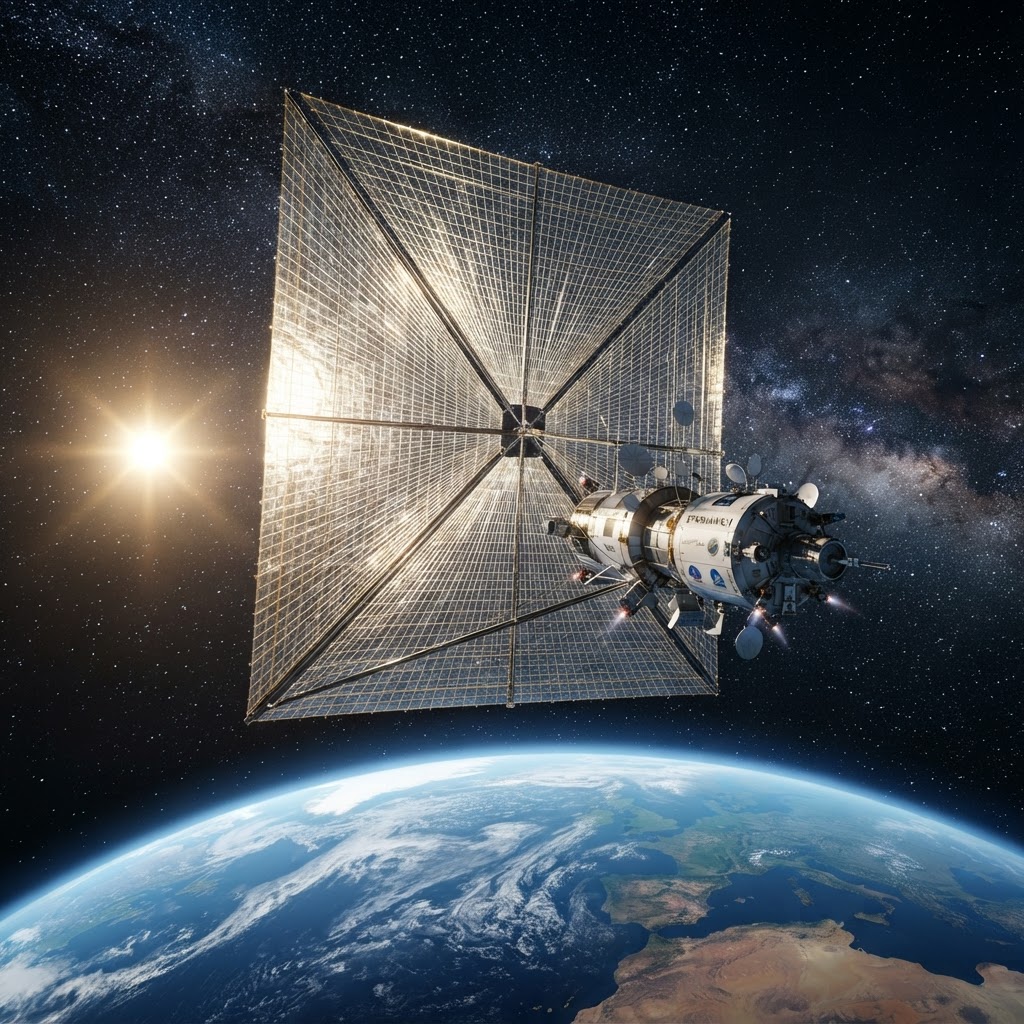
Instead of carrying propellant, an ultra-thin reflective sail is accelerated by photons from either:
→ Sunlight
→ Extremely powerful laser arrays
Because photons carry momentum, they can transfer energy to the sail without requiring onboard fuel.
The concept has existed for decades, but controlling these sails has always been one of the biggest engineering challenges.
Imagine trying to steer a sailboat from hundreds of millions—or even trillions—of miles away.
That's where metajets become incredibly interesting.
Instead of relying entirely on moving the sail itself, carefully engineered metasurfaces could redirect incoming light in ways that naturally help stabilize and steer the spacecraft.
The Science Behind the Idea
The work builds on an area known as metaphotonics, where scientists engineer materials at the nanoscale to control how light behaves.
Professor Yongmin Liu and colleagues at Texas A&M University demonstrated that carefully arranged silicon nanopillars create what researchers call metaphotonic forces.
These forces allow lasers to generate motion in multiple directions—not just forward propulsion.
Their experimental results matched theoretical predictions remarkably well, showing that specially designed metasurfaces can transform light into a highly precise steering mechanism.
This Isn't the First Step Toward Laser Sailing
The idea of laser-powered spacecraft has been gaining momentum for years.
Some of the most influential work comes from researchers including:
→ Harry Atwater (Caltech), whose team developed dynamically stable flexible light sails designed to remain balanced while accelerating under intense laser beams.
→ Artur Davoyan, who has extensively studied laser-driven light sail propulsion and wafer-scale spacecraft capable of traveling throughout the solar system.
→ Breakthrough Starshot, a privately funded initiative proposing gram-scale spacecraft accelerated by massive Earth-based laser arrays to nearly 20% the speed of light, potentially reaching the Alpha Centauri system in about two decades.
Each breakthrough addresses a different challenge:
Designing sails that survive intense laser energy. Keeping spacecraft stable during acceleration. Building materials light enough to achieve extraordinary speeds. Developing methods to steer and control those sails.
Metajets may represent another major piece of that engineering puzzle.
The Challenges Still Ahead
As exciting as these results are, there are significant obstacles before this technology powers missions to another star.
Researchers must still solve problems involving:
→ Building laser arrays powerful enough for propulsion
→ Protecting sails from extreme heat
→ Preventing damage from interstellar dust
→ Maintaining communication across light-years
→ Manufacturing enormous, ultra-light sails with atomic precision
These are engineering challenges—not violations of physics.
That distinction matters.
Many concepts once considered impossible became reality once technology caught up.
Why This Research Is Worth Watching
History often remembers the final breakthrough while overlooking the countless small discoveries that made it possible.
The Wright brothers didn't invent modern aviation overnight.
The first computers filled entire rooms before becoming smartphones.
Likewise, today's microscopic metajets may appear insignificant compared to the dream of interstellar travel.
But every major technological revolution begins with learning how to control the smallest building blocks.
Today, scientists can steer microscopic silicon wafers using beams of light.
Tomorrow, that same principle could help guide spacecraft between the stars.
Whether that future arrives in decades or centuries, one thing is becoming increasingly clear:
The road to the stars may not be powered by fuel.
It may be powered by light.
Final Thoughts
Interstellar travel has long challenged humanity's imagination because the distances involved are almost incomprehensible. Yet with every advance in photonics, nanotechnology, and materials science, those impossible journeys become slightly less impossible.
Metajets won't send humans to another star tomorrow.
But they demonstrate something profoundly important:
We are learning not just how to ride light—but how to navigate with it.
Sometimes the biggest leaps toward the future begin with the smallest inventions imaginable.