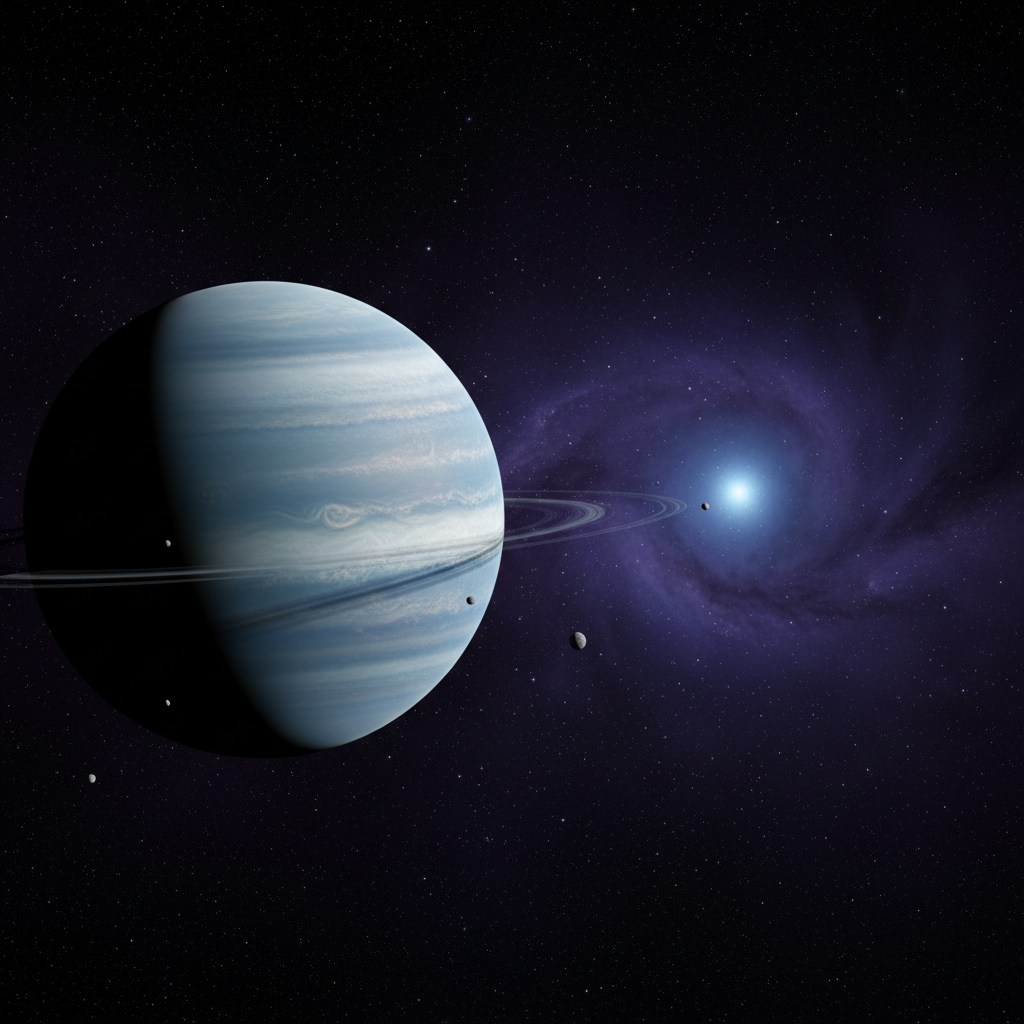
For decades, Uranus has remained one of the greatest mysteries in our Solar System.
Unlike Jupiter and Saturn, which are known as gas giants, Uranus belongs to a different category entirely—an ice giant. But exactly how much ice exists deep beneath its thick atmosphere has remained uncertain.
Now, astronomers have uncovered compelling new evidence suggesting Uranus possesses an even icier interior than scientists previously believed. The discovery comes from an unexpected source: carbon monoxide gas rising from deep within the planet.
While carbon monoxide may sound ordinary here on Earth, finding it in Uranus' atmosphere tells researchers an incredible story about what lies thousands of miles beneath its cloud tops.
A Planet That Refuses to Fit the Rules
Uranus has always been the oddball of our Solar System.
Unlike every other major planet:
→ It rotates almost completely on its side.
→ Its magnetic field is dramatically tilted.
→ It experiences seasons lasting more than 20 Earth years.
→ It emits surprisingly little internal heat.
Because of these unusual characteristics, scientists have spent decades trying to understand how Uranus formed and why it evolved differently from the other giant planets.
Every new observation helps piece together another part of that puzzle.
Why Carbon Monoxide Matters
Carbon monoxide (CO) isn't simply floating around Uranus by accident.
Researchers studying the planet's atmosphere found that the gas appears to originate from deep inside Uranus, rather than arriving only from external sources like comets or interplanetary dust.
That is significant because:
→ Carbon monoxide forms under specific chemical conditions.
→ Its abundance reflects the materials hidden inside the planet.
→ The gas slowly rises from deep atmospheric layers over long periods.
In other words, the atmosphere acts like a messenger carrying clues from Uranus' interior.
What Scientists Discovered
Using advanced atmospheric models combined with high-powered radio observations, researchers found that the amount of carbon monoxide present is difficult to explain unless Uranus contains far more icy material than rocky material.
That finding suggests:
→ Water ice is abundant deep inside the planet.
→ Frozen ammonia and methane likely make up large portions of its interior.
→ Rock represents a smaller percentage than some earlier models predicted.
Instead of being mostly rock with a layer of ice, Uranus appears to be dominated by volatile frozen materials.
This supports the idea that Uranus truly deserves its classification as an ice giant.
More Like Neptune Than We Thought
For years, scientists debated whether Uranus and Neptune formed differently.
Although similar in size, density, and composition, subtle differences led some planetary scientists to believe each planet followed a unique evolutionary path.
The new findings suggest otherwise.
Evidence now indicates Uranus may have formed much more like Neptune than researchers originally believed.
That means both planets likely accumulated enormous amounts of frozen material during the early stages of Solar System formation before gathering their surrounding hydrogen and helium atmospheres.
Looking Back Nearly 4.5 Billion Years
Understanding Uranus isn't just about one planet.
It also helps scientists reconstruct what happened during the birth of our Solar System.
Researchers believe the giant planets formed within a massive disk of gas, dust, rock, and ice surrounding the young Sun.
Studying Uranus allows scientists to better understand:
→ How planetary building blocks were distributed.
→ Why some planets became gas giants while others became ice giants.
→ How planets migrate over time.
→ How similar planets may form around other stars.
Every discovery adds another piece to humanity's understanding of planetary evolution.
Why Uranus Is So Difficult to Study
Unlike Mars or Jupiter, Uranus has received remarkably little direct exploration.
The only spacecraft ever to visit the planet was NASA's Voyager 2, which flew past Uranus in 1986 during a brief encounter lasting only a few hours.
Since then, nearly everything scientists have learned has come from:
→ Ground-based observatories.
→ Space telescopes.
→ Radio telescopes.
→ Computer simulations.
That limited data makes every new atmospheric measurement incredibly valuable.
A Planet Hidden Beneath the Clouds
The atmosphere of Uranus is primarily composed of:
→ Hydrogen
→ Helium
→ Methane
Methane absorbs red wavelengths of sunlight while reflecting blue-green light, giving Uranus its famous turquoise appearance.
Beneath those cloud layers lies an environment scientists cannot observe directly.
Instead, they rely on chemistry, physics, and atmospheric modeling to estimate what exists thousands of kilometers below the visible clouds.
Carbon monoxide has now become one of the most important chemical fingerprints available.
Why This Discovery Matters Beyond Uranus
Ice giants appear to be among the most common types of planets discovered outside our Solar System.
Thousands of exoplanets identified by astronomers resemble Uranus and Neptune more closely than Earth or Jupiter.
Understanding Uranus therefore helps researchers answer much larger questions.
These include:
→ How common ice giants are throughout the galaxy.
→ What ingredients are necessary for planetary formation.
→ Whether planetary systems around other stars develop similarly to our own.
The better we understand Uranus, the better we understand countless worlds beyond our Solar System.
Scientists Continue to Push for a Return Mission
Many planetary scientists—including researchers involved with the National Academies of Sciences, Engineering, and Medicine's Planetary Science Decadal Survey—have identified a dedicated Uranus mission as one of NASA's highest scientific priorities.
An orbiter could spend years studying:
→ The planet's atmosphere.
→ Its unusual magnetic field.
→ Internal structure.
→ Ring system.
→ Its many fascinating moons.
Unlike the brief Voyager 2 flyby, a modern mission could answer questions scientists have been asking for generations.
Final Thoughts
Sometimes the biggest discoveries don't come from dramatic photographs—they come from invisible molecules.
A trace amount of carbon monoxide has revealed that Uranus may possess a far icier interior than scientists once believed, strengthening the idea that it formed much like its neighboring ice giant, Neptune.
As telescope technology improves and future missions move closer to reality, Uranus is slowly transforming from one of the Solar System's greatest mysteries into one of its most informative worlds.
Every layer scientists uncover doesn't just teach us about one distant planet—it helps explain the remarkable story of how our entire Solar System came to exist.