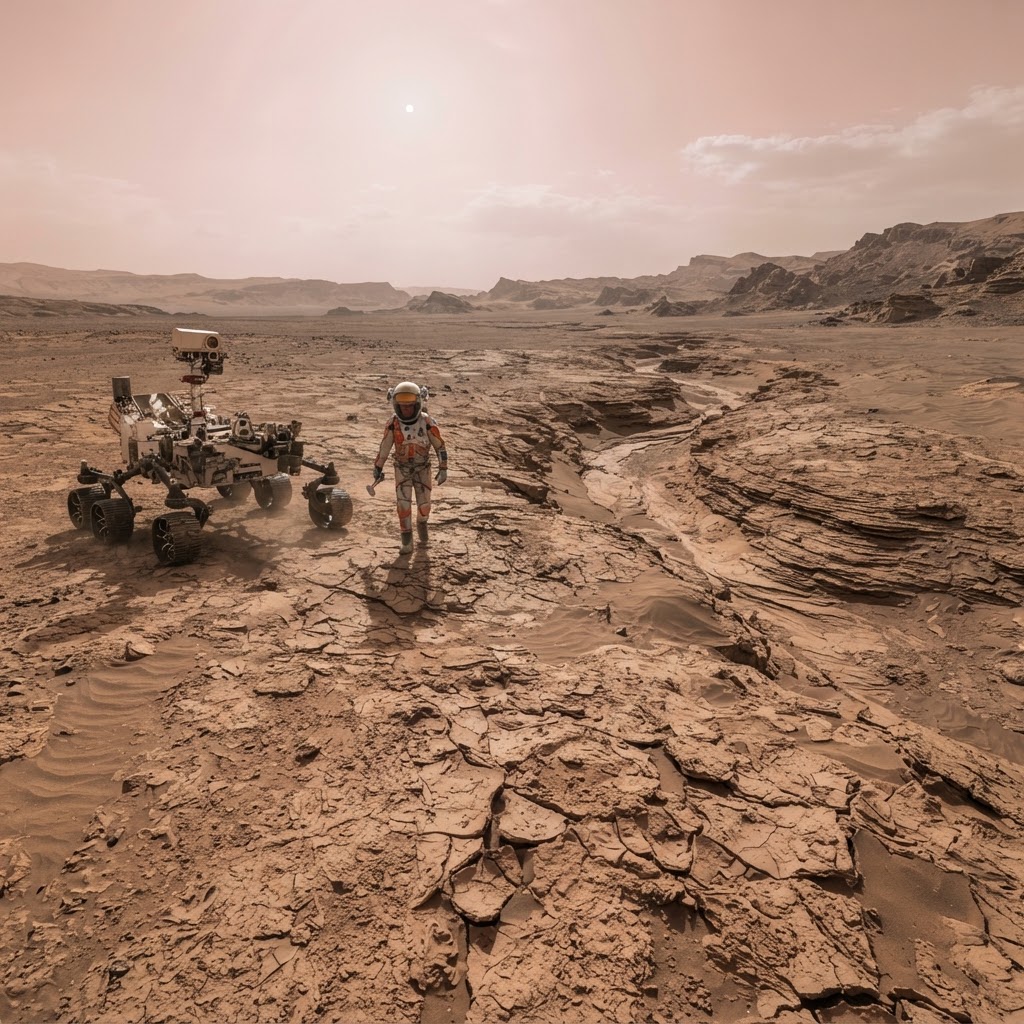
Mars is cold, dry, and covered in dust today. But billions of years ago, it was a completely different world.
Ancient river valleys stretch across its surface. Massive lake basins remain carved into its landscape. Mineral deposits reveal that water once flowed for incredibly long periods of time. Some scientists even believe Mars once hosted an ocean covering nearly half of its northern hemisphere.
So where did it all go?
That question has puzzled planetary scientists for decades. And despite decades of exploration by orbiters, landers, and rovers, researchers recently discovered something even stranger:
The numbers don't add up.
When scientists calculated how much water Mars should have had billions of years ago and compared it with how much can be accounted for today, a surprising amount is still missing.
It's one of the biggest unsolved mysteries in planetary science.
Mars Was Once a Wet Planet
For many years, Mars was imagined as nothing more than a barren desert.
Then spacecraft began sending back astonishing images.
Scientists found evidence of:
→ Ancient river channels stretching thousands of miles
→ Massive flood plains
→ Delta formations identical to those found on Earth
→ Lake shorelines
→ Sedimentary rock layers formed underwater
→ Water-altered minerals such as clays and sulfates
NASA's Spirit, Opportunity, Curiosity, and Perseverance rovers have all contributed evidence that liquid water once shaped enormous portions of Mars.
According to planetary geologist Michael H. Carr, the evidence overwhelmingly suggests that Mars once possessed an active hydrological cycle involving rainfall, rivers, lakes, groundwater, and perhaps even oceans.
How Much Water Did Mars Have?
Scientists estimate that early Mars may have contained enough water to cover the planet in an ocean hundreds of feet deep.
Some studies estimate:
→ A global ocean between 100 and 1,500 meters (330–5,000 feet) deep
Others suggest the northern lowlands contained an ocean covering nearly one-third of the planet.
That's not a few puddles.
That's an entire planetary water system.
So...Where Did It Go?
For years, scientists believed they had the answer.
Mars is much smaller than Earth.
Its gravity is weaker.
About 4 billion years ago, Mars also lost most of its magnetic field.
Without that magnetic shield:
→ Solar wind bombarded the atmosphere.
→ The atmosphere slowly escaped into space.
→ Water molecules were broken apart by sunlight.
→ Hydrogen drifted into space.
→ Oxygen reacted with rocks.
Problem solved...
Or so everyone thought.
The Math Doesn't Work
When researchers recently attempted to perform a complete accounting of Mars' ancient water supply, they ran into a major problem.
Even after including:
→ Water lost to space
→ Water frozen inside the polar ice caps
→ Water trapped beneath the surface
→ Water chemically locked inside minerals
There was still a tremendous amount missing.
Scientists simply cannot explain where all of it went.
It's almost like balancing a bank account and discovering that an entire ocean-sized withdrawal has no record.
Water Hidden Inside the Planet?
One leading explanation is that much of Mars' water never actually disappeared.
Instead...
It became trapped inside the crust.
When liquid water reacts with volcanic rocks, it creates hydrated minerals.
These minerals permanently lock water into their crystal structure.
Examples include:
→ Clay minerals
→ Serpentine
→ Hydrated silica
→ Sulfates
The water isn't flowing anymore.
It's literally part of the rock.
Research led by Eva Scheller suggests that 30–99% of Mars' original water may now be locked inside the crust, dramatically changing previous ideas that most water escaped into space.
That finding surprised much of the planetary science community because it suggested Mars may have retained far more water than previously believed.
But Even That Doesn't Solve Everything
Even after accounting for water trapped in rocks...
Scientists still find discrepancies.
Some models predict more water than geological evidence supports.
Other models require ancient oceans larger than current evidence suggests.
Different missions produce slightly different estimates.
In other words:
Every answer creates another question.
Mars Doesn't Behave Like Earth
One reason this mystery is so difficult is because Mars evolved very differently than Earth.
Earth constantly recycles water through:
→ Plate tectonics
→ Volcanoes
→ Oceans
→ Atmosphere
→ Rainfall
→ Groundwater
Mars largely shut down geologically billions of years ago.
Its crust became relatively stable.
Its magnetic field faded.
Its atmosphere thinned dramatically.
Without Earth's active recycling systems, Mars followed an entirely different evolutionary path that scientists are still trying to reconstruct.
Could Underground Water Still Exist?
This possibility has become increasingly exciting.
Radar observations from orbit have hinted at structures beneath the Martian surface that may contain frozen or possibly even liquid water.
Meanwhile, NASA's InSight mission provided valuable information about Mars' interior structure, helping researchers understand where hidden water reservoirs could exist.
Some scientists now believe enormous amounts of groundwater may remain buried several miles beneath the surface.
If true...
Mars may still be hiding a significant portion of its ancient water underground.
Why This Matters Beyond Mars
Understanding where Mars' water went isn't just about satisfying curiosity.
It helps answer much bigger questions.
→ How long can rocky planets remain habitable?
→ What causes planets to permanently lose oceans?
→ How important are magnetic fields?
→ How does climate evolve over billions of years?
→ Could Earth someday experience similar changes?
Mars serves as a natural laboratory for understanding planetary evolution.
Every discovery teaches scientists something about our own planet's long-term future.
The Search Continues
Each new mission reveals another piece of the puzzle.
NASA's Perseverance rover is collecting samples that may eventually be returned to Earth.
The Mars Reconnaissance Orbiter continues mapping mineral deposits from orbit.
Future missions may drill deeper than ever before into the Martian crust.
Researchers hope these efforts will finally reveal whether Mars truly lost its water—or whether much of it has simply been hiding beneath our feet all along.
Final Thoughts
Mars reminds us that science rarely ends with simple answers.
Every discovery opens another mystery.
The rivers are real.
The lakebeds are real.
The minerals are real.
The evidence for a wetter Mars is overwhelming.
Yet when scientists add everything together, an enormous amount of water is still unaccounted for.
Perhaps it's buried deep underground.
Perhaps it's trapped inside billions of tons of rock.
Or perhaps Mars still has secrets waiting for the next generation of explorers to uncover.
Sometimes, the most fascinating part of science isn't what we've discovered.
It's realizing how much we still don't know.