For decades, the idea of protecting Earth from a catastrophic asteroid impact has sounded like something straight out of a science fiction movie. We've imagined nuclear explosions, massive spacecraft, and even laser weapons. But now, researchers are exploring another fascinating possibility—using an enormous magnet to gently pull dangerous asteroids off a collision course with Earth.
While the concept may sound unbelievable at first, it is grounded in physics and is generating serious discussion within the planetary science community.
The question isn't whether magnets can move objects.
The real question is whether they can move an asteroid enough to save an entire planet.
Why Asteroids Remain a Real Threat
Every day, thousands of small pieces of space debris burn up harmlessly in Earth's atmosphere. Most never reach the ground.
However, larger Near-Earth Objects (NEOs) occasionally pass close enough to remind scientists that planetary defense isn't science fiction—it's an active area of research.
NASA's Planetary Defense Coordination Office continuously monitors thousands of asteroids that cross Earth's orbital path. Fortunately, the overwhelming majority pose no immediate danger, but history has shown that even relatively small impacts can cause significant destruction.
Scientists agree on one important point:
→ The earlier we detect a threatening asteroid, the easier it becomes to change its trajectory.
The Giant Magnet Concept
One of the newest ideas is known as Non-Contact Orbital Velocity Adjustment (NOVA).
Rather than crashing into an asteroid like NASA's successful DART mission, the NOVA concept proposes something much gentler.
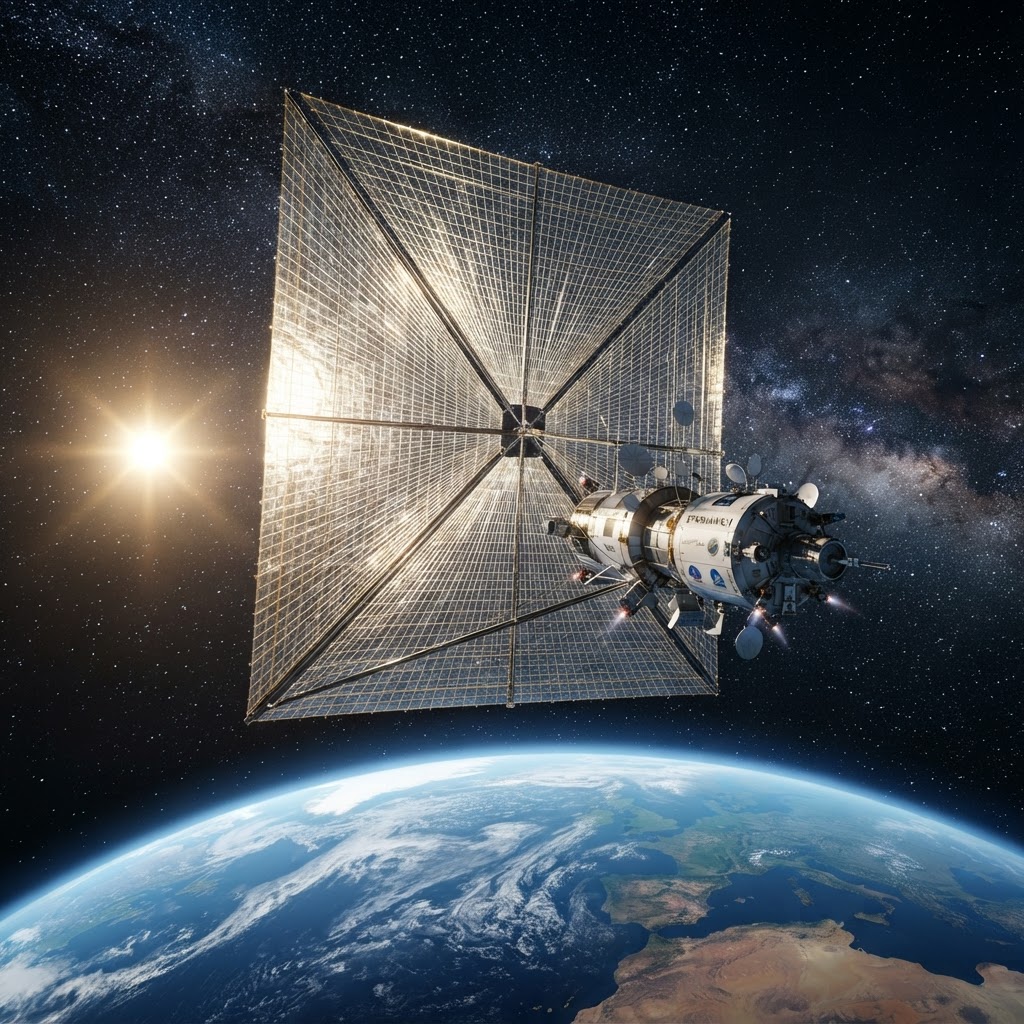
Imagine a spacecraft carrying an incredibly powerful superconducting magnet.
Instead of making physical contact, the magnetic field would interact with naturally occurring magnetic materials found within certain asteroids.
Over months—or even years—the tiny but continuous magnetic force could slowly alter the asteroid's orbit.
It wouldn't require an explosion.
It wouldn't shatter the asteroid.
Instead, it would simply encourage the space rock to miss Earth entirely.
Why Avoid Hitting the Asteroid?
NASA proved in 2022 that kinetic impact works.
The Double Asteroid Redirection Test (DART) intentionally collided with the asteroid moon Dimorphos and successfully changed its orbit.
It was humanity's first successful demonstration that we can alter the path of a celestial object. Later studies confirmed the impact also changed the asteroid system's orbit around the Sun, making DART a major milestone in planetary defense.
However, impacting an asteroid isn't always straightforward.
Researchers have since discovered that the collision ejected unexpected debris and boulders, creating complex forces that scientists are still studying.
That means future deflection missions may not behave exactly as predicted.
A magnetic approach could avoid many of those complications because:
→ No collision occurs.
→ No fragmentation is created.
→ The asteroid remains structurally intact.
→ The orbit changes gradually and predictably.
The Biggest Challenge
There is one enormous obstacle.
Not every asteroid is magnetic.
Many asteroids are primarily composed of rock, carbon-rich material, or other minerals that would respond only weakly—or not at all—to a magnetic field.
That means the technique would likely work only on asteroids containing enough metallic iron or nickel to experience a meaningful magnetic pull. Researchers emphasize that the concept remains theoretical and has not yet been demonstrated in space.
Time Is Everything
Unlike a Hollywood-style rescue mission launched days before impact, magnetic deflection would require patience.
Scientists estimate the spacecraft would need months or even years to gradually change an asteroid's orbit.
Fortunately, orbital mechanics work in our favor.
A tiny change made early can become an enormous change years later.
Think about changing lanes on a highway.
A slight turn of the steering wheel now can place you hundreds of feet away down the road.
The same principle applies in space.
What Do Scientists Say?
Several researchers have spent decades studying ways to protect Earth from asteroid impacts.
Dr. Gunther Kletetschka (University of Alaska Fairbanks)
Kletetschka introduced the NOVA magnetic deflection concept, proposing that a powerful superconducting magnet could alter the trajectory of certain metallic asteroids without making physical contact. The idea was presented at the 2026 Lunar and Planetary Science Conference and is still awaiting experimental validation.
Dr. Alan Harris
A longtime planetary scientist, Harris has published foundational work on asteroid deflection and has repeatedly emphasized that changing an asteroid's orbit—not destroying it—is generally the safest strategy when enough warning time exists.
NASA's Planetary Defense Team
NASA continues to stress that early detection remains humanity's greatest defense. Missions like DART have demonstrated that small changes to an asteroid's trajectory, applied years before a potential impact, can prevent a collision with Earth.
Could Magnets Work Alongside Other Technologies?
Many experts believe future planetary defense won't rely on a single solution.
Instead, scientists may choose from several methods depending on the asteroid's size, composition, and warning time.
Possible strategies include:
→ Kinetic impactors like DART
→ Gravity tractors
→ Directed-energy laser systems
→ Ion beam propulsion concepts
→ Nuclear deflection in extreme emergencies
→ Magnetic deflection for suitable metallic asteroids
Each technique offers different strengths, and the best option may depend entirely on the specific threat.
Looking Ahead
The giant magnet concept remains in its early stages, but it represents a fascinating shift in how scientists think about planetary defense.
Instead of relying on force, researchers are asking whether subtle, continuous influence could be just as effective.
That idea reflects a broader trend in modern space science: solving enormous problems through precision rather than brute strength.
Whether giant magnets ultimately become part of Earth's planetary defense toolkit remains to be seen. Yet every new concept expands our options—and in planetary defense, having more options could one day make all the difference.
As NASA's DART mission demonstrated, humanity has already crossed an important threshold. We no longer have to wonder whether we can change the path of an asteroid.
Now we're exploring smarter, safer, and more sophisticated ways to do it.