 Billy's Colloidal Silver + Starfire Gold duo —
For decades, astronomers believed they had a solid understanding of what lies at the heart of the Milky Way. At the center of our galaxy sits Sagittarius A (Sgr A), a supermassive black hole containing roughly four million times the mass of our Sun. Yet the deeper scientists look into this chaotic region, the more mysteries emerge.
Now, a fascinating new theory suggests that an unseen black hole may be hiding near our galaxy's center—one capable of explaining several strange stellar populations that have puzzled astronomers for years.
If confirmed, this hidden cosmic heavyweight could dramatically reshape our understanding of how galaxies evolve and how black holes influence the stars around them.
The Strange Neighborhood Around Sagittarius A*
The center of the Milky Way is unlike any other region in our galaxy.
Imagine a crowded city where stars are packed tightly together, moving at extraordinary speeds while orbiting an invisible gravitational giant. That giant is Sagittarius A*, whose existence was confirmed through decades of observations and later directly imaged by the Event Horizon Telescope collaboration.
Yet astronomers have identified something unusual:
→ Young, massive stars orbiting surprisingly close to the black hole.
→ Older stars distributed differently than expected.
→ Hypervelocity stars and other stellar populations that appear to have experienced extreme gravitational interactions.
These groups don't fit neatly into current models of galactic evolution.
The question has remained:
Why are there three dramatically different stellar populations sharing the same neighborhood?
A Missing Piece in the Puzzle
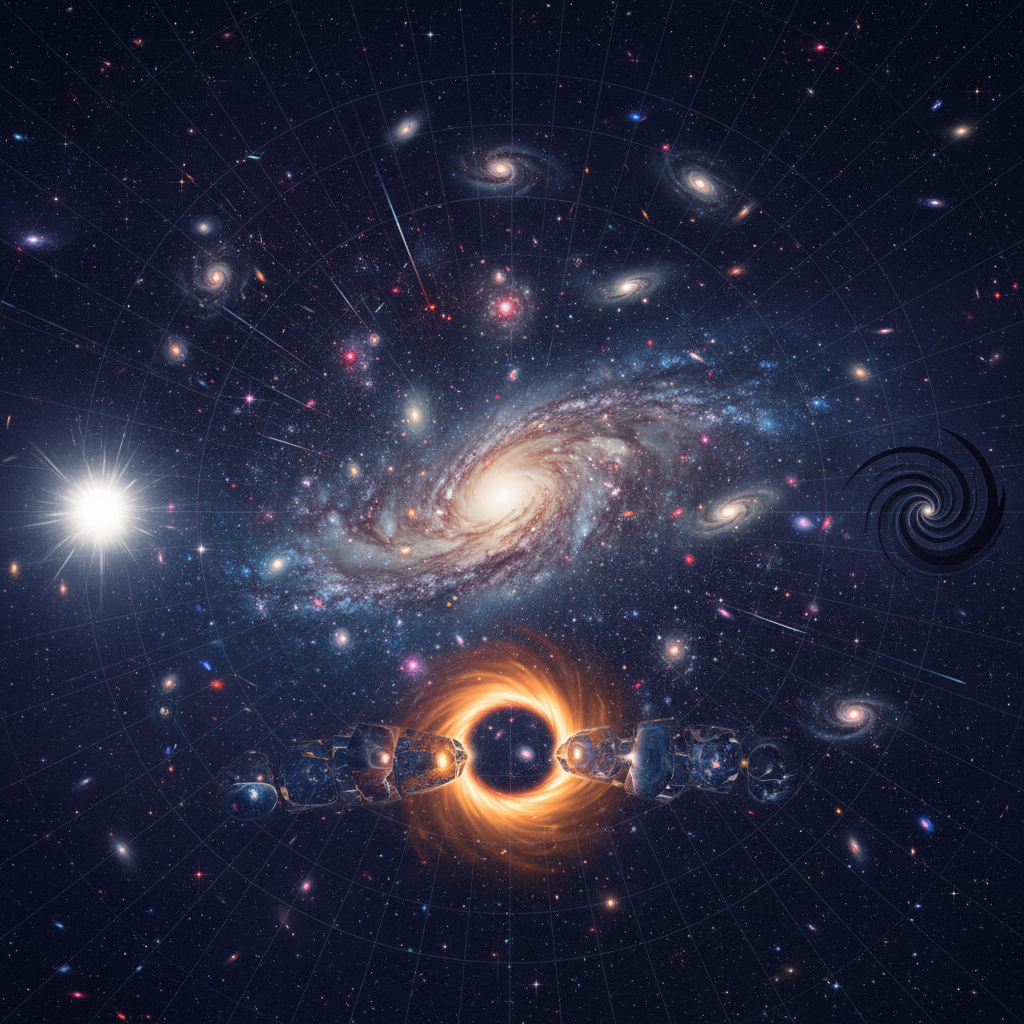
Researchers have proposed that a second, hidden black hole may be lurking near Sagittarius A*.
Unlike the supermassive giant dominating the galactic center, this object would likely be an intermediate-mass black hole—larger than black holes formed from dying stars but smaller than the monster at the center of the Milky Way.
Its presence could create powerful gravitational disturbances capable of reshaping stellar orbits over millions of years.
In other words:
→ Stars could be flung outward.
→ Stellar clusters could be scattered.
→ Young stars could be relocated into unexpected positions.
→ Older stars could be redistributed into patterns astronomers observe today.
What currently appears to be three unrelated stellar populations may actually be the fingerprints of one hidden gravitational architect.
Why Scientists Are Taking This Idea Seriously
This isn't just speculation.
Astronomers have repeatedly observed evidence that black holes often exist in complex systems.
The discovery of multiple black holes within merging galaxies has become increasingly common thanks to observations from:
→ NASA's Chandra X-Ray Observatory
→ The Event Horizon Telescope
→ The James Webb Space Telescope
→ Ground-based observatories such as the European Southern Observatory's Very Large Telescope
Recent studies have also revealed unexpected black hole behavior, including hidden black hole mergers and black holes forming in unusual environments.
As astrophysicist Dr. Marta Volonteri, one of the leading experts on black hole formation, has noted, the origins and growth of massive black holes remain among the biggest unanswered questions in modern astronomy.
The Legacy of Andrea Ghez and Reinhard Genzel
Much of what we know about Sagittarius A* comes from the groundbreaking work of:
Andrea Ghez Reinhard Genzel
Their teams spent decades tracking stars orbiting an invisible object at the center of the Milky Way.
By observing these stellar motions, they provided the strongest evidence that a supermassive black hole resides there.
Their work earned them the 2020 Nobel Prize in Physics and transformed our understanding of galactic centers.
Today, researchers are building upon their discoveries to investigate whether additional hidden objects may also be influencing the region.
A Cosmic Laboratory Unlike Any Other
The galactic center is often described as a laboratory for extreme physics.
The environment contains:
→ Powerful magnetic fields
→ Dense molecular gas clouds
→ Violent stellar winds
→ High-energy radiation
→ Enormous gravitational forces
Recent ALMA observations have revealed previously unseen structures and mysterious objects within the Central Molecular Zone surrounding Sagittarius A*, reinforcing the idea that the Milky Way's core remains one of the least understood regions of our galaxy.
Every new observation seems to generate as many questions as answers.
Could We Detect This Hidden Black Hole?
Finding an invisible object is never easy.
Black holes emit no light of their own, making them extraordinarily difficult to detect directly. Scientists instead look for their effects on nearby stars, gas clouds, and surrounding matter.
Researchers are searching for clues such as:
→ Unexpected stellar motions
→ Distorted orbital paths
→ Gravitational perturbations
→ Future gravitational wave signatures
Upcoming observatories and next-generation instruments may finally provide the precision needed to reveal whether a hidden black hole truly exists.
Why This Discovery Matters
At first glance, finding another black hole near the center of our galaxy may sound like a niche astronomical curiosity.
It isn't.
Understanding whether hidden black holes exist could help answer some of astronomy's biggest questions:
→ How do supermassive black holes grow?
→ How do galaxies evolve?
→ How are stars distributed throughout galactic centers?
→ How common are intermediate-mass black holes?
→ What role do black holes play in shaping the universe itself?
The Milky Way is our cosmic home. Every mystery solved at its center helps us understand not only our galaxy's history but also the forces that have shaped countless galaxies across the universe.
Final Thoughts
The story of the Milky Way's center is far from complete.
What once seemed like a straightforward picture—a single supermassive black hole governing its surroundings—has evolved into something much more intriguing. Astronomers now see a crowded, dynamic environment filled with unexplained stellar populations, strange gas clouds, and gravitational mysteries.
A hidden black hole may ultimately provide the missing link connecting these puzzles.
Or it may lead to an even bigger mystery.
As theoretical physicist Stephen Hawking once remarked, "The greatest enemy of knowledge is not ignorance, it is the illusion of knowledge."
The closer we look at the heart of our galaxy, the more we realize just how much remains hidden in the darkness.