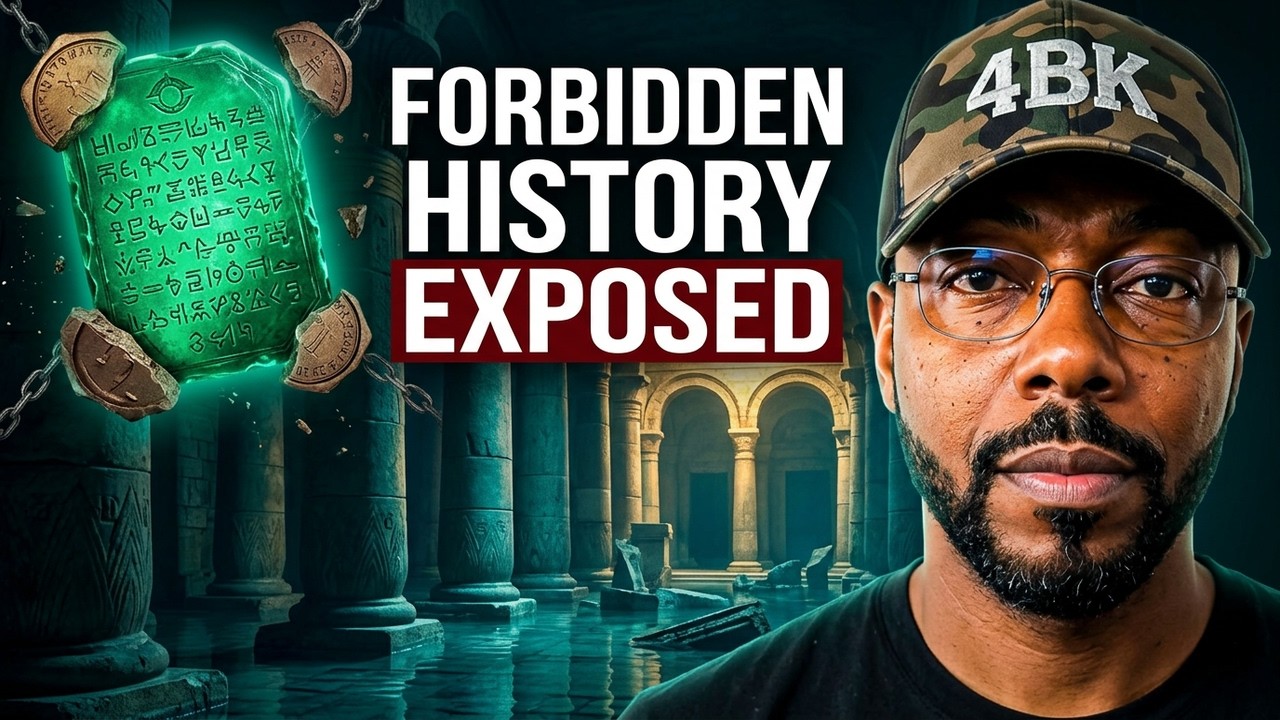
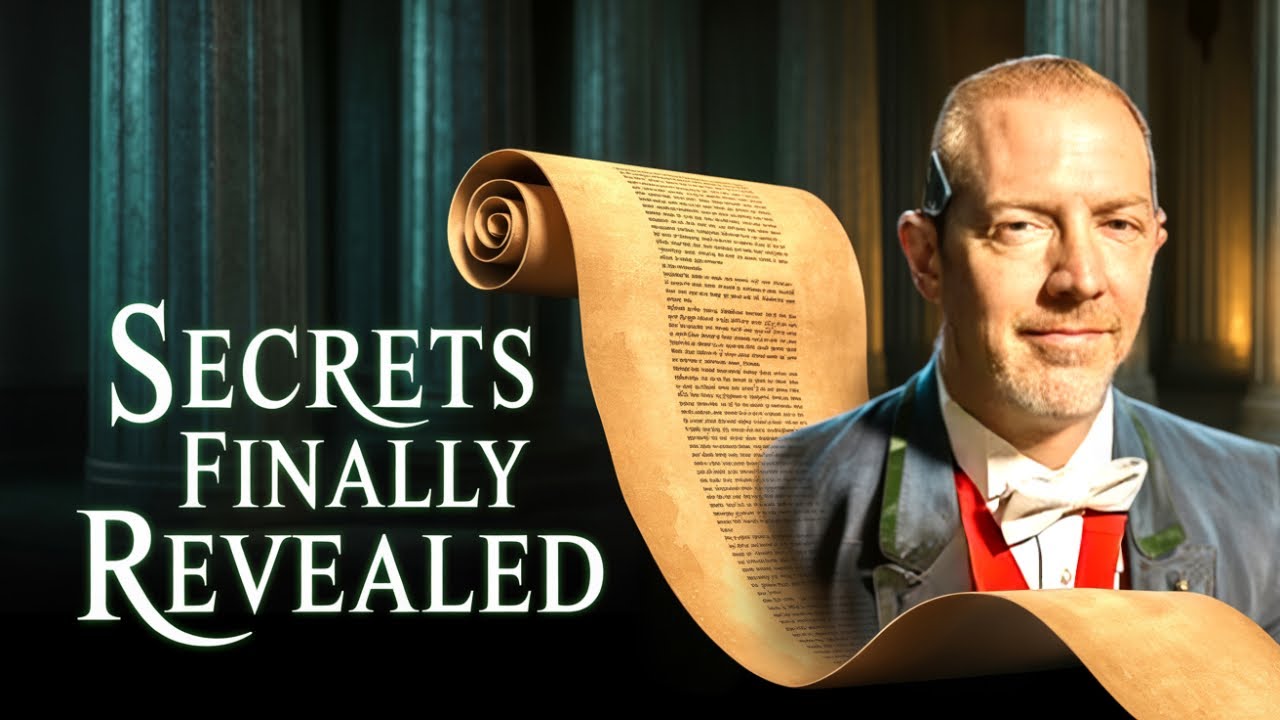
The mystery schools are the initiatory traditions, Egyptian, Greek, Hermetic and later Masonic, that claimed to pass a secret body of wisdom from master to adept, and where that wisdom came from is the thread running through "Emerald Tablets of Thoth: Atlantis Secrets Revealed," a 4BK TV conversation between Billy Carson and the Templar historian Timothy Hogan. Hogan's answer is Thoth, the Egyptian god of writing, whom he treats as a real teacher who survived the end of Atlantis and seeded everything from the Torah to the Knights Templar. Carson asks how a text supposedly invented in the 1930s could describe science rediscovered decades later.
The YouTube upload is a free preview segment of the full episode, so it begins mid-sentence and ends with a pointer to the complete show. This article covers what the segment contains, from the serpent staff to Göbekli Tepe, leaves out the closing tour promotion and a passing film reference, and sets each claim beside the documented record. It is a companion to the earlier Hogan conversation on the Emerald Tablets and the Templars.
What does Hogan mean by the serpent staff and the caduceus?
The segment opens with Hogan on the bronze serpent Moses raised in the desert, the Nehushtan. His argument is linguistic: the Hebrew words for copper and serpent are nearly identical, so a copper coil and a coiled snake were "pretty much the same" idea, and he says Nikola Tesla regarded this as the foundation of the Tesla coil. Hogan also says electricity applied to snake venom separates its proteins; this article reports that only as his statement. He then reads the caduceus, two serpents on a winged staff, as "as above, so below" in picture form: the serpent belongs to the ground, the bird to the sky, and the winged serpent joins them, as in Quetzalcoatl.
The Hebrew nachash (serpent) and nechoshet (bronze) do share a root, and the pun is noted in commentaries on Numbers 21. Nothing in Tesla's writings connects his coil to the Nehushtan. The two-snake caduceus became an American medical emblem through a 1902 Army Medical Corps decision; the healing symbol proper is the single-snake rod of Asclepius.
Why does Hogan call monoatomic gold the "secret salt" of the Philosopher's Stone?
Carson raises the alchemical texts that call the Emerald Tablet a key to the Philosopher's Stone, and Hogan lays out the tradition as he understands it. The Stone, which Newton, Robert Boyle and Benjamin Franklin studied, had a salt, a sulfur and a mercury, and the "secret salt" was monoatomic gold, which he says appears on Egyptian temple walls and in Indian alchemy. He identifies it with biblical manna, with the Vedic vimana and a Sumerian word he gives as "shimana," both tied to flying craft, and with the contents of the Ark of the Covenant, which he says weighed tons yet was carried by a few Levites. He adds the Kebra Nagast's story of Solomon's flying ship and says Sheba derives from "Saba," meaning stargate in ancient Egypt.
Newton's alchemical manuscripts are real, and the salt, sulfur and mercury triad comes from Paracelsus in the 16th century. "Monoatomic gold" is a 1990s coinage from David Hudson, and no laboratory has confirmed the substance he described; our ORMUS explainer covers the history. The 14th-century Kebra Nagast describes the Ark being carried aloft on its journey south, but the flying-ship reading is a modern synthesis. Saba is the Arabian kingdom of Sheba; the stargate meaning is not an attested Egyptian etymology.
Do the Emerald Tablets really predate Maurice Doreal?
Carson's main concern is an online claim that someone "just sat down in the 1920s" and wrote the Emerald Tablets as science fiction. His counter is that the tablets describe science not rediscovered until the 1940s to the 1990s. Hogan agrees, repeats a suggestion that Doreal was an esoteric name for George Hunt Williamson, and cites the Tulli papyrus, which he describes as a Thutmose III text recording ships in the sky, as an ancient parallel to the tablets' account of Thoth arriving in Egypt.
The record separates two texts. The single Emerald Tablet, the Tabula Smaragdina, is attested in Arabic from the 8th to 9th century; its "as above, so below" formula is genuinely medieval. The Emerald Tablets of Thoth the Atlantean, the 13-tablet work Carson comments on, were published by Maurice Doreal in 1939, and no earlier manuscript has ever been produced. Williamson, born in 1926, was a separate 1950s author. The Tulli papyrus is known only from a 1950s transcription; the original has never been located, and Egyptologists treat it as unverified. Our Emerald Tablets explainer sets out the history.
Why does Hogan read Osiris as a symbol of Atlantis?
Carson suggests the mystery teachings fragmented into secret societies after the original masters vanished, and Hogan answers with Osiris. Set dismembers his brother; Isis gathers the pieces and reassembles him. In Hogan's reading Osiris is Atlantis, the pieces are "pockets" of wisdom sent out before the collapse, and reassembling the body means tracking them down: "that's how we're rebuilding Atlantis." Isis, whose name he says means throne, is the power; Osiris the tradition; Thoth its soul. He finds the same message in Thoth's ibis: black, white and red, the colors he assigns to Egypt, Atlantis, alchemy and the Templars, and said to stand on one leg holding a pebble that drops and wakes it if it dozes, an image of the "borderline state" where mystical impressions arrive. Sekhmet and the Sphinx, he adds, point to the age of Leo and the Younger Dryas cataclysm.
The myth is genuine and early: Osiris's death and restoration appear in the Pyramid Texts, and Isis's name is written with the throne hieroglyph. The pebble story, though, comes from medieval bestiaries, where it is told of the crane. The age of Leo dating of around 10,500 BCE belongs to Robert Bauval and Graham Hancock, and the Younger Dryas (about 12,900 to 11,700 years ago) is a real climate event, but no archaeological find connects either to an Atlantean civilization. The Osiris myth explained has the sources.
Did the Nag Hammadi library bury Hermetic texts with the gospels?
Carson frames the return of Thoth's teaching as "the second coming of the Christ consciousness," and Hogan reaches for Nag Hammadi, where he says early Christian texts were buried bound with Hermetic writings, proof that the community valued Thoth's words as highly as Jesus's. He quotes the Corpus Hermeticum's "I am mind," notes that Thoth restored Horus's eye with spittle as Jesus heals with spittle in the gospels, and says biblical scholars ignore the Hermetic material because it does not fit their narrative. Carson adds that his own reading of the Emerald Tablets turned up the same parallels.
On the core fact Hogan is right. Codex VI of the Nag Hammadi library contains three Hermetic tracts, the Discourse on the Eighth and Ninth, a prayer and part of the Asclepius, and scholars have discussed that juxtaposition since the 1970s. The dating cuts the other way: the codices are 4th-century copies, and the Greek Hermetica were composed in Roman Egypt between roughly the 1st and 3rd centuries CE, contemporaries of the Christian writings rather than their ancestors.
Is there a Hall of Records under the Sphinx's right paw?
Carson asks whether a version of the Emerald Tablets could be hidden in the Hall of Records, and Hogan says he believes the hall exists. He cites ground-penetrating radar showing a cavity under the right paw and claims passageways from the Sphinx toward the Great Pyramid can be seen from the ground. The Masonic master mason's grip is called the lion's paw, which he reads as a pointer to the Sphinx, and he says early Templar excavations supported the tradition. Both men dispute a 2025 MrBeast video with Zahi Hawass that entered the Sphinx and showed an empty chamber; Carson mentions his own footage of the opening by the right paw.
The Hall of Records is Edgar Cayce's prophecy from the 1930s, not an Egyptian tradition. In the 1990s the Schor Foundation's seismic and radar surveys, led by geophysicist Thomas Dobecki, reported probable cavities near the paws; nothing has been excavated or dated, and natural fissures in Giza limestone are common. No document records Templar digging at Giza. Our Hall of Records explainer walks through what the scans found.
Was Göbekli Tepe an "Osirian hall of records"?
Hogan connects the Sabians of Harran, in southeastern Turkey, to nearby Göbekli Tepe, which he says was once called an Osirian hall of records and was visited by Templars in the 1200s who left graffiti while hunting Thoth's wisdom. Carson, who visited in September, cannot accept that Neolithic people who "couldn't build a front door" built it, and notes that some archaeologists say the covering soil was brought from elsewhere and placed deliberately, which raises the question of who had the labor to bury it.
Excavations led by Klaus Schmidt from 1995 established that Göbekli Tepe's enclosures date to roughly 9500 BCE and were built by pre-pottery hunter-gatherers; only a small fraction of the mound has been dug. Whether the fill was deliberate burial or slope wash is an open debate. There is no evidence of Templar activity there, and "Osirian hall of records" appears in no ancient or medieval source. The Sabians of Harran, a star-venerating community known from medieval Arabic writers, have no documented link to the site.
What does Carson mean by "decommissioned" ancient sites?
Carson's closing question is why sites around the world look deliberately disabled: the apex of the pyramids removed, rods taken from the Grand Gallery, temples broken so they "can't function and harness the energy." Hogan's hypothesis is that the sites formed a world grid broadcasting energy drawn from the Earth, Sun and Moon, that they were built before the cataclysm and later restored by Egyptians, and that free energy is suppressed today too, as when J. P. Morgan asked Tesla "where do you put the meter?" The Serapeum boxes at Saqqara, both agree, could not have been cut with copper tools, and Carson suggests the Serapeum may be one of the Halls of Amenti.
The Great Pyramid's capstone is missing, but the Grand Gallery slots are generally read as sockets for construction beams. The Serapeum's granite boxes were made for Apis bulls from the 26th dynasty on, and experimental archaeology shows dolerite pounders and sand-fed copper saws can work granite, slowly. Tesla's Wardenclyffe project did lose Morgan's backing after 1903, but the "meter" line is unsourced. No instrument has detected an energy grid at any site.
Watch, read, listen
- Watch the preview segment:
- The 4biddenknowledge Podcast archive: https://4biddenknowledge.ai/Podcast
- Topic hubs: Emerald Tablets and Ancient Egypt
- Related reading: who was Thoth, god of wisdom and Hermes Trismegistus, the Gnostic gospels and Nag Hammadi explained and Göbekli Tepe explained.
Frequently asked questions
Are the Emerald Tablets of Thoth older than the 1930s? No. The 13-tablet text was published by Maurice Doreal in 1939, and no earlier manuscript exists. The single medieval Emerald Tablet, attested in Arabic from the 8th to 9th century, is a different text.
Does the Nag Hammadi library really contain Hermetic writings? Yes. Codex VI includes the Discourse on the Eighth and Ninth, a prayer and part of the Asclepius, bound with Gnostic Christian works.
Has anything been found under the Sphinx's right paw? Seismic and radar surveys in the 1990s reported cavities near the paws, but nothing has been excavated or dated.
Is the Tulli papyrus a genuine Egyptian record of flying ships? It is known only from a 1950s transcription; the original has never been located, so Egyptologists treat it as unverified.
Sources mentioned
- Numbers 21, the bronze serpent raised by Moses
- Maurice Doreal, The Emerald Tablets of Thoth the Atlantean (1939)
- The Tulli papyrus, attributed to the reign of Thutmose III
- Isaac Newton, Robert Boyle and Benjamin Franklin, as students of alchemy
- The Kebra Nagast, on Solomon and the Queen of Sheba
- The Corpus Hermeticum and the Nag Hammadi library
- The 2025 MrBeast video with Zahi Hawass inside the Sphinx
- Nikola Tesla and J. P. Morgan