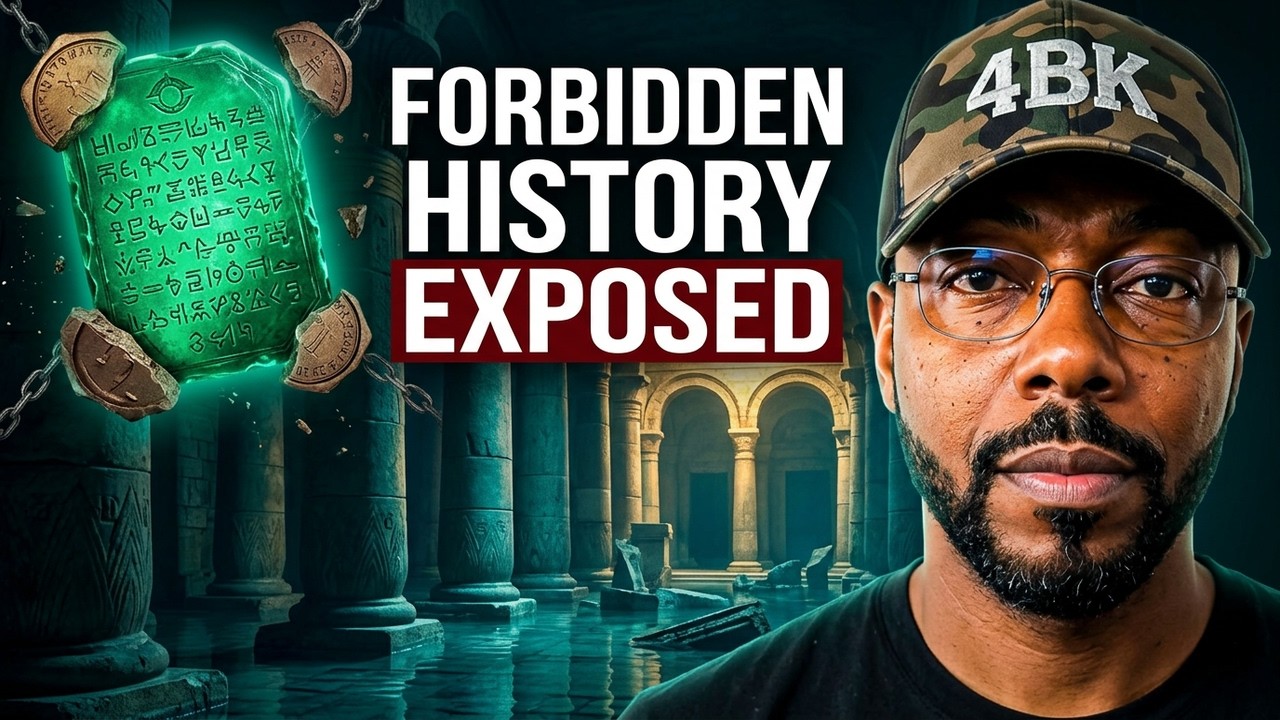
Was Jesus a student of Thoth? In this live talk Billy Carson argues that the teachings attributed to Jesus in the New Testament line up, sometimes phrase for phrase, with statements Thoth makes in the Emerald Tablets, and that there are only two ways to explain it: either Jesus studied in the Egyptian mystery schools that Thoth founded, or the two figures are the same being appearing in different bodies. Carson presents this as his own hypothesis, built from the Emerald Tablets, the Apocrypha, the Gospel of the Holy Twelve and a handful of Bible verses, and he asks viewers to weigh the parallels and reach their own conclusion.
The talk is a sequel to his earlier session on whether the Bible was copied from ancient texts. This time he reads from his own book, the Compendium of the Emerald Tablets, searching for every place the book mentions Jesus and setting each passage next to the tablet it echoes. Below is what he claims, where it comes from, and where mainstream scholarship disagrees.
Who does Billy Carson say Thoth was?
Carson opens by restating his position on Thoth, which he develops at length in Thoth the Atlantean. In his reading Thoth was an Atlantean priest-king who, according to Egyptian tradition, ruled the land of Kemet for 16,000 years, founded the mystery schools, and wrote the Emerald Tablets. He notes that 16,000 years is modest next to the reigns recorded on the Sumerian King List, where single rulers are credited with 28,800 years.
He also makes a claim about the name Jesus itself. According to Carson, "Jesus" is a late form, the letter J being a recent addition to English, and the historical person was called Yeshua. He goes further and says the Greek form "Iesous" encodes "hail Zeus," which he presents as his own reading. Standard etymology traces Iesous to the Hebrew Yeshua with no connection to Zeus, so this is one place where his argument departs from the mainstream.
What does the Book of the Dead have to do with it?
Carson's first textual stop is the Egyptian Book of the Dead, which he says records Thoth as the designer and builder of the Great Pyramid. He pairs that with the opening of the Emerald Tablets, where Thoth states, "Builded I the Great Pyramid, patterned after the pyramid of earth force, burning eternally so that it too might remain through the ages."
He unpacks each phrase in his own way. "Earth force" means the planet's gravitational and electromagnetic field, and he cites the claim that the Great Pyramid scaled up 43,200 times matches the dimensions of the Earth. "Burning eternally" he connects to an energetic "fire" he says can be felt inside the King's Chamber. "Magic science" he translates as advanced technology, calling the pyramid a "multifunctional stone computer." These are Carson's interpretations; Egyptology treats the Book of the Dead as New Kingdom funerary spells and does not credit Thoth with building anything at Giza.
Where did Jesus go between the ages of 12 and 30?
The core of the talk is the gap in the Gospels. Matthew 2 describes the flight into Egypt, and Carson points out that the canonical text then goes silent on Jesus from roughly age 12 until his ministry begins. He fills the gap with two sources.
The first is a Coptic church in Old Cairo built over the house where, according to local tradition, the Holy Family lived. Carson has visited it and photographed it, and he describes a bed, a copper nameplate and a shrine still visited daily. He uses the site to argue that Yeshua was a flesh-and-blood person, not an abstraction.
The second is the Gospel of the Holy Twelve, a text he says was omitted from the canon and is now out of print and expensive. In his summary of it, Jesus went to Egypt to learn the Egyptian mysteries from the school Thoth founded, travelled to Tibet to learn energy work with the hands, continued to India to study reincarnation, then returned to Egypt before appearing in Jerusalem. He adds that the current Dalai Lama has affirmed the Tibet tradition. Readers should know that the Gospel of the Holy Twelve was published in 1901 by the Rev. Gideon Ouseley, who said it was channelled, and that scholars treat it as a modern composition, not an ancient manuscript. Our overview of the lost books of the Bible covers which non-canonical texts have real antiquity and which do not.
What are the parallels between Thoth and Jesus?
This is where Carson lays his cards on the table. He reads tablet lines and Bible verses side by side and argues they are the same teaching:
- Thoth: "From aeon to aeon did they renew their life in the Halls of Amenti, where the river of life flows eternally onward." Jesus, John 7:38: "Out of his being shall flow rivers of living water."
- Thoth: "Surely I will return again... from beyond time, from beyond death will I return." Jesus, Mark 9:31 and John 14, where he says he will rise and come again.
- Thoth calls himself "son of Atlantis" and "son of man"; Jesus repeatedly calls himself "son of man."
- Thoth promises an accounting and reward or punishment for those who kept or betrayed his teaching; Carson sets this beside the judgment passages in Matthew 7, Matthew 25 and 2 Corinthians 5.
- Thoth: "Believe in the light that you might be the children of light." Jesus, John 12:36, uses nearly identical words.
- Thoth tells the seeker to lie in the sarcophagus of his chamber and "I shall meet him, even in the darkness of earth"; Carson pairs it with "Today you will be with me in Paradise."
He also reads the Emerald Tablet line about the "Halls of Amenti" beneath the Great Pyramid as a literal description of rejuvenation chambers where Thoth swapped bodies and transferred his consciousness, "walking among men unlike a man." He claims a lost labyrinth has been found under Giza and that his October tour visits a second set of chambers at Saqqara.
One caution the article owes readers: the English Emerald Tablets Carson quotes are the 1939 text published by Maurice Doreal, who said he translated them from tablets held in a pyramid. No tablets have been produced, and the vocabulary of the Doreal text, including "son of man" and "children of light," is itself steeped in the King James Bible. Critics therefore read the parallels in the opposite direction: a twentieth-century author borrowing biblical phrasing. Carson's response in the video is that the tablets are 36,000 years old, so the Bible must be the copy. Our guide to who Thoth was lays out both the Egyptian god and the modern books that carry his name.
Did Jesus teach reincarnation?
Carson's answer is an emphatic yes, and he builds it from canonical verses rather than the Apocrypha. He reads Malachi 4:5, where Elijah is promised to return, against Matthew 11:14, where Jesus says of John the Baptist, "this is Elias, which was for to come," and Matthew 16 and 17, where the disciples discuss the same idea. He reads John 3:3 and 3:7, "you must be born again," alongside the King James use of "matrix" for the womb in Exodus 13 and Numbers 3, and argues that being born again originally meant returning through the womb. He adds 2 Corinthians 5, where Paul describes putting on a new body "not made by human hands," and concludes that the New Testament describes physical return in a body, not disembodied spirits.
He then offers his own theory of why the Western church dropped the idea: if people believed they could try again next life, they would not fear hell, and fear was the lever of control. Mainstream Christian theology reads the Elijah passages as John the Baptist fulfilling a prophetic role, not literal rebirth, and reads "born again" as spiritual regeneration. Carson acknowledges that his interpretation is the minority one.
What about the virgin births and the bloodline?
In a shorter section Carson argues from the Apocrypha that Mary's mother was also said to have conceived without a man, which he takes as evidence that a specific bloodline was being engineered. He compares it to the Sumerian account in which Ninmah (he says Isis) takes an egg, adds genetic material and carries Adamu, the "first man," to term, which he calls ancient in vitro fertilisation. From this he floats a second possibility: that Thoth, who claimed the power to reincarnate at will, may have chosen to return through a human womb and regain his memories as he grew, making Yeshua Thoth himself.
What does Carson say the Bible really is?
The back half of the talk broadens into Carson's wider view, which readers of Could the God of the Bible Be Satan? will recognise. He argues the Bible was assembled between roughly 100 and 900 CE from scrolls found in caves, that the disciples were illiterate, that the Council of Nicaea removed the Egyptian years, and that the crucifixion was added later for control. He notes that Thoth, in the tablets, never asked to be worshipped and rebuked people who grovelled at his feet, whereas his relatives, including Marduk, did demand worship.
He ends with a long appeal to viewers to do their own research, saying that the divine spark is inside every atom and that "you are God and God is you," and mentions that Thoth, in his reading, went on to found Teotihuacan, the city of Tehuti in Mexico.
Watch, read, listen
Watch the full talk above or on the 4biddenknowledge Podcast page. Read Billy's source text in the Compendium of the Emerald Tablets, and explore the rest of the series on the Emerald Tablets topic hub and the Ancient Egypt hub.
Frequently asked questions
Does the Bible say Jesus went to Egypt?
Yes. Matthew 2:13-23 describes Joseph taking Mary and the infant to Egypt to escape Herod and returning after Herod's death. The canonical text gives no detail of the stay, which is the gap Carson fills with non-canonical sources.
What is the Gospel of the Holy Twelve?
A text published in 1901 by Gideon Jasper Ouseley, who said it was communicated to him in visions. It describes Jesus studying in Egypt, Tibet and India and teaching vegetarianism and reincarnation. Historians classify it as a modern work rather than a recovered ancient gospel.
Where do the Emerald Tablets Carson quotes come from?
From "The Emerald Tablets of Thoth the Atlantean," published by Maurice Doreal in 1939. Doreal said he translated them from green tablets he was shown; none have been produced for study. The older, separate "Emerald Tablet" of Hermes is a short alchemical text first attested in Arabic around the eighth century.
Did Jesus teach reincarnation?
Carson says yes, citing the Elijah and John the Baptist passages and "you must be born again." Mainstream Christianity reads those passages differently, as prophetic fulfilment and spiritual rebirth, and no major denomination teaches reincarnation.
Is "Jesus" really "hail Zeus"?
No. The Greek Iesous is a transliteration of the Hebrew Yeshua, and the English J developed from the Latin I. Carson's claim is part of his argument but is not supported by linguists.
Sources mentioned
Billy Carson, "Compendium of the Emerald Tablets"; Maurice Doreal, "The Emerald Tablets of Thoth the Atlantean" (1939); the Egyptian Book of the Dead; the Gospel of the Holy Twelve (Ouseley, 1901); the First Apocalypse of James (Nag Hammadi); Matthew 2, 11, 16 and 17, John 3, 7, 12 and 14, Mark 9, Malachi 4 and 2 Corinthians 5; and the Coptic church of Abu Serga in Old Cairo.