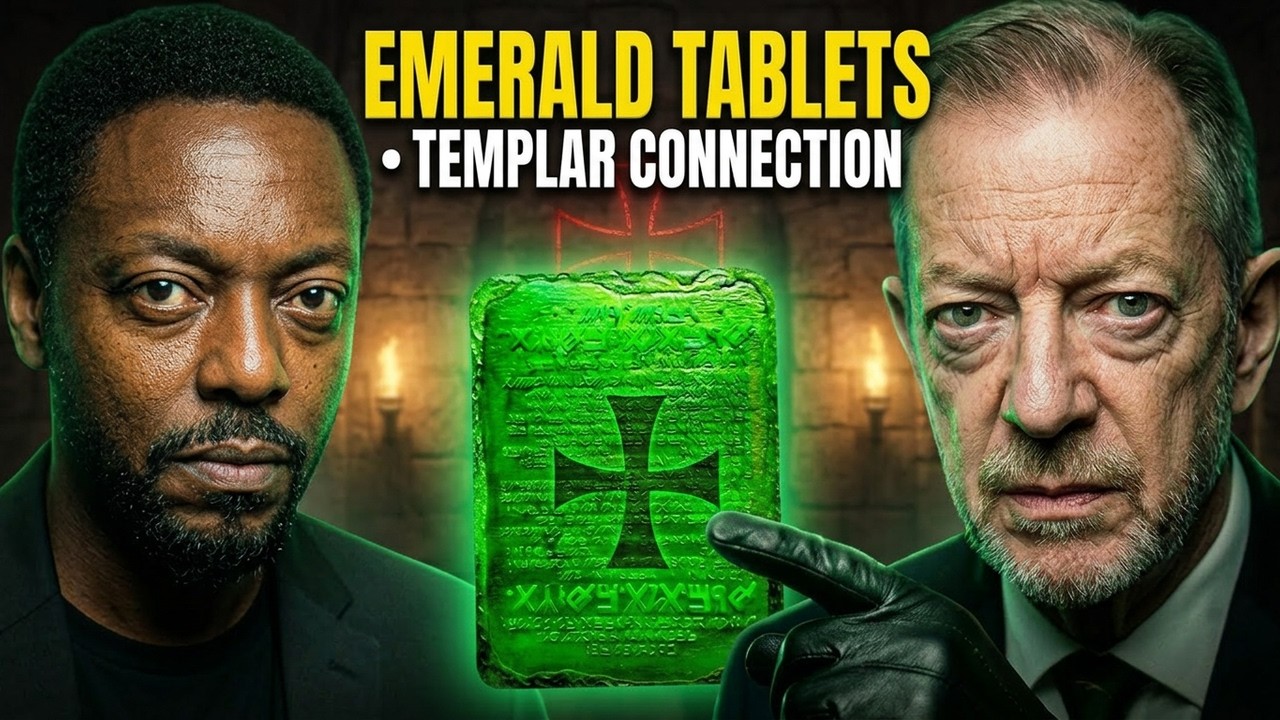
In this interview, Billy Carson argues that Thoth the Atlantean was a real, physical being who survived a great flood, landed in the land of Khem to rebuild civilization, extended his life by moving his consciousness between bodies, and wrote the Emerald Tablets as a blueprint for human awakening rather than a text to be read once. The video covers Thoth's origins and abilities, the evidence that he was flesh and blood, his travels beyond Egypt, the Gnostic parallels, and why Carson wrote the Compendium of the Emerald Tablets.
The question matters because the Emerald Tablets of Thoth the Atlantean is one of the most widely read esoteric texts of the last century, and how a reader answers "who was Thoth" decides whether they approach it as the testimony of an ancient teacher, as allegory, or as a twentieth-century channelled work.
What the video covers
Thoth, "thought" and the mission after the flood (from the start)
The host opens with the resemblance between Thoth and "thought" and asks whether it is an accident. Carson's answer: "There's no accidents. There's no coincidences." In his telling, Thoth was sent by his father, Thotme in the Tablets, whom Carson identifies with Enki of the Sumerian tablets, to raise civilization after a great flood Carson dates to more than 36,000 years ago. He paraphrases the opening of the Tablets: waters receding, survivors leaving the caves, a great ship rising until Earth disappeared and descending on Khem, the ancient name for Egypt.
Spiritual technology and names that are frequencies (from about 3:00)
Asked where Thoth's abilities came from, materializing from thought, moving stone with sound, living far beyond a human span, Carson answers with scale: a civilization a million years ahead of ours would have developed spiritual technology and hard technology, combined them, and built them into its own bodies. He adds a specific reading of the text: the names scattered through the Tablets "look like names, but they're frequencies", meant to be voiced in times of need to shift one's reality tunnel. The host connects this to Tesla's remarks on frequency and vibration, and Carson agrees.
Was Thoth flesh and blood, and what are the Halls of Amenti (from about 5:30)
Asked for the best evidence that Thoth was physical rather than a roaming soul frequency, Carson points to the avatar-body passages: Thoth walking among men in one body while the other rested in the Halls of Amenti beneath the Great Pyramid, in what Carson calls rejuvenation chambers, for a hundred years at a time, a cycle repeated a hundred times. Carson's arithmetic makes that 100,000 years. He links the Halls of Amenti to reports of chambers about a mile beneath the pyramid, which he calls a recent discovery, and adds that Egyptian records show Thoth ruling Egypt for 14,000 years.
From Africa to Teotihuacan and Australia (from about 7:30)
When Thoth left Africa, Carson says, he took a mixed African crew and founded Teotihuacan in Mexico, where the Maya and later the Aztecs encountered him and deified him as Quetzalcoatl, Viracocha, Kukulkan and Lord Pakal. He describes those cultures as cargo cults of an earlier Atlantean settlement that inherited rather than built the city. The same architect, in Carson's view, explains pyramids in Cambodia, across Asia and underwater, and the Egyptian-style glyphs at Kariong in Australia, which he describes as a temple recording a journey to learn from the Aboriginal people; he says he met the other half of that story in Egypt in 2014.
Is Thoth still here, and whose side is he on (from about 10:00)
Yes, Carson says. The Tablets have Thoth travelling from world to world watching civilizations rise and fall, cycles Carson frames with the second law of thermodynamics, and anyone able to store and transfer consciousness could continue indefinitely. On purpose he is emphatic: Thoth reached his level through service to others and "never wanted to be called a god". He retells the landing in Khem: hostile locals stunned by a ray from Thoth's staff, then peace talks, and when the people fell at Thoth's feet he lifted them and said, in Carson's paraphrase, that they were the sons of Atlantis, come to teach language, technology and architecture.
How Thoth is helping now (from about 13:30)
Asked whether Thoth is helping humanity today, Carson answers that he is, through the text itself: because the universe is a fractal hologram, reading the Tablets transfers a fractal of Thoth's consciousness into the reader. "They're a blueprint," not a casual read, and he credits his own work and that of the late author Gerald Clark with putting them in front of millions of people.
The Nag Hammadi parallel (from about 15:00)
The host asks whether the Tablets echo the Gnostic texts found at Nag Hammadi. Carson sees two parallels: the Gnostic argument that organised religion unknowingly worships a lesser power, and the teaching that divinity is within. The Tablets, which he dates far earlier, make the same case in his reading: a journey into inner space, divinity flowing through every human, and the goal of creating heaven on earth rather than waiting for one.
Hidden in plain sight (from about 16:30)
Who else knows? Carson points to the doors of the Library of Congress, which he says carry Thoth and Odin, the same figure under different names, and to the Egyptian motifs of Washington and the Vatican. His reading is that the institutions that built them understood the knowledge and displayed it in plain sight.
Comings and goings: Babel, genes and the 120-year cap (from about 18:00)
Would Thoth leave? He comes and goes, Carson says, as the long-lived beings of the Sumerian tablets do. His example is the Tower of Babel, read through Zecharia Sitchin's lens: the returning deity of Genesis 11 is Enlil, Enki's brother, alarmed by what united humans could do, who scattered them and split their languages. Carson extends this to biology, citing a roughly two percent variance between populations that he says is too large for evolution in the time available, a fused chromosome 2, and telomere caps that limit human life to about 120 years. Thoth, he concludes, is waiting for humanity to grow up.
Why the Compendium exists (from about 20:30)
The Tablets say to read them a hundred times; the Compendium of the Emerald Tablets was written so a beginner can understand them on the first pass. Carson describes going verse by verse, correlating lines with the Bible, the Mahabharata, the Bhagavad Gita and the Sumerian tablets, and with present-day work: satellites, experiments producing matter from light, and the 2045 Initiative on transferring consciousness. His thesis is that none of it is far-fetched: "We're probably just rediscovering these ancient technologies".
Key takeaways
- Carson reads Thoth as a physical survivor of a flood more than 36,000 years ago, sent to Khem to restart civilization.
- The names in the Emerald Tablets, in his reading, are frequencies to be spoken, not people.
- His case that Thoth was flesh and blood rests on the avatar-body passages and the Halls of Amenti.
- The Tablets, he argues, transmit a fractal of Thoth's consciousness to the reader, which is why they are read a hundred times.
Billy Carson's reading
Carson approaches the Tablets as the first-hand account of a living teacher. If Thoth wrote the text himself, then the flood, the ship, the Halls of Amenti and the avatar bodies are reportage, and the task is to find their fingerprints in the physical record: pyramids on several continents, glyphs in Australia, chambers beneath Giza. His longer treatment of the text is in Emerald Tablets of Thoth explained, and his view of the figure behind it is in Who was Thoth.
Two moves stand out. The first is the fractal-holographic model, which turns reading into transmission. The second is the equation of Thoth with the feathered-serpent deities of Mesoamerica, developed at length in Teotihuacan and Thoth. Both are interpretive choices rather than findings. The book that carries the whole method is covered in The Compendium of the Emerald Tablets explained.
What mainstream scholarship says
The Emerald Tablets of Thoth the Atlantean was published in 1939 by Maurice Doreal, founder of the Brotherhood of the White Temple in Colorado, who said he had translated it from tablets he was shown. No scholar has examined such tablets, and historians read the book as a twentieth-century work in the Theosophical tradition. It is distinct from the Emerald Tablet, a short alchemical text first attested in Arabic in the eighth or ninth century and attributed to Hermes Trismegistus. Manetho's third-century BCE history does place reigns of gods, Thoth among them, before the first dynasty; Egyptologists treat those reigns as myth.
The archaeology diverges on the specifics. Teotihuacan was built from about 100 BCE and flourished to roughly 550 CE; its founders are unknown, but there is no evidence of an African or Atlantean origin. The Maya built their own cities, Tikal and Palenque among them, and K'inich Janaab' Pakal was a historical ruler of Palenque from 615 to 683 CE. Quetzalcoatl, Kukulkan and Viracocha belong to different cultures. The Kariong glyphs near Gosford are regarded by Egyptologists and the New South Wales parks authority as modern. The 2025 claim of structures beneath a Giza pyramid came from a radar study by an Italian team, concerned the pyramid of Khafre rather than the Great Pyramid, was not peer reviewed and was rejected by Egyptologists and radar specialists. The bronze doors of the Library of Congress's John Adams Building, by Lee Lawrie in 1939, do carry Thoth and Odin, alongside ten other figures credited with giving writing to their peoples, including Nabu, Sequoyah and Quetzalcoatl; they commemorate writing.
On biology, any two humans are about 99.9 percent identical in DNA, with most variation lying within populations rather than between them; two percent is roughly the human-chimpanzee difference. The fusion that produced human chromosome 2 is well documented and is cited as evidence of shared ancestry with other great apes; every chromosome carries telomeres. The oldest documented human lived to 122, and the Harvard mouse study usually cited reversed tissue aging in mice engineered to lack telomerase, not a tripled lifespan. The Nag Hammadi codices are fourth-century Coptic copies of works composed in Greek in the second and third centuries, with no documented connection to Doreal's text; see The Gnostic Gospels and Nag Hammadi explained. Brookhaven's STAR experiment did report in 2021 the creation of electron-positron pairs from colliding photons, the Breit-Wheeler process; the 2045 Initiative has not transferred the consciousness of any animal.
Watch, read and go deeper
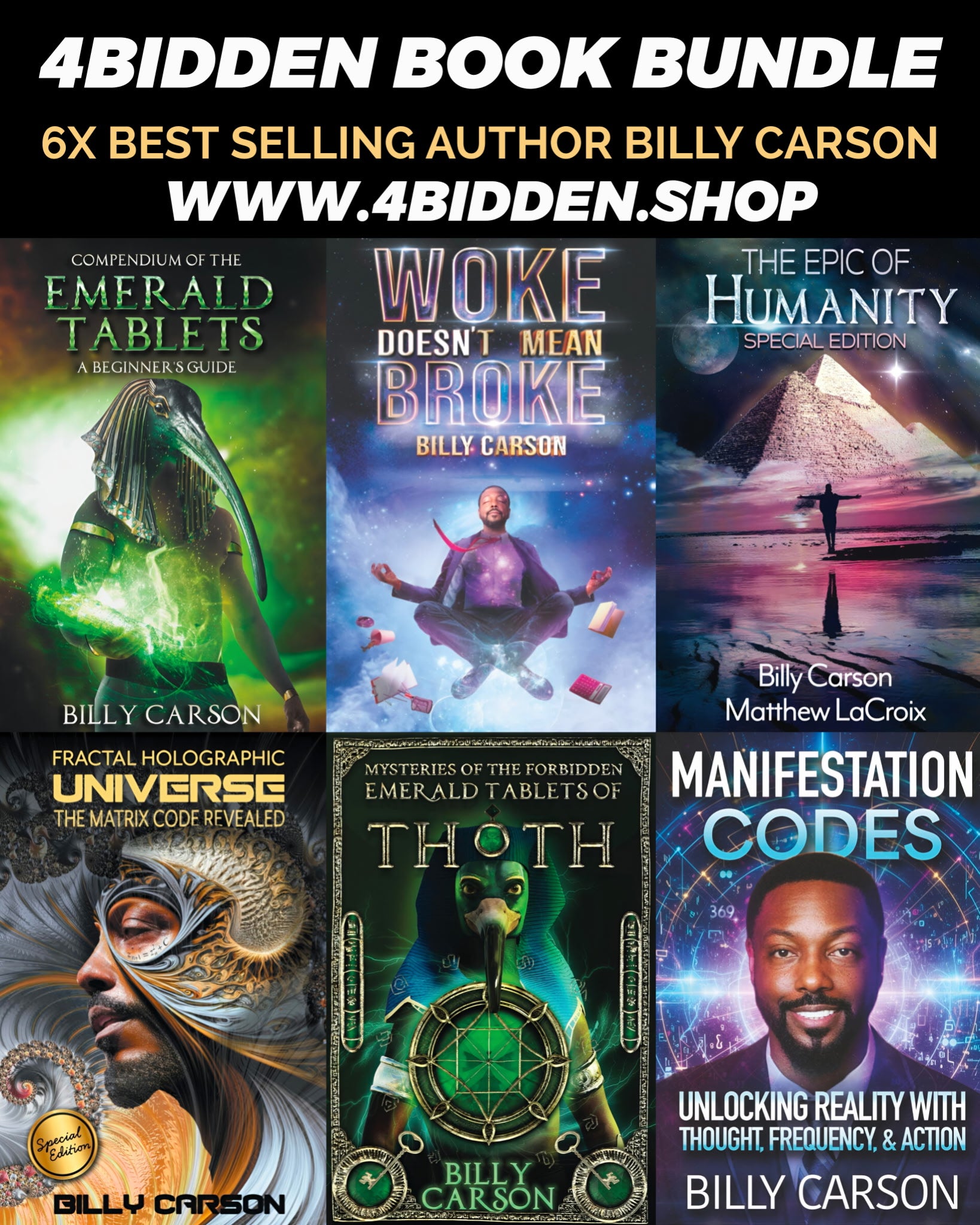
Start with Emerald Tablets of Thoth explained for the text's history, then Who was Thoth for the Egyptian god and Hermes Trismegistus. The Emerald Tablets hub gathers every article on the subject. Carson's own line-by-line reading is available on the books page and as a narrated series, Compendium of the Emerald Tablets audio book, on 4BK TV.
Frequently asked questions
Who is Thoth the Atlantean?
Thoth the Atlantean is the narrator of The Emerald Tablets of Thoth the Atlantean, who describes himself as a priest-king of Atlantis who survived its fall, settled in Khem and built the Great Pyramid. The character draws on Thoth, the Egyptian god of writing, and on Hermes Trismegistus. Billy Carson reads him as a real, long-lived being; historians read the book as a 1939 work by Maurice Doreal.
Are the Emerald Tablets of Thoth real?
There are two different texts. The Emerald Tablet, attributed to Hermes Trismegistus, is a genuine medieval alchemical text that circulated in Arabic and Latin. The Emerald Tablets of Thoth the Atlantean is a much longer modern work published by Maurice Doreal in 1939, translated, he said, from tablets no one else has examined. Carson's Compendium decodes the second.
What are the Halls of Amenti?
In Doreal's text, the Halls of Amenti are chambers beneath the Great Pyramid where the soul is renewed and where Thoth rested between lives; the name adapts Amenti, the Egyptian realm of the dead. Carson connects them to a 2025 radar claim of structures under a Giza pyramid, which Egyptologists have rejected.
What does the Compendium of the Emerald Tablets add?
The Compendium takes the Tablets passage by passage and sets each beside parallels in the Bible, the Mahabharata, the Bhagavad Gita and the Sumerian tablets, and beside modern technology, so a beginner can follow the text on the first reading. The parallels are Carson's interpretation.
Sources mentioned
Carson refers to The Emerald Tablets of Thoth the Atlantean, published by Maurice Doreal (1939); his own Compendium of the Emerald Tablets; the Sumerian tablets as read by Zecharia Sitchin in The 12th Planet (1976); Genesis 11; the Nag Hammadi library; the Mahabharata and the Bhagavad Gita; the late Gerald Clark, author of The Anunnaki of Nibiru (2013); Nikola Tesla; the 2045 Initiative; and the Lee Lawrie doors of the Library of Congress. For background: Florian Ebeling, The Secret History of Hermes Trismegistus (2007); George Cowgill, Ancient Teotihuacan (2015); Jaskelioff and colleagues on telomerase reactivation in mice, Nature (2010); and the STAR Collaboration on the Breit-Wheeler process, Physical Review Letters (2021).