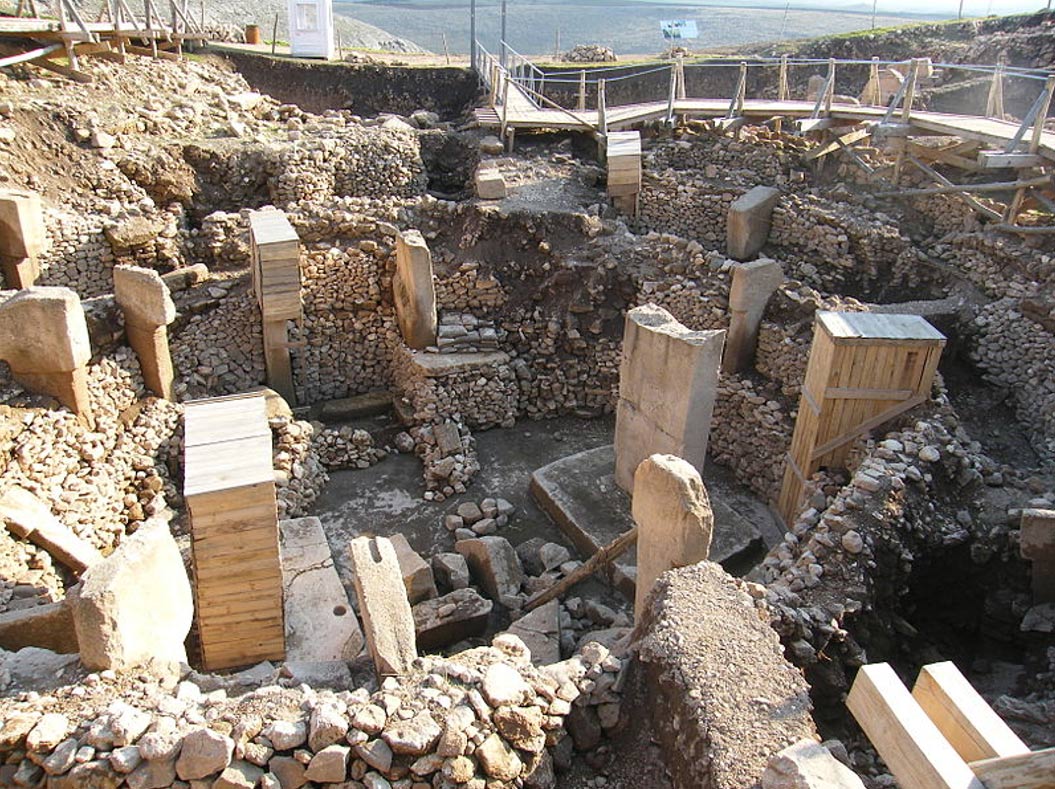
Göbekli Tepe is a Pre-Pottery Neolithic site in Şanlıurfa province, south-eastern Turkey, where hunter-gatherers raised circular enclosures of carved T-shaped limestone pillars beginning around 9500 BCE, more than 6,000 years before Stonehenge and nearly 7,000 years before the Great Pyramid. It is the oldest known monumental architecture built by humans, and because it was constructed before farming, pottery or metal tools, it overturned the long-held assumption that agriculture had to come first and monuments second. UNESCO added it to the World Heritage List in 2018.
The site matters because it forces a question nobody in archaeology was asking before the 1990s: how did people with no cities, no crops and no domesticated animals quarry, carve and raise ten-ton pillars covered in animal art? Every answer, from the excavators' own "first the temple, then the city" to the reset-cycle model Billy Carson argues for, starts from the same stones. This guide lays out what has been found, what the excavators now say, where the fringe readings come from, and what Carson adds.
Where Göbekli Tepe is and how it was found
Göbekli Tepe sits on a limestone ridge about 15 kilometres north-east of the city of Şanlıurfa, in the northern arc of the Fertile Crescent. The name is Turkish for "Potbelly Hill", after the rounded artificial mound on the ridge, and the site was first recorded in 1963 during a joint survey by Istanbul University and the University of Chicago. The surveyors read the mound as a medieval cemetery, and it was left alone for three decades.
In 1994 Klaus Schmidt of the German Archaeological Institute, who had worked at nearby Nevalı Çori before the Atatürk Dam flooded it, revisited the survey notes and recognised the broken slabs as the tops of the T-shaped pillars he had seen there. Excavation began in 1995 under Schmidt's direction and continued until his death in 2014; the German Archaeological Institute, now coordinated by Lee Clare, works there with the Şanlıurfa Museum. The mound is roughly 300 metres across and 15 metres high, and geophysical survey suggests more enclosures remain unexcavated.
How old is Göbekli Tepe
The oldest excavated enclosures at Göbekli Tepe date to the Pre-Pottery Neolithic A period, around 9500 BCE, and the site was in use through the Pre-Pottery Neolithic B, to roughly 8000 BCE. Radiocarbon dates from charcoal in the fill and from the wall plaster of Enclosure D both point to the tenth millennium BCE for the earliest monumental phase. That makes the enclosures older than any known city or pottery, and far older than the Sumerian temples that later rose downstream in the same river basin, covered in [the Anunnaki topic hub](/topics/anunnaki).
For scale: the earliest phase of Stonehenge belongs to around 3000 BCE, the Great Pyramid to around 2560 BCE, and the first cuneiform writing to around 3200 BCE; Göbekli Tepe's builders were gone before any of them began. The gap between the sophistication of the carving and the absence of everything normally associated with it is what made the site famous, and it is the subject of [The Prehistory of Göbekli Tepe](/the-prehistory-of-gobekli-tepe-the-rise-and-fall-of-civilization-is-rewritten) on this site.
What the T-shaped pillars show
The pillars at Göbekli Tepe are monolithic limestone slabs shaped like a capital T, arranged in rings of a dozen or so around two taller central pillars, and carved in relief with wild animals. The four best-known enclosures are labelled A to D. The tallest stand about 5.5 metres and weigh around 10 tons; smaller ones line the ring walls with their carved faces turned inward, and benches run along the inside.
The animal repertoire is consistent: foxes, wild boars, snakes, scorpions, cranes, vultures, aurochs and spiders. Few are animals the builders ate in quantity; gazelle, the main meat source in the bone record, is rare on the pillars. The central pillars of Enclosure D, numbered 18 and 31, are unambiguously human. Each has arms carved down the sides that meet in hands at the front, a decorated belt and a fox-pelt loincloth. Schmidt read them as stylised, deliberately faceless beings at the centre of a gathering place.
Pillar 43, in the north-western wall of Enclosure D, is the site's most photographed stone. It carries a large vulture with a disc above one wing, a scorpion, a headless human figure near the base, water birds and a row of bag-shaped motifs across the top. The excavators connect it with the vulture-and-skull imagery of later Neolithic Anatolia, including Çatalhöyük, and with the treatment of the dead; others, as discussed below, read it as an astronomical record.
Who built Göbekli Tepe
Göbekli Tepe was built by hunter-gatherers, not by farmers, and this is the single most important fact about the site. The animal bones are wild gazelle, aurochs, boar and birds; the plant remains are wild cereals, almonds and pistachio; there are no domesticated animals in the early layers and no pottery at all. Yet the genetic work of Manfred Heun and colleagues, published in Science in 1997, traced the domestication of einkorn wheat to the slopes of Karacadağ, a volcanic massif within sight of the ridge. The pillar builders lived at the exact place and time where farming was about to be invented.
Schmidt's explanation, set out in his 2006 book (in English in 2012 as Göbekli Tepe: A Stone Age Sanctuary in South-Eastern Anatolia), was that the monument came first and farming followed. Feeding the crowds who gathered to build and use the enclosures put pressure on wild cereal stands, he argued, and that pressure pushed people into cultivation. Hence "first the temple, then the city": the sacred site generated the social organisation that later produced agriculture and settlement. It remains the most influential single idea about the site.
Was Göbekli Tepe a temple or a settlement
The current excavators no longer describe Göbekli Tepe simply as a temple; the picture that has emerged since 2014 is of a place where people also lived. Under Lee Clare the team has documented rectangular domestic buildings around the great enclosures, rock-cut cisterns and channels for harvesting rainwater, and thousands of grinding stones for processing wild cereals, published by Laura Dietrich and colleagues in PLOS ONE in 2019. That is the equipment of a community feeding itself on site, not only of pilgrims passing through.
The team has also revised the idea that the enclosures were deliberately buried. Schmidt argued that each ring was ritually backfilled at the end of its life, which is why the pillars survived so well. Clare and Moritz Kinzel have argued instead that much of the fill arrived by slope erosion and mass movement from higher up the mound, and that some enclosures were rebuilt and reused over generations rather than sealed in a single act. Whether they were "temples" therefore depends on definition; the best current summary is that Göbekli Tepe combined communal ritual architecture with domestic life, closer to contemporary Nevalı Çori than to a lonely sanctuary on a hill.
What Pillar 43 and the Younger Dryas have to do with it
The Younger Dryas is a sharp return to near-glacial cold that began about 12,900 years ago and ended about 11,700 years ago, right before the first enclosures at Göbekli Tepe. That timing has made the site central to claims about a catastrophe at the close of the last Ice Age. The Younger Dryas impact hypothesis, proposed by Richard Firestone and colleagues in 2007, argues that a fragmenting comet triggered the cold snap; it remains contested among geologists, and the consensus explanation is meltwater disruption of ocean circulation.
In 2017 Martin Sweatman and Dimitrios Tsikritsis of the University of Edinburgh published a paper in Mediterranean Archaeology and Archaeometry proposing that the animals on Pillar 43 are constellations, the disc above the vulture the sun at a solstice, and the arrangement a date close to 10,950 BCE, which they tied to the impact hypothesis. The excavation team, in a reply by Jens Notroff and colleagues in the same journal, answered that the reading assumes constellations far younger than the site, ignores the rest of the Enclosure D imagery, and treats a religious relief as a data table. The site's archaeologists have not accepted it.
Graham Hancock's Magicians of the Gods (2015) goes further, arguing that Göbekli Tepe was founded by survivors of an advanced Ice Age civilisation destroyed in the Younger Dryas who passed their knowledge to the hunter-gatherers of Anatolia. Mainstream archaeology rejects the model because the site's tools, food remains and building techniques are entirely those of the local Pre-Pottery Neolithic. That is the state of the debate, and [Discovering the Secrets of Göbekli Tepe and Karahan Tepe](/discovering-the-secrets-of-göbekli-tepe-and-karahan-tepe) should be read against it.
Karahan Tepe and the Taş Tepeler sites
Göbekli Tepe is no longer unique: at least a dozen sites with T-shaped pillars are now known across the Şanlıurfa region, grouped since 2021 under the Turkish Ministry of Culture and Tourism's Taş Tepeler ("Stone Hills") project. The most important is Karahan Tepe, about 46 kilometres to the east, excavated since 2019 by Necmi Karul of Istanbul University. Karahan Tepe has its own pillar enclosures, a chamber cut into the bedrock with a ring of upright stone shafts and a human head carved from the wall, and a large seated human statue found in 2023; its dates overlap with Göbekli Tepe's.
Nevalı Çori, where Harald Hauptmann first recognised the T-pillar tradition in the 1980s, now lies under the reservoir. Together the Taş Tepeler sites show that Göbekli Tepe was one node in a shared regional culture rather than a lone anomaly, a comfort to conventional archaeology and, for lost-civilisation readings, a sign the knowledge was widely held. The pillar-building culture disappears from the record around 8000 BCE, and the region's later monumental traditions, in Mesopotamia and then in [ancient Egypt](/topics/ancient-egypt), begin thousands of years afterward.
Billy Carson's reading
Billy Carson reads Göbekli Tepe as physical evidence for what he calls reset cycles: periods in which a developed human knowledge base is largely wiped out by a planetary cataclysm and survives only in fragments carried by the survivors. In his framing the Younger Dryas, beginning around 10,800 BCE, is the most recent such reset, and Göbekli Tepe is what the fragments look like on the ground: people with hunter-gatherer tools producing architecture and imagery that, in his view, presuppose inherited astronomy, engineering and sacred geometry. Carson does not claim the builders were themselves an advanced civilisation; his argument is that they were working from a memory of one.
He connects that memory to the thread he traces through the Emerald Tablets and the Sumerian record: an older body of knowledge, later credited by Mesopotamian scribes to the gods, that resurfaces after each catastrophe. In his reading the reliefs, the enclosures and the anthropomorphic central pillars are the earliest surviving expression of that thread, and the site's abandonment is itself a data point about how knowledge is lost. He sets out the argument in his podcast episode Ancient Civilizations, Reset Cycles, Atlantis, Lost Knowledge and Human Amnesia.
This is an interpretation, and Carson presents it as one. The excavators' current model is a picture of people inventing sophistication in place rather than remembering it. Carson's reading is strongest on the question archaeology still cannot fully answer, how a culture with no prior monumental tradition produced its most accomplished work first, and weakest where no artefact from the site points to an outside source. Readers can weigh both and judge which explains more.
Watch, read and go deeper
For the site in context, watch [Matt LaCroix: Ancient History](/watch/matt-lacroix-ancient-history) on 4BK TV, which places Göbekli Tepe alongside the other early Anatolian and Mesopotamian sites and the flood traditions that follow them. [Megalithic Mysteries](/watch/megalithic-mysteries) covers the engineering questions the T-pillars raise beside the megalithic sites of Europe, Egypt and South America. Billy Carson's own argument is laid out in the reset cycles podcast episode. For the wider thread, [the Anunnaki topic hub](/topics/anunnaki) follows the knowledge tradition into Sumer, and [the Ancient Egypt hub](/topics/ancient-egypt) picks it up on the Nile.
Frequently asked questions
Is Göbekli Tepe really the oldest temple in the world
It is the oldest known monumental ritual architecture, dated to around 9500 BCE, and on that basis it is widely called the world's oldest temple. The excavators now use the word cautiously, because recent work shows people also lived and processed food at the site.
Who discovered Göbekli Tepe
The mound was recorded in a 1963 survey by Istanbul University and the University of Chicago but misread as a medieval cemetery. Klaus Schmidt of the German Archaeological Institute recognised its significance in 1994 and directed excavations from 1995 until his death in 2014.
Did Göbekli Tepe's builders know about farming
No. The food remains are entirely wild, there is no pottery and there are no domesticated animals in the early layers. Einkorn wheat was domesticated nearby at Karacadağ shortly afterward, which is why Schmidt argued that the site helped trigger agriculture rather than the reverse.
Does Pillar 43 record a comet impact
That is the claim of Sweatman and Tsikritsis (2017), who read the carvings as constellations dating a Younger Dryas impact to about 10,950 BCE. The site's excavators rejected the reading in a published reply, and the impact hypothesis itself is still disputed among earth scientists.
Was Göbekli Tepe deliberately buried
Klaus Schmidt thought so, and the idea became part of the site's legend. The current team argues that much of the fill came from slope erosion and that several enclosures were rebuilt and reused rather than sealed, so deliberate backfilling is no longer the default explanation.
Sources and further reading
- Klaus Schmidt, Göbekli Tepe: A Stone Age Sanctuary in South-Eastern Anatolia (2012; German original Sie bauten die ersten Tempel, 2006)
- Lee Clare, "Göbekli Tepe, Turkey. A brief summary of research at a new World Heritage Site (2015–2019)", e-Forschungsberichte des DAI, 2020
- Laura Dietrich et al., "Cereal processing at Early Neolithic Göbekli Tepe, southeastern Turkey", PLOS ONE, 2019
- Moritz Kinzel and Lee Clare, "Monumental – compared to what? A perspective from Göbekli Tepe", in Monumentalising Life in the Neolithic (2020)
- Manfred Heun et al., "Site of Einkorn Wheat Domestication Identified by DNA Fingerprinting", Science, 1997
- Martin Sweatman and Dimitrios Tsikritsis, "Decoding Göbekli Tepe with archaeoastronomy: What does the fox say?", Mediterranean Archaeology and Archaeometry, 2017, and the reply by Jens Notroff et al., "More than a vulture", same journal
- Graham Hancock, Magicians of the Gods (2015)
- UNESCO World Heritage Centre, Göbekli Tepe nomination file (2018)