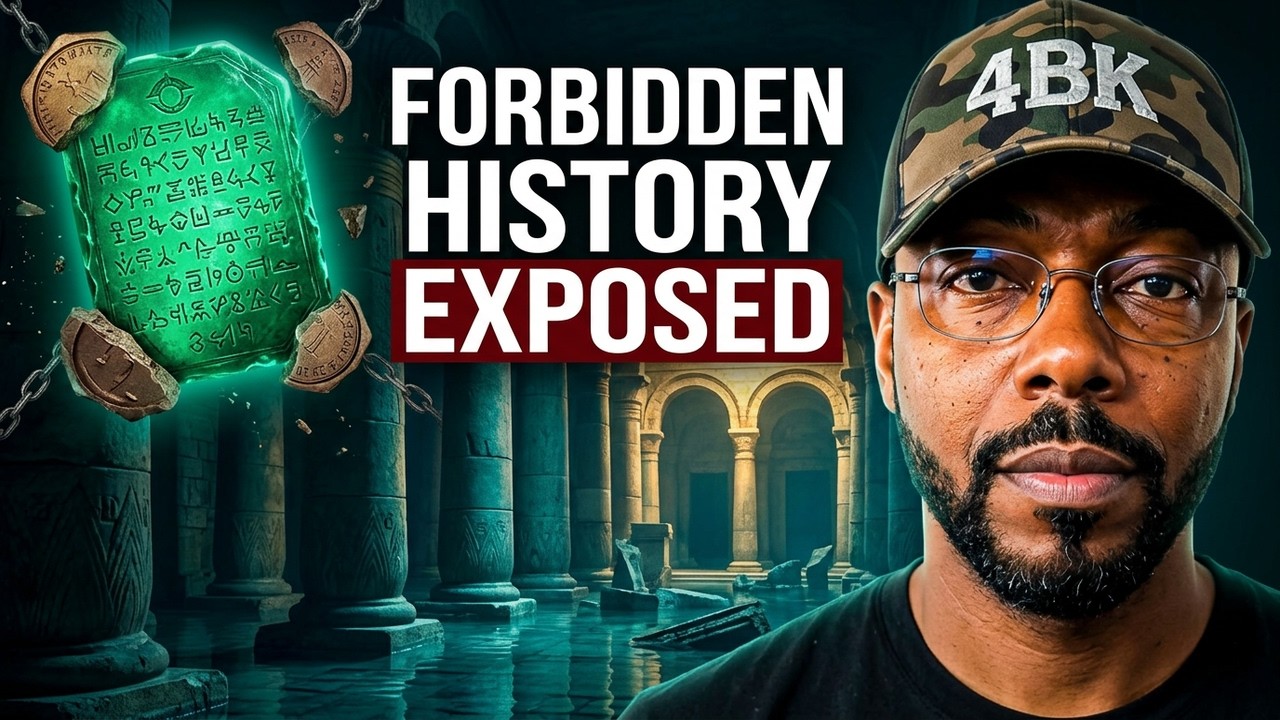
The Emerald Tablets of Thoth are a set of verses attributed to Thoth the Atlantean, a priest-king who, in Billy Carson's framing, wrote them about 36,000 years ago as a time capsule for a future humanity. In this 4biddenknowledge Podcast Network live stream, a solo talk with no guest, Carson reads from his book Compendium of the Emerald Tablets and interprets the passages he says describe a flying ship, a frequency weapon, a craft buried beneath the Sphinx and a global Atlantis, then works through Tablet 10, the Key of Time.
This article covers the tablets themselves, the aerospace and UFO readings, Carson's Atlantis chronology, his argument that thoughts are light waves, the Key of Time and the "sun of man" wordplay. It leaves out the tour and product mentions, the current-events asides and the personal remarks, and sets each claim beside the mainstream position.
What are the Emerald Tablets in Carson's framing?
Carson opens by separating two texts. The Emerald Tablets of Thoth, plural, are the long poetic tablets attributed to Thoth the Atlantean; the Emerald Tablet of Hermes, singular, is the short alchemical text behind "as above, so below." His book collects both and, as he puts it, breaks down "the science, technology that's encoded into the verses." He dates the Thoth tablets to around 36,000 years ago and says Thoth left them as "a time capsule waiting for a new human" able to decode them. Thoth, in Carson's reading, is the son of the Sumerian Ea or Enki, the "master" of the text.
The mainstream position differs on both texts. The Emerald Tablets of Thoth were published in 1939 by Maurice Doreal, founder of the Brotherhood of the White Temple in Colorado, who said he had translated them; no physical tablets have been produced, and scholars treat the work as a twentieth-century composition in the Theosophical tradition. The Emerald Tablet of Hermes is older but not ancient Egyptian: its earliest known versions appear in Arabic texts of the eighth and ninth centuries, and it reached Europe in Latin from the twelfth century. Our Emerald Tablets of Thoth explainer covers the publication history.
Why does Carson say thoughts are light waves?
Before opening the book, Carson lays out his premise. An EEG, he says, reads brain waves through electrodes on the scalp, which to him proves that thoughts "leave your skull" as waves of light encoded with information, the way a phone piggybacks data on a microwave signal to a cell tower. We are blind to this traffic, he argues, because we see less than one percent of the spectrum, but every thought ever thought is recorded in what he calls the Book of Life or the Akashic record, and a sudden good idea is often a download of something already thought elsewhere.
Neuroscientists describe EEG differently. The electrodes pick up tiny voltage changes from groups of neurons firing together; the signal is electrical, not optical, and it fades so steeply that it cannot be read more than a few centimeters from the head. There is no evidence that neural activity broadcasts structured information into space or that a universal record of it exists.
What does Carson read into the flood passage?
The first passage has the "sons of Amenti" changing the direction of the "flower of fire" at Earth's heart, after which "broke the great waters" and only a temple on the mountain of Undal stood above the flood. In Carson's reading this is a magnetic reversal recorded from the inside. He points to paleomagnetism, the fact that cooling volcanic rock locks in the direction of the field, and to the drift of magnetic north that has forced airports to renumber runways. He says the field flips about every 26,000 or 27,000 years, that we are overdue, and that the tablets describe the same event triggering a crustal shift and a global flood, with survivors like those in the Epic of Gilgamesh.
Geophysicists agree with the mechanism and not the timetable. Rocks do record the field and runways have been renumbered, but full reversals happen at irregular intervals averaging a few hundred thousand years; the last was about 780,000 years ago, and a brief excursion around 41,000 years ago coincided with neither a flood nor a crustal shift. The Mesopotamian flood stories predate Genesis by roughly a thousand years, not six thousand.
Which lines does Carson read as a flying craft?
After the flood, Thoth boards "the great ship of the master," and Carson's case rests on the verbs. The text says "upward we rose into the morning" and "dark beneath us lay the temple," and a boat, he points out, does neither. When the waters then vanish from view, he reads "the waters" as the ancient term for the upper atmosphere, meaning the craft left it entirely. On landing among the children of Khem, Thoth directs "a ray of vibration" from his staff that freezes attackers in place, which Carson calls a non-lethal frequency weapon, then awes them with "magic science," which he translates as hand-held devices, before insisting he is a messenger, not a god.
Later Carson reads "deep 'neath the rocks I buried my spaceship," with a marker "in the form of a lion, yet like unto a man," and concludes that the craft lies under the Great Sphinx, to be brought out when "invaders shall come from out of the deep," meaning deep space. The mainstream reply is that the word spaceship is Doreal's 1939 English, written in the age of aviation, with no older source behind it. Egyptologists date the Sphinx to about 2500 BC and Khafre's reign, and surveys beneath it have found natural fissures, not a chamber.
What is Carson's Atlantis chronology?
Carson's Atlantis is not an island. He says Thoth ruled the land of Khem for roughly 16,000 years, from about 52,000 to 36,000 BC, long before dynastic Egypt, raising a people who had fallen back to caves and spears. Thoth then sent the "sons of Atlantis" out to seed the same architecture and sciences on every continent, so that the ring city that sank in the Atlantic was one capital among many and "this Earth was literally Atlantis." He credits Thoth with the Great Pyramid and with Teotihuacan in Mexico, whose Pyramid of the Sun he says shares the Great Pyramid's base at half its height, and with the names Hermes, Quetzalcoatl, Kukulcan and Viracocha elsewhere.
The classical source for Atlantis is Plato, in the Timaeus and Critias of the fourth century BC: a sea power beyond the Pillars of Heracles, destroyed about 9,000 years before Solon, which most classicists read as a moral fable and which has left no archaeological trace. Egyptologists put the first dynasty around 3100 BC and the Great Pyramid around 2560 BC, and archaeologists date Teotihuacan to roughly 100 BC to 250 AD; the two pyramid bases are close, about 220 and 230 meters a side.
What is the Key of Time?
Tablet 10, chapter 12 of Carson's book, is a dialogue in which Thoth asks the dweller of Undal, "What is time?" The answer, as Carson reads it, is that into a void came a purposeful thought, and time was the law that grew from it so that events could be held apart. "Time is not in motion," the text says, "but ye move through time as your consciousness moves." Carson's gloss is that "Time does not exist. Clocks exist." He cites special relativity, where a faster-moving clock ticks slower, and general relativity, where clocks slow in stronger gravity, and concludes that the arrow of time is an illusion. When Thoth says time moves "through strange angles" and can be caught "only by curves," Carson hears the Fibonacci spiral and the compactified extra dimensions of string theory.
Time dilation is real and measured daily by GPS satellites; relativity does not say time is unreal, only that it is not universal. The block universe, in which past, present and future coexist, is one philosophical reading among several, and string theory's extra dimensions have never been detected, so the match to the tablet is a resemblance of language rather than a prediction.
What does the "sun of man" wordplay mean, and what is the takeaway?
Near the end of the tablet, Thoth tells the reader to walk "in the pathway that leads to the sun," and Carson stops on the word. Thoth calls himself a son of Atlantis and a son of man, and Carson hears both as S-U-N: a light, a beacon. He extends the pun to the Gospel phrase "son of man," a thread he develops in the Jesus and Thoth talk linked below. He treats "Zin Uru," the text's word of power, as a cymatic frequency that acts on space-time when spoken with intent, and glosses "fear is the lord of the dark Arulu" with the acronym false evidence appearing real.
The pun exists only in English. "Son" and "sun" have different Old English roots, and the Gospel phrase translates Hebrew ben adam and Aramaic bar enash, which mean a human being. The fear acronym is a modern backronym, and because Doreal's text was English from the start there is no original language in which to check for a pun.
Carson's throughline is the refrain that "light is thine heritage." He quotes Ouspensky's account of Gurdjieff on "waking sleep," the claim that most people run programming they never examine, and turns "man is only what he believeth" into a choice between fear and light. His practical instruction is the one Thoth gives himself: "departed I to ponder on time." Do not scroll past deep material, Carson says; sit with it and reread the tablets, because "the more you read them, the more wisdom and knowledge you gain."
Watch, read, listen
- Watch the full stream:
- The 4biddenknowledge Podcast archive: https://4biddenknowledge.ai/Podcast
- Topic hub: Emerald Tablets
- Related reading: the Compendium of the Emerald Tablets explained, Hermes Trismegistus and the Hermetica, who was Thoth?, Atlantis explained: Plato and the Anunnaki connection, Carson and Matthew LaCroix read the Timaeus and Critias, where are the Halls of Amenti?, the Emerald Tablets and the Knights Templar and was Jesus a student of Thoth?.
Frequently asked questions
Are the Emerald Tablets of Thoth really 36,000 years old? That is Carson's dating, following the text's own claims. The work was published in 1939 by Maurice Doreal, who said he had translated it, and scholars treat it as a modern composition.
How do the Emerald Tablets of Thoth differ from the Emerald Tablet of Hermes? The Thoth tablets are a long poetic cycle published in 1939. The Emerald Tablet of Hermes is a short alchemical text first attested in Arabic in the eighth and ninth centuries, best known for "as above, so below."
Does the text actually use the word "spaceship"? Yes, in Doreal's English. The line Carson reads is "deep 'neath the rocks I buried my spaceship," followed by a marker shaped like a lion. The word comes from a 1939 text with no known older original.
What is the Key of Time? Tablet 10, in which Thoth asks the dweller of Undal what time is and is told that time holds events apart while consciousness moves between them. Carson reads it through relativity and string theory.
Sources mentioned
- Billy Carson, Compendium of the Emerald Tablets, read from throughout
- The Emerald Tablets of Thoth the Atlantean (Maurice Doreal's 1939 text), including Tablet 10
- The Emerald Tablet of Hermes and the Hermetic principle "all is mind"
- The Epic of Gilgamesh and the Sumerian flood hero Ziusudra
- The Gospel phrase "son of man"
- P. D. Ouspensky, In Search of the Miraculous, on Gurdjieff's "waking sleep"
- Special and general relativity and string theory, as cited by Carson