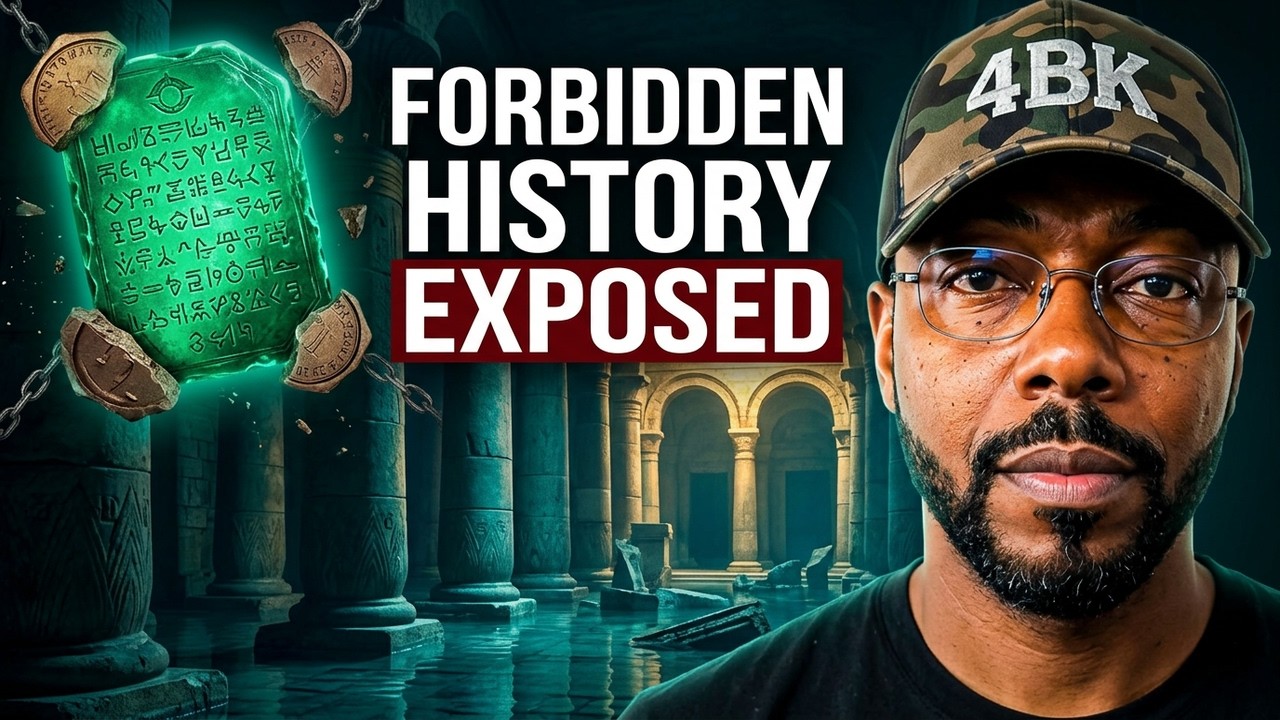
Thoth is the ancient Egyptian god of writing, reckoning and the moon, called Djehuty in Egyptian and identified by the Greeks with Hermes. In this short solo talk, Billy Carson argues that Thoth was something more: an Atlantean priest-king who ruled Kemet for 16,000 years, taught the first Egyptians alchemy, cymatics and quantum physics, and left behind a "language of light" and a crystal tablet that let an elite called the ordainers of destiny preview and select their own futures. Egyptology knows Thoth as a deity with a cult center at Hermopolis and a role in the judgment of the dead; the Atlantean colony, the 16,000-year reign and the reserved language come from Maurice Doreal's 1939 book The Emerald Tablets of Thoth the Atlantean, which Carson treats as a primary source.
This article takes Carson's claims in the order he makes them and sets the documented position beside each. It leaves out the closing promotion for his Academy and his aside about dolphins and killer whales.
Who was Thoth, and did he rule Kemet for 16,000 years?
Carson opens with a flat statement: Thoth was "the Atlantean priest king" who "ruled over ancient Kemet for 16,000 years, according to the ancient Egyptians," and taught alchemy, chemistry, frequency, vibration, cymatics, photons and quantum physics. In his telling, this is the wisdom modern people have failed to tap.
The Egyptian record is different in kind. Thoth, Djehuty in Egyptian, is a god who presides over writing, counting and the moon and records the verdict when the heart is weighed in the Book of the Dead. His cult center was Khemenu, renamed Hermopolis by Greeks who equated him with Hermes; by the Ptolemaic period that fusion had produced Hermes Trismegistus, to whom the Hermetica and the medieval Tabula Smaragdina were attributed. There is a genuine Egyptian tradition that gods ruled before human kings: the Turin King List, of the thirteenth century BCE, and Manetho's Aegyptiaca, from the third century BCE, both open with dynasties of gods, and Manetho names Thoth among them. Neither contains Atlantis, a priest-king or a reign of 16,000 years. Those details come from Doreal, whose preface has Thoth ruling Egypt from about 52,000 to 36,000 BCE; Carson's "written over 36,000 years ago" is Doreal's dating.
Is Thoth also Quetzalcoatl and Odin, and does "thought" come from his name?
Carson lists the names under which, he says, the same teacher appears worldwide: Quetzalcoatl, Kukulkan and Viracocha in the Americas, Mercury in Rome, Odin in the north. He adds two etymologies: chemistry is named "from the land of Khem," where Thoth taught alchemy, and "T h o u g h t comes from Thoth."
Two of the name links have an ancient pedigree. Greeks and Romans mapped foreign gods onto their own, so Thoth became Hermes and Hermes became Mercury, and Tacitus, in the Germania of about 98 CE, said the Germans worshipped "Mercury" above all, which scholars take to mean Woden. Quetzalcoatl, Kukulkan and Viracocha belong to separate Nahuatl, Maya and Andean traditions with no documented contact with Egypt, and Mesoamericanists read the recurring culture-bringer as a common mythological pattern. On the words, the Oxford English Dictionary traces thought to Old English þoht, from the Germanic root of think; the resemblance to Thoth is a coincidence of spelling. Chemistry is partly aligned with Carson: it comes from alchemy, from Arabic al-kimiya, from Greek khemeia, and Egyptian km.t, "the black land," is one of two proposed roots for the Greek, the other being chein, "to pour."
Were there three languages in ancient Egypt, including a "language of light"?
"If you go study ancient Egyptian," Carson says, "you learn there are three languages in ancient times." The highest was the language of light, spoken only by the gods and the elite because it "holds manifestation power"; below it the language of the politicians; and at the bottom "just basic Egyptian" for the poor. In his book The Forbidden Emerald Tablets of Thoth, he says, he lists the sounds Thoth gives as keys to "different portals"; they are "not names of people" but "cymatic frequencies."
What Egyptology documents is one language written in three scripts: hieroglyphs, which the Egyptians called medu netjer, "the god's words"; hieratic, the cursive scribes used on papyrus; and demotic, which appeared around the seventh century BCE for everyday business. The grammars of Alan Gardiner (1927) and James Allen (2000) treat these as scripts and stages of a single tongue, not languages of rank. Carson's hierarchy has a real counterpart in literacy: John Baines and Christopher Eyre estimated in 1983 that perhaps one percent of Egyptians could read. The Egyptians did credit speech with creative force: on the Shabaka Stone, Ptah creates the world by heart and tongue. A separate language of light, and a tier of speech forbidden to commoners, appear in no Egyptian text.
Did scientists create solid matter from sound and photons two years ago?
Carson says the Emerald Tablets describe Thoth using "cymatic frequencies and photons to manifest solid matter," and that "just two years ago" scientists "used cymatic frequencies and photons in a laboratory setting" and "created individual particles from sound and frequency vibration."
Two separate things are being joined. Cymatics is the name Hans Jenny gave in his 1967 book to the patterns sand, powder or liquid form on a vibrating plate; it visualizes vibration in matter that already exists and has never produced a particle. The experiment that matches the rest of the description is Breit-Wheeler pair production. Gregory Breit and John Wheeler predicted in 1934 that two photons could collide and become an electron and a positron, and in 2021 the STAR collaboration at Brookhaven National Laboratory reported detecting it in Physical Review Letters. That result involved photons and no sound, produced subatomic particles rather than solid matter, and is the nearest documented match to "two years ago." The "ancient emerald tablet book" Carson cites is Doreal's 1939 text; the medieval Tabula Smaragdina says nothing about photons.
Who were the "ordainers of destiny," and what was the crystal tablet?
The heart of the talk is an elite who "called themselves the ordainers of destiny." They "would look at the future inside of a crystal tablet," see several potential outcomes, select the one that "resonated with them the most," and take the actions that would "collapse" it into their timeline. Carson ties this to superposition: because the double-slit experiment shows that "everything exists as waves of potential" until "collapsed into fruition by conscious thought," the ancients were practicing a physics that science has only now rediscovered.
The documented ancestor of a tablet that governs destiny is Mesopotamian. The Tablet of Destinies, tuppi shimati in Akkadian, appears in the Babylonian creation epic Enuma Elish and in the Anzu myth, where Anzu steals it from Enlil. Whoever holds it has the authority to decree fates; it confers command, not foresight, and no text describes anyone viewing alternative futures on one. In physics, superposition means a quantum system is described as a combination of states until measured, and the double-slit experiment, first done by Thomas Young in 1801, shows interference vanishing when a which-path measurement is made. A measurement is any interaction that records information, a detector included; no experiment has shown a conscious choice is needed, and nothing in the formalism lets an observer pick the outcome.
Does the coffee-shop example show that we "fracture timelines" every day?
Carson tells two stories. In the first, you arrange to meet a friend at a coffee shop at one o'clock, an emergency call keeps you away, and your friend makes the trip alone: you have "created a fractured timeline," and "all these multiple realities are existing simultaneously." In the second, you plan a vacation, book it, and later "rendezvous with that timeline." His lesson is that conscious thought multiplied by action produces manifestation, that we can "send our mind into the future" to preview a decision's consequences, and that by the Hermetic principle of cause and effect every action has a consequence.
The physics he leans on is the many-worlds interpretation, which Hugh Everett proposed in his 1957 relative-state paper and Bryce DeWitt named in 1970. Branching is driven by quantum events rather than appointments, nothing lets a person steer into a preferred branch, and it is an interpretation, not a tool. The well-documented part of the story belongs to psychology: Daniel Gilbert and Timothy Wilson described prospection, the simulation of possible futures, in Science in 2007, and Gabriele Oettingen's research on mental contrasting, summarized in Rethinking Positive Thinking (2014), finds that people who imagine a desired outcome and then its obstacles follow through more often than those who only picture success. His closing line, that humans are "walking angels unaware," adapts Hebrews 13:2, a verse about hospitality to strangers.
Watch, read and listen next
Start with who Thoth was in Egyptian religion, then read the Emerald Tablets of Thoth explained and Carson's own account in Thoth the Atlantean: Billy Carson on who Thoth was. On the scripts, see Egyptian hieroglyphs explained; on the Mesopotamian decrees of fate, the Me, the Sumerian divine decrees. For the physics, read the double-slit experiment explained, and for the principle he invokes, the Kybalion and the seven Hermetic principles. Carson's method is in how to manifest what you want: the Billy Carson method and why manifesting isn't working: the CT x A = M formula, and the Emerald Tablets topic hub collects the rest.
Frequently asked questions
Did Thoth really rule Egypt for 16,000 years? Not in any Egyptian source. The Turin King List and Manetho record gods ruling before human kings, but the Atlantean priest-king, the 16,000-year reign and the 36,000 BCE date come from Maurice Doreal's 1939 book, which Carson uses as his text.
Does the word "thought" come from Thoth? No. Standard dictionaries trace thought to Old English þoht, from the Germanic root of think. Chemistry is different: Egyptian km.t is one of two proposed roots for the Greek khemeia behind it.
Did scientists create matter from sound two years ago? No experiment has made matter from sound. The closest documented result is the STAR collaboration's 2021 observation of Breit-Wheeler pair production, in which colliding photons produced electron-positron pairs.
What is the Tablet of Destinies? A Mesopotamian object that in the Enuma Elish and the Anzu myth gives its holder the authority to decree the fates of gods and humans. Carson's "crystal tablet" that displays possible futures is his reading of that motif; no ancient text describes one used to view alternative outcomes.
Sources mentioned
- Maurice Doreal, The Emerald Tablets of Thoth the Atlantean (1939)
- The Tabula Smaragdina, first attested in Arabic in the eighth century
- The Turin King List (thirteenth century BCE); Manetho, Aegyptiaca (third century BCE)
- Tacitus, Germania (c. 98 CE)
- Oxford English Dictionary, entries for thought and chemistry
- Alan Gardiner, Egyptian Grammar (1927); James Allen, Middle Egyptian (2000)
- John Baines and Christopher Eyre, "Four notes on literacy" (1983)
- The Shabaka Stone (Memphite Theology)
- Hans Jenny, Cymatics (1967)
- Gregory Breit and John Wheeler, Physical Review (1934); STAR collaboration, Physical Review Letters (2021)
- Enuma Elish and the Anzu myth
- Thomas Young's double-slit experiment (1801)
- Hugh Everett, Reviews of Modern Physics (1957); Bryce DeWitt, Physics Today (1970)
- Daniel Gilbert and Timothy Wilson, "Prospection," Science (2007); Gabriele Oettingen, Rethinking Positive Thinking (2014)
- Hebrews 13:2 (King James Version)
- Billy Carson, The Forbidden Emerald Tablets of Thoth, as cited in the talk