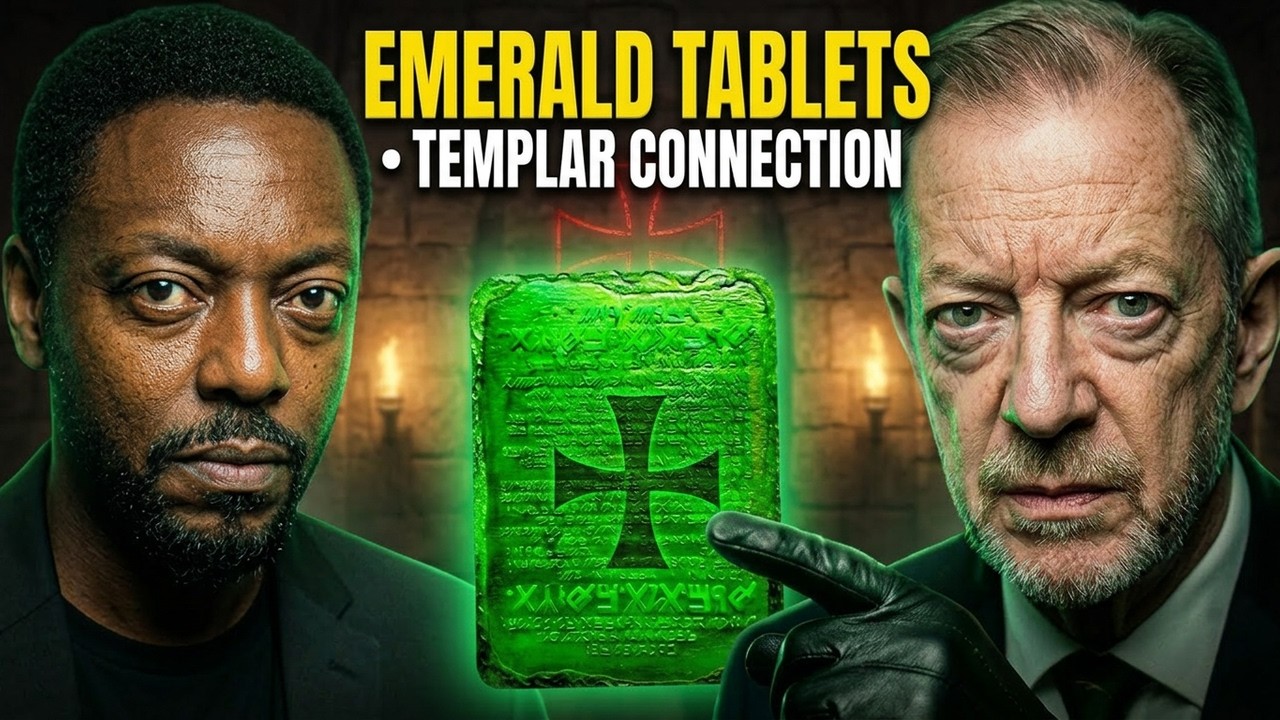
Thoth's message for humanity, as Billy Carson reads it in this video, is that the human soul is already free and that what holds it in place is not an outside power but the body and the darkness allowed to gather around the soul inside it. The way out, he argues, is not death or a promised afterlife but a present-tense practice: bringing order to the chaos of the emotions. The video builds that case through three passages from the Emerald Tablets: the nine interlocked dimensions, the vision of order rising from chaos, and the instruction Thoth receives when he asks for the path.
The question matters because it turns the Emerald Tablets from a story about an ancient teacher into a set of instructions for the reader. Rather than asking who Thoth was, it asks what actually binds consciousness to the body and what a person can do about it in this lifetime.
What the video covers
The question of bondage (from the start)
The video opens with the question it says is rarely asked: if consciousness at its deepest level is not bound by the body, its lifespan or this planet, what keeps it here, and is there a way out that does not run through death. Carson frames Thoth as a being who made the full journey and documented the route. For background on that figure and Carson's account of his origins, see the companion piece Thoth the Atlantean: who Thoth was, the Emerald Tablets and the Compendium.
What Thoth names (from about 2:20)
The first move is to identify the obstacle. In Carson's reading, Thoth does not name a sinister force, a government or a failing culture. He names the body itself and the darkness that has accumulated around the soul living in it. The problem is internal, so the solution has to be too.
The materialist model and its gaps (from about 3:00)
Carson then lays out the standard scientific position fairly: consciousness as an emergent property of roughly 86 billion neurons, testable through correlations between brain states and experience, and supported by what brain damage does to personality and cognition. He grants that it has an elegant simplicity before listing what he says it cannot account for. These are near-death experiences in which patients report accurate observations of events outside the room; terminal lucidity, where patients with severe dementia or brain damage regain clarity shortly before death; and the 2001 study in The Lancet by the Dutch cardiologist Pim van Lommel, which recorded conscious experiences reported by patients resuscitated from cardiac arrest. The fuller evidence and the debate around it are covered in near-death experiences explained.
One architecture across traditions (from about 5:30)
Next comes the comparative argument. The ancient Egyptians spoke of the ba and the ka; the Vedic tradition of atman as the individual expression of Brahman; the Gnostics of the pneuma, the divine spark in matter; and the Hermetic tradition, which traces itself to Thoth, of the light body. Carson's point is that these traditions arose in different languages and eras yet describe the same structure: a temporary body, a permanent soul and an awakening in which the soul remembers what it is.
"The body is nothing" (from about 7:20)
Here the video reads the line that gives it its title: "The body is nothing. The soul is all." Carson is careful here: the body is not worthless or a prison to escape through death, but a temporary frame of reference the soul adopts for a season. The freedom Thoth describes is, in his words, a present-tense possibility for anyone who develops the consciousness to reach it.
Mystery one: the nine interlocked dimensions (from about 8:25)
The first of three mysteries is the passage that begins "Nine are the interlocked dimensions and nine are the cycles of space." Carson reads it as a description of nine layers of reality occupying the same space at different frequencies, perceptible only to a consciousness developed enough to cross the boundary. He sets this beside string theory, which needs ten dimensions, and M-theory, which needs eleven, arguing that physics reached by mathematics what Thoth described by vision.
Mystery two: order from chaos and the Word (from about 9:55)
In the halls of Amenti, Thoth asks the Lord of the Nine where the source of all things lies and is shown creation itself: order shaped from chaos, light springing from order, life coming from light. The voice tells him that the flame contains all things in potentiality and that the order that sent forth light is the Word. The line Carson treats as the hinge of the whole teaching follows: "The life in thee is the word." The same organising force that shaped the cosmos, he argues, is present and usable inside every person.
Mystery three: the path through order (from about 12:00)
Thoth then asks to be shown the way to the Word. Carson stresses how practical the answer is: "Balance and order thy life. Quell all the chaos of the emotions." The path runs through daily, unglamorous emotional regulation rather than rare abilities or secret initiations.
Knowledge buried, never lost (from about 13:50)
Widening the frame, Carson reads Thoth's claim that knowledge has existed through the ages, buried in darkness and forgotten but never lost. In his view it survived in symbols and rituals and is resurfacing now in consciousness research, physics and texts like the Tablets.
Freedom as a natural state, and its cost (from about 15:00)
The closing argument is that freedom does not have to be built or earned. It is the natural state of a soul that has cleared what obstructs its own light, so each layer of emotional chaos brought into order is not preparation for freedom but part of it. Carson names the cost plainly: self-honesty, and trading familiar reactivity and fear for stillness, again and again, without promise of quick reward. The video ends (from about 19:25) with Thoth's line "Remember and ye shall be free," addressed, Carson says, to every reader rather than a chosen few.
Key takeaways
- In Carson's reading, the Emerald Tablets locate the soul's bondage in the body and the darkness gathered around the soul, not in any outside enemy.
- He presents near-death experiences, terminal lucidity and van Lommel's 2001 Lancet study as gaps in the view that the brain alone produces consciousness.
- The Tablets' nine interlocked dimensions are, for Carson, a precursor to the extra dimensions of string theory and M-theory.
- The central instruction he draws from the Tablets is practical: bring order to the emotions, because the path to the Word runs through inner order.
- Freedom, in this reading, is the soul's natural state once its obstructions are removed, and it is available in this lifetime.
Billy Carson's reading
Carson reads the Emerald Tablets as testimony from a being who left his body, travelled through dimensions and returned to report what he found, and so as a practical manual rather than poetry. That is why this video spends most of its time on the instruction Thoth receives rather than on the cosmic vision that precedes it. The vision explains why the method works, since the Word that ordered chaos is also the life within each person; the method itself is ordinary: emotional honesty, stillness and consistency.
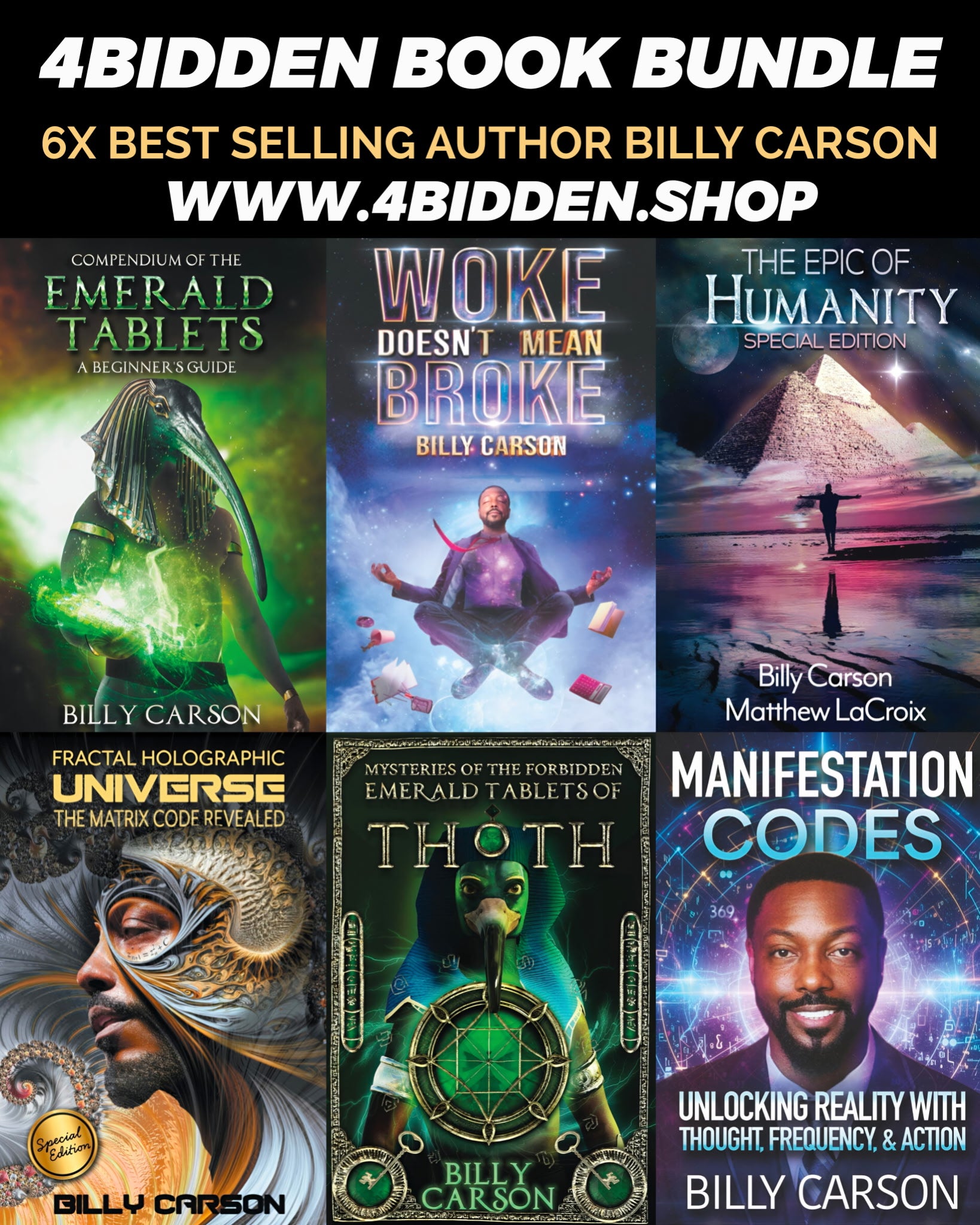
The reading fits the wider framework Carson sets out in his book, which works through the text passage by passage alongside religious and scientific parallels; see the Compendium of the Emerald Tablets explained and his other titles on the books page. For the text itself, its structure and its recurring themes, start with the pillar guide to the Emerald Tablets of Thoth.
What mainstream scholarship says
The Emerald Tablets of Thoth the Atlantean were published by Maurice Doreal, founder of the Brotherhood of the White Temple, in the 1930s. Doreal said he had translated ancient tablets, but no physical tablets or earlier manuscripts have ever been produced, and scholars treat the work as a twentieth-century esoteric composition. Its creation-by-the-Word language echoes Genesis 1 and John 1. The text is also distinct from the short alchemical Emerald Tablet, which first appears in Arabic sources. Historians date the Greek Hermetic writings attributed to Hermes Trismegistus to Roman Egypt, roughly the first to third centuries CE; the background is covered in Hermes Trismegistus and the Hermetica explained.
On the comparative claims, Egyptologists describe the ka as a life force sustained by offerings and the ba as the mobile personality of the dead, with the akh as the transfigured spirit, so these are not a single eternal soul in the later sense. Gnostic and Hermetic thought also grew up in the same Hellenistic world around Alexandria, so some of their convergence reflects shared contact rather than independent discovery.
On the science, van Lommel's study followed 344 cardiac-arrest patients in Dutch hospitals and found that 62 reported a near-death experience; it did not record brain activity, and critics argue the experiences cannot be pinned to the period when the brain was inactive. The AWARE studies led by Sam Parnia placed hidden images in resuscitation areas, and no participant has yet identified one. Terminal lucidity rests mostly on case reports. In string theory the extra dimensions are usually modelled as tiny and curled up, not as parallel layers at different frequencies, and none has been detected experimentally.
Watch, read and go deeper
Start with the pillar guide to the Emerald Tablets of Thoth, then the companion piece on Thoth the Atlantean. The Emerald Tablets topic hub gathers every article on the text. To hear the text with Carson's commentary, the 4BK TV series Compendium of the Emerald Tablets audio book works through it section by section.
Frequently asked questions
What is Thoth's message for humanity in the Emerald Tablets?
In Billy Carson's reading, the message is that the soul is free and the body is only its temporary vehicle. What holds a person back is the darkness that gathers around the soul, and the way through is to bring balance and order to the emotions. The Tablets present this freedom as available in this lifetime rather than after death.
What are the nine interlocked dimensions?
The phrase comes from a passage in Maurice Doreal's Emerald Tablets of Thoth the Atlantean that describes nine dimensions, nine cycles of space and nine worlds within worlds. Carson reads it as nine layers of reality sharing the same space at different frequencies. Physicists' extra dimensions in string theory are a separate, mathematical idea that has not been confirmed by experiment.
Who is the Lord of the Nine in the Emerald Tablets?
In the Tablets, the Lord of the Nine is the being Thoth meets in the halls of Amenti and asks about the source of all things. He shows Thoth order emerging from chaos and light from order, and tells him the path to the Word runs through order in his own life.
Are the Emerald Tablets of Thoth an ancient text?
Billy Carson treats them as the record of an ancient teacher. Scholars date the text to Maurice Doreal's twentieth-century publication, since no physical tablets or earlier copies exist. It is a different work from the short alchemical Emerald Tablet known from medieval Arabic and Latin sources.
Sources mentioned
The video reads from The Emerald Tablets of Thoth the Atlantean as published by Maurice Doreal. It cites Pim van Lommel and colleagues' prospective study of near-death experience in cardiac-arrest survivors, published in The Lancet in 2001; research on terminal lucidity; string theory and M-theory; the Egyptian concepts of ba and ka; the Vedic atman and Brahman; the Gnostic pneuma; and the Hermetic light body. For background, see Garth Fowden's The Egyptian Hermes, Brian Copenhaver's translation Hermetica, Sam Parnia and colleagues' AWARE study in Resuscitation (2014), and Brian Greene's The Elegant Universe.