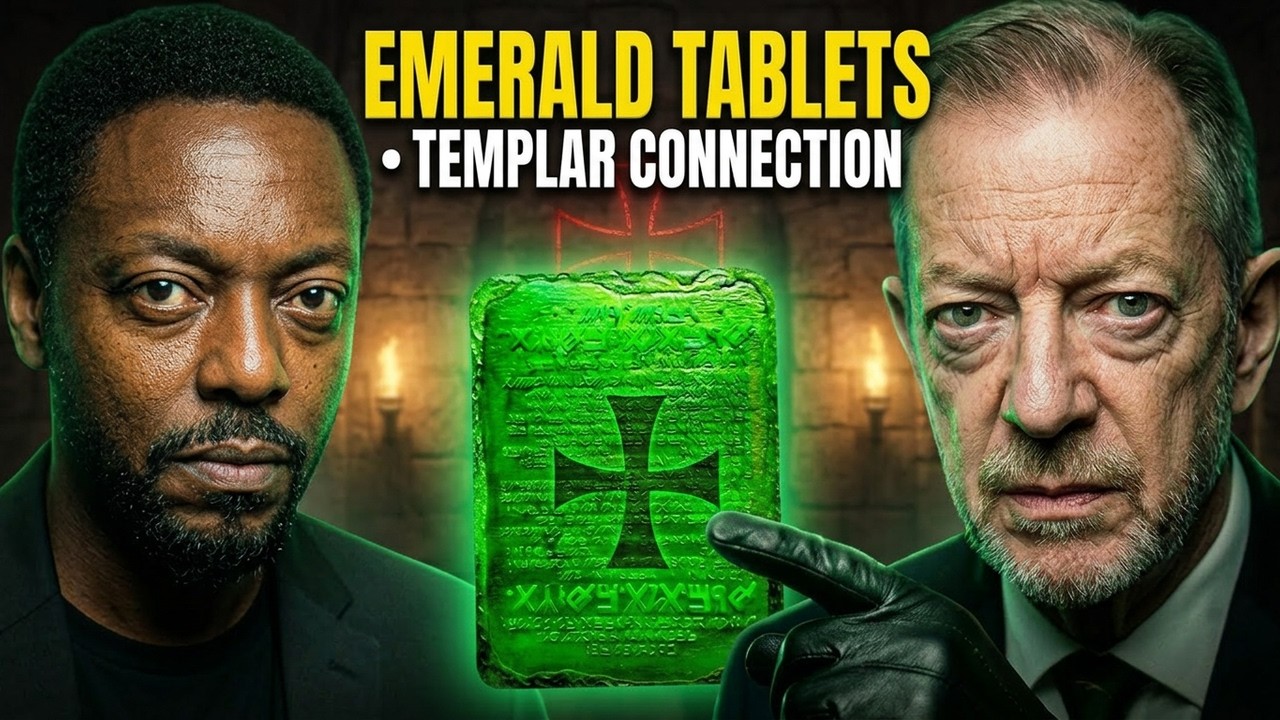
Where did the Emerald Tablet come from, and how did the Knights Templar get involved? In this 4BK Pod conversation, Billy Carson and Templar researcher Timothy Hogan trace the Emerald Tablets from Thoth and a lost Atlantean civilization through Alexander the Great, Apollonius of Tyana, Arabic and Druze translators and the Templars. Hogan's thread is that alchemy was a worldwide science kept alive by initiates; Carson's is that the Thoth of the Emerald Tablets is one teacher remembered under many names.
The topic sits on a fault line. To historians, the singular Emerald Tablet is a short medieval alchemical text and the multi-tablet Emerald Tablets of Thoth the Atlantean is a twentieth-century book. To Carson, who wrote a full commentary on the latter, both point back to the same source. This conversation gives the strongest version of the case for a connection, and this article sets it beside the documentary record.
What the video covers
The earliest accounts (from about 2:50)
Carson opens by asking for the earliest recorded mention of the Emerald Tablet of Hermes. Hogan gives two. In the first, Alexander the Great found the tablet in the Saqqara region, in what was said to be the tomb of Thoth or Hermes, and Aristotle helped him translate it. In the second, Apollonius of Tyana held the tablet. Hogan repeats an esoteric claim that Apollonius was the apostle Paul, conceding that with Apollonius "it's hard to know how much his myth and how much his truth." He then traces copies to China, carried by Manichaeans, and proposes that the Ming dynasty, whose name means light, reflects their influence.
Arabic translators and the Templar handoff (from about 7:10)
On the claim that the tablet is Arabic in origin, Hogan points to Islamic alchemists, Jabir among them, and to translators who recovered Greek and Egyptian learning after Rome fell. He singles out the Druze, who call themselves the Muwahhidun and, in his account, honor Hermes as a prophet. Because the Templars had close ties with the Druze, Hogan says, this is how Hermetic material reached Europe.
Aztlan and the green tablets (from about 9:20)
Hogan connects the tablets' global spread to Atlantis, citing Maya tradition that Aztlan held as many as 2,160 green tablets, described as emerald or jade, some of which survivors carried to the Yucatan after a cataclysm. He names Votan, a civilizing teacher in Chiapas tradition, as their author, links Votan to Wotan and from there to Thoth, and says Bishop Nunez de la Vega gathered up the tablets and writings of Votan in 1691. He adds that a tablet obtained by his order proved to be crystallized copper acetate.
Where the tablets might be now (from about 15:00)
Hogan's best guess for the 1691 cache is the Vatican archives. He cites George Hunt Williamson, whose book Secret Places of the Lion describes tablets passing between Egyptian and Maya hands, and says Doreal, who first published the Emerald Tablets of Thoth, drew on Williamson. He calls the singular tablet an alchemical recipe and states his core thesis: "alchemy was the science of Atlantis." In his view the singular tablet was one of the roughly 2,000 Atlantean tablets.
Thoth under many names (from about 19:30)
Carson recounts a walkabout in Australia where Aboriginal elders showed him a large petroglyph they called Thothamabi, a figure riding a sky ship through the Milky Way. Hogan describes Utah pictographs of a Hermes-like figure and links Thoth to the Sumerian Enki. Carson adds Quetzalcoatl, Kukulkan, Viracocha, Mercury, Odin and Djehuti as names for the same figure.
Horus's eyes, Moses and the serpent (from about 25:30)
Hogan reads Thoth's restoration of Horus's damaged eye as possible planetary symbolism, the blue and red eyes standing for Earth and Mars. Carson ties this to the tablets' account of Thoth leaving a flooded homeland in a ship that rises into the sky. Hogan then turns to Moses: the golden calf ground to powder and the staff that becomes a serpent read to him as alchemical and Hermetic. He notes that the Hebrew words for serpent and copper are nearly identical and argues that the winged serpent encodes as above, so below.
The philosopher's stone and the Ark (from about 34:20)
Hogan names Royal Society figures, Newton, Robert Boyle, John Theophilus Desaguliers and Robert Moray, and says their secret salt was monoatomic gold, one of the stone's three parts with sulfur and mercury. He equates it with biblical manna and the Vedic vimana, says the manna kept in the Ark of the Covenant explains how the Levites could carry so heavy an object; he also cites the Kebra Nagast.
Was it invented by Doreal? (from about 38:45)
Carson raises the online claim that the Emerald Tablets are twentieth-century fiction. His answer is that the text describes science not rediscovered until later: "how do you make up a story based on science that doesn't even exist?" Hogan offers the so-called Tulli Papyrus, which he dates to Thutmose III, as an ancient parallel.
Osiris, the ibis and Nag Hammadi (from about 43:25)
Hogan reads Osiris as Atlantis, its scattered wisdom like the god's scattered body awaiting reassembly. The ibis, Thoth's bird, sleeps on one leg holding a pebble that wakes it when dropped, a symbol, he says, of the borderline state where deeper consciousness surfaces. He stresses that Hermetic writings were buried alongside early Christian texts in the Nag Hammadi library, and compares the passages in the Corpus Hermeticum where Hermes speaks as mind and word with sayings of Jesus.
The Hall of Records and Goebekli Tepe (from about 54:05)
Hogan believes a Hall of Records lies beneath the Sphinx's right paw and says early Templar excavations there found something. He also claims Templar graffiti from the 1200s around Goebekli Tepe. Carson, back from a trip to the site, questions the Neolithic attribution, and the two agree the Serapeum's granite boxes may have been rejuvenation chambers.
The Templar mission (from about 70:15)
Hogan says the order was formed to rescue Hermetic and Gnostic material, citing the Albigensians, Bogomils and Paulicians, from destruction. After digging beneath the Temple Mount, he says, Templars worked between Giza and Saqqara, the area called Rostau, which he reads as rose cross, and at Philae, Dendera, Esna, Edfu and Elephantine, finding an ark at the Temple of Seti I in Abydos. He describes such arks as capacitors and says the goal became a new Atlantis in America. The task now, he says, is to put the scattered pieces back together.
The one mind (from about 81:45)
The conversation closes on the Emerald Tablet's line that all things came into being through the meditation of the one. Hogan reads the hermit Trevrizent in Parzival as a Hermes figure and says the Templars saw Jesus "as the great exemplar, not necessarily as a savior." Carson sums up Thoth's purpose as bringing heaven to earth now.
Key takeaways
- Hogan traces the singular Emerald Tablet through Alexander, Apollonius of Tyana, Manichaean, Arabic and Druze hands to the Templars and Newton.
- He believes the tablets were physical objects and that the singular tablet was one of some 2,000 Atlantean originals.
- Carson argues that Thoth appears worldwide under different names and that this recurrence is evidence of a single historical teacher.
- Hogan presents the Templars as an order created to recover and protect Hermetic wisdom.
- Both agree the deeper alchemy is the transformation of consciousness.
Billy Carson's reading
Carson's position is that the Emerald Tablets record real teachings of a real figure. He rests it on three supports. The first is recurrence: Thoth, Hermes, Djehuti, Quetzalcoatl and Thothamabi read to him as one teacher, a pattern he frames as circumstantial evidence. The second is content: he holds that the text describes science that had not been rediscovered when Doreal published it. The third is moral: he finds the tablets' teaching consistent with the words of Jesus, and notes that Thoth never claims to be God, only a son of Atlantis.
His full line-by-line interpretation is in The Compendium of the Emerald Tablets, with an overview in the Emerald Tablets of Thoth explained and a profile of the figure himself in who was Thoth.
What mainstream scholarship says
The singular Emerald Tablet is first attested in Arabic, in texts of roughly the eighth or ninth century such as the Sirr al-khaliqa (Secret of Creation). That text attributes the tablet's discovery to Balinas, the Arabic name for Apollonius of Tyana, so the Apollonius link has a textual basis, though scholars treat it as legendary. Latin translations reached Europe in the twelfth century. The Alexander story is a later legend, the identification of Apollonius with Paul is a fringe idea without support, and the link between the Ming dynasty's name and Manichaean light movements is a debated hypothesis rather than an accepted fact.
The Emerald Tablets of Thoth the Atlantean were published by Maurice Doreal in the 1930s and historians regard them as his own composition; no ancient manuscript exists. Williamson's Secret Places of the Lion appeared in 1958, after Doreal's text. The Tulli Papyrus has never been seen in an original. Linguists do not accept the Levite and levitation or Rostau and rose cross derivations.
On the Templars, the documented origin of the order, around 1119, is the protection of pilgrims. There is no evidence of Templar excavations under Giza or at Goebekli Tepe, and the crosses carved at Philae and other Egyptian temples are generally attributed to Coptic Christian reuse of those buildings in late antiquity.
Watch, read and go deeper
The full conversation is on the podcast episode page, and Carson's own reading of the tablets is available as the Compendium audiobook on 4BK TV. For the Hermetic texts buried with early Christian writings, see the Gnostic Gospels and Nag Hammadi explained. The biblical ark is covered in the Ark of the Covenant explained. Everything else on the subject is collected in the Emerald Tablets topic hub.
Frequently asked questions
Did the Knights Templar have the Emerald Tablet?
Timothy Hogan says the Templars received Hermetic texts through the Druze and that his order later obtained a green tablet made of copper acetate. No historical record documents Templar possession of the Emerald Tablet. The text was already circulating in Latin in twelfth-century Europe.
What is the difference between the Emerald Tablet and the Emerald Tablets of Thoth?
The Emerald Tablet is a short alchemical text, a dozen or so lines beginning with the idea later summarized as as above, so below, first attested in Arabic. The Emerald Tablets of Thoth the Atlantean is a much longer work of fifteen tablets published by Doreal in the twentieth century. Carson and Hogan treat both as coming from Thoth; historians treat them as unrelated texts.
Who is Timothy Hogan?
In the episode he is a Denver-based researcher who speaks from inside a modern Templar order and from a Masonic background. His focus is the Hermetic lineage he believes runs from Egypt through the Templars to Freemasonry.
Where are the Emerald Tablets today?
Hogan suggests the green tablets confiscated in Chiapas in 1691 may have gone to the Vatican archives. That claim is not documented. The singular tablet survives only as text, in Arabic and Latin versions.
Sources mentioned
In the conversation the speakers cite the Emerald Tablet of Hermes and Isaac Newton's translation of it; Doreal's The Emerald Tablets of Thoth the Atlantean; George Hunt Williamson's Secret Places of the Lion; the Corpus Hermeticum; the Nag Hammadi library and the Gospel of Thomas; the Kebra Nagast; Wolfram von Eschenbach's Parzival; the books of Exodus and Numbers and the Gospel of John; the Tulli Papyrus; and Robert Bauval's Orion correlation. For the scholarly picture, see Julius Ruska's Tabula Smaragdina (1926), Brian Copenhaver's Hermetica (1992), Garth Fowden's The Egyptian Hermes (1986) and Malcolm Barber's The New Knighthood (1994).