 Billy's Colloidal Silver + Starfire Gold duo —
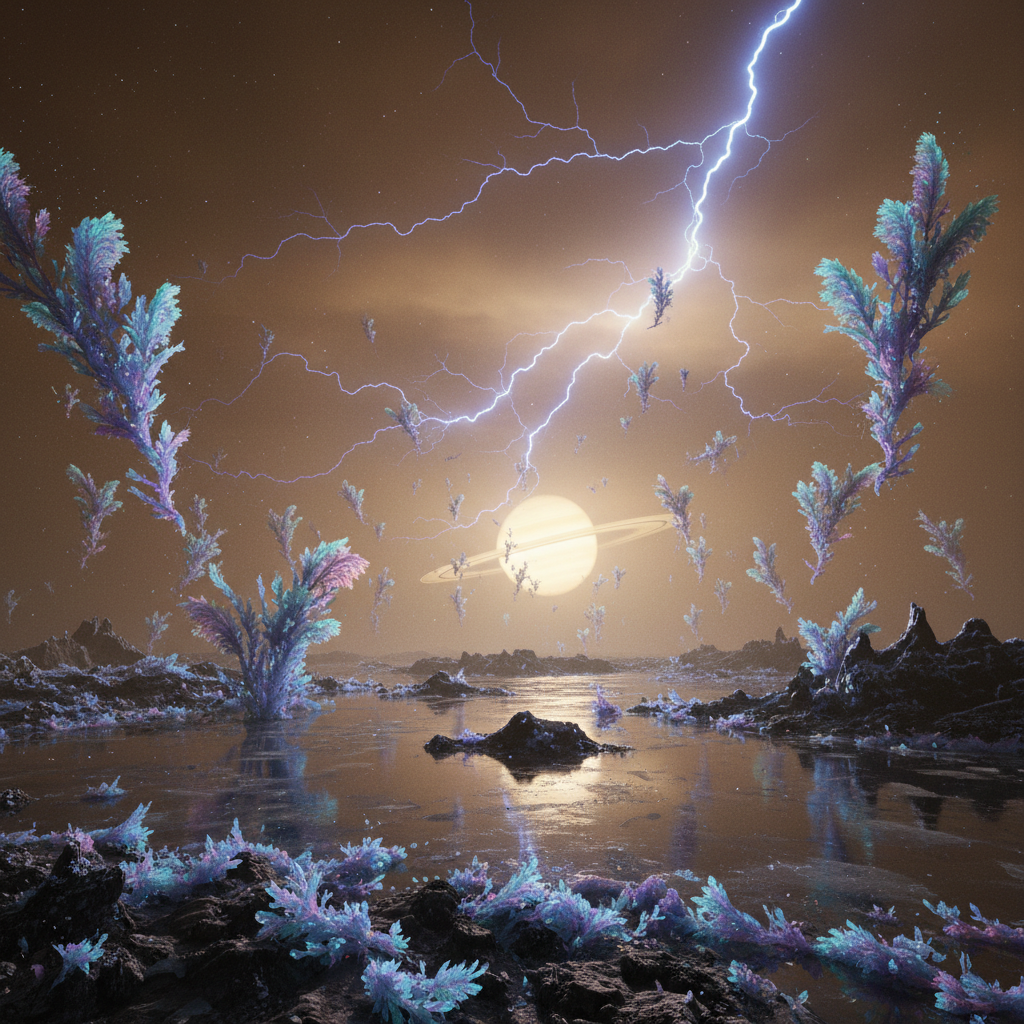
There’s something almost unsettling about Titan. A world wrapped in thick haze, rivers that aren’t water, and plains so eerily smooth they look… edited. Not carved by time—but softened, muted, like someone pressed a cosmic “blur” filter over an entire landscape.
Scientists now believe the answer may be falling from the sky.
The Mystery of Titan’s Unusually Flat Surface
For years, data from the Cassini–Huygens mission revealed something puzzling:
→ Vast regions of Titan are remarkably flat and smooth → Few sharp الصخور (rock-like features) compared to other icy moons → A surface that looks more like powdered terrain than solid ground
That’s not normal. Not even for a moon 746 million miles from the Sun.
So what’s softening Titan’s face?
A Sky That Snows Organic Matter
Researchers propose a fascinating explanation:
→ Titan’s thick atmosphere is constantly producing organic particles → These particles form from chemical reactions driven by sunlight and methane → Over time, they drift downward like snow
Not snow like Earth’s. Not even close.
This is more like:
→ Fine, carbon-rich dust → Fluffy, aerosol-like material → Hydrocarbon “ash” from atmospheric chemistry
According to planetary scientist Ralph Lorenz, this material may accumulate to depths of up to a meter or more in some regions.
Let that sink in.
Titan may be quietly blanketed in a thick, soft layer of organic fallout—a surface you wouldn’t walk on so much as sink into.
How This “Alien Snow” Reshapes a World
This isn’t just a cosmetic layer. It changes everything.
→ Impact smoothing Meteor strikes that would normally leave sharp craters get softened over time
→ Erosion without water Instead of rain carving rock, this material fills and levels terrain
→ Muted landscapes Edges blur, features fade, and the land becomes strangely uniform
Think of it like pouring powdered sugar over a detailed sculpture—eventually, all the sharpness disappears.
Titan’s Weather System: Familiar, But Not
Titan’s climate runs on a different script, but the rhythm feels oddly Earth-like:
→ Rain exists—but it’s liquid methane and ethane → Clouds form, storms roll in, and rivers flow → Seasons shift under the influence of Saturn
But instead of water cycling through the system, Titan cycles hydrocarbons.
And floating within that system?
→ A constant drizzle of microscopic organic particles → A slow, steady “snowfall” that never makes a sound
Evidence from Space Exploration
Data supporting this idea comes largely from:
→ Radar imaging and atmospheric analysis by NASA → Contributions from European Space Agency → Surface and atmospheric readings from the Huygens probe
These observations revealed:
→ Low reflectivity surfaces consistent with soft सामग्री → Limited rugged terrain in certain equatorial regions → Atmospheric chemistry rich in complex organic compounds
The Bigger Picture: Why This Matters
Titan isn’t just another moon—it’s a laboratory.
→ It holds clues about early Earth chemistry → It shows how organic molecules evolve in thick atmospheres → It may hint at prebiotic conditions—the ingredients that come before life
And this “snow”?
It could be part of a long, slow process that builds complexity over time.
What Comes Next: Touching Titan’s Surface
The upcoming Dragonfly mission aims to take this from theory to reality.
→ A rotorcraft drone will explore Titan’s surface → It will sample जमीन, atmosphere, and organic المواد → It may finally confirm whether Titan’s plains are as soft—and strange—as we think
Final Thought
Titan doesn’t scream for attention. It whispers.
A quiet world where the sky sheds organic dust, where landscapes are softened instead of shattered, and where weather doesn’t just shape the land—it gently erases it.
Not with force. But with patience.
And somewhere under that silent snowfall, a story is building—layer by layer.