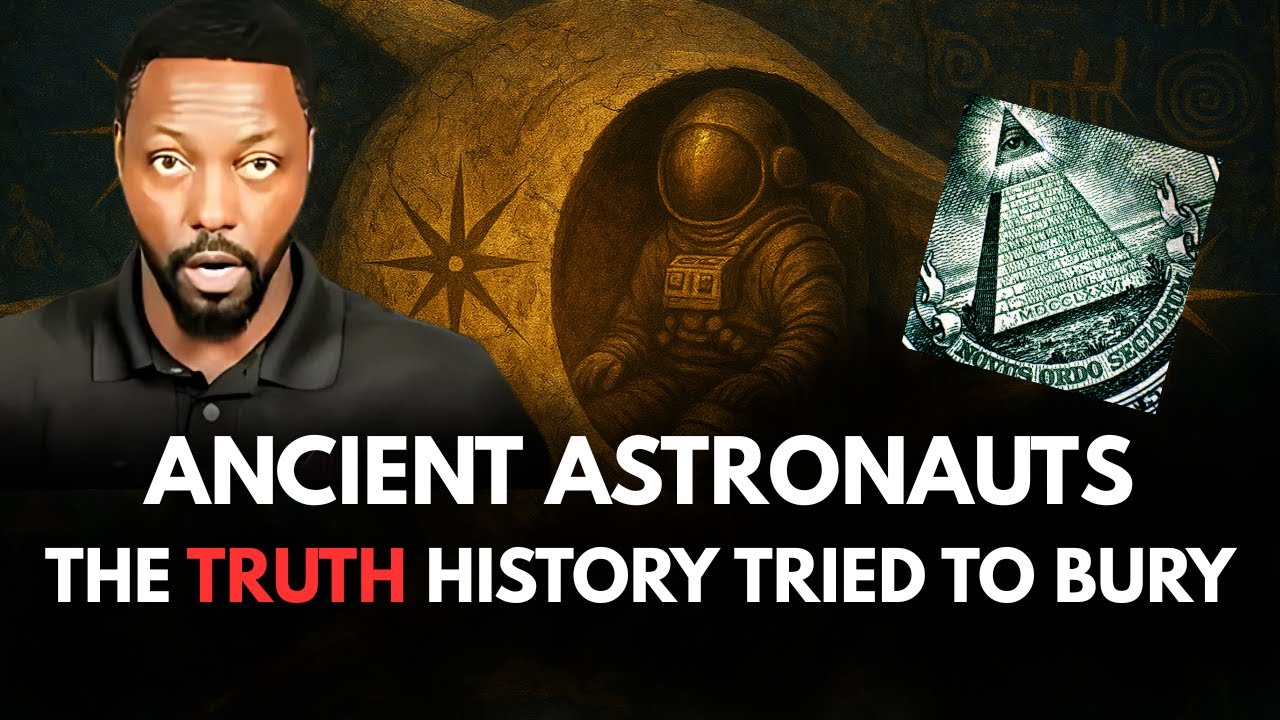
In this live stream Billy Carson argues that Enlil's all-seeing eye was a piece of technology, not a divine power: a satellite in polar orbit that let the Sumerian god of the air watch the whole Earth, and which he believes still orbits today as the Black Knight. "Enlil's all-seeing eye" is Carson's own reading, not a term used in Sumerian texts or by Assyriologists. The talk runs from what the tablets say Enlil knew about humanity to the Tablet of Destinies, the Great Pyramid, the Dogon and the Black Knight signals.
The topic matters because the eye is one of the most recognised symbols on the planet, from the Eye of Horus to the Eye of Providence on the US dollar, and because an all-seeing god raises a question believers and skeptics both ask. Carson's answer is technological, and it reads best next to the conventional history of the symbols he connects.
What the video covers
Enlil and the noise of humanity (from about 7:30)
Carson says the idea came from reading Sumerian tablets years ago. In them Enlil complains that humans are noisy, and he seems to know where people live, how many there are, how their crops are doing and who is acting up. When people grew too loud, Carson says, Enlil culled them by drying out crops, releasing plagues or sending armed guards. His question is how a ruler in one region could know population and harvests across the world thousands of years ago.
Omniscience as technology (from about 11:00)
Carson's method is to "take away the spiritual magical aspect of that statement and analyze that statement by understanding technology." Today a smartphone linked to satellites lets anyone see live traffic cameras, and his own car can pull up highway camera feeds. To someone from a pre-industrial culture, adjusting a thermostat from a glass tablet would look like summoning cool air by magic. He calls religion a cargo cult: advanced beings did things people could not understand, and generations later the memory became a deity.
The Tablet of Destinies (from about 13:15)
Carson cites the Tablet of Destinies, the object Mesopotamian myths place in Enlil's keeping. In his reading it worked like a tablet computer: it showed events on Earth, sent information to the Anunnaki home world and controlled a weapon, which is why it was stolen more than once.
A tower into the heavens (from about 16:15)
Reading from his notes, Carson describes Enlil building a tower into the heavens with a device that could oversee all of Earth and communicate with Nibiru and a way station on Mars. He compares it to the Eye of Sauron and claims Tolkien took the idea from the Sumerian tablets. His conclusion: "What he's talking about in my personal opinion, he's got a satellite."
The Great Pyramid and the polar orbit (from about 19:00)
Finding the centre of Earth's land mass, which Carson says the Great Pyramid marks, would require a satellite in polar orbit scanning the planet in strips. He then reads pyramid measurements from his notes: a base side of 9,131 pyramid inches, or 365.24 pyramid cubits, matching the days in a year; the height multiplied by ten to the ninth power giving the distance from Earth to the Sun; and a sacred cubit times ten to the seventh giving Earth's polar radius. His point is that such numbers require prior knowledge: "You can't put the chicken before the egg." He dates the pyramid to at least 36,000 years ago.
The Dogon and the Nommo (from about 27:15)
Carson adds the Dogon of Mali, who he says have long held that the Nommo came from a planet in the Sirius system and taught them about Sirius B before astronomers could see it. He equates the Nommo with the Anunnaki and links their teachings to physicist James Gates Jr.'s work on adinkras, which he describes as error-correcting codes underlying reality.
The Black Knight and Epsilon Boötis (from about 30:15)
Carson recounts the signal history from his documentary The Black Knight Satellite: Nikola Tesla's reports of signals in the early 1900s, radio operators recording the same frequencies decades later, and Duncan Lunan's decoding of a star map pointing to Epsilon Boötis as the sky looked 11,000 to 13,000 years ago. He then says the Sumerian tablets assign Boötes to Enlil, which suggests Enlil came from that region of the galaxy. Putting the two together, he concludes that the satellite is Enlil's eye and is still transmitting to Epsilon Boötis. "There's something watching us," he says.
Quantum links and the STS-88 images (from about 38:00)
Because light-speed signals are too slow across interstellar distances, Carson proposes that the satellite sends binary data instantly through quantum entanglement. He cites photographs from the STS-88 shuttle mission and an NSA document in his documentary that he says shows communication with the object.
Why the eye is still watching (from about 46:00)
Carson previews a forthcoming show built on testimony from former missile-site personnel who say craft appeared over launch facilities and disabled the weapons, testimony he reads as a warning that Earth will not be allowed to be destroyed. He closes with his timeline: the Anunnaki arrived some 450,000 years ago, genetically modified the hominids already here about 200,000 years ago, and still watch to see whether humanity takes weapons into space.
Key takeaways
- "Enlil's all-seeing eye" is Billy Carson's interpretation, not a term from Sumerian texts or mainstream scholarship.
- Carson reads divine omniscience as a description of technology, using the smartphone and the traffic camera as modern parallels.
- He treats the Tablet of Destinies as a communication device and Enlil's tower into the heavens as an orbiting satellite.
- He argues that the Great Pyramid's measurements encode knowledge that required a polar-orbiting satellite.
- He identifies the eye with the Black Knight satellite and links it to Epsilon Boötis, a star he says the tablets assign to Enlil.
Billy Carson's reading
Carson's position is that the ancient gods were flesh-and-blood beings with advanced technology, and that the attributes later given to God, all-knowing and all-seeing, describe what those beings did with machines. Enlil is central because the texts present him as a ruler who monitors and punishes humanity. In his words, "Enlil had access to some type of satellite technology." For background on Enlil's place in the pantheon, see [Sumerian Gods and Goddesses Explained](/sumerian-gods-and-goddesses-explained-anu-enlil-enki-inanna-and-the-pantheon) and the rivalry covered in [Enki and Enlil](/enki-and-enlil-the-two-brothers-of-sumerian-myth).
He also repeats views developed elsewhere: that Anu, Enlil and Enki were the original trinity, that Enlil is the figure the Bible calls Yahweh, and that Enki spoke the words "let us make man in our image." These belong to his wider reading, set against the texts in [Who Were the Anunnaki?](/who-were-the-anunnaki-sumerian-texts-vs-ancient-astronaut-theory)
What mainstream scholarship says
Assyriologists recognise Enlil, "Lord Wind" or "Lord Air", as the chief executive god of the Sumerian pantheon, worshipped at Nippur. The Old Babylonian Atrahasis epic does describe him disturbed by the noise of humanity and sending plague, drought and famine, then the flood; scholars read this as a myth about overpopulation and divine order, with the storm god withholding rain rather than crops being sprayed. The Tablet of Destinies appears in the Anzu poem, where the bird Anzu steals it from Enlil, and in the Enuma Elish, where Marduk takes it; no text describes it as crystal or as a screen. Nippur's epithet Dur-an-ki, "bond of heaven and earth", is the nearest thing to a tower linking sky and land, while Nibiru as a planet and a way station on Mars come from Zecharia Sitchin's modern reading, not standard translations. Babylonian star lore did divide the sky into paths of Anu, Enlil and Ea, but no cuneiform text calls Epsilon Boötis Enlil's home. Tolkien never named Sumerian texts as a source.
The all-seeing eye as a symbol has a documented history. The Eye of Providence, an eye inside a triangle or rays of light, is a Christian motif from Renaissance and early modern European art, standing for the watchful God of the Trinity; Pontormo's Supper at Emmaus of 1525 is an early example. Pierre Eugène du Simitière proposed an eye for the first Great Seal committee in 1776, and Congress adopted the reverse with the eye above an unfinished pyramid in 1782; Masonic use became common in the 1790s, and the design has appeared on the dollar bill since 1935. Far older is the Egyptian Eye of Horus, the wedjat or "whole one": in myth Horus's eye was injured by Seth and healed, often by Thoth, and it became one of Egypt's most common protective amulets, linked to the Eye of Ra and the cobra goddess Wadjet. Neither tradition connects the eye to Enlil. The wider context sits in [Egyptian Gods and Goddesses Explained](/egyptian-gods-and-goddesses-explained-ra-osiris-isis-horus-thoth-and-more).
Egyptologists date the Great Pyramid to Khufu's reign, about 2560 BCE; the pyramid inch comes from 19th-century pyramidology, Flinders Petrie's 1880 to 1882 survey did not support it, and with enough units and powers of ten, matches are easy to find. Walter van Beek's later fieldwork among the Dogon did not find the Sirius B knowledge Marcel Griaule reported, and adinkras in Gates's physics are diagrams named after Akan symbols from Ghana, not Dogon textiles. Duncan Lunan published his Epsilon Boötis star map in 1973 and later withdrew it, NASA identifies the STS-88 object as a thermal blanket lost in December 1998, and physicists hold that entanglement cannot carry information faster than light.
Watch, read and go deeper
The audio version of this stream is on the podcast episode page. For the gods involved, start with [Sumerian Gods and Goddesses Explained](/sumerian-gods-and-goddesses-explained-anu-enlil-enki-inanna-and-the-pantheon), and for the Egyptian eye see [Egyptian Gods and Goddesses Explained](/egyptian-gods-and-goddesses-explained-ra-osiris-isis-horus-thoth-and-more). Carson's wider work is collected on [the Anunnaki topic hub](/topics/anunnaki), and his documentary The Black Knight Satellite streams on 4BK TV.
Frequently asked questions
What is Enlil's all-seeing eye?
It is Billy Carson's name for a technology he believes Enlil used to monitor the whole Earth, which he identifies with the Black Knight satellite. The phrase does not come from Sumerian texts; it is his interpretation of passages in which Enlil knows humanity's numbers, crops and behaviour.
Is the all-seeing eye on the dollar bill Sumerian?
No. The Eye of Providence is a Christian symbol from European art, where it represented God watching over creation. It was adopted on the reverse of the Great Seal of the United States in 1782 and has been printed on the one-dollar bill since 1935.
What is the difference between the Eye of Horus and the Eye of Providence?
The Eye of Horus, or wedjat, is an ancient Egyptian symbol of protection and healing based on the myth of Horus's injured eye being restored. The Eye of Providence is a Christian image of God's watchfulness, usually inside a triangle, that developed separately thousands of years later.
Who was Enlil in Sumerian mythology?
Enlil was the Sumerian god of air and wind, one of the three highest gods with Anu and Enki, with his main temple at Nippur. Myths show him enforcing the gods' decisions, including sending the flood.
Sources mentioned
Carson cites the Sumerian tablets on Enlil, including his response to human noise and the Tablet of Destinies; Tolkien's The Lord of the Rings; the Great Pyramid's measurements in pyramid inches and cubits; Dogon traditions of the Nommo and Sirius B; physicist James Gates Jr.; Nikola Tesla's signal reports; Duncan Lunan's Epsilon Boötis star map; the STS-88 photographs; an NSA document from his documentary The Black Knight Satellite; and Genesis. Standard references for the mainstream view include W. G. Lambert and A. R. Millard's Atra-hasis: The Babylonian Story of the Flood, Jeremy Black and Anthony Green's Gods, Demons and Symbols of Ancient Mesopotamia, Flinders Petrie's The Pyramids and Temples of Gizeh, and, for the ancient-astronaut framework Carson's reading parallels, Zecharia Sitchin's The 12th Planet.